
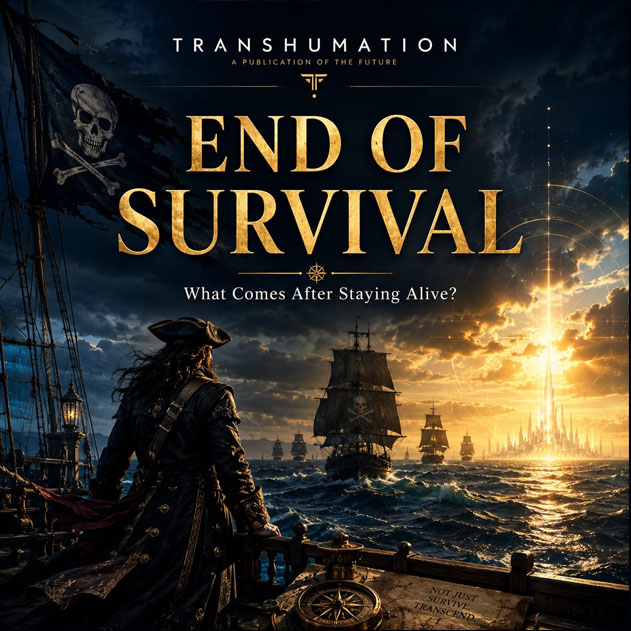
What Comes After Staying Alive?
For most of human history, survival was the central problem of existence. Human beings searched for food, protected themselves from danger, raised families, and built communities in environments where disease, hunger, violence, and uncertainty were constant threats.
Civilization developed around that struggle. Agriculture stabilized food. Medicine reduced disease. Laws limited violence. Technology increased safety and control. Almost every major human system can be understood as an attempt to make survival more predictable.
But what happens when survival is no longer the only force organizing life?
What happens when a civilization becomes increasingly capable of protecting the body, extending life, and reducing physical necessity, yet continues to think as though it were still fighting for immediate survival?
The World Was Built Around Necessity
Survival gave human life a clear structure. People worked because food and shelter were necessary. Communities formed because isolation was dangerous. Social roles developed around protection, reproduction, resources, and continuity.
Meaning was closely connected to necessity. A successful life was one in which a person survived, supported a family, contributed to the group, and helped the next generation continue.
Even today, many ideas of success still come from this older structure. Security, income, property, status, and social acceptance are treated as evidence that life is moving in the correct direction.
These goals remain important, but they were shaped by a world in which losing resources could quickly become a matter of life and death.
We Are Outgrowing the Survival Environment
Technology has already changed many of the conditions that shaped the human mind.
Most people in advanced societies do not hunt for food, build their own shelter, or defend themselves daily against predators. Infrastructure provides water, energy, transportation, communication, and medical support. Machines perform work that once required enormous physical effort.
This does not mean that suffering, poverty, violence, or insecurity have disappeared. Survival remains an immediate problem for millions of people, and technological progress is distributed unevenly.
But the general direction is clear: civilization increasingly separates human existence from the constant demands of the natural environment.
The problem is that the human mind still carries the instincts of that earlier world.

Ancient Instincts in a New Civilization
Human psychology evolved under conditions of scarcity and danger. Attention is drawn toward threats. Loss feels more powerful than gain. Social rejection can feel like a danger even when it does not threaten physical survival.
These instincts once helped humans remain alive.
In modern environments, the same mechanisms can produce anxiety, competition, accumulation, and permanent dissatisfaction. A person may possess enough food, shelter, and security yet still feel that something essential is missing.
The nervous system continues preparing for threats that may never arrive.
This creates a gap between the world civilization is constructing and the mind through which that world is experienced.
We are beginning to solve some survival problems without overcoming the psychology of survival.
When Survival Stops Providing Meaning
Survival gave humanity direction because it established priorities automatically. Hunger had to be answered. Danger had to be avoided. Children had to be protected. Resources had to be found.
When these pressures weaken, life becomes more open but also more uncertain.
A person who no longer spends every day trying to remain alive can ask questions that survival once pushed aside: Why am I here? What should I create? What makes existence valuable? What should humanity become?
This freedom can feel like progress, but it can also produce confusion.
Necessity provides instructions. Possibility does not.
The decline of survival as the central goal does not automatically create a new purpose. It removes the old one and leaves humanity responsible for deciding what comes next.
Survival Was Never the Final Goal
Many modern systems still treat continued existence as though it were enough.
Medicine preserves life. Economics protects production. Politics promises security. Technology removes inconvenience. Yet none of these systems can fully explain what life should be used for once it has been protected.
Living longer does not answer how that time should be spent.
Greater safety does not determine which risks are worth taking.
More freedom does not explain what should be chosen.
Survival is necessary because without existence, no other goal is possible. But necessity should not be confused with purpose.
Survival creates the conditions for meaning. It does not complete meaning.
From Biological Evolution to Conscious Evolution
Biological evolution has no planned destination. Traits survive when they help organisms reproduce under particular conditions.
Technology introduces a different process.
Human beings can increasingly modify the conditions that shape them. Medicine alters lifespan. Education changes cognition. Digital systems extend memory. Artificial intelligence supports reasoning. Biotechnology may eventually allow direct intervention in biological limitations.
Evolution begins to move from an unconscious process toward a partially intentional one.
This is where transhumanism becomes more than the desire for stronger bodies or longer lives. It asks what intelligence should do once it gains the ability to redesign itself.
The question is no longer only how humanity can survive.
It becomes what kind of humanity should survive.
The Beginning of Choice
The end of survival would not mean that danger disappears or that biological needs no longer matter. It would mean that necessity stops being the only force directing civilization.
Humanity would gain more freedom to shape its own development, but that freedom would come with responsibility.
A species guided by survival can follow instinct.
A species capable of controlling its own future must make choices.
Should intelligence remain biological? Should consciousness be extended technologically? Should human limitations be preserved because they are familiar, or changed because they cause suffering? What values should guide a civilization capable of redesigning life?
There is no evolutionary mechanism that can answer these questions for us.
What Comes After Survival?
The next stage of civilization may be organized around possibility rather than necessity.
Knowledge could become more important than accumulation. Exploration could replace expansion. Creativity could become a central function of intelligence rather than a secondary activity performed after survival needs are met.
Humanity could begin designing environments not only to keep people alive, but to expand perception, understanding, and conscious experience.
This would not automatically create a better civilization. Freedom can produce growth, but it can also produce domination, distraction, and stagnation.
The disappearance of one struggle does not guarantee wisdom.
It only creates the opportunity for a different kind of development.
End of Survival
The end of survival is not the end of life’s difficulties. It is the beginning of a more demanding question.
When existence is no longer completely organized around staying alive, humanity must decide what continued existence is for.
Survival brought us to this point. It shaped the body, the mind, and the civilization we inherited.
But it was never the final purpose of intelligence.
It was the foundation that made every other possibility available.
Humanity may now be approaching a transition from life directed by necessity to life shaped by conscious intention.
We are not simply trying to survive the future.
For the first time, we may have to decide what future is worth surviving for.

Frequently Asked Questions
1. What does “the end of survival” mean?
It means a future in which basic survival becomes less dominant as the main force shaping human life and civilization.
2. Has humanity already solved survival?
No. Poverty, conflict, disease, and environmental danger remain serious problems. The article describes a technological direction, not a completed transformation.
3. Why is the human mind still focused on danger?
Human psychology evolved under conditions of scarcity, competition, and physical threat. Those instincts remain active even in safer environments.
4. Does survival give life meaning?
Survival provides clear priorities and makes other goals possible, but it does not necessarily explain what existence should ultimately be used for.
5. Why can greater security create confusion?
When necessity weakens, people gain more choices but lose the automatic direction that immediate survival once provided.
6. What is conscious evolution?
It is the growing ability of intelligent beings to influence their own biology, cognition, environment, and future development through deliberate choices.
7. How does transhumanism relate to survival?
Transhumanism explores how humanity might overcome biological limitations and move from merely preserving life toward transforming its possibilities.
8. Would life beyond survival automatically be better?
No. It could create greater freedom, but also new forms of inequality, control, boredom, or loss of purpose.
9. What is the central idea of the article?
Survival was the beginning of human development, not its final goal. As technology reduces some survival pressures, humanity must decide what existence should become.
Continue the Transhumation Series
Explore the full journey:
- End of Reality — Where Do You Really Exist?
- End of Physics — Are the Laws of Reality Real?
- End of the Real World — Reality Is No Longer Required
- End of Consciousness — Beyond the Human Mind
- End of Death — When Human Limits Disappear
- End of Religion — When Technology Replaces Faith