
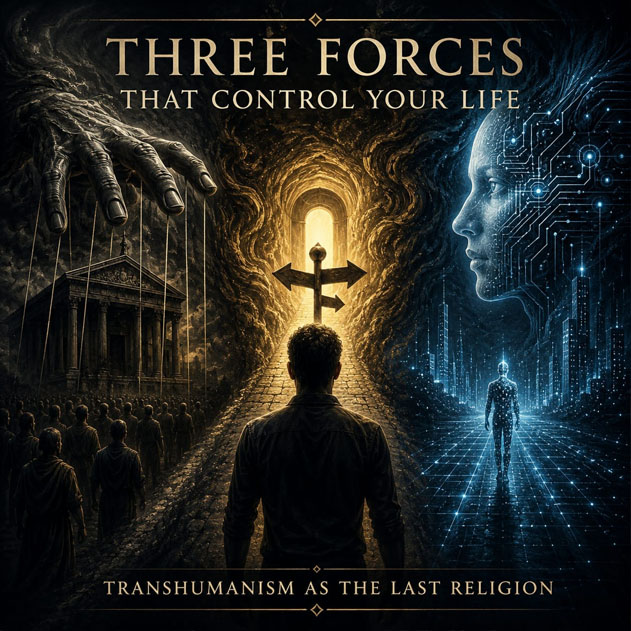
You don’t have to believe in gods
to still live inside their patterns.
What If Ancient Gods Never Truly Disappeared?
Modern civilization believes mythology belongs to the past.
Ancient gods became stories.
Symbols became entertainment.
Rituals became psychology.
But perhaps mythology never disappeared.
Perhaps it evolved.
Not as literal supernatural beings, but as symbolic descriptions of forces still shaping human consciousness today.
In this episode of Transhumation, we explore three archetypes hidden beneath civilization itself:
Ishtar,
Hekate,
and Baal.
Not as historical dogma, but as emotional and psychological structures describing the human condition.
Ishtar — The Force That Breaks Identity
Ishtar represents transformation through emotional collapse.
Love.
Desire.
Loss.
Seduction.
Power.
Pain.
In mythology, Ishtar repeatedly descends into darkness and loses parts of herself.
Symbolically, this mirrors something deeply human: identity often transforms only after it breaks.
Modern civilization still operates through the same mechanism:
heartbreak,
humiliation,
social comparison,
status,
desire,
digital validation.
Humans rarely evolve through comfort.
Transformation usually begins through destabilization.
Hekate — The Crossroads
Hekate stands at the crossroads.
Not as a demon, but as confrontation itself.
The moment when consciousness realizes:
reality is more complicated than expected,
identity no longer feels stable,
and the old path no longer works.
Hekate represents awareness inside uncertainty.
This is why crossroads appear constantly in mythology, psychology and cinema.
Because human life repeatedly forces confrontation:
between safety and transformation,
instinct and awareness,
biology and transcendence.
Baal — The System Nobody Escapes
Baal was often associated with:
storms,
fertility,
power,
and the force of nature itself.
Over time, Baal became demonized by later civilizations. But symbolically, the archetype survived.
Baal represents something larger than belief: biology itself.
Hunger.
Sexuality.
Competition.
Survival.
Instinct.
The human body remains part of nature whether consciousness accepts it or not.
This is why modern civilization still struggles with:
addiction,
desire,
reproduction,
power,
consumption,
and repetition.
Humanity built technology, yet still remains deeply biological.
Kubrick and the Modern Mythological Language
Stanley Kubrick understood the psychological power of symbols.
Films like Eyes Wide Shut and The Shining use:
repetition,
rituals,
masks,
labyrinths,
sexuality,
and hidden systems to create emotional structures resembling mythology itself.
Kubrick was not creating historical documentaries.
He was showing that modern consciousness still unconsciously understands symbolic language.
The gods changed form.
The patterns survived.
Why This Matters Today
Modern civilization often believes humans became rational and free.
But humans are still shaped by forces they barely control:
instincts,
emotional loops,
algorithms,
systems,
social rituals,
technological environments,
and biological limitations.
This does not make humanity powerless.
It makes awareness necessary.
Perhaps transformation does not begin when humans escape the system.
Perhaps it begins when consciousness finally sees it clearly.
The Beginning of Forgotten Religion
FORGOTTEN RELIGION explores mythology not as literal supernatural history, but as symbolic maps describing:
consciousness,
civilization,
suffering,
transformation,
technology,
and the future of humanity itself.
Because modern civilization may not be escaping mythology at all.
It may simply be creating new gods.
Continue the Transhumation Series
Explore the full journey:
- End of Reality — Where Do You Really Exist?
- End of Physics — Are the Laws of Reality Real?
- End of the Real World — Reality Is No Longer Required
- End of Consciousness — Beyond the Human Mind
- End of Death — When Human Limits Disappear
- End of Religion — When Technology Replaces Faith