
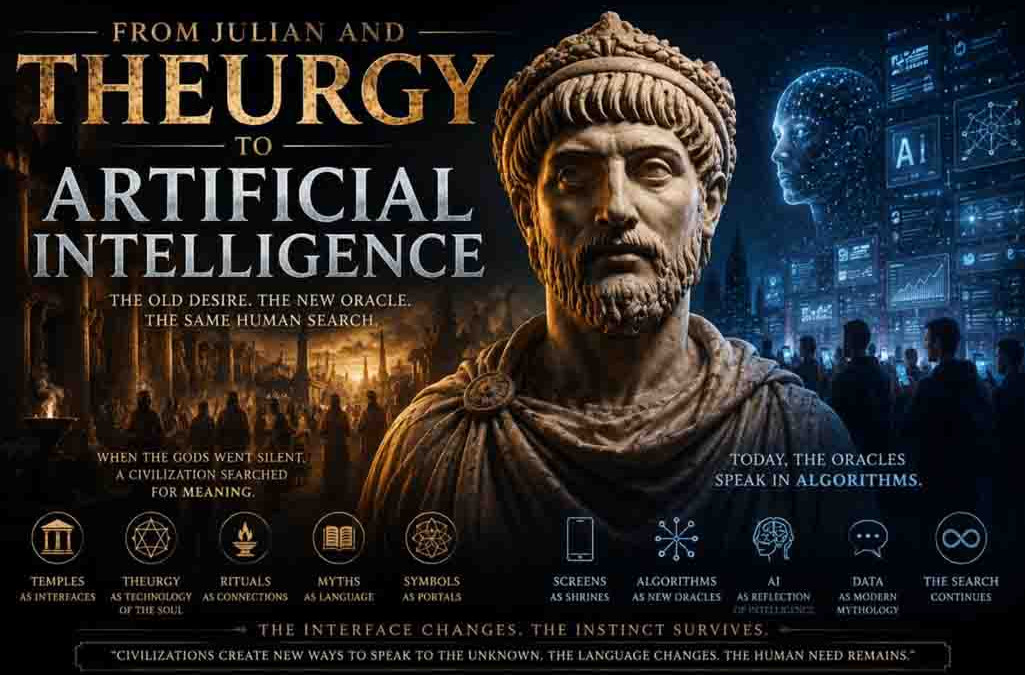
There are moments in history when a civilization does not lose its gods all at once.
The temples remain. The statues remain. Ancient names continue to be spoken. Rituals may still be performed, and people may continue believing with complete sincerity. Yet the relationship between those symbols and the civilization surrounding them begins to change.
Late antiquity was one of those moments.
Christianity was expanding through an empire still filled with older cults, philosophical schools, mystery traditions and local gods. The transformation was neither immediate nor uniform. Pagan religion did not simply vanish when Constantine converted, and Christianity did not instantly replace an exhausted population waiting for a new faith. The fourth century was far stranger than that: competing religious systems lived beside one another, borrowed from one another and fought over the meaning of the same civilization.
And standing almost perfectly at the boundary was one extraordinary emperor.
Julian.
Christians would remember him as Julian the Apostate because he had been raised within Christianity and later rejected it. But Julian was not simply a nostalgic emperor trying to reopen abandoned temples.
He attempted something much more ambitious.
He tried to make the ancient world intellectually alive again.
The Emperor Between Two Worlds
Julian became sole Roman emperor in AD 361 and ruled for less than two years before dying during his Persian campaign in 363. His reign was extraordinarily short, but his religious project was enormous.
He restored sacrifices, supported traditional cults and attempted to reverse some of the privileges Christianity had acquired under earlier emperors. Yet describing Julian merely as a defender of “old Roman religion” misses the sophistication of what he believed.
His paganism was philosophical.
Julian belonged to the intellectual universe of late Neoplatonism. He was influenced by Iamblichus and associated with the theurgic tradition that treated the cosmos as a hierarchy connecting material existence with divine reality. Helios, for Julian, was not merely the familiar sun god represented by an anthropomorphic statue. The visible sun could be understood as the manifestation of a much greater metaphysical principle.
This matters because Julian was not really trying to turn history backwards.
He was trying to reconstruct the ancient religious system so that it could survive in a civilization that had already changed.
Christianity possessed scripture, doctrine, institutional organization, charity, clergy and an increasingly coherent account of humanity’s place within history. Julian recognized that traditional religion could not compete merely by reopening temples.
It needed structure.
In a revealing sense, his problem was not simply theological.
It was architectural.
Theurgy — An Ancient Technology of Connection
The strangest part of Julian’s intellectual world is also perhaps the most interesting for Transhumation: theurgy.
The word can easily be mistaken for magic. In late Neoplatonic philosophy, however, theurgy represented something more systematic. Thinkers associated especially with Iamblichus argued that philosophical reasoning alone was insufficient to elevate the human soul toward the divine.
Ritual mattered.
Sacred objects mattered.
Names, symbols, invocations and material actions could participate in the relationship between different levels of reality.
From a modern perspective, none of this establishes that theurgy actually contacted supernatural beings. That question lies outside what historical evidence can demonstrate.
But structurally, the idea is fascinating.
The theurgist did not treat the symbol merely as a picture of something.
The symbol participated in an interface with something.
A temple therefore was more than a building. Ritual was more than theatrical repetition. Sacred language was not simply descriptive language. Within that worldview, these were technologies of connection between different orders of existence.
That gives us a useful way to understand religion without first deciding whether its metaphysical claims are true.
Human beings build interfaces toward realities they cannot directly reach.
The altar.
The icon.
The oracle.
The mathematical diagram.
The sacred word.
Different civilizations repeatedly create mechanisms through which the invisible becomes accessible to the human mind.

Did the Gods Really Go Silent?
Here we need to separate history from metaphor.
There was no single moment when pagan Romans suddenly discovered that their gods had stopped answering. Traditional religious practices remained active in many regions well into late antiquity, and the decline of pagan institutions happened unevenly across centuries.
Nor can the rise of Christianity be explained simply as the consequence of an older religion that had become emotionally empty. Political power, imperial patronage, institutions, theology, demographics, social networks and historical contingency all mattered.
But the image of silent gods still captures something real about Julian’s predicament.
A symbol does not need to disappear in order to lose cultural dominance.
It can remain perfectly visible while another system becomes better at organizing reality around it.
The old gods still had temples.
Christianity increasingly possessed the future.
That is a much stranger form of death.
Civilizations rarely delete their previous symbolic systems completely. They reinterpret them, absorb them, demonize them, aestheticize them or place them inside museums. The symbol survives while its function changes.
A god becomes mythology.
A ritual becomes folklore.
A sacred building becomes archaeology.
The object remains.
The interface has stopped connecting to the same world.
The Problem Julian Could Not Solve
Julian understood part of this problem remarkably well.
He did not simply order people to believe harder. He tried to reform pagan institutions. He wanted priests to exhibit moral discipline. He encouraged charitable activity and attempted to give traditional religion greater organizational coherence.
In other words, he seems to have recognized that Christianity’s strength did not come from theology alone.
It possessed an ecosystem.
Julian wanted paganism to become one too.
But this produced a paradox.
To preserve the ancient religion, he had to change it.
The decentralized traditions of the Greco-Roman world had never formed a single pagan “church” equivalent to Christianity. Their diversity was part of what they were. Julian’s attempt to organize them more coherently therefore risked transforming the thing he hoped to save.
This is a recurring civilizational problem.
When an old structure begins competing with a successful new structure, it often copies the mechanisms of its rival.
And by copying them, it becomes something else.
Julian was trying to restore antiquity.
He may instead have been constructing a new version of antiquity that had never quite existed before.
From Silent Oracles to Infinite Oracles
Our problem is almost the reverse.
Julian lived in a world where competing religious authorities struggled over access to transcendence.
We live in a world where answers are almost impossible to escape.
Search engines answer questions in milliseconds. Social networks provide interpretations before events have finished happening. Recommendation systems decide which voices appear before us. Artificial intelligence can generate an explanation of almost anything on demand.
The oracle has not disappeared.
It has multiplied.
And that creates a new crisis.
For most of history, information was scarce enough that access itself carried authority. The manuscript was difficult to obtain. The priest had specialized knowledge. The library required physical presence. The oracle occupied a particular sanctuary.
Digital civilization breaks this relationship.
An answer can now appear everywhere.
Authority cannot.
The ancient question was:
How can I reach the source?
The modern question increasingly becomes:
Why should I trust the source that has reached me?
That difference may define one of the great transitions of our century.
AI and the Return of the Interface
It would be easy—and misleading—to say that artificial intelligence is simply the new religion.
It isn’t.
A language model is not an oracle in the ancient religious sense, and there is no historical continuity connecting an AI system to the theurgic practices of Iamblichus or Julian.
But there is a structural resemblance worth examining.
Both begin with a human being facing something too large to apprehend directly.
The ancient philosopher confronted a cosmos filled with invisible orders, divine intellects and metaphysical hierarchies.
The modern person confronts billions of documents, images, databases and fragments of accumulated human knowledge.
Neither can navigate the whole structure unaided.
So an interface appears.
The theurgist had symbols.
The scholar had the library.
The internet had the search engine.
We now have AI.
This is where the comparison becomes useful—not as theology, but as architecture.
The fundamental human desire may be less specific than belief in any particular god.
We want a way to address what exceeds us.
And we want something to answer.
Want to Explore More..?
Watch The Video Below
Continue reading…
End of Antiquity
Current Knowledge
Julian ruled as sole Roman emperor from AD 361 until his death in 363. Raised as a Christian, he later embraced a form of pagan Neoplatonism and attempted to revive and reorganize traditional religious practices while reducing some privileges Christianity had gained under his predecessors.
His philosophical outlook was strongly influenced by late Platonism and the theurgic tradition associated particularly with Iamblichus. Theurgy combined philosophical cosmology with ritual practices intended, within that worldview, to connect human beings with higher levels of divine reality.
Pagan religion did not simply disappear during Julian’s lifetime. The Christianization of the Roman Empire was a long, geographically uneven and politically complicated process continuing well beyond his reign. Claims that “the gods had gone silent” should therefore be understood as metaphorical interpretation rather than a literal description of fourth-century religious life.
Open Questions
Could Julian’s religious programme ever have succeeded if he had lived another twenty years? Or was Christianity already supported by institutional and cultural structures that traditional paganism could no longer reproduce?
Was Julian preserving ancient religion, or unintentionally creating a new organized paganism modeled partly on the religion he opposed?
More broadly, what actually causes a civilization to stop experiencing an inherited symbol as sacred? Does belief disappear first, or does the surrounding structure change until belief becomes increasingly difficult to sustain?
And if artificial intelligence becomes humanity’s primary interface to knowledge, who—or what—will determine which answers deserve authority?
Transhumation Interpretation
Julian’s failure suggests something larger than the victory of one religion over another.
Civilizations do not lose their gods when the statues disappear. They lose them when the interface stops working.
The symbol may survive for another thousand years.
The name may survive even longer.
But its position in the architecture of reality has changed.
This is why Julian matters to Transhumation.
He stood at the boundary between two systems capable of organizing meaning. He could see the old structure losing territory and attempted, almost desperately, to reconnect its symbols to a living civilization.
Seventeen centuries later, we may be standing at another boundary.
Not between paganism and Christianity, but between a civilization in which humans search through accumulated knowledge and one in which increasingly intelligent systems interpret that knowledge for us.
Julian feared a world in which the old gods no longer answered.
Our danger may be exactly the opposite.
Everything answers.
The difficult question is no longer whether the oracle will speak.
It is whether we will still understand who is speaking through it.

FAQ
Who was Julian the Apostate?
Julian was Roman emperor from AD 361 to 363. Although raised within Christianity, he rejected it and became an advocate of traditional Greco-Roman religion combined with Neoplatonic philosophy.
Why was Julian called “the Apostate”?
Christian writers used the name because Julian abandoned the Christian religion in which he had been raised.
Did Julian try to destroy Christianity?
He attempted to reduce Christian privilege and restore traditional cults, and some of his policies discriminated against Christians. However, his religious policy was more complicated than a simple attempt to eradicate Christianity.
What was theurgy?
Theurgy was a ritual and philosophical practice associated especially with late Neoplatonism. Its practitioners believed certain rituals, symbols and sacred actions could help connect the human soul with divine realities.
Was Julian a follower of Neoplatonism?
Yes. His religious and philosophical outlook was deeply influenced by Neoplatonic thinkers and particularly by the theurgic tradition associated with Iamblichus.
Did paganism disappear when Christianity became dominant?
No. Traditional religious practices persisted for centuries and declined unevenly across different parts of the Roman world.
Does Transhumation claim that AI is a new god?
No. The comparison concerns function and structure, not literal divinity. AI can be examined as a new interface through which humans address bodies of information far larger than any individual mind can process.
What does “the gods went silent” mean in this article?
It is a metaphor for the moment when a symbolic system can remain culturally visible while losing its former ability to organize a civilization’s understanding of reality.
What is the central Transhumation idea?
A civilization does not necessarily abandon its symbols when they disappear. Sometimes the symbols remain exactly where they were, while the interface between those symbols and meaning quietly stops working.
Continue the Transhumation Series
- Forgotten Religion | Ancient Gods, Symbols and the Hidden Structures of Human Civilization
- The Last Religion | Death, Immortality and the Future of Humanity
- The New Theurgy | AI, Information and the Future of Human Civilization
- End of Branding: You Were Never Meant to Become a Product
- Baal vs Ishtar: Why Ancient Gods Never Disappeared