
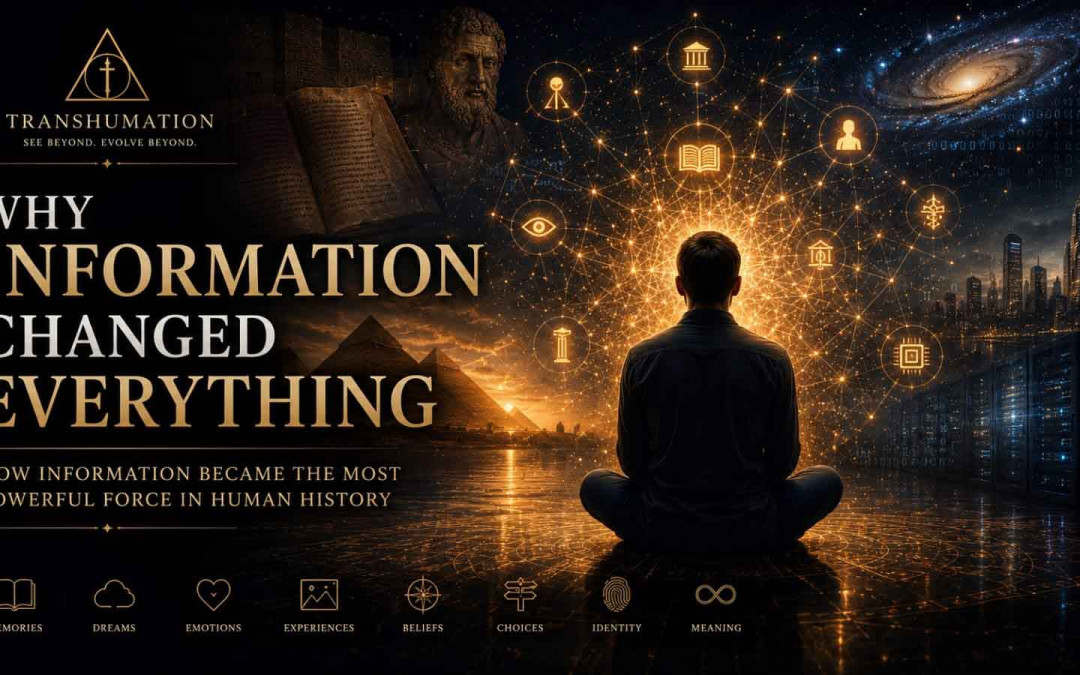
The Pattern Could Outlive the Material
A vinyl record and a music file can contain the same song without sharing almost anything physically.
One is a grooved disc of plastic. The other may exist as magnetization, electrical charge, optical storage or some later physical arrangement inside a machine. Put either into the correct system and a recognizably similar sequence of sound can return. Destroy the record and the song may survive somewhere else. Replace the phone and the file may reappear on another device. Change the speakers and the melody remains identifiable.
Something has crossed.
Not without matter. Never without matter.
But without loyalty to one particular piece of matter.
That distinction may be one of the most important intellectual achievements of technological civilization. For most of human history, structures were heavily tied to their carriers. A statue depended on one block of stone. A handwritten manuscript depended dangerously on one physical object. A person’s voice vanished when the vibration of air ended unless another mind remembered it.
Civilization gradually learned to separate pattern from particular carrier.
Writing allowed language to survive a speaker. Printing allowed a text to survive one manuscript. Recording allowed sound to survive one performance. Computation allowed formal structures not merely to be preserved but executed repeatedly on different machines.
Information did not become immaterial.
It became migratory.
And that changed almost everything.
What Is Information?
The word is deceptively broad.
In everyday speech, information can mean news, knowledge, meaning or facts. In information theory, the concept is narrower and more formal: information can be treated in terms of distinctions, uncertainty and possible signals without requiring that the system understand what those signals mean.
This distinction matters.
A hard drive can contain an encrypted manuscript without “knowing” the philosophy inside it. Two files can contain the same number of bits while carrying radically different meanings to a human reader. A DNA sequence can carry biologically consequential information inside cellular processes without functioning like a simple human-written computer program.
Information therefore should not be treated as a ghostly substance floating behind matter.
It is more useful to think in terms of physically instantiated patterns and relationships capable of making differences within a system.
The carrier matters.
The arrangement matters too.
Take two identical sets of letters and rearrange them. The material inventory may remain almost unchanged, yet the meaning can disappear. Rearrange transistors into another architecture and the machine behaves differently. Change a sequence of nucleotides and biological consequences may change dramatically depending on where and how that sequence functions.
Matter gives the pattern a place to exist.
Organization determines what the pattern can do.
Does Information Exist Without Matter?
Everything we know operationally says that information requires a physical realization.
A book requires a surface carrying marks.
A digital message requires states inside physical systems.
A memory requires biological activity.
A transmitted signal requires some physical process capable of distinguishing one state from another.
This is why the fashionable phrase that civilization is “dematerializing” can be misleading.
Cloud computing still requires data centers.
Streaming music requires networks, storage devices and energy.
Artificial intelligence requires semiconductor fabrication, cooling infrastructure, electrical power and enormous physical systems whose complexity disappears from the user’s screen.
What changed is not the need for matter.
What changed is the dependence on one specific carrier.
A manuscript once existed precariously in one copy. A digital text can be reconstructed across thousands of different devices. A photograph can survive the destruction of the original phone because the pattern has migrated through networks and storage systems.
The carrier remains indispensable.
Its individual identity becomes less important.
That is a very different claim from saying information transcended the physical world.
It is also much more interesting.

When the Pattern Became Portable
Civilization had been experimenting with carrier migration long before computers.
A story moved from one human memory to another.
Writing moved speech into visible marks.
Musical notation separated elements of composition from one particular performance. Printing multiplied textual structures across thousands of physical copies.
Each step reduced dependence upon one event or object.
But computation introduced another possibility.
The pattern could become executable.
A mathematical procedure written on paper remains static until a human performs it. A program instantiated inside a working computer can repeatedly transform inputs into outputs according to encoded relations.
The carrier does not merely preserve the structure.
It participates in running it.
That transition matters because civilization begins filling with structures whose identity appears partly functional rather than material.
We do not normally identify a piece of software by asking which individual electrons carried it yesterday. We identify it through code, behavior, version, architecture and relationships that can be recreated across compatible hardware.
This is one reason digital technology feels philosophically strange.
The object persists even while its physical instances change.
Is Mathematics Discovered or Invented?
Mathematics makes the problem older than computers.
Two apples can be eaten.
The number two cannot.
A chalk circle can be erased.
The mathematical relationships defining an ideal circle do not seem to depend upon that particular drawing.
This has fascinated philosophers for more than two thousand years because mathematical objects behave oddly compared with familiar physical things. Plato provided one influential answer through his broader philosophy of Forms. Later traditions produced many others. Contemporary philosophers of mathematics still disagree about whether mathematical objects are discovered, invented, constructed, formalized or understood in some other way.
Technology does not settle the dispute.
A computer displaying a perfect-looking circle still uses finite physical states and finite numerical precision. The machine has not created an immaterial Platonic Form inside the processor.
Yet mathematical structure remains remarkably portable.
The same relation can be written in different notation, implemented in different software and instantiated on different machines while remaining recognizably equivalent for the relevant task.
That portability is real even if its metaphysical interpretation remains open.
The important observation is therefore not that mathematics “exists without matter.”
It is that some relations seem far less dependent on the identity of their carrier than ordinary physical objects are.
That is enough to reopen very old philosophical questions.
Can Information Survive a Change of Carrier?
Sometimes exceptionally well.
A text can move from parchment to printed page to digital display while preserving nearly every letter. A geometric relation can be represented in chalk, ink or software. A melody can move between instruments and remain recognizable.
But carrier independence has boundaries.
A painting cannot be reduced perfectly to a verbal description without loss.
A live performance contains timing, acoustics, social context and embodiment that notation may preserve only partially.
A human memory moved into written language becomes a representation of the memory, not the original biological event.
Even software migration can depend on precision, architecture, operating environment and implementation details.
The right question is therefore not whether a pattern can change carrier.
It is:
Which relationships have to survive for us to say it is still the same pattern?
For a simple text, the answer may be relatively straightforward.
For a melody, somewhat harder.
For a living organism, much harder.
For a conscious person, we do not know.
This gradient is where information becomes philosophical rather than merely technical.
DNA Is Not Simply Software
Modern culture often describes DNA as code.
The metaphor is useful to a point.
Nucleotide sequences participate in biological processes that influence the production and regulation of molecules, and inheritance involves the transmission of structured biological information across generations.
But a living organism is not assembled from DNA the way a computer executes a self-contained application.
Cells provide enormous amounts of context.
Gene regulation matters.
Development matters.
Epigenetic states, cellular environments and interactions among biological systems matter.
The same genetic sequence can behave differently depending upon context.
Calling DNA software can therefore illuminate one feature while hiding others.
This is a recurring problem whenever information metaphors become too successful.
The metaphor begins as an interface.
Then we forget what it removed.
Biology reminds us that patterns do not merely float above their carriers.
The carrier can participate in what the pattern means.
Is AI Made of Information?
An AI model makes the carrier question particularly vivid.
A trained model can be described through parameters, architecture and computational relationships. In principle, sufficiently equivalent implementations of those structures can operate on different compatible hardware while preserving much of the model’s functional behavior.
That makes it tempting to say the “real AI” is purely informational.
But the statement goes too far.
The model must be instantiated somewhere.
Numerical precision matters.
Hardware behavior matters.
Software frameworks matter.
Timing, memory, context and interfaces can affect outputs.
And the trained system itself emerged through a physical process of computation consuming energy and transforming enormous amounts of data.
Still, the relative portability of the organization is philosophically important.
We can replace much of the hardware without believing that we necessarily created an entirely new model in the ordinary functional sense.
That immediately suggests a dangerous analogy with human identity.
If an AI’s functional organization can migrate, could a human mind do the same?
Perhaps.
But the analogy does not answer the question.
It merely makes the question possible.
The Information Trap
Once information becomes culturally powerful, it is easy to conclude that everything important must therefore be information.
That move should be resisted.
A map contains information about territory.
It is not the territory.
A genetic sequence carries information relevant to development.
It is not the organism.
A neural recording contains information about brain activity.
It is not automatically the experience associated with that activity.
A digital model of a person might preserve extraordinary amounts of behavior and still fail to preserve first-person continuity.
Information is powerful precisely because it allows selected relationships to be represented.
Selection always leaves something out.
The danger begins when representation becomes so successful that the omitted world starts to look unnecessary.
Digital civilization is particularly vulnerable to this mistake because its interfaces make informational structures appear almost self-sufficient.
Tap an icon and money moves.
Send a message and another continent responds.
Ask a model and language appears.
The physical machinery disappears from experience.
It has not disappeared from reality.
“In the Beginning Was the Word”
The information age makes the opening of the Gospel of John sound uncannily contemporary.
But the resemblance needs discipline.
John’s Logos belongs to a theological and philosophical world involving divine reality, intelligibility, creation and incarnation. It should not be translated backward into modern information theory or treated as evidence that ancient Christianity anticipated software.
Yet modern technology does make one structural feature easier for us to appreciate.
Symbolic organization can have real effects.
Language can coordinate people.
Mathematics can describe relationships used in engineering.
Code can alter the behavior of machines.
Legal language can create obligations because institutions act upon it.
Prompts can influence computational output.
The modern world has made operational symbolism spectacularly visible.
That does not prove that reality itself is language.
It does remind us that dismissing symbols as mere decoration misunderstands how civilization works.
A symbol becomes causally powerful when a system exists that can interpret it.
Does Information Challenge Materialism?
Not automatically.
A materialist can perfectly well argue that information is a way of describing relationships among physical states. From this perspective, the importance of information does not weaken materialism at all. It reveals that the organization of matter matters enormously.
Two brains composed of broadly similar biological materials can occupy radically different states.
Two computers built from similar components can execute completely different programs.
A pile of letters and a Shakespeare play may use the same alphabet while possessing completely different structure.
Matter alone, described without arrangement, tells us too little.
But the opposite conclusion is not forced either.
The fact that organization matters does not demonstrate an immaterial realm.
Information therefore reopens metaphysical questions without settling them.
Perhaps structure is fundamental.
Perhaps structure is inseparable from physical realization.
Perhaps our distinction between matter and information itself reflects an inadequate conceptual vocabulary.
Those remain philosophical possibilities.
Technology has made the questions harder to ignore.
It has not answered them for us.
The Return of Structure
This may be the deepest transformation produced by the information age.
The modern world increasingly trains us to look not only at objects but at relationships.
Network rather than node.
Program rather than machine.
Genome rather than molecule in isolation.
Protocol rather than cable.
Pattern rather than one instance.
The physical world remains.
But the explanatory emphasis changes.
A cathedral is stone, yet architecture lies in the organization of stone.
A melody is physical sound, yet melody lies in relationships among sounds.
A language requires bodies, air, ink or electronics, yet grammar is not usefully described by listing the atoms in a sentence.
At some scales, structure becomes the level at which explanation works.
That does not make matter secondary.
It makes organization impossible to ignore.
Perhaps this is why older philosophical languages suddenly feel interesting again. Plato, Logos, form and symbol all belong to intellectual traditions that took structure seriously, though in ways very different from modern information science.
The information age does not prove them right.
It makes their questions newly legible.
Watch The Video
How to Read the World
Current Knowledge
Information in the technical sense is not synonymous with meaning or knowledge. Information theory provides formal ways of describing signals and uncertainty without requiring semantic interpretation, while human communication usually adds layers of meaning, context and intention.
Known information storage and transmission require physical systems. Digital information is instantiated in hardware, signals and physical states even when the user does not directly encounter the infrastructure carrying it. Information is therefore better described as capable of migration among carriers than as independent of physical implementation.
Mathematical structures can be represented across many physical media, but the ontological status of mathematics remains a philosophical dispute. The success of mathematics in describing nature does not by itself establish Platonism or prove that mathematical entities exist independently of matter.
Genetic information is real and scientifically useful, but DNA should not be treated as a complete software program for an organism. Biological function depends on cellular machinery, regulation, development and environmental context in addition to nucleotide sequence.
AI models are defined partly by complex mathematical structures learned through training, and similar models can be instantiated across different computational hardware. This functional portability raises interesting questions about identity and implementation but does not demonstrate that intelligence or consciousness is independent of physical systems.
Open Questions
One unresolved question is whether information should ultimately be treated as fundamental in physics or as a description of relationships among more basic physical states. Different research programs and philosophical interpretations approach this problem differently, and present science does not provide one universally accepted metaphysical answer.
Another concerns identity across implementation. For software, we are often comfortable saying that the “same” program runs on different machines. For organisms and conscious persons, the relevant invariants are far less clear. Functional similarity may not be sufficient for subjective continuity.
There is also the question of semantics. Formal information can be quantified without meaning, but human civilization depends overwhelmingly on information interpreted within contexts. How physical systems generate or support meaning remains connected to broader problems in cognition and consciousness.
AI intensifies all of these uncertainties. If increasingly sophisticated capacities can emerge from learned organization inside physical machines, does that show that intelligence is primarily structural, or only that certain structures implemented physically can perform tasks we describe as intelligent? The distinction remains open.
Transhumation Interpretation
For Transhumation, information matters because it gives us a clean demonstration that the identity of a pattern can sometimes become less dependent on the identity of its carrier.
That principle works extraordinarily well for text, mathematics and software. It works partially for culture and biological information. It becomes much less certain when applied to consciousness and personal identity.
That boundary should remain visible.
The information age does not prove that humans are data, that reality is a simulation or that Plato was right.
It gives us a more disciplined question:
Which structures can survive migration, and which disappear when the carrier changes?
That may ultimately tell us far more than declaring either matter or information victorious.
FAQ
What is information?
The term has several meanings. In technical contexts it can refer to distinctions or reductions in uncertainty encoded in physical states; in everyday life it often includes meaning, knowledge and context.
Does information exist without matter?
No known process allows information to be stored or transmitted without physical realization. The important feature is that some patterns can migrate among different carriers.
Is mathematics proof that structure exists independently of matter?
No. Mathematics raises that philosophical possibility, but its ontological status remains disputed. Its extraordinary effectiveness does not settle the debate.
Is an AI model basically information?
An AI model can be described through learned parameters and mathematical structure, but it must be physically instantiated and executed. Its organization is portable to a degree; it is not carrier-free.
Does information disprove materialism?
No. Information can be interpreted within materialist frameworks as organization among physical states. It makes structure more important to explanation without automatically proving a non-material realm.
What is the deeper Transhumation question?
The most important discovery of the information age may not be that information defeated matter.
It may be that we finally learned to separate the carrier from the pattern well enough to see that they are related without being identical.
A book burns while its text survives elsewhere. A computer dies while software reappears on another machine. A melody crosses instruments. A mathematical relation crosses notation.
The temptation is to take one final step and say that everything important can therefore migrate.
We do not know that.
The real frontier begins precisely there.
What can change without destroying identity, and what only looked independent because we had not yet discovered which part of the carrier was essential?
Information changed everything because it gave civilization the tools to ask that question experimentally rather than only metaphysically.
It did not prove that reality is made of structure instead of matter.
It revealed something stranger: very often, understanding matter is not enough until we understand the pattern matter has been asked to carry.
Continue the Transhumation Series
- Forgotten Religion | Ancient Gods, Symbols and the Hidden Structures of Human Civilization
- The Last Religion | Death, Immortality and the Future of Humanity
- The New Theurgy | AI, Information and the Future of Human Civilization
- End of Branding: You Were Never Meant to Become a Product
- Baal vs Ishtar: Why Ancient Gods Never Disappeared