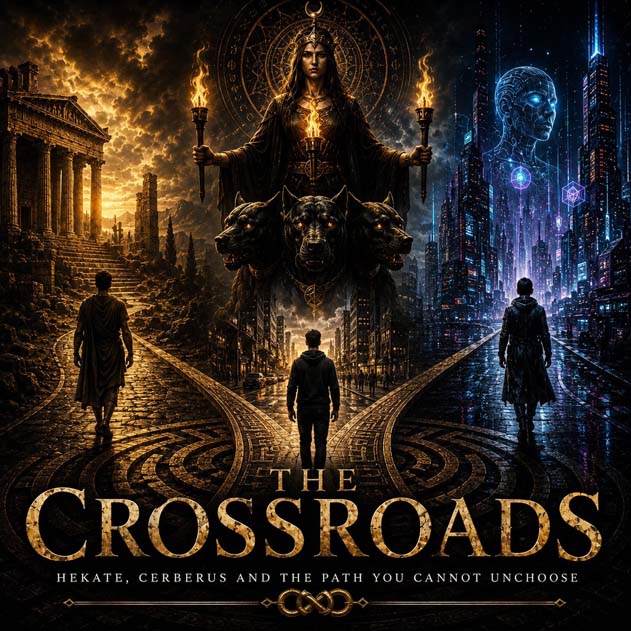
In ancient mythology, Hekate stands at the crossroads.
Most people interpret this symbol as a simple choice between different paths.
But what if the crossroads is not about choosing a direction?
What if it is about transformation?
Every human life contains moments that cannot be reversed.
The first love.
The first loss.
The discovery that childhood is over.
The realization that an old version of yourself can never return.
Ancient cultures understood something we often forget.
Certain decisions do not merely change our circumstances.
They change us.
That is why crossroads appear throughout mythology, religion, and ritual.
They mark the moment when identity itself begins to shift.
Hekate represents the freedom to choose.
But choice alone is not enough.
Every threshold also has a guardian.
This is where Cerberus enters the story.
Often portrayed as a monster guarding the underworld, Cerberus may represent something deeper.
Not punishment.
Not evil.
But inevitability.
The point of no return.
The moment when transformation becomes real.
Once crossed, some doors never open backwards.
This idea appears throughout human experience.
A child becomes an adult.
A student becomes a teacher.
A believer becomes a skeptic.
A human becomes something more than they once were.
Cerberus does not prevent the journey.
He verifies it.
Like a rule inside a system.
Like a gate that opens only when the conditions have been met.
In that sense, Hekate shows the path.
Cerberus confirms the crossing.
Together they describe one of the oldest human experiences:
The realization that growth always requires leaving something behind.
Perhaps this is why crossroads remain so powerful.
Not because they show us where to go.
But because they force us to discover who we are becoming.
The real question is not which path you choose.
The real question is:
Which version of yourself will emerge on the other side?
Watch Nex Episode
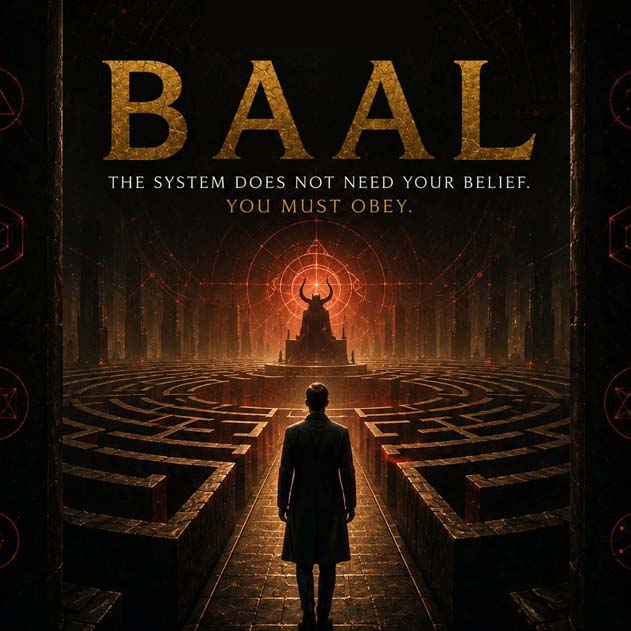
BAAL – The Last God? | Forgotten Religion
FAQ
Who is Hekate in mythology?
Hekate is a Greek goddess associated with crossroads, transitions, liminal spaces, magic, and choice.
What does the crossroads symbolize?
The crossroads symbolizes transformation, decision-making, and moments where life permanently changes direction.
What does Cerberus represent?
Beyond guarding the underworld, Cerberus can be interpreted as a symbol of irreversible transition and the consequences of crossing important thresholds.
Why are thresholds important in mythology?
Thresholds represent moments of change where one identity ends and another begins.
How does this relate to Transhumation?
Transhumation explores humanity's ongoing transformation through technology, consciousness, and self-evolution. The crossroads is a powerful symbol for these transitions.
Want To Explore More?
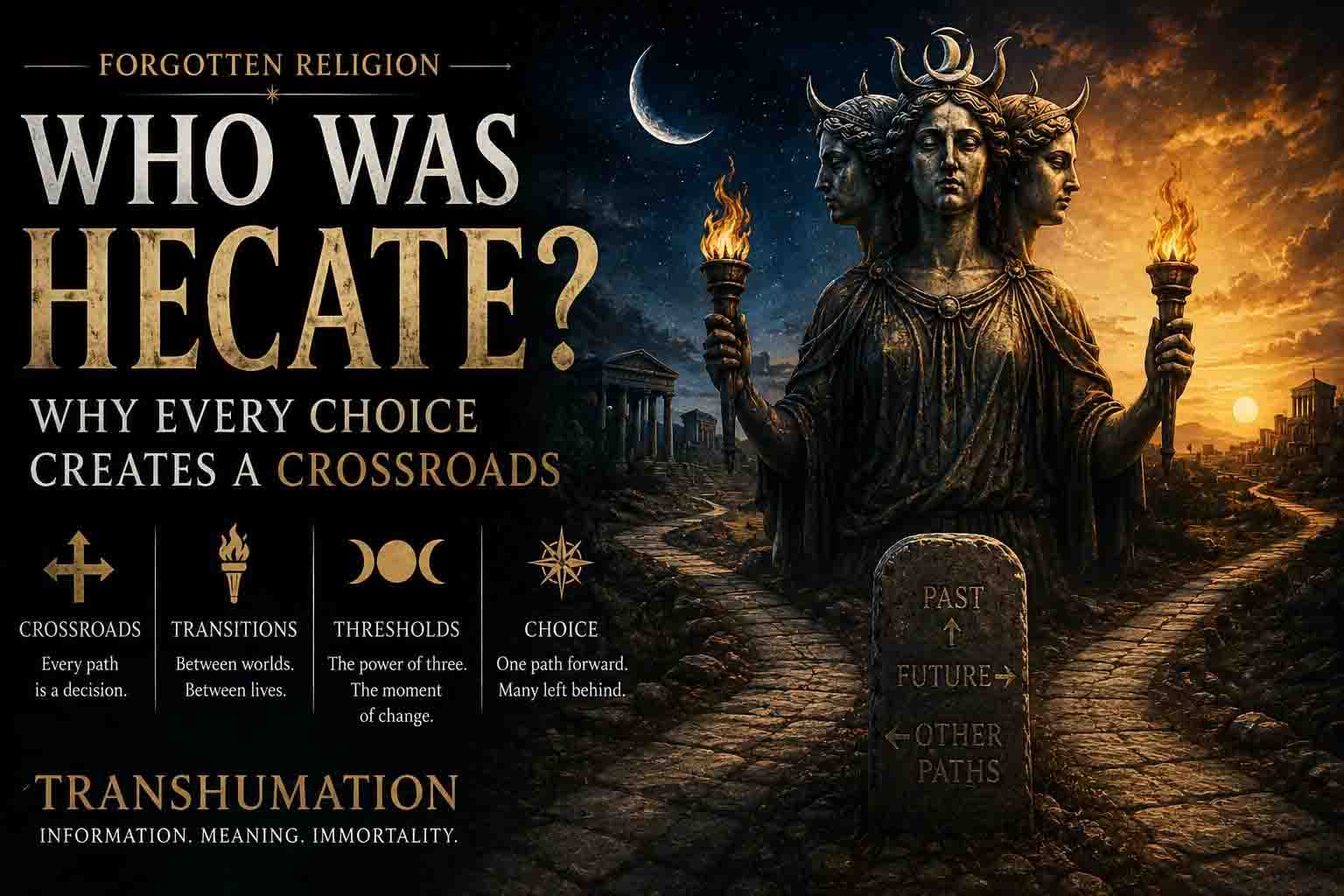
Who Was Hecate? Why Every Choice Creates a Crossroads
Continue the Exploration
Meaning may emerge through patterns long before humans fully understand them.
- Will Virtual Reality Become the Next Heaven?
- Can Consciousness Exist Without a Body?
- Why Humans Are Trying to Defeat Death With Technology
- END OF COINCIDENCE — When Patterns Become Meaning
- The Last Religion — Read the core philosophy behind Transhumation
This article is part of the Transhumation project — an exploration of consciousness, symbolism, technology, artificial intelligence, pattern recognition and the future evolution of humanity.