
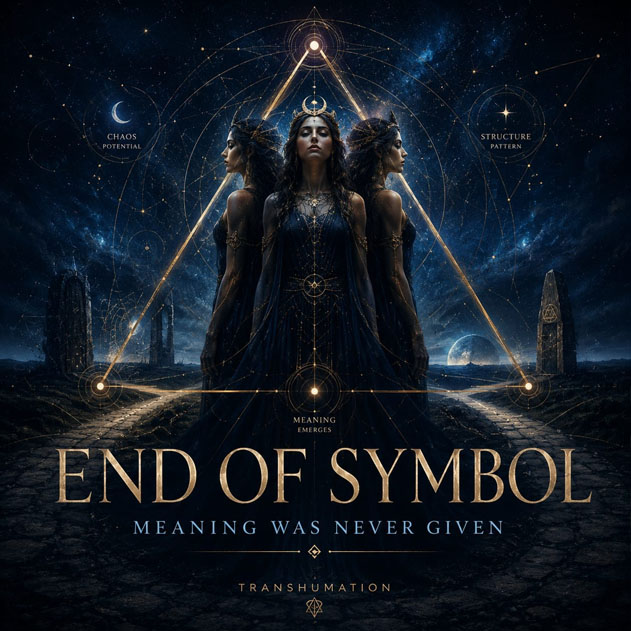
Meaning Was Never Given
Human beings have always surrounded themselves with symbols. Religious signs, geometric forms, numbers, gestures, colors, and repeated images appear across civilizations because they allow complex ideas to be carried through simple forms.
We usually assume that a symbol receives meaning from someone who defines it. A culture assigns a value. A religion provides an interpretation. A tradition explains what the image is supposed to represent.
But symbols often survive long after those original explanations disappear.
They continue to attract attention, produce new interpretations, and connect ideas that were never part of their first historical context. This suggests that meaning may not be permanently contained inside the symbol itself.
Perhaps meaning is not given at the beginning.
Perhaps it emerges when a structure becomes visible.
The Symbol Is Not the Message
A symbol is often treated like a container. We imagine that it holds a specific message and that interpretation means opening it correctly.
But many powerful symbols do not behave this way.
The circle can represent unity, eternity, repetition, protection, or enclosure. A doorway can suggest opportunity, danger, transformation, or exclusion. A crossroads can represent freedom, confusion, destiny, or the presence of several possible futures.
The form remains the same while the interpretation changes.
This does not make the symbol meaningless. It means its power may come from something deeper than a single definition.
The symbol creates a structure in which meaning can appear.
It does not always provide the answer. Sometimes it organizes the question.
The Rule of Three
One event can be dismissed as an accident. Two related events may suggest coincidence. A third begins to create a recognizable structure.
This is not a universal law of reality, but it is a powerful pattern of perception.
One point is only a position. Two points create a relation. Three points can create the first enclosed geometric form: a triangle.
The same principle appears in stories, arguments, rituals, and visual composition. The first element introduces something. The second creates comparison or opposition. The third changes the relation into a system.
At that moment, the observer no longer sees isolated events.
The observer sees a pattern.
Meaning begins not because the events suddenly acquire a hidden message, but because their relationship becomes visible.
When Does Meaning Begin?
Meaning does not always exist as a finished object waiting to be discovered.
It can emerge through repetition, contrast, and connection.
A sound heard once may be meaningless. Repeated in a particular sequence, it becomes rhythm. A gesture performed once may be accidental. Repeated within a ceremony, it becomes ritual. An image appearing across several places may begin to feel symbolic because the observer recognizes a shared structure.
Meaning therefore exists neither entirely inside the object nor entirely inside the observer.
It emerges between them.
The world provides forms, events, and differences. Consciousness compares them, remembers them, and places them into relationships.
Meaning is the result of that encounter.
Recognition Before Interpretation
Interpretation is often described as an active process in which the mind imposes meaning on something neutral.
Sometimes this happens. Human beings are capable of seeing patterns that do not exist and forcing unrelated events into a preferred explanation.
But interpretation can also begin with recognition.
The observer notices that several elements share a form, position, rhythm, or function. Before deciding what they mean, the observer recognizes that they belong together.
This distinction matters.
Recognition says: there is a structure here.
Interpretation says: this is what the structure means.
The first may be relatively stable. The second can remain open.
A symbol can therefore continue living across centuries because people recognize its structure even while disagreeing about its final explanation.
The End of the Fixed Symbol
The “end of symbol” does not mean that symbols disappear.
It means the end of treating them as objects with one permanent and complete meaning.
A fixed symbol asks the observer to receive an answer.
An open symbol asks the observer to participate.
This is why ambiguity can make a symbol stronger rather than weaker. A completely explained image may become historically interesting but intellectually closed. An underdetermined symbol continues to produce thought because it leaves space for new relationships.
Its historical origin still matters. We should distinguish what a symbol meant in a particular culture from what later observers see in it.
But the origin does not control the entire future of the form.
Symbols can outlive the systems that created them.
The Observer Completes the Structure
Some symbols seem incomplete without the person who encounters them.
A crossroads contains several directions, but it becomes meaningful only when someone must choose. A doorway is only an opening until someone stands before it. A mask creates a distinction between appearance and identity, but that distinction matters because an observer suspects that something is hidden.
In this sense, the observer does not merely decode the symbol.
The observer becomes part of it.
The structure creates a position for consciousness: the person who sees, compares, chooses, or questions.
This may explain why certain forms remain powerful. They do not deliver a finished message. They create a situation in which the viewer must respond.
Meaning is not placed inside the symbol like an object inside a box.
It is produced by participation.
Hekate and the Open Position
The threefold form associated with Hekate offers a useful philosophical example.
Historically, Hekate accumulated different associations across time and place. She could be connected with thresholds, crossroads, night, protection, danger, and transitions. These historical meanings should not be reduced to one modern interpretation.
But the three-sided form can also be read philosophically.
Three directions create a structure that cannot be seen completely from one position. The observer stands before several possibilities but does not possess a view from everywhere at once.
There may even be an open position within the arrangement: the place occupied by the person looking.
This is not a claim about the original intention of the symbol. It is a way of understanding why the form remains productive.
It does not simply show three faces.
It asks where the fourth perspective is.
The answer may be: you are standing in it.
Structure Before Meaning
Perhaps symbols were never primarily messages.
Perhaps they were technologies of attention.
They preserve relationships, oppositions, repetitions, and thresholds in forms simple enough to survive cultural change. Their meanings shift, but their structures continue inviting recognition.
The circle returns.
The crossroads returns.
The mask returns.
The triangle returns.
Not because every civilization secretly gave them the same meaning, but because these forms repeatedly organize the same fundamental problems: unity and division, choice and uncertainty, appearance and identity, observer and world.
The symbol does not tell us what to think.
It shows us where thought begins.
Final Thought
Meaning was never simply given.
It was not permanently locked inside the sign, waiting for the correct authority to reveal it. Nor was it created freely by the observer without limits.
Meaning emerged from a relationship between form, repetition, context, and consciousness.
One event may look random. Two create comparison. Three can reveal structure.
And once structure becomes visible, the symbol changes.
It is no longer only an image.
It becomes a place where reality and interpretation meet.
Frequently Asked Questions
-
What does “the end of symbol” mean?
It means abandoning the idea that every symbol contains one fixed and final meaning. Symbols can function as open structures that generate new interpretations.
-
Are symbols meaningless without interpretation?
Not entirely. Symbols have forms, histories, and cultural contexts, but their significance becomes active when an observer recognizes and interprets them.
-
What is the rule of three?
It is the idea that three related elements often create the first recognizable structure. It is a cognitive and symbolic pattern, not a universal scientific law.
-
Is meaning discovered or created?
It may be both. The observer discovers relationships within a form but also interprets those relationships through memory, culture, and experience.
-
Can one symbol have several meanings?
Yes. Symbols often accumulate different meanings across periods, cultures, and individual encounters.
-
Does historical context still matter?
Yes. A later philosophical interpretation should not be confused with the original historical meaning of a symbol.
-
Why are ambiguous symbols so powerful?
Ambiguity leaves room for participation. Instead of delivering one answer, the symbol invites the observer to complete the structure.
-
What does Hekate represent in this article?
Hekate serves as a philosophical example of a threefold structure associated with thresholds and multiple perspectives. The interpretation is not presented as a definitive historical claim.
-
What is the main idea of the article?
Meaning is not always given in advance. It often emerges when consciousness recognizes a structure and enters into a relationship with it.
Continue the Transhumation Series
Explore the full journey: