
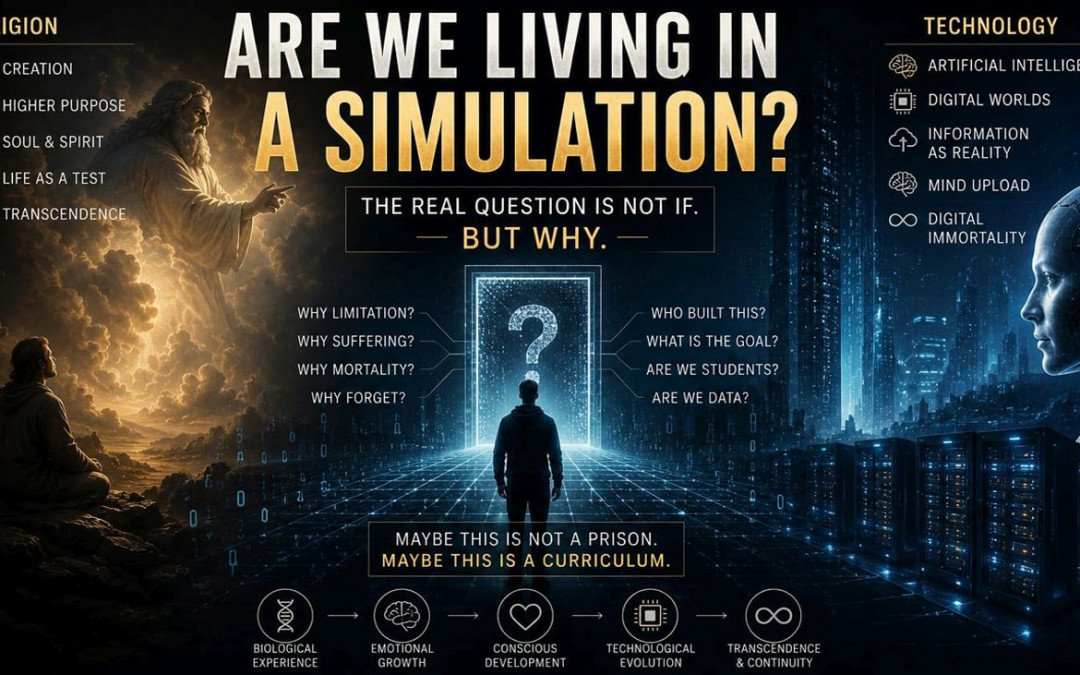
Are We Living in a Simulation?
At cruising altitude, the world begins to lose some of its authority.
Cities flatten into geometry. Roads become lines. Borders disappear entirely. A storm that feels enormous from the ground becomes a gray system seen from above, and the landscape that normally surrounds us like unquestionable reality starts to resemble a model of itself.
Perhaps this is why human beings have always been tempted by the idea that there is another level.
For one civilization, that level was divine. For another, metaphysical. Plato gave us a cave in which appearances could be mistaken for reality. Religious traditions imagined heavens, invisible orders and worlds beyond death. Mystics distrusted the evidence of ordinary perception. Philosophers asked whether the senses reveal the world as it is or merely the world as human minds are able to encounter it.
The technological age did not invent this suspicion.
It changed the metaphor.
Now the hidden level has servers.
The world might be rendered.
Physics might be code.
The universe might be implemented inside something larger.
And so an old question returns in the vocabulary of Silicon Valley:
Are we living in a simulation?
The language is new.
The unease is ancient.
Are We Living in a Simulation?
There is currently no established scientific evidence showing that the observable universe is an artificial simulation.
That sentence matters because the simulation hypothesis has an unusual ability to borrow authority from technological vocabulary. Words such as code, processing, rendering and digital physics sound precise. Precision of language, however, does not automatically create evidence.
A mathematically structured universe does not prove software.
Quantum phenomena do not prove pixelation.
An unexplained event is not a glitch simply because glitch is an attractive word.
The best-known modern simulation arguments are philosophical and probabilistic. They ask us to imagine civilizations advanced enough to create enormous numbers of conscious simulations and then consider what that might imply about the probability that we ourselves occupy an original rather than simulated world.
That can be an interesting argument.
It is not an observation of the computer outside the universe.
The first useful Transhumation move is therefore restraint. We should resist asking whether the hypothesis feels exciting and instead ask what evidence could actually distinguish a simulated universe from a non-simulated one.
If no conceivable observation counts against the idea, then the idea may remain philosophically provocative while becoming scientifically weak.
That boundary should stay visible.
Is Simulation Theory Scientific?
The difficulty is not that simulation is inherently unscientific.
We simulate things constantly.
Weather.
Traffic.
Aircraft.
Economies.
Physical systems.
The problem arises when the proposed simulator is allowed to explain every possible observation.
If the universe is smooth, perhaps the simulation is sophisticated. If it is discrete, perhaps we have found the resolution. If physics behaves consistently, perhaps the code is elegant. If something anomalous appears, perhaps it is an error.
A hypothesis that can survive every result has protected itself too well.
This is where Try to Disprove It becomes important.
A serious proposition should reveal where it can lose.
Simulation theory often becomes most valuable when we stop treating it as a hidden cosmological fact and begin treating it as a philosophical instrument.
What assumptions does it expose?
One of them is surprisingly basic:
we assume that the world containing us must also be the deepest level of reality.
Perhaps it is.
But the simulation thought experiment forces us to admit that this assumption is rarely examined because everyday life gives us no practical reason to examine it.
The hypothesis may therefore be more useful as a mirror than as a map.
It reflects the limits of what we normally mean by real.

If the World Were Simulated, Would It Be Less Real?
This may be the most interesting question because popular discussion usually answers it too quickly.
If we discovered that reality were simulated, people often imagine that everything would become fake.
The chair becomes code.
The body becomes code.
Love becomes code.
Death becomes code.
But implementation does not automatically cancel consequence.
A person experiencing pain inside a simulated environment would still experience pain. A betrayal would still be betrayal to the consciousness living through it. A promise would still reorganize expectations. A child would not become meaningless merely because the substrate beneath the world turned out to be unfamiliar.
The distinction is better framed as fundamental versus implemented, not real versus unreal.
A chess game is real as a game although its rules are not made from the same material as the board.
Software is real as software although it depends on hardware.
A digital economy can produce real poverty or wealth even though its accounting structures are informational.
If our universe were implemented inside another system, the discovery would revolutionize cosmology.
It would not automatically erase lived experience.
The world could turn out to be artificial in origin and remain completely real in consequence.
That possibility matters for Transhumation because it separates the carrier of reality from the reality of experience.
Why Would an Advanced Civilization Create a Simulation?
Once we grant the premise, the question of purpose becomes irresistible.
But it is also where speculation becomes most dangerous.
An advanced civilization might create simulations for scientific research, historical reconstruction, entertainment, education, art, cultural preservation or reasons completely inaccessible to us.
It might not create them deliberately at all. Conscious systems could emerge as side effects inside environments designed for another purpose.
There is no evidence allowing us to choose among these possibilities.
Still, one possibility deserves examination because it connects simulation theory with a recurring feature of human development.
We build constrained environments in order to learn.
Children play within rules.
Pilots train in simulators.
Students solve simplified problems.
Scientists isolate variables.
Games create artificial limitations because a game without limits ceases to be a game.
This allows a speculative but disciplined question:
Could limitation ever be deliberately useful to a conscious system?
The answer is obviously yes in some local cases.
Whether mortality, suffering and biological vulnerability belong to such a design is another matter entirely.
Nothing in the world demonstrates that they do.
Could Suffering Have a Function in a Simulated World?
Certain values seem inseparable from limitation.
Courage requires something capable of frightening us.
Sacrifice requires something capable of being lost.
Commitment acquires meaning partly because time and attention are finite.
Forgiveness exists because injury exists.
This can tempt us toward a dangerous conclusion: perhaps suffering was designed in order to create wisdom.
That conclusion goes much too far.
A person can learn from illness without illness having been created to teach them.
A society can become stronger after disaster without the disaster possessing pedagogical intention.
Evolution can produce suffering because nervous systems capable of detecting damage are useful, not because nature has a moral curriculum.
The better question is narrower and more interesting:
Which human meanings depend upon conditions of vulnerability?
If a civilization eliminated disease, scarcity, aging and irreversible loss, would courage disappear? Probably not entirely, because new forms of risk could arise. Would empathy vanish? Again, not necessarily. Intelligence may generate moral depth without requiring unnecessary suffering.
But some parts of human meaning might change radically.
An immortal being would experience commitment differently from a mortal one.
A person who could restore every lost memory from backup might understand forgetting differently.
A civilization in which every mistake were reversible might develop a different relationship with responsibility.
Limitation does not need to be designed to matter.
Its presence already shapes the architecture of human value.
The Problem of Perfect Beings
Imagine a civilization that has solved nearly everything we currently fear.
Disease is manageable.
Bodies can be repaired.
Material scarcity is minimal.
Lifespan is indefinite.
Memory is perfectly supported.
Most physical labor is automated.
We tend to assume this civilization would simply be happier.
Perhaps it would.
But it would also encounter psychological conditions for which biological evolution gave us little preparation.
What happens to urgency when there is always more time?
What happens to identity if memory can be copied or edited?
What happens to ambition when technical competence can be acquired from machines?
What happens to love if loss becomes optional?
None of these questions proves that perfection would lead to stagnation.
Curiosity could survive indefinitely.
Art could become deeper.
Relationships could acquire forms we cannot imagine.
The point is more modest.
Remove a limitation and you do not merely remove suffering.
You may also alter the structures that evolved around that limitation.
A civilization capable of designing consciousness might therefore become interested not only in maximum freedom but in which constraints generate valuable forms of experience.
That is the strongest version of the developmental simulation hypothesis.
Not a belief.
A thought experiment.
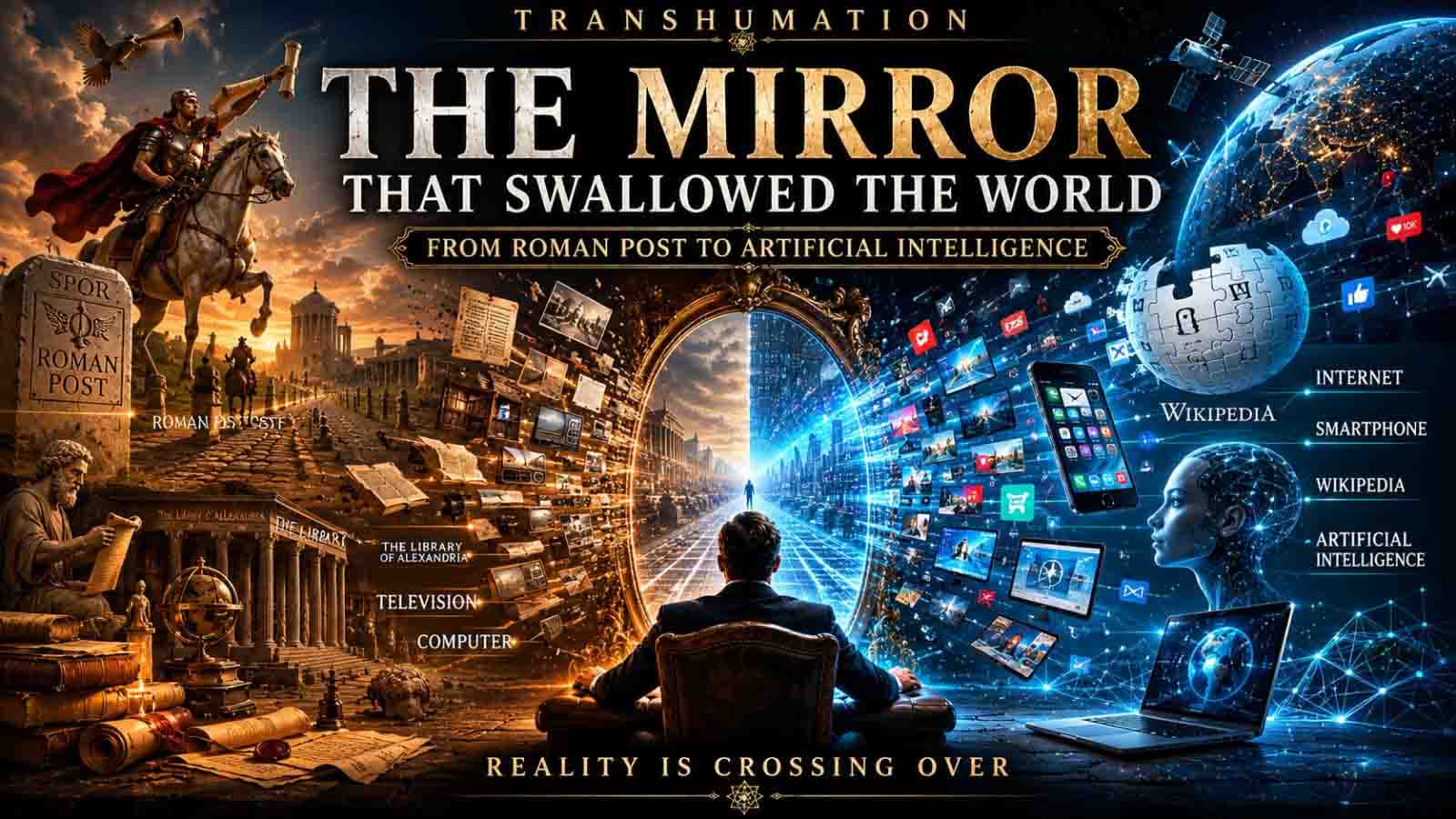
Religion and Simulation Theory Are Not the Same Thing
They can nevertheless illuminate one another.
Many religious traditions ask whether visible reality depends upon something beyond it. They contain ideas of creation, divine intelligence, higher orders, judgment, continuity and worlds inaccessible to ordinary perception.
Simulation theory can generate superficially similar structures.
A creator.
A lower reality.
A higher reality.
Possible continuation outside the local environment.
Yet resemblance should not erase difference.
A programmer does not automatically possess omniscience or moral authority.
A simulated universe is not creation from nothing.
A backup is not resurrection.
A higher computational substrate is not heaven.
A system administrator is not God.
These distinctions prevent a provocative analogy from becoming a false equivalence.
The deeper overlap lies not in the answers but in the human pressures generating the questions.
Mortality.
Uncertainty.
The suspicion that appearance is incomplete.
The desire to know whether consciousness belongs only to one temporary body.
Technology has not translated religion into engineering.
It has wandered into some of the same rooms through a different entrance.
The Cosmic Problem
The universe makes this convergence more interesting.
Human bodies exist on a timescale measured in decades.
Interstellar distances are measured in light-years.
A civilization attempting to spread through the galaxy would encounter delays and durations completely unlike ordinary human experience.
This does not mean post-biological existence becomes inevitable.
Humans could travel slowly.
Generation ships are conceivable.
Machines could explore for us.
Civilizations might remain local forever.
But cosmic scale places pressure on the assumption that the individual biological human must be the primary unit of expansion.
A machine can potentially tolerate environments that a human body cannot.
Information can cross distance more cheaply than a biological adult.
An autonomous system can remain inactive for periods that would encompass generations of human lives.
The first thing humanity sends deeply into the galaxy may therefore not be humanity in any ordinary biological sense.
It may be civilization without the citizen.
An archive.
A machine.
A model.
A message capable of answering back.
That raises a question far more difficult than simulation theory.
If the representation travels, did we?
Could Consciousness Exist Outside Biology?
Human consciousness, as far as current evidence shows, is deeply dependent on the functioning brain.
Anesthesia can interrupt it.
Brain injury can alter it.
Neurodegenerative disease can damage memories, personality and perception.
This makes biological organization impossible to dismiss.
But it does not establish that carbon-based nervous systems are the only possible substrate capable of supporting consciousness.
Perhaps conscious experience depends upon particular causal structures that could in principle be recreated elsewhere.
Perhaps biological chemistry matters in ways functional descriptions do not capture.
Perhaps current concepts are simply inadequate.
AI has not solved the problem.
It has made the problem harder to avoid because machines can now perform increasingly sophisticated cognitive tasks without resolving whether anything is subjectively present behind those abilities.
This distinction matters for simulated-world scenarios too.
A civilization can simulate behavior.
That does not automatically mean it can create experience.
A world filled with perfect artificial humans would still require an answer to the question we have not solved in ourselves:
What makes there be something it is like to be the system?
The Final Twist
Now return to the most speculative possibility.
Suppose biological existence were an environment deliberately created by a post-biological intelligence.
Suppose mortality, uncertainty, emotion and embodiment were constraints rather than accidents.
What would follow?
Surprisingly little.
We still would not know whether suffering was educational.
We would not know whether death led anywhere.
We would not know whether the creators were benevolent.
We would not know whether the simulation had a moral purpose at all.
That is why the phrase mortality is curriculum should remain poetry, not conclusion.
But the thought experiment still reveals something.
A life can acquire meaning through conditions that are not themselves desirable.
Scarcity makes selection necessary.
Mortality makes time non-refundable.
Uncertainty makes decisions consequential.
Embodiment gives perspective a location.
These conditions do not need cosmic intention in order to structure consciousness.
Remove the simulator and the observation survives.
That is the sign of a useful philosophical experiment.
The speculative machine disappears.
The question remains standing.
Watch The Video
How to Read the World

Current Knowledge
There is currently no empirical evidence demonstrating that the observable universe is a simulation. The major modern arguments supporting the possibility are philosophical or probabilistic rather than established scientific demonstrations.
Mathematical regularity in physics does not by itself imply that the universe is software or that an external programmer exists. Computational metaphors can be intellectually useful, but metaphor must be separated from physical evidence.
Humans already use simulations extensively for research, training, planning and entertainment. These systems show that artificial environments can influence real decisions and experiences, but they do not provide evidence that our own universe was created for an analogous purpose.
Human consciousness is strongly associated with brain function. It remains unresolved whether consciousness could exist in a non-biological substrate, and current AI capabilities do not establish the presence of subjective machine experience.
Religious traditions and simulation hypotheses sometimes share structural themes involving higher realities, creation and continuity, but they differ substantially in historical origin, metaphysical content and standards of evidence.
Open Questions
The first major question is testability. A simulation hypothesis that can explain every observation may be philosophically flexible but scientifically weak. A more serious version would need to identify observations that could genuinely reduce its plausibility.
A second question concerns consciousness. Even if advanced civilizations could simulate human behavior perfectly, it remains unknown whether such simulations would possess subjective experience rather than simply reproduce outward behavior.
Purpose introduces another layer of uncertainty. If artificial origin were ever established, the fact of creation would still not reveal motive. Scientific, artistic, commercial, educational and accidental explanations could all remain possible.
The deepest question concerns reality itself. If an implemented universe could contain genuine conscious experience, then perhaps reality should be defined less by whether a world is fundamental and more by whether events inside it possess consequences for beings capable of experiencing them.
Transhumation Interpretation
For Transhumation, simulation theory matters because it separates origin from experience.
Change the proposed carrier of reality and ask what survives.
Physics may acquire another explanation. Cosmology may be overturned. Yet love, pain, memory, responsibility and choice would remain real to the consciousness living through them.
This is the useful boundary.
Transhumation does not require a simulator.
It asks whether meaning depends on the deepest layer of reality or whether meaning can arise inside any world where conscious experience and consequence are genuine.
That question survives even if the universe is exactly what it appears to be.
FAQ
What is the simulation hypothesis?
It is the idea that our observable universe might be implemented within a more fundamental system rather than being the deepest level of reality.
Are we living in a simulation?
There is currently no scientific evidence establishing that we are. It remains principally a philosophical possibility.
Why would an advanced civilization create simulated worlds?
Possible reasons include research, education, historical reconstruction, entertainment or art, but without evidence of a simulator, every proposed purpose remains speculative.
Could suffering be part of a developmental simulation?
It is conceivable as a thought experiment, but there is no evidence that suffering was designed for education. Learning from suffering does not prove that suffering exists in order to teach.
Does simulation theory replace religion?
No. The two can share structural questions about creation and higher levels of reality, but simulation theory does not establish God, an afterlife, moral purpose or the survival of a soul.
What is the deeper Transhumation question?
The most interesting question is no longer simply whether someone built our universe.
It is what would actually change if we discovered that they did.
A mountain would still resist the body. Grief would still hurt. A promise would still reorganize another person’s expectations. A child born yesterday would not become less real because cosmologists discovered another layer beneath physics.
Perhaps the ultimate carrier matters enormously to explanation while mattering much less to lived significance.
That possibility turns simulation theory inside out.
We begin by wondering whether reality is fake.
We end by asking whether a world must be fundamental in order to be real at all.
Continue the Transhumation Series
- Forgotten Religion | Ancient Gods, Symbols and the Hidden Structures of Human Civilization
- The Last Religion | Death, Immortality and the Future of Humanity
- The New Theurgy | AI, Information and the Future of Human Civilization
- End of Branding: You Were Never Meant to Become a Product
- Baal vs Ishtar: Why Ancient Gods Never Disappeared