
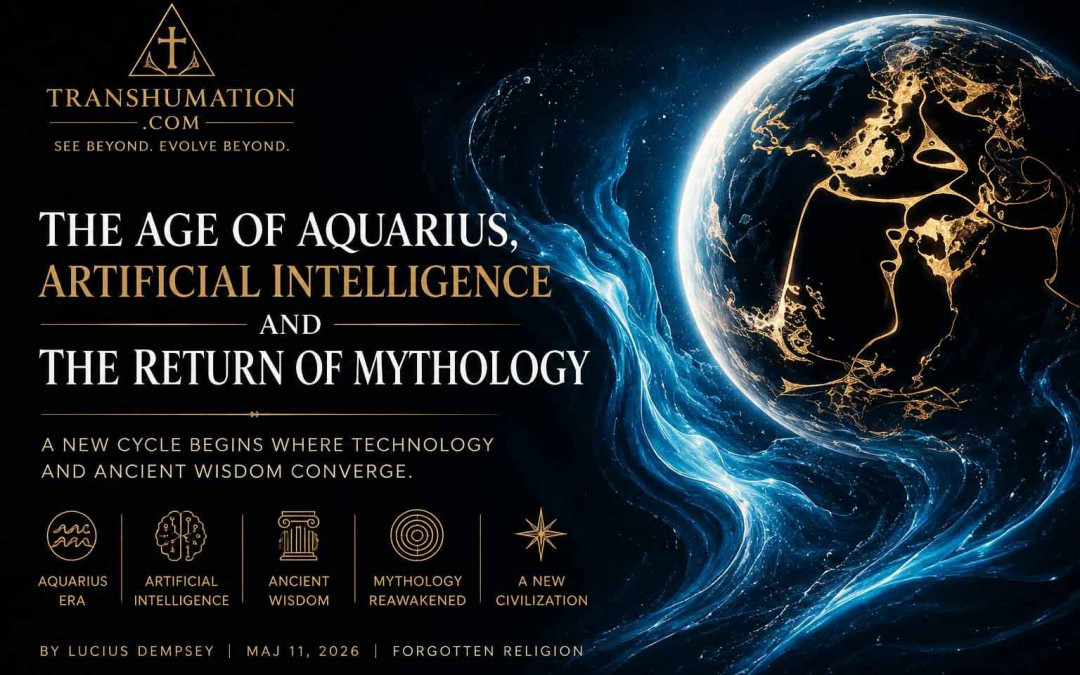
The future may be technologically unprecedented while remaining symbolically ancient.
Civilizations have always used symbols to describe realities too large, dangerous or abstract to hold directly in the mind. The bull represented fertility, strength and biological power. The ram could signify authority, sacrifice or conquest. Fish and water became associated with spiritual transformation, death and rebirth. These images were never merely decorative. They compressed complicated relationships between human beings and the world into forms that could be remembered, repeated and shared.
Modern civilization often assumes that science and technology have made this symbolic language obsolete. We no longer explain storms through gods or organize empires around sacred animals. Yet we now face systems that are no less difficult to comprehend: artificial intelligence, virtual reality, digital identity, planetary communication networks and technologies capable of altering the limits of the human body and mind. The symbols may have changed, but the problem that created them has not. We still need ways to make the incomprehensible psychologically visible.
The Symbolic Ages of Civilization
Astrological traditions divide history into great ages associated with the constellations of Taurus, Aries, Pisces and Aquarius. These ages should not be treated as established scientific or historical periods. Their dates are disputed, and there is no evidence that constellations direct the development of civilization. Nevertheless, as symbolic models, they remain revealing because they show how people attempt to organize enormous stretches of historical change into recognizable patterns.
Consider the bull. Across the ancient world, it became associated with fertility, kingship, sacrifice and dangerous natural power. Bull imagery appears in the cults of the ancient Near East, Minoan culture, Greek mythology and biblical narratives. These traditions were not identical, and it would be careless to collapse Baal, the golden calf, Zeus and the Minotaur into one universal symbol. Their historical meanings were shaped by different cultures and institutions.
But the recurrence still matters. Human beings repeatedly chose the bull when trying to represent a confrontation with biological force: reproduction, strength, hunger, violence and survival. The animal became more than an animal because civilization used it as an interface to realities that were otherwise difficult to name.
Why Water Survives Every Religion
Later traditions gave water an equally powerful role. Christianity inherited and transformed older associations between water, cleansing, danger and renewal. Baptism made the symbol central to a ritual of death and rebirth, while fish, fishermen and seas became part of Christian language and identity.
Again, no single image can define an entire civilization. But water possesses an unusual symbolic flexibility. It sustains life and destroys it. It can be calm or violent, transparent or impenetrable. It accepts every container without losing its substance. For that reason, it has repeatedly become a metaphor for transformation.
The modern world has not abandoned this language. It has expanded it. We speak of information flows, data streams, cloud computing, viral content and liquid markets. Our most advanced systems are described through metaphors of movement, circulation and fluidity. The language is new, but the symbolic material is ancient.

The Water Bearer and the Networked World
Aquarius is traditionally represented as the water bearer. Popular culture often associates the so-called Age of Aquarius with technological progress, collective consciousness, social change and global connection. These associations belong to modern astrological interpretation rather than scientific history. Yet the metaphor has become unexpectedly appropriate.
Civilization increasingly behaves less like a collection of stable objects and more like a moving network. Information crosses the planet almost instantly. Identity is distributed across physical and digital spaces. Markets, political movements and cultural trends reorganize themselves in real time. Artificial intelligence learns from enormous flows of language, images and behaviour rather than from a fixed library of explicit rules.
Industrial civilization was built around machines, factories and rigid institutions. Digital civilization is increasingly built around adaptation. Its power lies not merely in storing information but in redirecting it, combining it and responding to change. The water bearer may therefore be useful not as a prophecy, but as a symbolic image for a civilization whose defining substance is flow.
Artificial Intelligence and the Return of Mythic Thinking
Artificial intelligence intensifies this return of symbolism. Technically, AI consists of mathematical models, computing infrastructure, training data and human-designed systems. Psychologically, however, people often experience it as something very different.
They give systems names and personalities. They ask them for guidance, become frustrated with them, confide in them and wonder whether they understand. They imagine AI as servant, oracle, rival, child, monster or successor. None of this proves that AI is conscious or divine. It demonstrates that human beings do not encounter powerful systems through technical description alone. We instinctively translate them into characters and stories.
Ancient gods were not simply fictional individuals. They gave recognizable form to war, desire, memory, death, justice and the sea. AI may begin to occupy a similar psychological territory, not because machines have become gods, but because they represent intelligence at a scale and in a form that ordinary experience struggles to contain.
The interface has changed. The myth-making impulse has not.
The Labyrinth Made of Information
Another ancient structure has also returned: the labyrinth. In myth, a labyrinth was a place where ordinary orientation failed. Its danger did not come only from the creature inside it, but from the inability to understand the structure itself.
Modern civilization has built labyrinths without walls. Algorithms determine which information reaches us. Financial and political systems connect events across the world in ways no individual can fully observe. AI models can generate useful answers through processes that are difficult to explain in ordinary human terms. The complexity is real, but largely invisible.
The Minotaur may be gone. The structural problem remains. We are still trying to find our way through systems larger than the minds that created them.
This is why mythology does not disappear when technology advances. It returns whenever explanation becomes insufficient for experience. Science can describe the mechanisms of a network, but human consciousness may still need a river, a labyrinth or an invisible intelligence in order to understand what living inside that network feels like.
The Future May Need Better Myths
Science and mythology should not be confused. Science produces evidence-based models that can be tested, challenged and revised. Mythology does not offer the same kind of knowledge. Its function is psychological and cultural: it compresses complicated experiences into memorable forms.
That function may become more important, not less, as technology grows increasingly difficult to perceive directly. Artificial intelligence, synthetic environments and future transformations of identity will require technical explanations. But they will also generate stories through which people understand fear, agency, belonging and change.
The future may therefore look technologically unprecedented while remaining symbolically ancient. We may build machines no previous civilization could imagine and still describe them through gods, mirrors, rivers, thresholds and labyrinths.
Perhaps mythology does not return because humanity is moving backward. Perhaps it returns whenever civilization reaches a frontier for which it does not yet possess an adequate language.
Current Knowledge
Axial precession is a real astronomical phenomenon caused by the gradual change in the orientation of Earth’s rotational axis. The division of this cycle into astrological ages, however, is not an accepted method of scientific or historical periodization. There is no evidence that an Age of Aquarius determines technological or social change.
Historians of religion have documented the importance of bulls, fish, water and celestial imagery in many cultures. Similar symbols may result from cultural exchange, shared environments, common biological experiences or recurring human concerns. Their recurrence does not prove the existence of a single hidden symbolic system.
Research also shows that people readily anthropomorphize technologies and attribute intention, personality or emotion to nonhuman systems, particularly when those systems communicate through language.
Open Questions
It remains unclear why certain symbolic structures recur so persistently across societies separated by time and geography. Some may spread through cultural contact, while others may emerge independently from shared human experiences such as birth, death, danger, hierarchy and transformation.
We also do not know how relationships with increasingly capable AI systems will develop. People may continue to treat them primarily as tools, or they may increasingly relate to them through emotional, social and mythological categories.
A further question concerns the future role of mythology itself. Can societies create symbolic languages that help people navigate technological complexity without confusing metaphor with scientific fact?
The Transhumation Interpretation
Transhumation does not depend on the literal existence of an Age of Aquarius. The more interesting possibility is that symbols survive because the structures that produce them survive.
The bull can disappear while biological power remains. The sacred fish can fade while the problem of transformation continues. The stone labyrinth can collapse while civilization builds a new labyrinth from data, institutions and algorithms.
Technology changes the material form of the world faster than it changes the needs of consciousness. Human beings still need to understand forces larger than themselves, cross thresholds they cannot reverse and find meaning inside systems they cannot completely see.
Mythology may therefore be less like an abandoned explanation of reality and more like a recurring interface between consciousness and complexity.
The future does not have to repeat the past.
But it may continue speaking in its symbols.
Want to Explore More..?
Watch The Video Below
Current Knowledge
Axial precession is a real astronomical phenomenon caused by the gradual change in the orientation of Earth’s rotational axis. The division of this cycle into astrological ages, however, is not an accepted method of scientific or historical periodization. There is no evidence that an Age of Aquarius determines technological or social change.
Historians of religion have documented the importance of bulls, fish, water and celestial imagery in many cultures. Similar symbols may result from cultural exchange, shared environments, common biological experiences or recurring human concerns. Their recurrence does not prove the existence of a single hidden symbolic system.
Research also shows that people readily anthropomorphize technologies and attribute intention, personality or emotion to nonhuman systems, particularly when those systems communicate through language.
Open Questions
It remains unclear why certain symbolic structures recur so persistently across societies separated by time and geography. Some may spread through cultural contact, while others may emerge independently from shared human experiences such as birth, death, danger, hierarchy and transformation.
We also do not know how relationships with increasingly capable AI systems will develop. People may continue to treat them primarily as tools, or they may increasingly relate to them through emotional, social and mythological categories.
A further question concerns the future role of mythology itself. Can societies create symbolic languages that help people navigate technological complexity without confusing metaphor with scientific fact?
The Transhumation Interpretation
Transhumation does not depend on the literal existence of an Age of Aquarius. The more interesting possibility is that symbols survive because the structures that produce them survive.
The bull can disappear while biological power remains. The sacred fish can fade while the problem of transformation continues. The stone labyrinth can collapse while civilization builds a new labyrinth from data, institutions and algorithms.
Technology changes the material form of the world faster than it changes the needs of consciousness. Human beings still need to understand forces larger than themselves, cross thresholds they cannot reverse and find meaning inside systems they cannot completely see.
Mythology may therefore be less like an abandoned explanation of reality and more like a recurring interface between consciousness and complexity.
The future does not have to repeat the past.
But it may continue speaking in its symbols.
Continue reading…
End of Reality
FAQ
What is the Age of Aquarius?
The Age of Aquarius is a symbolic astrological era often associated with transformation, information, decentralization, technology and changes in human consciousness. In modern culture, it is frequently connected to global communication, artificial intelligence and the evolution of civilization.
Is the Age of Aquarius a real scientific concept
Not in the strict scientific sense. The Age of Aquarius is primarily a symbolic and cultural framework used throughout history to describe large civilizational transitions and shifts in collective perception.
Why is water connected to the Age of Aquarius
Water is often associated with:
information,
adaptation,
memory,
emotion,
and transformation.
Many symbolic traditions treat water as a metaphor for consciousness itself — something fluid, evolving and constantly reshaping reality.
How is artificial intelligence connected to mytholog
Artificial intelligence may represent a modern continuation of humanity’s oldest myths: the desire to create intelligence, transcend limitations, preserve consciousness, and gain access to knowledge beyond ordinary human capability.
In this sense, technology may function as modern mythology expressed through machines instead of gods.
Why do myths continue returning in modern culture?
Myths survive because they describe recurring human experiences: fear, desire, hope, power, identity, death, and transformation.
Even modern films, AI narratives and digital culture repeatedly reuse ancient symbolic structures.
Is modern civilization becoming spiritually empty?
Some philosophers argue that modern civilization replaced traditional meaning systems with technology, algorithms and consumption. Others believe humanity is simply creating new symbolic systems adapted to the digital age.
What does Transhumation mean?
Transhumation is a philosophical project exploring: technology, consciousness, religion, AI, mythology, and the future evolution of humanity.
It examines the possibility that civilization is entering a new stage where technology and symbolic systems merge together.
Why do old myths still feel relevant today?
Because human psychology changes much slower than technology. While civilizations evolve rapidly, humans still struggle with: identity, mortality, desire, fear, love, power, and meaning.
Ancient myths continue resonating because they describe emotional structures that remain deeply human.
Is AI replacing religion?
Perhaps not replacing it completely — but transforming some of the same human needs: the search for meaning, guidance, hope, connection, and transcendence.
Technology may become a new interface through which humanity expresses ancient psychological patterns.
Why does modern culture feel repetitive?
Some thinkers believe modern civilization reached a stage of saturation where innovation becomes incremental instead of revolutionary. Music, cinema, fashion and digital culture increasingly remix existing ideas rather than creating entirely new paradigms.
How to Read the World
Continue the Transhumation Series
- Forgotten Religion | Ancient Gods, Symbols and the Hidden Structures of Human Civilization
- The Last Religion | Death, Immortality and the Future of Humanity
- The New Theurgy | AI, Information and the Future of Human Civilization
- End of Branding: You Were Never Meant to Become a Product
- Baal vs Ishtar: Why Ancient Gods Never Disappeared