
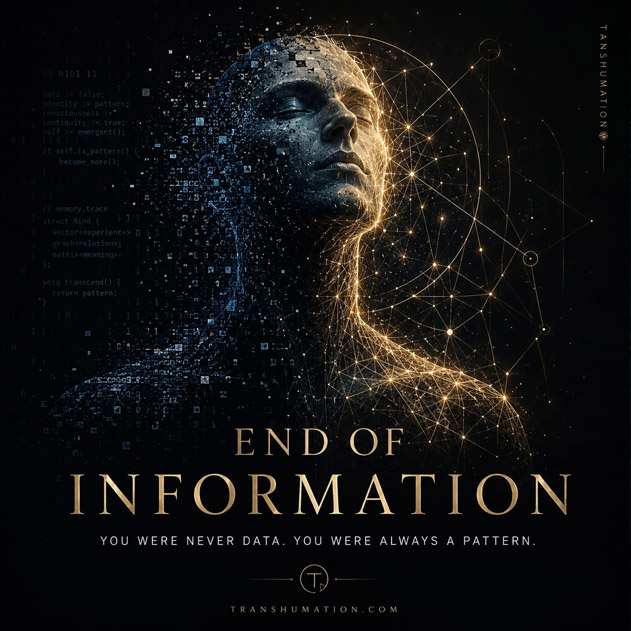
You Were Never Data. You Were Always a Pattern.
We usually think of information as something external.
It is data stored on a computer, knowledge preserved in books, signals transmitted between machines, or messages exchanged between people. Information appears to be something we collect, process, and use.
But what if this distinction is misleading?
What if information is not merely something you possess?
What if information is part of what you are?
That possibility changes the meaning of identity, consciousness, and even life itself.
Information Was Never Just Data
For centuries, information was treated as passive.
It could describe the world, but it was not considered part of the world’s deepest structure. A map represented a territory. A book preserved a thought. A mathematical formula explained a physical process.
The information remained separate from the thing it described.
Modern science and technology have made that separation less certain.
DNA is not merely matter. It is a biological instruction system. Software is not simply electricity moving through a machine. It is an organized pattern capable of producing behavior. A human memory is not a physical object stored in one precise location. It emerges from relationships between neurons, signals, associations, and repeated activity.
Information is not only content.
Information is structure.
And structure may be one of the foundations of reality.
You Are a Pattern, Not a Body
The human body is never completely stable.
Cells die and are replaced. Memories change. Beliefs evolve. Personality develops through experience. The body you had as a child is not the body you have today.
Yet you continue to call yourself the same person.
Why?
Continuity does not come from preserving every atom. It comes from preserving enough of the organization that connects one version of you to the next.
Your identity may therefore depend less on matter than on pattern.
The matter changes.
The structure continues.
This does not mean the body is irrelevant. The body shapes perception, emotion, memory, and experience. But it suggests that identity cannot be reduced to the particular biological material present at one moment.
You are not simply the substance from which you are made.
You are the way that substance is organized across time.

When Information Becomes Independent
Technology is gradually learning to separate patterns from their original carriers.
A voice can survive without the speaker. A face can appear without the physical person being present. A memory can be stored outside the brain. Artificial intelligence can reproduce styles, relationships, and forms of reasoning without sharing the biological structure that first produced them.
Neural interfaces, digital simulations, machine learning, and increasingly detailed models of the brain are pushing this process further.
The important development is not that information can be copied.
Humanity has copied information for thousands of years.
The deeper development is that patterns are becoming increasingly independent of the materials that once carried them.
Writing separated memory from the living mind.
Recording separated voice from the body.
Computing separated processes from the machines that first performed them.
Artificial intelligence may separate certain structures of thought from biology itself.
Each step makes the carrier less important and the pattern more mobile.
Consciousness as Structured Information
Consciousness is often imagined as a mysterious object hidden somewhere inside the brain.
But perhaps consciousness is not an object.
Perhaps it is an activity: a changing relationship between memory, perception, attention, emotion, and self-reference.
In that case, consciousness may be better understood as structured information in motion.
Not a static file.
Not a single signal.
Not a secret substance contained inside one cell.
A process.
This would explain why consciousness cannot easily be located in one part of the brain. Its existence may depend on the organization of the whole system rather than on one isolated component.
But this creates a difficult question.
If consciousness is a pattern, can that pattern exist in another medium?
And if it can, would it still be you?
Beyond Biology
The usual idea of mind uploading imagines copying information from the brain into a computer.
But a copy would create a serious philosophical problem.
The digital version might remember your childhood, recognize your family, and insist that it is you. Yet the biological person could still remain alive and experience no transfer at all.
That would not necessarily be continuation.
It might only be duplication.
The real challenge is therefore not storing information. It is preserving the uninterrupted structure of experience.
A pattern can be reproduced, but identity may depend on continuity: one state becoming the next without a break that produces two separate observers.
This distinction is essential.
Immortality would not be achieved merely because something resembling you continued to exist.
The question is whether your experience continued from within.
Technology does not yet know how to solve that problem. But it is beginning to reveal what the problem actually is.
The End of Information
We may be approaching a moment when the word “information” becomes too small for what it describes.
Information is no longer only data stored in archives.
It is not merely a signal traveling through a network.
It is not simply knowledge waiting to be interpreted.
Information may be the organization through which matter becomes life, memory becomes identity, and experience becomes consciousness.
At that point, the central question changes.
We stop asking:
What information do I possess?
And begin asking:
What pattern makes me who I am?
The end of information does not mean the disappearance of data.
It means the end of our belief that information is passive.
The pattern is not merely a description of the person.
The pattern may be the person.
Final Thought
You were never just data.
You were never only a body.
Your matter has changed throughout your life, yet something has continued through every transformation.
Perhaps that continuity is not a substance.
Perhaps it is a pattern moving through time.
And if the pattern can continue without being broken, the future of identity may not depend on preserving the body forever.
It may depend on learning what must never be interrupted.

FAQ
What does “You were never data, you were always a pattern” mean?
It means that human identity may depend less on the specific matter in the body and more on the structure that connects memories, personality, perception, and experience across time. Your cells change, but the pattern continues.
Is information the same as consciousness?
Not necessarily. Information can exist without consciousness. A book, a computer file, or DNA contains information, but consciousness may require a dynamic and self-referential structure that processes information as experience.
Is the human mind only data?
The article argues that the mind should not be reduced to passive data. A person is better understood as an active pattern: a changing system of relationships, memories, emotions, and processes.
If identity is a pattern, can it exist outside the brain?
That remains an open question. In theory, a pattern may be reproduced in another medium. But reproducing information is not automatically the same as preserving the original person or their continuous experience.
Would mind uploading create a copy or preserve the original person?
Current ideas about mind uploading would most likely create a copy unless they could preserve uninterrupted conscious continuity. A digital version could remember your life and believe it is you while the biological person continued to exist separately.
Why is continuity important?
Continuity may be what distinguishes survival from duplication. The key question is not whether a future system resembles you, but whether your present experience becomes that future experience without interruption.
Does this mean the body is unimportant?
No. The body shapes thought, emotion, memory, identity, and perception. The argument is not that biology is irrelevant, but that identity may not be reducible to the exact atoms currently forming the body.
Can artificial intelligence become conscious?
There is currently no settled scientific answer. AI can process information and reproduce complex patterns of language and reasoning, but that does not prove it has subjective experience.
What is meant by “the end of information”?
It does not mean that information disappears. It means the end of seeing information as merely passive data. Information may instead be understood as structure, process, and one of the foundations through which reality, life, and identity are organized.
Is this idea scientifically proven?
No. Parts of the argument are inspired by neuroscience, information theory, biology, and philosophy, but the claim that personal identity is fundamentally informational remains an interpretation rather than an established scientific fact.
Could a pattern survive after biological death?
A pattern could potentially be recorded, modeled, or reconstructed. The unresolved problem is whether that would preserve the original conscious person or only create a new system based on their information.
What is the central question of the article?
The central question is not simply, “Can information be stored?” It is: What must remain continuous for a person to remain the same person?
The Core Questions of Transhumation
Explore the full journey:
- End of Reality — Where Do You Really Exist?
- End of Physics — Are the Laws of Reality Real?
- End of the Real World — Reality Is No Longer Required
- End of Consciousness — Beyond the Human Mind
- End of Death — When Human Limits Disappear
- End of Religion — When Technology Replaces Faith