
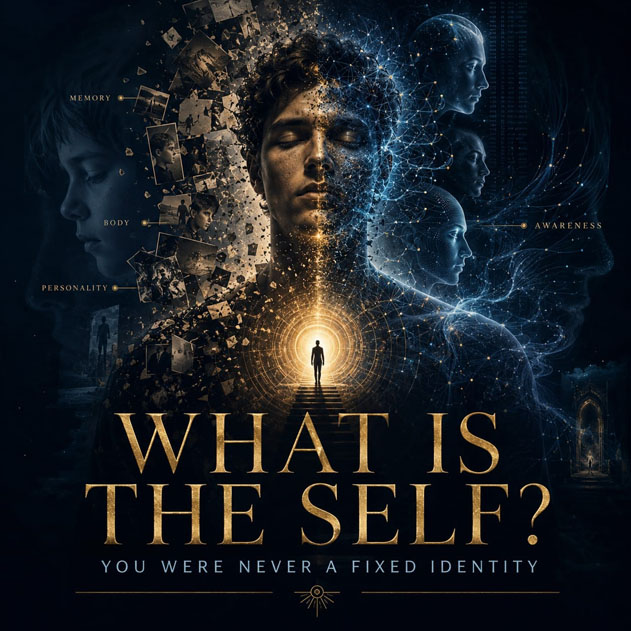
You Were Never a Fixed Identity
Human beings like to believe that the self is stable. We imagine that somewhere beneath changing moods, memories, and experiences there is a permanent identity that remains the same throughout life.
We say, “This is who I am,” as if the answer were clear.
But almost everything that seems to define us changes. The body ages. Beliefs evolve. Personality adapts. Memories fade, shift, and are rewritten. The person you were ten years ago may think, feel, and behave very differently from the person reading these words now.
Yet both are described with the same word: I.
So what exactly is the self?
The Illusion of a Stable Identity
Identity feels continuous because the mind creates a story that connects different moments of life. Childhood, relationships, mistakes, achievements, and expectations are arranged into a narrative that appears to belong to one person.
This story is useful. It allows us to make plans, take responsibility, and maintain relationships. Without some sense of continuity, daily life would become almost impossible.
But usefulness does not prove permanence.
The self may not be a solid object hidden inside the mind. It may be a process that constantly rebuilds itself from memory, perception, emotion, and expectation.
Identity feels fixed because the reconstruction happens continuously.
You Are Not Your Memories
Memory is often treated as the foundation of personal identity. We believe we are the sum of everything that has happened to us.
But memory is not a perfect archive.
Every time a memory is recalled, it can be altered. Details disappear. Emotions change. Later experiences affect how earlier events are understood. Two people may remember the same moment in completely different ways, and even one person may reinterpret the same event several times throughout life.
If identity depends entirely on memory, then identity is built on something unstable.
This does not mean that the past is meaningless. It means that the past is never simply preserved. It is continuously reconstructed by the present.
You Are Not Your Personality
Personality also appears to define the self. A person may describe themselves as confident, anxious, generous, impatient, or ambitious.
Yet personality changes with circumstances.
Someone may behave differently at work, with family, during a crisis, or when alone. Trauma, education, relationships, illness, and age can transform behavior and values. Even traits that seem permanent may weaken or disappear.
The self is therefore not identical to one personality.
Personality may be a temporary pattern produced by biology, environment, and experience. It is part of the person, but it is not necessarily the deepest layer of identity.
You Are Not Your Body
The body provides the physical boundary of the self. It determines where sensation begins, where pain occurs, and where the outside world appears to start.
But the body is also constantly changing.
Cells are replaced. Appearance changes. Strength rises and falls. Organs can be repaired or replaced. A person can lose part of the body and still experience themselves as the same individual.
This suggests that identity is not located in any single physical component.
At the same time, the body cannot simply be dismissed. Human consciousness is shaped by hormones, senses, movement, pain, and the structure of the brain. The self may not be the body, but it is currently formed through the body.
The Self as a Process
A more useful way to understand identity is to treat the self as a process rather than an object.
A flame remains recognizable even though the matter passing through it constantly changes. A river keeps its name even though its water never stays the same. A living organism remains continuous while its internal structure is continuously repaired and reorganized.
The self may exist in a similar way.
It is not permanent because nothing changes. It is continuous because change itself follows a recognizable pattern.
Thoughts, memories, emotions, and bodily states interact to create an ongoing sense of presence. The self is not one thing inside this system. It is the activity of the system maintaining a relationship with itself.
What Remains When Identity Changes?
If memories, personality, and the body are all unstable, what remains?
One possible answer is awareness.
Not a biography. Not a name. Not a fixed personality. Simply the fact that experience is happening.
Thoughts appear and disappear, but something is aware of them. Emotions rise and fade, but they are experienced. Identity changes, yet each new version is accompanied by a sense of presence.
This does not prove that awareness exists independently of the brain. Current evidence strongly connects conscious experience with biological processes.
But it does reveal an important distinction.
The content of consciousness changes. The experience of being conscious continues.
The Self Is Something You Experience
We usually say that we are a self.
But perhaps the self is something consciousness experiences.
The mind constructs an identity in the same way that it constructs a model of the external world. It organizes memory, emotion, bodily sensation, and social feedback into a coherent image called “me.”
That image is not false. It is an interface.
It allows a complex biological system to act as one person. But an interface is not the entire system. It is a simplified structure that makes interaction possible.
Once the self is understood as an interface, identity becomes less rigid. Change no longer appears as the destruction of the person. It becomes part of how the person exists.
Transhumation Beyond Identity
Transhumation is not only about modifying the body or extending life. It also raises a deeper question: how much of the current self must remain for existence to continue?
If memory can be expanded, personality altered, cognition connected to artificial systems, and consciousness supported by new forms of technology, then identity may become increasingly flexible.
The future self may not be one stable individual preserved forever.
It may be distributed across biological and digital systems. It may contain several forms of memory, perception, or personality. It may change more radically than any human identity can change today.
From the perspective of the present, this may look like losing the self.
From another perspective, it may be the expansion of consciousness beyond a structure that was never permanent in the first place.
Final Thought
The self is not something finished.
It is not a fixed object that must be protected from every change. It is an ongoing pattern created through memory, perception, biology, and awareness.
You are not exactly the person you were in the past, and the person you become will not be identical to who you are now.
Yet continuity remains.
Perhaps the self is not the permanent center of experience.
Perhaps it is the temporary form that experience takes.
Transhumation is not about escaping the self.
It is about recognizing that you were never completely confined to it.
Frequently Asked Questions
-
What is the self?
The self can be understood as an ongoing process that combines memory, perception, personality, bodily experience, and awareness into a coherent identity.
-
Is personal identity an illusion?
Identity is not necessarily unreal, but it may be less fixed than it appears. It functions as a changing model rather than a permanent object.
-
Are we the same people we were in childhood?
There is continuity between different stages of life, but the body, memories, beliefs, and personality can change significantly.
-
Are memories reliable?
Memories are useful but imperfect. They can fade, change, and be influenced by later experiences.
-
Is the self located in the brain?
Current evidence strongly connects identity and consciousness with brain activity, but there is no single known location that contains the entire self.
-
What is the difference between awareness and identity?
Identity is the changing story and structure associated with a person. Awareness is the experience of thoughts, emotions, sensations, and events as they occur.
-
Could technology change personal identity?
Yes. Neural interfaces, artificial intelligence, memory enhancement, and digital systems could alter how identity is formed and maintained.
-
Would a radically changed person still be the same person?
There is no simple answer. It depends on how continuity is defined: through memory, consciousness, biology, behavior, or relationships.
-
What is the main idea of the article?
The article argues that the self is not a fixed structure. It is a changing process, and future human development may expand consciousness beyond its current form.
Continue the Transhumation Series
Explore the full journey:
- End of Reality — Where Do You Really Exist?
- End of Physics — Are the Laws of Reality Real?
- End of the Real World — Reality Is No Longer Required
- End of Consciousness — Beyond the Human Mind
- End of Death — When Human Limits Disappear
- End of Religion — When Technology Replaces Faith
- End of Survival
This is not a theory. This is a transition.