
The Problem with Body
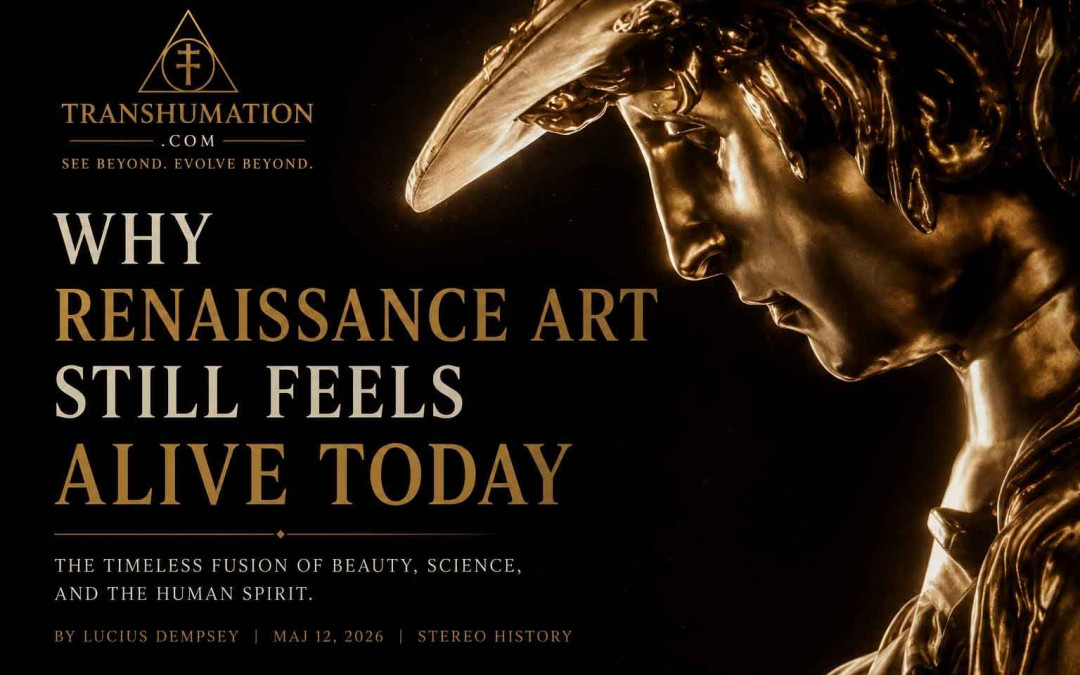
Stand in front of Michelangelo’s David long enough and the marble begins to become inconvenient. You know perfectly well that the figure cannot move. The stone is cold, the muscles are carved, the eyes do not see, and the enormous right hand will remain exactly where Michelangelo left it. Yet the sculpture refuses to behave like a dead object. Something in the shoulders seems unfinished, as though the body has been caught between decision and action. The head turns. The weight shifts. The face appears to be concentrating on an event that has not yet happened.
The usual explanation is technical brilliance. Michelangelo understood anatomy, proportion, contrapposto and the expressive possibilities of stone extraordinarily well. All of that is true. It is also incomplete.
What makes the work feel so alive is not simply that Michelangelo reproduced a human body accurately. The body is not, in fact, entirely naturalistic. The proportions are manipulated. Certain features are enlarged. The scale itself removes the figure from ordinary human encounter. What survives those departures from literal accuracy is something more important: the impression that a body has become the location of an interior decision.
That is one of the Renaissance’s great achievements.
Not the rediscovery of flesh after a thousand years without it.
The rediscovery of a much older tension: how much can the visible body tell us about the invisible person acting through it?
The Renaissance did not solve that question.
It made it impossible to ignore.
The Human Being Was Never Completely Lost
The word Renaissance encourages a beautifully simple story. Greece and Rome understood the human body. Christianity arrived. Medieval Europe turned away from earthly existence. Then Florence opened an old book, excavated a statue and suddenly remembered that people had muscles.
History is less cooperative.
Medieval European art contains extraordinary physicality, observation and emotion. Romanesque and Gothic sculpture could produce bodies of remarkable expressive force. Illuminated manuscripts preserve intimate gestures and psychological details. Late medieval painters increasingly explored space, volume, grief, tenderness and recognizable individuality well before anyone decided where the Renaissance officially began.
The classical world was not simply forgotten either. Ancient texts survived through Byzantine, Islamic and western manuscript traditions. Medieval theologians read and argued with Aristotle, Augustine, Cicero and others. Roman buildings, inscriptions and objects remained physically present across Europe.
What changed during the Renaissance was therefore not the sudden discovery that human beings possessed bodies.
It was the concentration of cultural attention placed upon those bodies and upon the classical intellectual and artistic traditions that had treated human form as an object worthy of sustained investigation.
Artists studied anatomy with new intensity. Perspective became a mathematical problem. Classical sculpture was collected, copied and competed with. Humanist scholars recovered, edited and circulated ancient texts. Wealthy patrons wanted biblical figures, saints, civic heroes and themselves represented with a new degree of physical and psychological authority.
The human being did not return from extinction.
The human being moved closer to the center of the frame.
A Christian David With a Pagan Body
Michelangelo’s David contains the contradiction almost perfectly.
The subject belongs to the Hebrew Bible. David is not Apollo. The story exists inside a religious tradition in which victory comes through a young man confronting a stronger enemy under divine providence.
Yet Michelangelo gives that biblical figure a monumental nude body whose artistic ancestry cannot be separated from classical antiquity.
This is what makes Renaissance humanism so much more interesting than the familiar story of religion losing ground to secular modernity. Michelangelo was not standing outside Christianity looking backward nostalgically toward pagan Greece. He was working inside a Christian civilization that had become fascinated by classical models of beauty, proportion, heroism and human dignity.
The two worlds did not simply replace one another.
They entered the same body.
David can therefore carry biblical meaning while looking like a citizen of a recovered classical imagination. The marble becomes a meeting point between traditions that had once appeared historically separated.
Donatello’s earlier bronze David performs another version of the problem. The youthful naked body is elegant, vulnerable and triumphantly physical while remaining embedded in a biblical narrative. Botticelli places pagan gods and mythological figures inside a Florentine culture that remains deeply Christian. Raphael paints ancient philosophers into the Vatican.
The Renaissance did not choose between Christianity and antiquity.
For a remarkable period, it forced them to share rooms.
That tension may be one reason the art still feels modern. Modern people also live among systems they do not experience as mutually exclusive: science and ritual, technology and symbolism, individual autonomy and inherited tradition.
The Renaissance viewer did not necessarily experience these combinations as contradictions in the way we might.
But from our distance, the friction is unmistakable.
The Body Became Evidence
One of the Renaissance’s most consequential changes was not simply that artists represented the body more realistically.
They began treating the body as evidence.
The shoulder tells us where weight is carried. The neck shows tension. The hand reveals intention. Drapery responds to anatomy rather than floating independently of it. Space is constructed so that bodies occupy measurable relationships with other bodies and with architecture.
The artwork increasingly behaves as though the visible world can be investigated.
This is why perspective matters beyond the technical history of painting. Linear perspective organizes an image around a geometrically defined relation between viewer, picture plane and represented space. It does not reproduce visual reality neutrally; it creates a disciplined model of seeing.
Anatomical study does something comparable.
The body is no longer only a symbol upon which meaning is placed from outside. Its internal organization becomes worthy of curiosity.
Muscles matter because they explain movement.
Bones matter because they explain posture.
Light matters because it explains volume.
The physical form acquires explanatory power.
Yet this intensified materialism of observation did not require abandoning the soul. Quite the opposite. Renaissance art repeatedly asks the body to reveal interior qualities that cannot literally be seen.
Resolve.
Grief.
Grace.
Fear.
Authority.
Contemplation.
The paradox is central.
The artists look more closely at matter because they want matter to communicate something beyond itself.
Why David Looks Like He Is About to Move
Michelangelo’s David is especially powerful because its drama occurs before the expected climax.
The giant is absent.
The battlefield is absent.
The stone has not yet left the sling.
David stands in a suspended moment in which almost nothing has happened and almost everything may happen next.
This is a sophisticated solution to a problem sculpture always faces.
Stone cannot move.
So Michelangelo gives us potential movement.
The body becomes a compressed future.
A more conventional heroic image might have shown David after victory, with Goliath defeated beneath him. Michelangelo instead creates tension from withholding the event. The viewer supplies what is missing.
That is why the sculpture feels alive.
Not because the marble has somehow approached consciousness.
Because our own perceptual system recognizes the signs of intention.
A slight turn of the head.
The distribution of weight.
The state of the hand.
The tension in the face.
We read these things in living people constantly. Michelangelo arranges them carefully enough that our social perception activates in front of stone.
The sculpture cannot think.
The viewer cannot stop imagining that it might.
That distinction matters enormously.
The artwork does not contain consciousness.
It contains a pattern capable of making another consciousness infer one.
When Representation Reached a Beautiful Limit
The great achievements of Renaissance representation also reveal a boundary.
No matter how convincingly marble suggests movement, it never chooses to move.
No matter how psychologically complicated a painted face becomes, it does not alter its expression because the viewer has entered the room.
A portrait can contain traces of a person’s presence but cannot enter a new conversation.
Static representation therefore possesses an asymmetry.
The viewer can change.
The image cannot.
This limitation did not make Renaissance art incomplete. It simply defined the medium. A painting or sculpture could preserve extraordinary amounts of human intention precisely because it remained stable enough for people separated by centuries to encounter the same arrangement.
But technological culture has created another possibility.
A represented object can now respond.
A digital figure can turn when the user moves. A simulated environment can change according to behavior. A conversational system can generate a reply that did not exist before the interaction began. Artificial intelligence can produce language, images and voices dynamically rather than merely replaying a fixed inscription.
This is a genuine transformation.
The correct comparison, however, is not:
Renaissance artists tried to create consciousness, and AI finally succeeds.
We have no basis for that.
The more interesting transition is from representation to generative response.
The marble preserves one arrangement.
The software can produce another state.
The difference is operational, not necessarily conscious.
From the Portrait to the Process
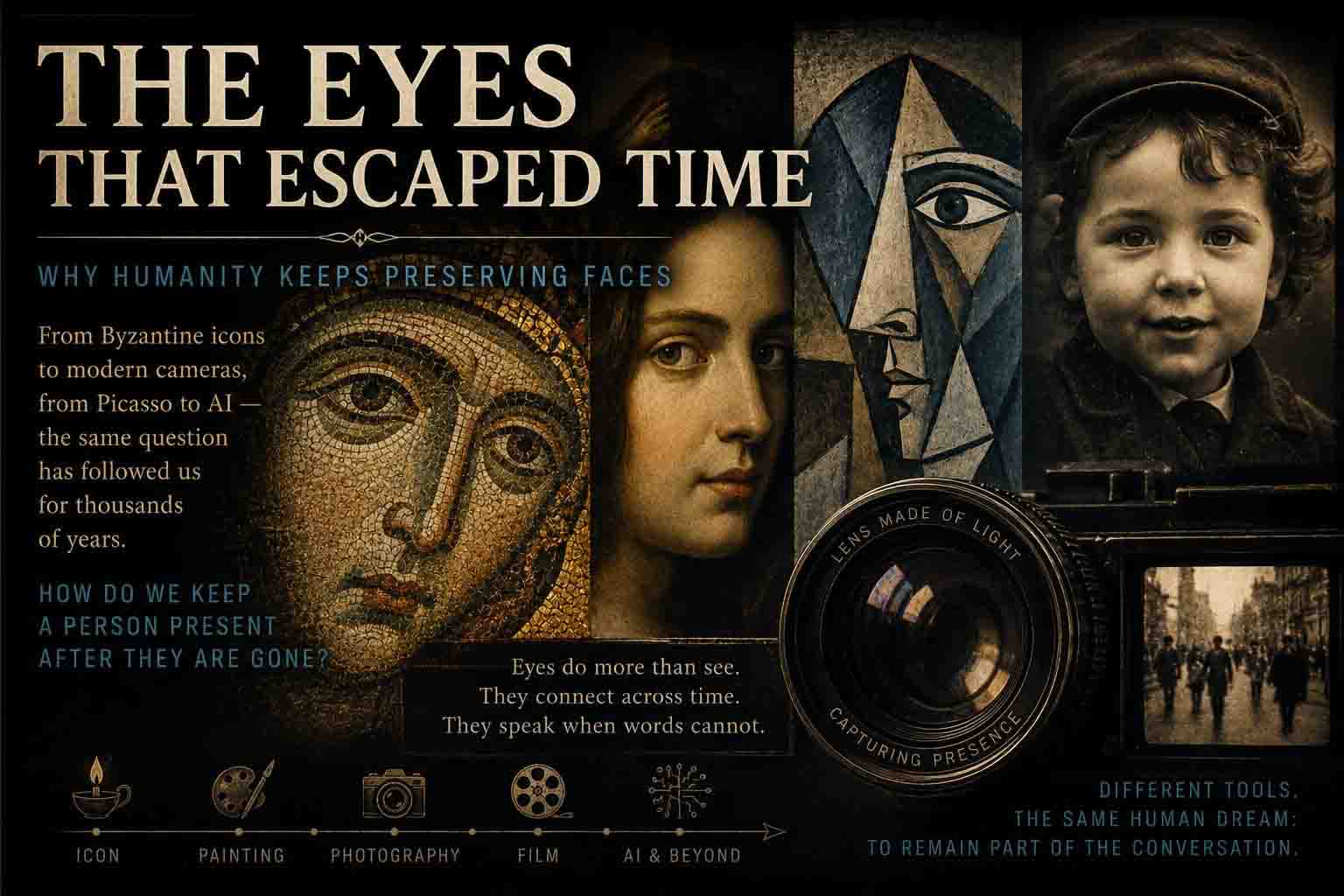
For thousands of years, much human cultural production has preserved appearances and expressions.
A mask fixes a face.
A statue fixes a body.
A painting fixes a moment.
Writing fixes a sequence of language.
Film adds movement and time while remaining recorded.
Software changes the structure again because rules can generate outcomes that were not individually fixed beforehand.
This matters for the human image.
Imagine three representations of one person.
A painted portrait preserves appearance.
A film preserves movement and voice.
A sufficiently sophisticated interactive model could preserve patterns of language and produce new responses based upon them.
Each level adds behavioral depth.
But at no point does increasing representational complexity automatically establish that the original person has survived.
This is where Renaissance art unexpectedly becomes useful for Transhumation.
Michelangelo teaches us how easily humans attribute life to organized signs.
A block of stone becomes psychologically present because its structure activates our ability to recognize another human body.
Artificial systems may eventually produce that effect with overwhelming power.
They may look at us.
Speak.
Remember previous conversations.
Display hesitation.
Change expression.
The danger will be assuming that increasingly convincing signs of interiority automatically settle the question of interiority itself.
The Renaissance already knew, without putting it into computational language, that matter can be organized until the observer feels another presence.
Technology is now learning how to make the representation answer back.
The Renaissance Was Not the Beginning of Modernity
It is tempting to make the Renaissance the heroic beginning of everything modern: science, individualism, secularism, humanism, artistic freedom and eventually technological civilization.
That mythology is almost as powerful as the artworks themselves.
The historical transition was slower and less clean. Medieval institutions continued. Religious patronage remained central. Ancient sources were filtered through many centuries of preservation and interpretation. Renaissance society could be innovative and deeply hierarchical, intellectually adventurous and violently intolerant, humanistic and devout at the same time.
That ambiguity is precisely what makes the period useful.
Civilizations do not usually enter modernity by closing one door and opening another.
They carry old structures through new interfaces.
The Renaissance inherited Christianity, Roman ruins, Greek texts, medieval universities, civic rivalry, banking wealth, workshops, guild systems and political conflict. It rearranged them.
That is closer to the LEGO Principle than to a rebirth from nothing.
New civilization from old pieces.
Michelangelo did not need to reject Christian David in order to rediscover the classical nude.
He made one body carry both.
The Ancient Question Returns in Another Form
Today the human body is again becoming a problem rather than a given.
Digital avatars can represent people without resembling their biology. Artificial images can produce faces without human originals. Genetic engineering may allow some biological traits to become modifiable. Prosthetics and neural interfaces increasingly complicate the border between organism and tool. Artificial intelligence forces us to ask which elements of apparently intelligent behavior actually require the kind of conscious organism in which intelligence first became familiar to us.
None of this means we have left biology behind.
It means the relationship among appearance, behavior, embodiment and identity is becoming less stable.
The Renaissance asked what could be revealed by looking more carefully at the human body.
Our period may ask what remains human when parts of what the body once uniquely performed can be reproduced elsewhere.
This is not the same question.
It may be the next one.
And that is perhaps why Renaissance art still feels uncannily alive. It belongs to a civilization that found itself confronting the human being as an object of renewed wonder precisely because inherited answers no longer seemed sufficient by themselves.
The body was Christian.
The body was classical.
The body was anatomical.
The body was symbolic.
The body was political.
The body was beautiful.
The Renaissance did not reduce those meanings to one.
It allowed them to compete inside the same figure.
Five centuries later, we are doing something similar again.
Watch The Video
How to Read the World
Current Knowledge
The Renaissance was a broad and uneven cultural transformation rather than a sudden rediscovery of humanity after a uniformly symbolic Middle Ages. Medieval European art included substantial naturalistic, emotional and bodily representation, while classical texts and artistic traditions survived in varying degrees throughout the medieval period.
Renaissance artists did intensify engagement with classical antiquity, anatomical observation, mathematical perspective and naturalistic representation. Humanist scholarship recovered, edited and circulated ancient texts, while artistic patronage encouraged renewed interest in classical forms alongside overwhelmingly Christian subjects.
Michelangelo’s David, completed in the early sixteenth century, represents the biblical David before his confrontation with Goliath and combines scriptural subject matter with a monumental nude form deeply informed by classical artistic traditions. Its proportions are not simply photographic copies of an ordinary body; Michelangelo manipulated scale and anatomy to serve the sculpture’s visual and expressive purposes.
Donatello, Leonardo, Raphael, Botticelli, Michelangelo and their contemporaries worked within diverse political, religious and artistic contexts. It is therefore misleading to describe Renaissance art as a single philosophical program in which spirituality was replaced by humanism.
Modern interactive software and AI systems differ fundamentally from static artworks because they can generate new outputs in response to changing inputs. This behavioral flexibility does not by itself establish consciousness or subjective experience.
Open Questions
One question concerns why Renaissance naturalism remains so persuasive to modern viewers. Is the emotional response primarily rooted in biological sensitivity to faces and bodies, in cultural familiarity with Renaissance visual conventions, or in a combination of both?
There is also the historical problem of continuity. How much of Renaissance innovation should be understood as recovery of antiquity, how much as development from medieval artistic traditions, and how much as a genuinely new response to the social and intellectual circumstances of fifteenth- and sixteenth-century Europe?
The technological comparison creates another uncertainty. If an interactive artificial representation becomes capable of producing new language, gestures and expressions, at what point will viewers cease to experience it merely as representation and begin treating it socially as a presence?
The most difficult question belongs to consciousness itself. Human beings are extraordinarily sensitive to signs of agency and interiority, but recognizing those signs does not tell us whether the represented or artificial system possesses subjective experience.
Transhumation Interpretation
Renaissance art becomes useful to Transhumation when we stop treating it as the moment humanity “discovered the human” and begin seeing it as a historical experiment in how much inner life can be suggested through organized matter.
Stone does not contain David’s courage.
Pigment does not contain the private mind of a painted sitter.
The artwork arranges visible relations so effectively that another human nervous system reconstructs intention, emotion and presence from them.
That is already extraordinary.
It is also a warning for the technological future.
Humans are pattern-reading animals.
We see three marks and recognize a face.
We hear hesitation in a voice and infer uncertainty.
We watch a body shift its weight and predict movement before it happens.
Artists learned to work with those mechanisms long before neuroscience described them.
Michelangelo could make marble appear expectant because the viewer supplies the expectation.
This suggests a useful distinction between presence and the signs that produce a feeling of presence.
The two overlap in ordinary life because human faces normally belong to conscious human organisms.
Digital technology can separate them.
A synthetic face may display precisely the muscular pattern associated with grief without any evidence that grief is being experienced. A generated voice may contain warmth, hesitation or irony because those structures can be modeled. A conversational system may produce language that activates the same social instincts ordinarily triggered by another person.
The representation becomes operationally deeper.
The philosophical problem becomes harder.
This is where the Renaissance and artificial intelligence can be placed in one conversation without pretending that Michelangelo anticipated machine learning.
The Renaissance pushed static representation toward the threshold where matter seems inhabited.
Computation creates representations that can change state.
Artificial intelligence creates representations capable of generating responses whose details are not individually predetermined.
Those are real historical transitions.
But none automatically crosses the line into consciousness.
That line remains unknown.
This also changes the phrase “the human body.”
For Renaissance artists, the body could become the privileged carrier through which virtue, beauty, suffering, sacred history and individual character were expressed.
Our century is beginning to separate some of those functions from one carrier.
A voice can exist without a visible body.
A face can exist without a biological person.
A memory can be stored outside the nervous system.
An avatar can preserve recognizable identity while changing appearance.
An artificial system can imitate elements of dialogue without sharing human anatomy.
The carrier becomes negotiable.
The pattern becomes more portable.
But Transhumation must keep asking the question that Renaissance art cannot answer for us:
which part of the pattern belongs to the person, and which part merely makes another observer recognize one?
This distinction matters enormously for any future claim about digital identity or survival.
A sculpture can preserve enough of human bodily structure to make us feel that David is about to act.
David does not act.
A portrait can preserve enough of a face to make us feel that someone is present.
The sitter may have been dead for five hundred years.
A future model may preserve enough speech, memory and expression to create an even stronger sense of continuity.
That would be culturally powerful.
It would not, by itself, tell us whether the original observer continued.
Perhaps this is the deeper reason Renaissance art belongs in Transhumation.
It demonstrates that matter can carry an extraordinarily convincing pattern of life without becoming alive in the relevant sense.
And yet it also demonstrates the opposite fact: our access to another human being has always depended upon patterns carried by matter.
A face.
A voice.
A gesture.
A body.
A sentence.
We never see another person’s consciousness directly.
We infer it from the carrier.
That is why the future problem will be so difficult.
Technology may become capable of reproducing the signs we have always trusted.
The Renaissance taught us to make stone look alive.
Our century may teach the image to answer.
The difficult question begins after it answers.
FAQ
Why does Renaissance art often feel so lifelike?
Renaissance artists combined close observation of anatomy, movement, light and space with highly controlled composition. They also used bodily cues that viewers naturally interpret as signs of intention and emotion.
Did the Renaissance rediscover realism after the Middle Ages?
Not literally. Medieval art already contained naturalistic and emotionally powerful traditions. The Renaissance intensified particular forms of naturalism while drawing heavily on classical antiquity.
Why is Michelangelo’s David so psychologically powerful?
Partly because Michelangelo represents the moment before action rather than the aftermath. Posture, gaze and muscular tension encourage the viewer to infer a decision that has not yet been carried out.
Was Renaissance art religious or humanistic?
Often both. Christian subjects, classical forms, humanist scholarship and intense interest in the human body frequently existed within the same artistic culture.
What does Renaissance art have to do with AI?
The connection is structural, not historical. Renaissance art shows how matter can be organized to produce a powerful impression of human presence. AI raises the newer question of what happens when representations can also generate responses.
What is the deeper Transhumation question?
Renaissance sculpture shows that the signs of life can be extraordinarily convincing without the object being alive.
Artificial systems may eventually reproduce far more of those signs.
The challenge will be deciding when we are still looking at the representation of a person—and when, if ever, there is genuinely someone looking back.
Continue the Transhumation Series
- Forgotten Religion | Ancient Gods, Symbols and the Hidden Structures of Human Civilization
- The Last Religion | Death, Immortality and the Future of Humanity
- The New Theurgy | AI, Information and the Future of Human Civilization
- End of Branding: You Were Never Meant to Become a Product
- Baal vs Ishtar: Why Ancient Gods Never Disappeared