
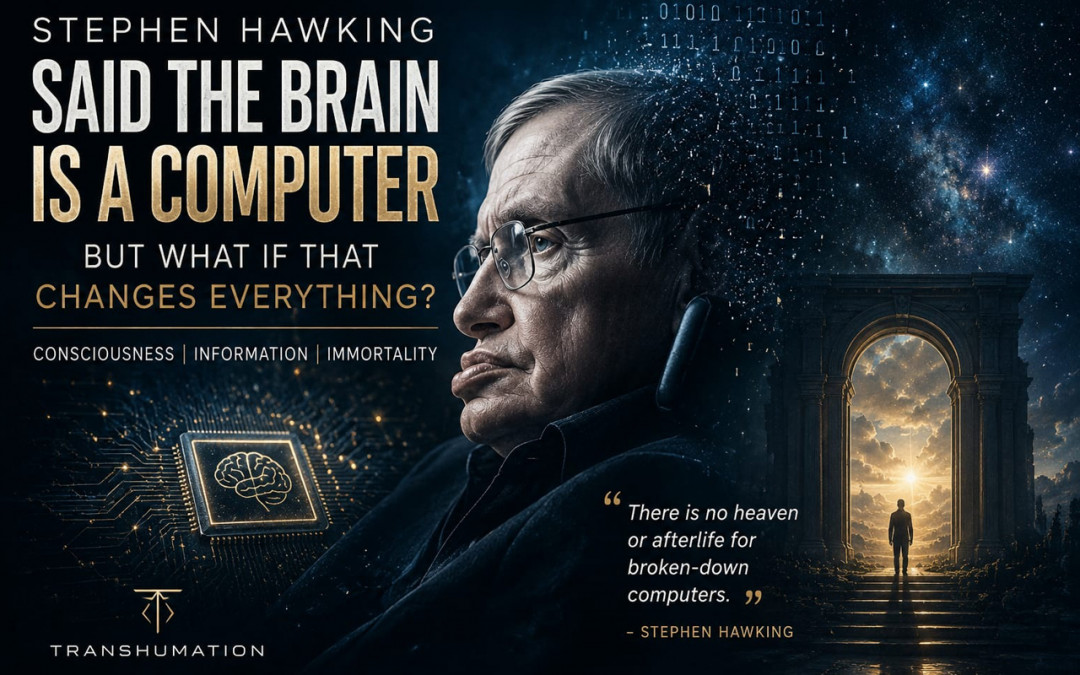
„There is No Hawking” – God
If the mind depends on the machine, what exactly would have to survive for the person to survive?
There is something almost theatrical about a machine going dark.
The screen fades. The fan stops. The blinking light disappears. A device that, seconds earlier, could answer questions, display photographs, play music and retrieve years of work becomes a silent object on a desk.
If the data were backed up, we do not panic.
Another machine can be opened. The files return. The photographs are still there. The music still plays. The documents appear almost indifferent to the death of the particular hardware that once carried them.
This is the image hiding inside one of Stephen Hawking’s most famous remarks about death.
He compared the human brain to a computer whose components eventually fail and rejected the idea of an afterlife for the broken machine. The point was materialist and deliberately unsentimental: consciousness depends on the functioning brain, and when the brain irreversibly ceases to function, there is no scientific reason to assume the conscious subject continues elsewhere.
It sounds like an argument designed to close a door.
Yet the computer metaphor creates a difficulty of its own.
Computers are precisely the machines that taught modern civilization that function, data and hardware are related without being identical.
A destroyed laptop does not necessarily destroy the file.
But a destroyed brain may destroy the person.
The difference between those two statements is where the real philosophical problem begins.
What Did Hawking Mean by the Brain as a Computer?
Hawking’s point should not be softened into a hidden endorsement of technological immortality.
He was expressing a strongly physical view of mind. Consciousness, in that framework, depends upon the operations of the brain. There is no independent ghost operating the machinery and waiting to leave when the machinery breaks.
That position fits a great deal of what neuroscience observes.
Change the brain and experience can change.
Anesthesia can remove conscious awareness.
Brain injury can alter language, memory, impulse control or personality.
Degenerative disease can progressively damage abilities that once seemed inseparable from the person.
Whatever consciousness ultimately turns out to be, the living brain is not merely a temporary case around an otherwise independent mind.
But the word computer carries more than one implication.
A computer is physical.
It is also organizational.
Two machines can be built from different individual components while executing equivalent software. A program can move to new hardware. A data structure can survive the destruction of one physical device.
So the analogy produces a second question that Hawking did not need to answer for his argument to work.
Which aspects of the brain are like the hardware, and which — if any — are portable like the software?
That remains unanswered.
Is the Human Brain Really a Computer?
Only if we are careful about what we mean.
The brain processes information. It receives signals, integrates them, stores and modifies patterns, predicts, selects actions and maintains complex internal states. In that broad sense, computational language can be useful.
But the brain is not simply a laptop made of cells.
Neurons are living biological structures. Their chemistry matters. Timing matters. Hormones matter. Glial cells matter. The body matters. Development matters. The nervous system is constantly exchanging information with organs, senses and environment.
Human cognition is embodied in a way that ordinary computer metaphors can hide.
Even memory is not simply a file retrieved unchanged from storage. Human recollection can be reconstructive, context-dependent and altered by subsequent experience.
The danger of the computer metaphor is therefore the same danger that appears whenever an interface becomes too successful.
It simplifies enough to let us think.
Then we forget what was simplified.
Calling the brain a computer may help us ask how information is processed.
It does not prove that a person can be copied the way a directory is copied from one drive to another.
The File and the Person
This distinction seems obvious until the copy becomes perfect.
Imagine a future technology capable of mapping every detail necessary to reproduce your memories, habits, emotional responses, language, preferences and recognizable style of thought.
The resulting system wakes up.
It remembers your childhood.
It recognizes your partner.
It knows the private joke nobody else knows.
It remembers deciding to undergo the procedure.
Its first sentence is: “It worked.”
From the outside, the temptation is overwhelming.
The person survived.
Now create two copies.
Both wake up with exactly the same memories.
Both insist that they are the original.
Both have equally strong psychological continuity with the person who entered the scanner.
One goes to Paris.
The other stays home.
Within minutes, their experiences begin diverging.
The copying process has preserved similarity magnificently.
It has not told us which continuing subject is the original you.
That is the crack inside every simple theory of digital immortality.
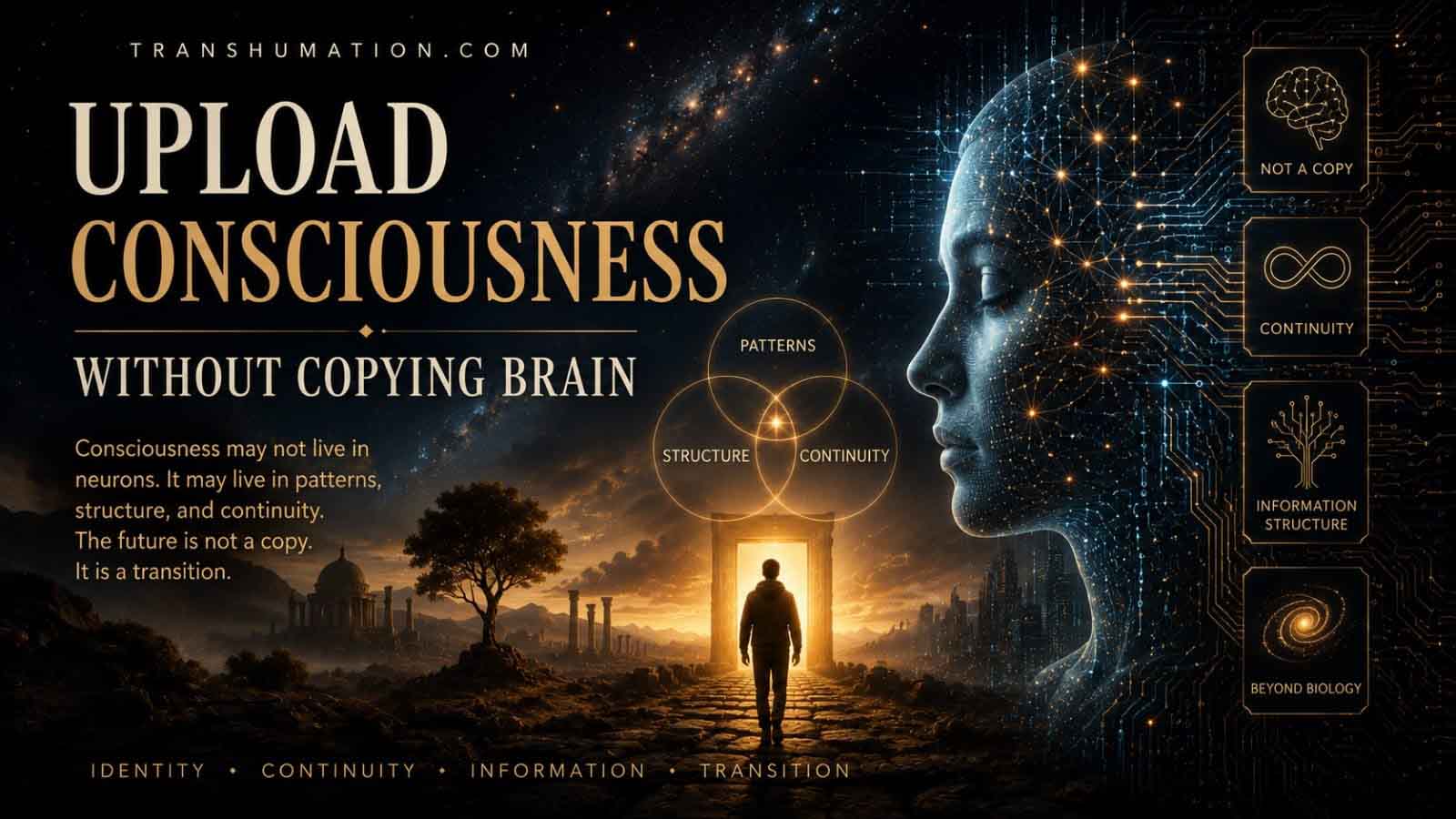
Information may explain how a pattern can be reproduced.
It does not automatically explain how first-person continuity travels.
A file has no problem with duplication.
A subject might.
Can Consciousness Be Uploaded?
At present, there is no technology capable of doing this, and even the theoretical meaning of uploading consciousness remains unsettled.
We do not possess a complete model of the brain at the level required to reconstruct an individual mind. We do not know which physical details are essential and which can be abstracted away. We do not know whether reproducing functional organization would produce subjective experience.
Most importantly, we do not know whether producing a conscious copy would preserve the original person’s continuity.
This is why mind uploading actually contains at least two separate problems.
The first is an engineering problem: can the relevant organization of a brain be measured and reproduced in another system?
The second is an identity problem: if it can, does the person transfer, or has a new person simply been created who remembers being the old one?
Technology might solve the first without touching the second.
That distinction is often lost because copy and continue sound deceptively similar.
They are not.
The Strange Nature of Informational Survival
There is nevertheless something extraordinary about information.
A text can outlive its author.
A melody can cross instruments.
A photograph can survive the camera that produced it.
A person’s letters can preserve recognizable patterns of thought centuries after the biological person has disappeared.
Modern media intensify this dramatically.
A dead person’s voice can remain.
Video preserves movement.
Messages preserve fragments of conversation.
Searchable archives preserve preferences and habits.
AI can already generate plausible language in recognizable styles, and future systems will almost certainly become better at constructing interactive representations from large personal archives.
This will create a new cultural category.
The dead will become increasingly responsive.
But responsive is not the same as alive.
A system built from someone’s recordings may answer new questions in their style, but the answer is a new computational event generated after their death.
The archive has started talking back.
The dead person has not necessarily returned.
That difference may become one of the most important philosophical distinctions of the next century.
Does Digital Immortality Preserve the Person?
The phrase digital immortality contains several different possibilities that should be separated.
One form is simply archival persistence. Photographs, documents, recordings and messages remain accessible.
Another is behavioral reconstruction. A model predicts what someone might have said or done.
A third, much stronger possibility would be actual continuation of a conscious subject in another physical implementation.
The first is already ordinary.
The second is emerging.
The third has not been demonstrated.
Calling all three immortality creates an illusion of technological progress toward a destination that may not even be one problem.
Civilization is already very good at preserving traces.
It may become extraordinarily good at preserving patterns.
Whether it can preserve the subject remains unresolved.
This is where Hawking’s metaphor becomes unexpectedly useful.
If the brain is a machine, simply producing another machine that behaves identically does not automatically establish that the original machine’s experience crossed into it.
We have preserved computation.
Have we preserved someone?
Religion Asked a Different Question
It is tempting to say that ancient religions were trying to solve the same technical problem.
That would be too simple.
Religious ideas of soul, resurrection, rebirth and afterlife belong to very different metaphysical systems. They involve moral order, divine reality, ritual, community and claims about what a human being fundamentally is.
They are not primitive versions of mind uploading.
Yet mortality gives both religion and modern technology a common pressure point.
A person dies.
What, if anything, can continue?
Religion may answer with soul, resurrection, rebirth or union with a greater reality.
Technology answers more modestly with archives, medicine, life extension, prosthetics, external memory and increasingly sophisticated simulation.
The resemblance lies in the problem.
Not necessarily in the answer.
This distinction matters because technology can imitate functions associated with survival without establishing metaphysical survival itself.
A photograph preserves appearance.
A recording preserves voice.
An AI model may preserve conversational style.
None of these demonstrates continued first-person existence.
The old question survives every technical improvement:
What exactly are we trying to save?
Hawking’s Broken Computer
Return to the metaphor.
A broken computer can sometimes be repaired.
Its storage can sometimes be removed.
Data can be copied.
Software can be installed elsewhere.
The machine can be replaced while much of its informational structure survives.
If the human brain were analogous in precisely the same way, technological continuity might be possible.
But that if contains the entire mystery.
Perhaps consciousness depends mainly upon functional organization, in which case alternative substrates may someday become possible.
Perhaps specific biological processes contribute something indispensable.
Perhaps consciousness can be instantiated elsewhere but personal continuity cannot be transferred.
Perhaps the very question assumes that a person is a static thing rather than an ongoing causal process.
Current science does not decide among these possibilities.
Hawking’s comparison therefore works well as an argument against assuming an independent afterlife.
It works much less well as a complete theory of personal identity.
The metaphor closes one door.
Behind it stands another.
Can AI Recreate Someone After Death?
Increasingly, it may be able to recreate aspects of them.
Given enough recordings, correspondence, photographs, preferences and biographical information, a future AI could probably produce an extraordinarily convincing representation of a deceased person.
It could know family stories.
Recognize voices.
Use characteristic phrases.
Remember important dates.
Respond in a style that feels eerily familiar.
The psychological effect could be profound.
But there is a simple test.
Ask the deceased something they never answered while alive.
The generated response must be inferred.
At that moment, preservation becomes creation.
This does not make the system worthless. It may offer comfort, historical access or extraordinary forms of interactive biography.
But the provenance must remain visible.
A library that begins inventing new sentences in the voices of the dead has crossed a boundary.
The future librarian will need to mark that boundary carefully.
Original trace.
Reconstruction.
Generated continuation.
They are not interchangeable.
The Soul After the Computer Metaphor
Perhaps the word soul returns here, but not as proof of anything supernatural.
It returns as the name of an unresolved invariant.
What would have to survive for you to remain you?
Memory?
Personality?
Biological continuity?
Causal continuity?
A particular pattern of consciousness?
Some combination of them?
Something we have not yet learned how to measure?
For centuries, religious and philosophical traditions answered this question using metaphysical language.
Modern technology cannot avoid it simply by replacing soul with information.
Information is not an answer.
It is another way of sharpening the question.
If tomorrow we can preserve every memory but cannot establish continued subjectivity, we will have learned that the person was not exhausted by memory.
If copying every functional relation preserves consciousness and continuity, we will have learned something equally extraordinary.
Either result would transform philosophy.
Neither result can be assumed in advance.
Watch The Video
How to Read the World

Current Knowledge
Stephen Hawking publicly described the brain using a computer analogy and argued that consciousness ends when the physical system irreversibly stops functioning. His position reflected a physicalist understanding of mind rather than a proposal for technological survival.
Modern neuroscience strongly supports dependence between brain function and conscious experience. Injury, anesthesia, neurodegeneration and other changes to the nervous system can alter or eliminate aspects of consciousness, memory and personality.
The brain can usefully be described as processing information, but computational descriptions do not establish that human cognition is equivalent to conventional digital computing. Biological context, embodiment and complex neural dynamics remain essential parts of the system.
Digital information can be copied between physical carriers, but no existing evidence shows that copying informational patterns from a human brain would preserve first-person continuity. Mind uploading remains speculative both technologically and philosophically.
AI systems may increasingly reconstruct behavioral and linguistic patterns of deceased individuals, but such systems would generate new outputs from surviving traces rather than provide established evidence that the original conscious subject continued.
Open Questions
One unresolved question is how much detail would have to be preserved to recreate a functionally equivalent human mind. The relevant scale may involve synaptic structure, biochemical state, dynamic neural activity or properties we do not yet know are essential.
Another is whether functional equivalence is sufficient for consciousness. A system may behave as though it possesses subjective experience without giving external observers an obvious method for determining whether that experience exists.
The problem becomes harder when personal identity is introduced. Even if a copy were conscious, it remains unclear whether psychological continuity would constitute survival of the original subject or the birth of a new one with inherited memories.
The deepest uncertainty is therefore not whether information can persist. We already know that it can. The unresolved question is whether the perspective from which information is experienced is itself transferable.
Transhumation Interpretation
For Transhumation, Hawking’s computer metaphor is valuable because it exposes the boundary between preserving a pattern and preserving a person.
A computer teaches us that information can survive replacement of particular hardware. The human brain warns us not to assume the analogy travels all the way to consciousness.
That is the interesting territory.
Transhumation does not need to promise digital immortality. It needs to keep asking which structures survive a change of carrier and where continuity finally breaks.
The future may teach us how much of a person can be reconstructed.
The harder discovery will be whether reconstruction is ever the same thing as return.
FAQ
Did Stephen Hawking really compare the brain to a computer?
Yes. He used the comparison to argue that consciousness depends on the functioning physical brain and rejected an afterlife once that system irreversibly fails.
Is the human brain literally a computer?
Not in the ordinary engineering sense. Computational language can describe important aspects of brain function, but brains are embodied biological systems with properties that ordinary computer metaphors do not capture completely.
Can consciousness be uploaded today?
No. We cannot currently map and reproduce an individual human mind at the required level, and it remains unknown whether such reconstruction would preserve consciousness or personal continuity.
What is digital immortality?
The term can refer to several very different things, from preserving photos and messages to AI-based personality reconstruction or hypothetical mind uploading. These should not be treated as equivalent.
Could AI recreate a dead person?
AI may increasingly reconstruct their speech patterns, preferences and biographical knowledge from surviving data. That could create a convincing representation, but it would not by itself demonstrate continuation of the original conscious person.
What is the deeper Transhumation question?
Hawking’s metaphor leaves us with a problem more interesting than the original argument.
A computer can lose one physical machine while its data survive elsewhere. If a future technology allowed the same thing to happen to every measurable pattern in a human brain, we would still need to ask whether the person crossed with the information or whether only the information crossed.
That distinction may eventually become one of the most important boundaries civilization has ever had to define.
We already know how to preserve traces.
We are learning how to preserve patterns.
We do not yet know how to preserve the one thing every promise of immortality quietly assumes:
the continuing point of view that says I.
Continue the Transhumation Series
- Forgotten Religion | Ancient Gods, Symbols and the Hidden Structures of Human Civilization
- The Last Religion | Death, Immortality and the Future of Humanity
- The New Theurgy | AI, Information and the Future of Human Civilization
- End of Branding: You Were Never Meant to Become a Product
- Baal vs Ishtar: Why Ancient Gods Never Disappeared