
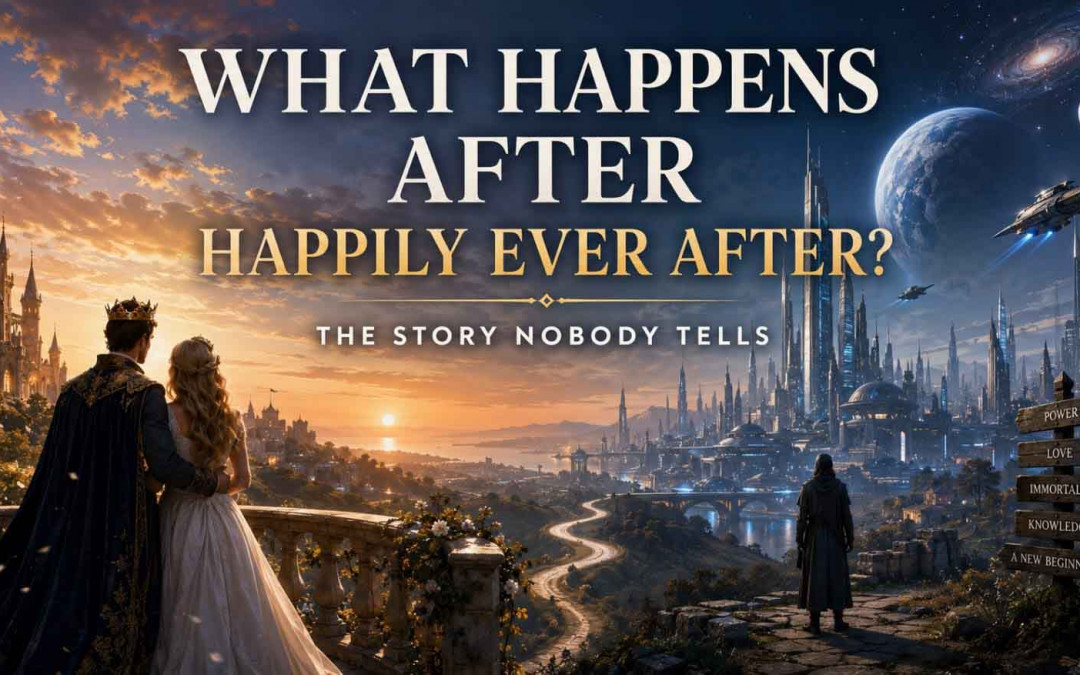
The Inconvenient Part of Stories
At the end of the fairy tale, the palace is immaculate.
The dragon is dead. The enemy has fled. The ballroom glows beneath chandeliers. The prince and princess have found one another, the kingdom has recovered its proper order, and the orchestra reaches the chord that tells the audience it is safe to leave.
Then morning arrives.
Someone has to open the palace.
Breakfast has to be prepared. Horses need feeding. Ministers are waiting with petitions. A roof still leaks over the western corridor. Two noble families who politely applauded the wedding despise one another. The young king discovers that defeating a monster was much easier than settling a tax dispute.
Nothing has gone wrong.
This is simply what happens when the story continues after the storyteller has found a satisfying place to stop.
Perhaps that is the real secret of happily ever after.
It was never eternity.
It was an edit.
Why Do Stories End After the Victory?
Stories need shape.
Without selection, every narrative expands into the rest of the universe. A marriage leads to children, aging, illness, arguments, reconciliations and eventually death. A war victory creates borders, debts, veterans, resentments and political settlements. A scientific discovery creates industries, regulations, accidents, inequalities and new questions.
If every consequence had to be followed indefinitely, no story could end.
Narrative therefore chooses a privileged problem.
Kill the dragon.
Reach home.
Win the war.
Find the lover.
Solve the mystery.
When that problem is resolved, the audience experiences closure even though the fictional world, if we imagine it continuing, would immediately generate another set of problems.
This is not a flaw in storytelling.
It is one of storytelling’s essential technologies.
Narrative compresses reality by deciding what counts as relevant.
The danger appears when we begin using the same structure to imagine history.
The Morning After the Coronation
Becoming king is an excellent ending.
Being king is administration.
The difference reveals something about human imagination. We are naturally attracted to thresholds because they are visible. Coronations, weddings, launches, discoveries, declarations and revolutions all create moments that can be photographed and remembered.
Maintenance is harder to dramatize.
There is no single afternoon when a good marriage succeeds.
There is no ribbon-cutting ceremony for the fifteenth year in which a bridge continues not to collapse.
No newspaper prints a special edition because a democratic institution functioned reasonably well again on Tuesday.
Achievement has a moment.
Continuation has a schedule.
This is why civilization tends to celebrate founders more than caretakers. The founder gives us a beginning. The caretaker gives us another ordinary morning in which the system still works.
Yet the second task may be harder.
A kingdom can be won once.
It has to be governed every day afterward.
Why Is Maintenance Harder Than Achievement?
Not always harder in the technical sense, but often harder psychologically.
Achievement provides feedback.
The summit.
The degree.
The wedding.
The successful launch.
The company opening.
The finished book.
Maintenance replaces drama with repetition.
The house you dreamed of owning eventually contains gutters, insurance, plumbing and invoices. The body you trained into excellent condition requires another workout next week. The archive you built requires cataloguing. The software that changed an industry eventually becomes legacy infrastructure someone must keep compatible with everything built after it.
Success creates obligations precisely because something now exists that can deteriorate.
This is the Balance Problem in another form.
A structure creates possibility.
Possibility creates a distinction between functioning and failing.
The more valuable the structure becomes, the more consequential its maintenance becomes.
This is why the morning after victory matters so much.
The victory has manufactured something worth losing.

The Hero After the Heroism
Myths and popular stories often preserve heroes at the most flattering moment.
They defeat the monster before age makes them cautious.
They return home before domestic life becomes repetitive.
They claim the throne before the first compromise disappoints the people who supported them.
But a more interesting question begins after the mythic act.
What does courage become when there is no obvious enemy?
Can the warrior become an administrator?
Can the revolutionary preserve a functioning society without requiring another revolution to feel alive?
Can the explorer remain useful after the map has been drawn?
This is where personal identity encounters success.
A person can become organized around a problem so completely that solving it creates a crisis.
The athlete retires.
The founder sells the company.
The parent watches the children leave.
The activist sees the law finally passed.
The goal that structured years of behavior is gone, and suddenly victory contains absence.
The question is no longer Can I achieve it?
It becomes Who am I after achievement no longer tells me what to do?
Does Success Create New Problems?
Almost always.
This should not be confused with pessimism.
Solving a problem can be genuinely good while revealing the next layer of reality.
Agriculture increased food production and made larger settlements possible. Larger settlements created new problems of sanitation, administration and inequality.
Industrialization increased productive capacity and created new problems involving labor, pollution and urban life.
Antibiotics saved extraordinary numbers of lives and contributed to the later problem of antimicrobial resistance when used badly or excessively.
The internet reduced the cost of communication and created new problems involving attention, misinformation and surveillance.
The pattern is not that progress is fake.
The pattern is that solutions enter systems.
Systems react.
The dragon is dead.
Now something has to be done with the kingdom.
This is why utopian thinking becomes dangerous when it imagines a final technology or institution after which history becomes maintenance-free.
There is no evidence that complexity works that way.
A solution changes the environment in which the next problem appears.
The Problem of Paradise
Paradise is often misunderstood in secular imagination as a place where nothing ever needs to happen again.
That may be more revealing about modern fantasies than about religion.
The dream appears in technological language too.
Cure aging.
Automate labor.
Solve energy.
Create superintelligent AI.
Reach post-scarcity.
Then, somehow, the future settles into a permanent state of resolution.
But what exactly would people do inside that state?
Not because boredom is inevitable.
Because every stable condition still contains relationships, choices and consequences.
Suppose aging disappears.
Now population, inheritance, memory and political power change.
Suppose energy becomes extraordinarily cheap.
Now environmental impact, resource distribution and new forms of consumption change.
Suppose AI performs most economically necessary work.
Now income, identity, education and the social meaning of contribution change.
Suppose humanity settles Mars.
The headline is magnificent.
The next morning somebody discovers that the waste-recycling system is malfunctioning.
Paradise, if it is to remain inhabited, requires operations.
That may be the sentence utopian imagination least enjoys.
What Happens After Humanity Solves Aging?
This is where happily ever after becomes one of the central problems of Transhumation.
Life extension is usually narrated as a destination.
The disease is defeated.
The body no longer deteriorates normally.
The person lives.
End credits.
But extreme longevity would begin a new story rather than ending the old one.
How does a three-hundred-year-old person organize memory?
How long should ownership persist?
What happens to inheritance if parents remain alive for centuries?
How does political succession work?
Do marriages assume several centuries of commitment?
How many professions can one life contain?
What happens when wealth compounds inside one individual for four hundred years?
The medical triumph does not disappear because these questions arise.
It becomes larger.
Solving aging would move mortality from a biological problem into an institutional, psychological and philosophical one.
The cure becomes a threshold.
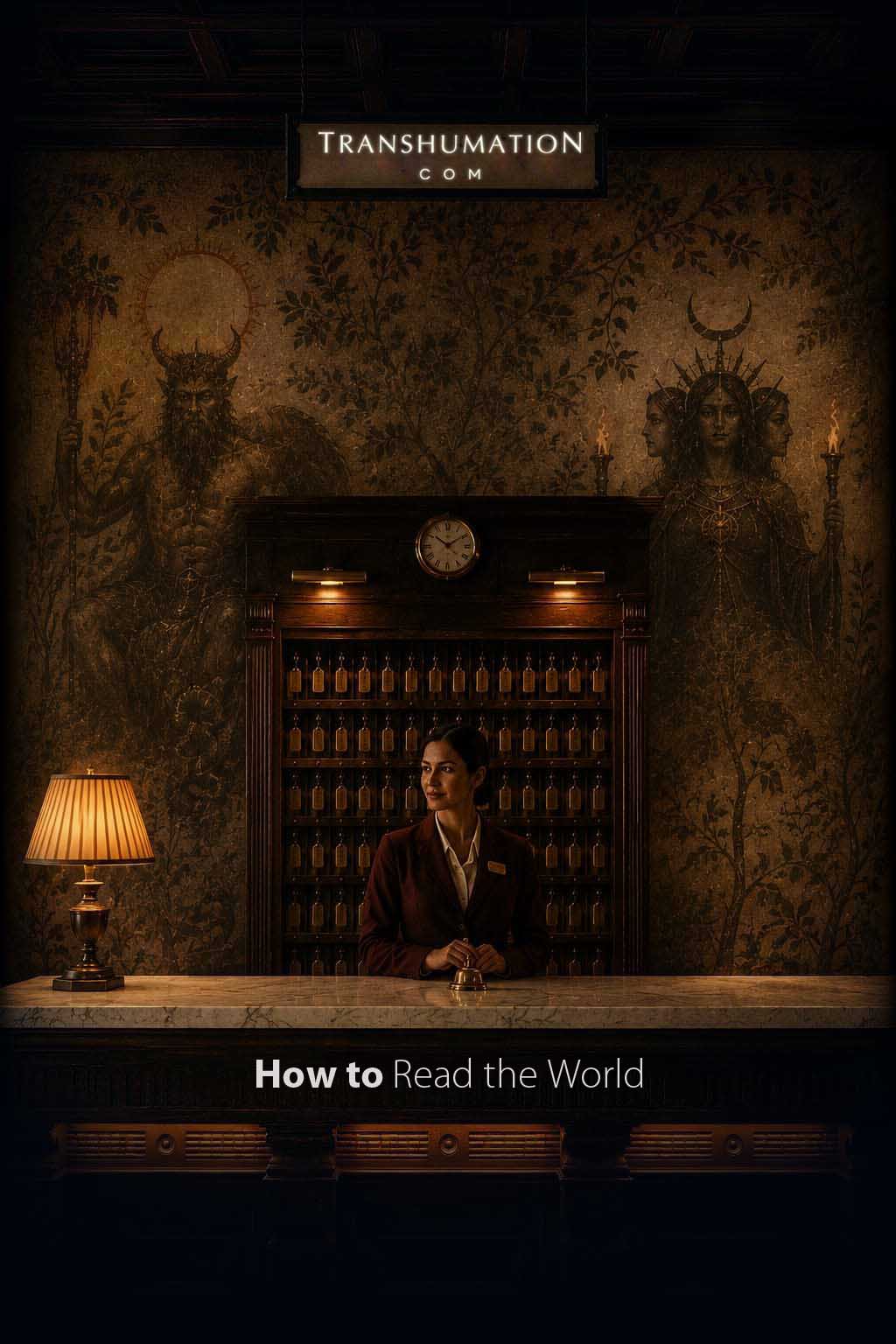
Janus stands at the door again.
One face sees the disease that was overcome.
The other sees the civilization created by overcoming it.
Current Knowledge
Narrative closure is a basic feature of storytelling because stories must select boundaries from events that could otherwise be described indefinitely. The ending of a narrative therefore reflects structure and emphasis rather than the literal end of all consequences inside the imagined world.
Rituals such as weddings, coronations and graduations mark transitions in social status, but the durable relationships or responsibilities associated with those transitions continue after the ceremony.
Technological and institutional solutions regularly create second-order effects. Solving one problem can change incentives, behavior or environmental conditions enough to generate new challenges without invalidating the value of the original solution.
Human motivation can also change after major goals are achieved. People may experience satisfaction, relief, loss of direction or a need for new goals. There is no universal psychological response to success.
Utopian, religious and technological ideas of final states vary enormously. They should not be reduced to one human fantasy of a problem-free world, although modern culture repeatedly does imagine technologies or institutions as if they could end the need for further adaptation.
Open Questions
One major question is whether highly advanced societies can design institutions around permanent adaptation rather than final solutions. A system built to change intelligently may be more durable than one optimized around an assumption of completion.
Another concerns technological success. If AI, longevity research or abundant energy solves problems that currently organize large portions of human life, how quickly can culture adapt to the second-order problems produced by those successes?
There is also a psychological question about achievement. Humans are exceptionally good at organizing themselves around goals, but it is less clear how individuals and societies maintain direction once the goal that structured their behavior disappears.
The deepest question may concern utopia itself. Is a good future a destination, or is it a civilization capable of repeatedly repairing the difference between what it intended and what reality produced?
Transhumation Interpretation
For Transhumation, happily ever after is an interface.
It compresses an unresolved future into a completed story.
That is useful in fiction and dangerous in civilization.
The more powerful technology becomes, the more important the morning after the breakthrough becomes.
The Transhumation question is therefore not merely:
Can we reach the future we wanted?
It is:
Can we live responsibly inside it once it becomes ordinary?
That may be the real test of every paradise.
Watch The Video
How to Read the World
Current Knowledge
Narrative closure is a basic feature of storytelling because stories must select boundaries from events that could otherwise be described indefinitely. The ending of a narrative therefore reflects structure and emphasis rather than the literal end of all consequences inside the imagined world.
Rituals such as weddings, coronations and graduations mark transitions in social status, but the durable relationships or responsibilities associated with those transitions continue after the ceremony.
Technological and institutional solutions regularly create second-order effects. Solving one problem can change incentives, behavior or environmental conditions enough to generate new challenges without invalidating the value of the original solution.
Human motivation can also change after major goals are achieved. People may experience satisfaction, relief, loss of direction or a need for new goals. There is no universal psychological response to success.
Utopian, religious and technological ideas of final states vary enormously. They should not be reduced to one human fantasy of a problem-free world, although modern culture repeatedly does imagine technologies or institutions as if they could end the need for further adaptation.
Open Questions
One major question is whether highly advanced societies can design institutions around permanent adaptation rather than final solutions. A system built to change intelligently may be more durable than one optimized around an assumption of completion.
Another concerns technological success. If AI, longevity research or abundant energy solves problems that currently organize large portions of human life, how quickly can culture adapt to the second-order problems produced by those successes?
There is also a psychological question about achievement. Humans are exceptionally good at organizing themselves around goals, but it is less clear how individuals and societies maintain direction once the goal that structured their behavior disappears.
The deepest question may concern utopia itself. Is a good future a destination, or is it a civilization capable of repeatedly repairing the difference between what it intended and what reality produced?
Transhumation Interpretation
For Transhumation, happily ever after is an interface.
It compresses an unresolved future into a completed story.
That is useful in fiction and dangerous in civilization.
The more powerful technology becomes, the more important the morning after the breakthrough becomes.
The Transhumation question is therefore not merely:
Can we reach the future we wanted?
It is:
Can we live responsibly inside it once it becomes ordinary?
That may be the real test of every paradise.
FAQ
Why do fairy tales end after the main victory?
Because stories require closure. They usually end once the central conflict has been resolved, even though an imagined life beyond that point would contain new events and consequences.
Are happy endings unrealistic?
Not necessarily. They can represent genuine moments of happiness or resolution. They become unrealistic only when we mistake a successful moment for a permanent condition requiring no further maintenance.
Why is maintenance important after success?
Because anything valuable that persists can deteriorate, change context or create new responsibilities. Achievement creates something that now has to be lived with.
Does every solution create another problem?
Not necessarily, but major solutions often alter systems enough to expose second-order effects. That does not make progress meaningless; it makes adaptation part of progress.
What happens after humanity solves aging or creates very advanced AI?
Nobody knows. But such breakthroughs would likely generate new questions involving identity, power, responsibility, governance and the structure of human life.
What is the deeper Transhumation question?
The deeper question is not what happens after the fairy tale ends.
It is why we keep imagining that the ending means the world has stopped demanding anything from us.
The dragon is dead.
The palace is safe.
The lovers finally have one another.
Then the sun rises.
There are letters on the desk, repairs to approve, promises to keep, people who have changed during the journey and consequences nobody noticed while the music was playing.
That is not the failure of the happy ending.
It is what makes the ending real.
Civilization may eventually defeat diseases that terrified every earlier generation, build machines capable of astonishing intelligence and extend human life far beyond its present scale.
If it does, we should celebrate.
Then we should wake up the next morning.
Because every dream, once achieved, stops being a dream.
It becomes an environment.
And environments have to be lived in.
Continue the Transhumation Series
- Forgotten Religion | Ancient Gods, Symbols and the Hidden Structures of Human Civilization
- The Last Religion | Death, Immortality and the Future of Humanity
- The New Theurgy | AI, Information and the Future of Human Civilization
- End of Branding: You Were Never Meant to Become a Product
- Baal vs Ishtar: Why Ancient Gods Never Disappeared