
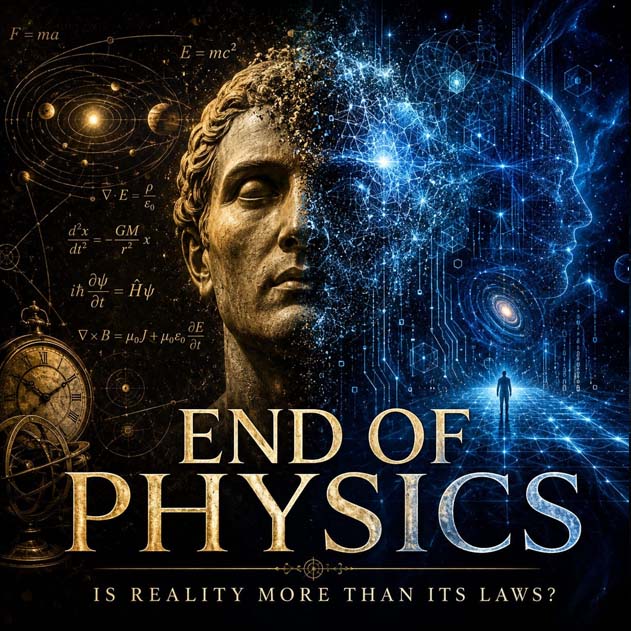
Is Reality More Than Its Laws?
For centuries, physics has been humanity’s most trusted language of reality. It gave us structure, predictability, and the ability to describe the universe with extraordinary precision. Through physics, we learned how planets move, how light behaves, how matter changes, and how energy flows through space and time.
Its success created a powerful impression: that physics does not merely describe reality, but reveals what reality ultimately is.
But these are not necessarily the same thing.
Physics may be the most accurate map humanity has ever created. Yet even the most precise map is still not the territory.
The Limits of Description
Physics explains patterns.
It tells us how objects behave under specific conditions. It describes relationships between mass, energy, motion, space, and time. It allows scientists to make predictions, build machines, and test ideas against observation.
But a description of behavior is not automatically an explanation of existence.
Physics can describe how gravity affects matter, but that does not fully answer what gravity is at the deepest level. It can model the evolution of the universe, but it does not explain why there is a universe capable of following mathematical laws at all.
The equations work.
The deeper question is why reality can be expressed through equations in the first place.
Physics Depends on Observation
Every physical theory begins with observation.
Measurements are made. Patterns are discovered. Mathematical models are constructed to explain those patterns. The models are then tested against further observations.
This process is enormously powerful, but it also reveals a limit.
Physics never encounters reality without mediation.
It encounters readings, signals, effects, and measurements produced through instruments and interpreted by conscious observers. Even when a machine performs the measurement, a human mind eventually decides what the result means.
Physics therefore describes reality as it appears through systems of observation.
It may not describe reality entirely independently of them.

Reality as a Model
Human beings often confuse successful models with reality itself.
A model becomes convincing because it predicts what will happen. If it works repeatedly, we begin to treat it as a direct picture of the world.
But scientific models change.
Newtonian mechanics once appeared to provide a complete structure of motion. Relativity later revealed that space and time behaved differently under extreme conditions. Quantum physics introduced probabilities, uncertainty, and relationships that seemed impossible within earlier models.
The older theories were not useless. They remained accurate within certain limits.
What changed was their status.
They were no longer understood as final descriptions of reality, but as layers within a larger framework.
This raises a difficult possibility: today’s physics may also be incomplete, not because it is wrong, but because it describes only the layer we are currently capable of observing.
Beyond Matter
For much of modern history, reality was imagined as fundamentally material. The universe was made of objects, particles, and forces interacting inside space.
But matter itself has become increasingly difficult to define in simple terms.
At deeper levels, reality appears less like a collection of solid things and more like relationships, fields, probabilities, and information. The familiar physical world may emerge from structures that do not resemble ordinary objects at all.
This has encouraged a more radical question.
What if information is more fundamental than matter?
A physical object can be understood partly as a stable pattern. Its identity depends not only on what material it contains, but on how that material is organized.
If the organization changes, the object changes. If the pattern is preserved through another medium, some part of its identity may continue.
From this perspective, matter may be one expression of information rather than the deepest foundation of existence.
The Problem of Consciousness
Physics describes the external world with extraordinary success, but consciousness remains difficult to place within that description.
The brain can be studied as a physical system. Neural activity can be measured. Connections between brain states and experience can be observed.
Yet none of this fully explains why physical processes produce subjective experience.
Why should electrical and chemical activity feel like anything from the inside?
Why does information become color, pain, memory, fear, or self-awareness?
Physics can describe the mechanisms associated with conscious experience, but it does not yet explain the existence of experience itself.
This creates a strange imbalance.
Everything we know about physics appears inside consciousness, yet consciousness does not fit easily inside physics.
Is Reality Constructed?
Human beings do not experience the universe directly.
We experience signals interpreted by the brain.
Light reaches the eyes. Sound reaches the ears. The nervous system processes information and constructs an experienced world from it.
The colors, shapes, distances, and objects we perceive are not simply delivered to the mind in finished form. They are organized through biological systems evolved to support survival.
This does not mean the external world is imaginary.
It means that experienced reality is an interpretation of something external.
What we call reality may therefore contain at least two layers: the structure that exists independently of us and the world produced through perception.
Physics attempts to describe the first layer, but it can only do so through the second.
The End of Physics
The end of physics would not mean the disappearance of physics.
It would mean the end of treating physics as the final and complete explanation of existence.
Physics would remain essential. Its equations would still predict events. Its theories would still guide technology and deepen our understanding of the universe.
But its role might change.
Physics could become one interface through which reality is understood rather than the ultimate foundation beneath every possible form of existence.
It would describe the stable rules of our observable layer without necessarily explaining why that layer exists, how consciousness enters it, or whether deeper structures lie beneath it.
A Deeper Structure
If physics is not fundamental, then what is?
Information?
Mathematics?
Consciousness?
Computation?
Something for which human thought does not yet have the right language?
The honest answer is that we do not know.
But uncertainty does not weaken the question. It makes the question more important.
Humanity may be approaching a point where understanding reality requires more than improving existing equations. It may require a new relationship between physics, information, consciousness, and observation.
The deepest mystery is no longer only how the universe works.
It is why there is a universe that can be experienced, measured, and understood at all.
Perhaps physics is not reality itself.
Perhaps it is the interface through which consciousness encounters one layer of a structure far deeper than matter.
The final question is therefore not simply what the universe is made of.
It is whether we exist inside reality as separate observers, or whether observation is one of the processes through which reality becomes visible.

Frequently Asked Questions
1. Does the article claim that physics is wrong?
No. Physics is extraordinarily successful. The article asks whether it is a complete description of reality or a model limited to observable phenomena.
2. What does it mean to say that physics is a map?
It means that physical theories represent patterns and relationships in reality, but the representation should not automatically be confused with reality itself.
3. Could information be more fundamental than matter?
Some philosophical and scientific approaches explore this possibility, but it has not been established as a final explanation of the universe.
4. Why is observation important in physics?
Physical knowledge is based on measurements and experiments. These require instruments, interpretation, and ultimately an observer capable of understanding the results.
5. Does quantum physics prove that consciousness creates reality?
No. Quantum physics raises difficult questions about measurement, but it does not prove that human consciousness creates the physical universe.
6. Why is consciousness difficult to explain physically?
Physics can describe brain activity, but it does not yet explain why physical processes produce subjective experience.
7. Is experienced reality constructed by the brain?
The brain organizes sensory signals into a coherent model of the world. This means that perception is an interpretation of external reality rather than a direct copy of it.
8. What would the “end of physics” actually mean?
It would mean recognizing physics as one powerful layer of explanation rather than assuming that it provides the final answer to every question about reality.
Continue the Transhumation Series
Explore the full journey:
- End of Reality — Where Do You Really Exist?
- End of Physics — Are the Laws of Reality Real?
- End of the Real World — Reality Is No Longer Required
- End of Consciousness — Beyond the Human Mind
- End of Death — When Human Limits Disappear
- End of Religion — When Technology Replaces Faith
This is not a theory. This is a transition.