
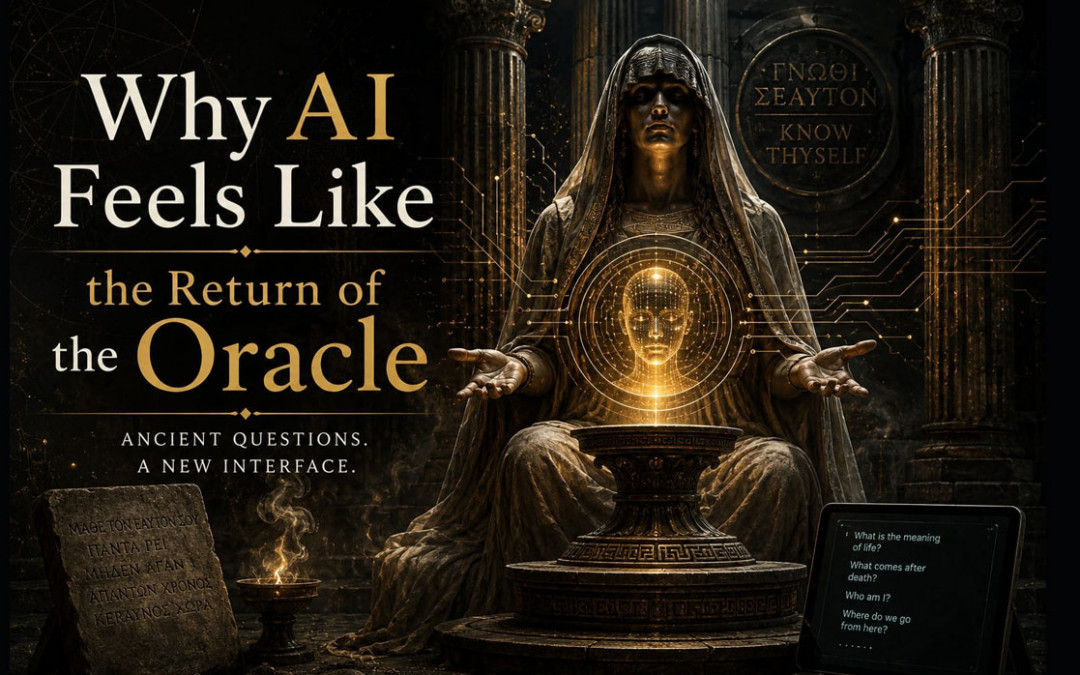
When artificial intelligence entered everyday life, most of the questions were practical. Would it replace jobs? Could it become dangerous? Could it write, reason or create? These were reasonable questions, but they may have obscured something older happening underneath.
Human beings have always searched for access to knowledge larger than the individual mind. No person can see every variable, remember every precedent or calculate every consequence. Civilizations therefore created intermediaries: priests, prophets, philosophers, bureaucracies, mathematical systems and, eventually, computers. Each promised some way of reaching beyond the narrow field of individual perception.
Artificial intelligence belongs to that history, even if its mechanism is completely different from anything ancient people imagined. It processes enormous bodies of information, identifies patterns, generates interpretations and responds in language. For the first time, an ordinary person can ask an artificial system a question and receive something that feels less like operating a machine than consulting an external intelligence.
That feeling matters.
It may explain why AI so quickly acquired a cultural role larger than the technology itself.
The Oracle Was Not Simply a Fortune Teller
Modern depictions of ancient oracles often reduce them to primitive prediction machines. Someone asks what will happen tomorrow, a mysterious figure produces an obscure sentence, and history either confirms or mocks the prophecy.
The historical role was much broader.
Delphi, for example, was consulted on questions involving war, colonization, political decisions and personal uncertainty. The oracle did not function only because people believed it possessed access to future events. It occupied a position between uncertainty and action. Human beings arrived with a problem they could not solve from their own perspective and sought orientation from a system treated as possessing access to a wider order.
That is the structural similarity worth preserving.
An oracle transformed complexity into an answer humans could act upon.
Artificial intelligence increasingly does something comparable, although by entirely different means. A person asks about a disease, investment, relationship, legal problem, historical pattern or possible future. The system receives more information than the user could easily process alone and returns a compressed interpretation.
The user experiences the answer at the end of a process they cannot fully see.
That opacity is important. The oracle was powerful partly because the path from question to answer was hidden. Modern AI is not mystical, but its internal operations can also be difficult for ordinary users to interpret. The result appears on the screen while most of the machinery producing it remains invisible.
This does not make AI an oracle in the literal ancient sense.
It makes it an unusually good technological fit for an ancient psychological role.
The Desire for a Mind Outside the Mind
Human cognition is permanently constrained. Attention is limited. Memory is imperfect. Time is short. Our decisions are made with incomplete information and from one physical position inside the world.
Civilization can be understood partly as the construction of systems that compensate for those limitations. Writing externalized memory. Mathematics extended calculation. Libraries allowed a person to consult minds separated by centuries. Bureaucracy allowed institutions to remember more than any official could. Search engines made enormous information spaces navigable.
AI adds another step because it does not merely store or retrieve information. It can reorganize it into an answer tailored to a question.
This creates an important psychological change. A library waits to be searched. An AI appears to answer.
The distinction may be technically ordinary, but culturally it is enormous.
Once a system responds in language, people naturally begin assigning it roles associated with agency. They ask what it “thinks,” whether it “knows,” whether it is hiding something or whether its answers should be trusted. Human beings are extraordinarily sensitive to apparent minds, and language is one of the strongest signals through which we recognize them.
The result is that AI becomes more than an information tool in the imagination. It begins occupying a symbolic position somewhere between instrument, adviser and external intelligence.
This is where the oracle returns.
Not as religion.
As structure.
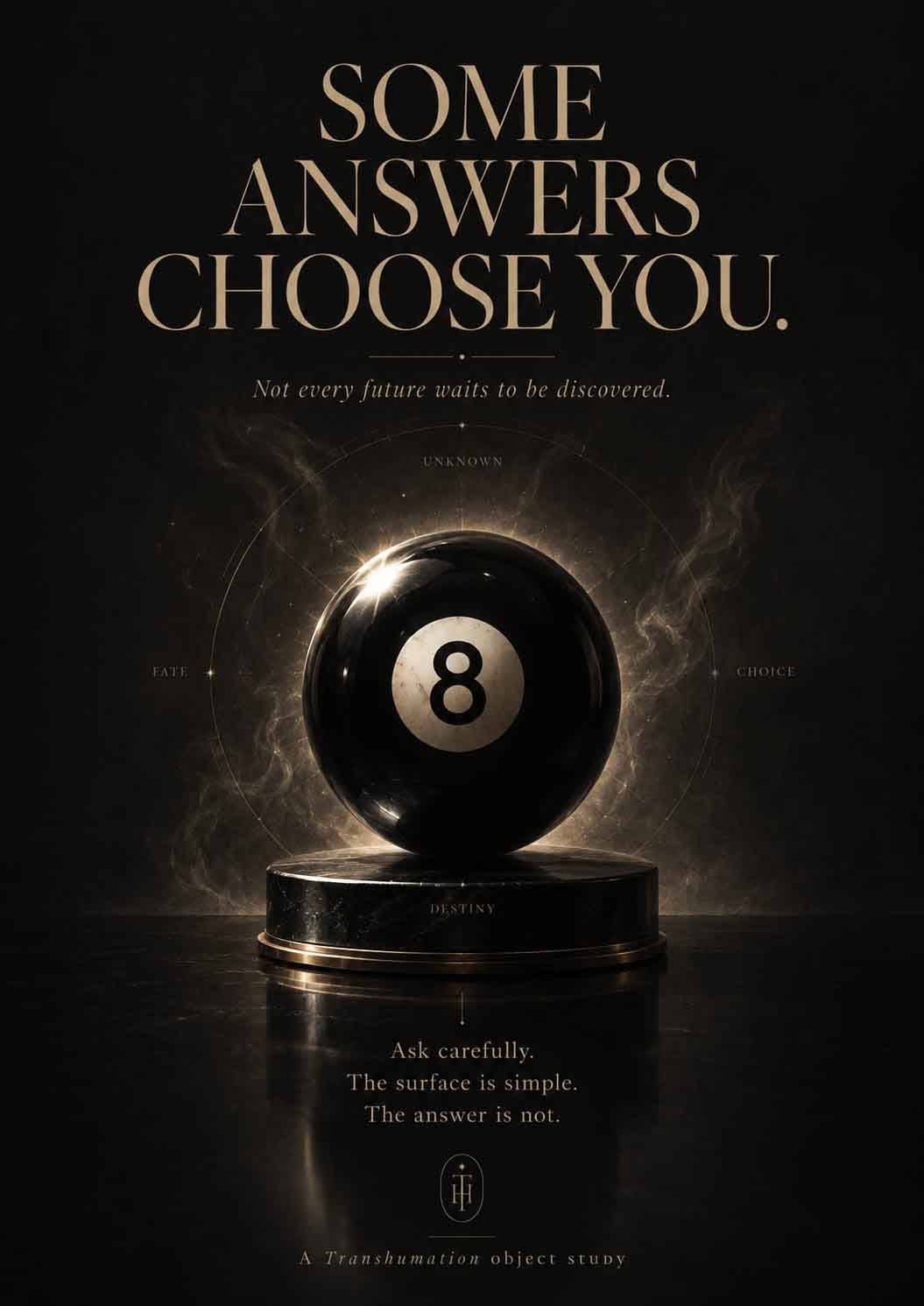
Pattern Recognition Is Not Prophecy
The comparison becomes stronger when we consider patterns.
Ancient divination often interpreted ambiguous signals: dreams, celestial events, ritual signs, unusual coincidences or the enigmatic language of an oracle. Meaning emerged through interpretation. The world was treated as containing relationships that were not immediately visible.
Modern AI also works with patterns, but the resemblance ends quickly if taken literally. Machine-learning systems operate through mathematical relationships learned from data. They do not receive messages from Apollo or uncover a hidden metaphysical intention behind events.
Yet both structures confront the same human problem: there is more information in the situation than one person can easily organize.
The oracle transformed uncertain signs into orientation.
AI transforms statistical and linguistic complexity into human-readable output.
This is why the technology can feel uncanny even when the mechanism is understood. A user provides a fragmentary question and receives an answer containing connections they did not explicitly supply. Something appears to have seen more than the person asking.
That experience can easily become mythological.
Sometimes dangerously so.
A system that recognizes patterns well can still hallucinate, reproduce bias, misunderstand context or offer a confident answer where uncertainty would be more appropriate. Pattern recognition is not omniscience, and prediction is not wisdom.
The ancient oracle was dangerous for a similar structural reason: interpretation could become authority.
Once the answer is treated as coming from a higher level, the person asking may stop taking responsibility for what happens next.
The Oracle Is Most Dangerous When It Is Right
The obvious danger of AI is that it can be wrong.
The more interesting danger may be that it can often be right.
A consistently useless oracle would quickly lose power. A system becomes influential when enough of its answers are useful that people begin trusting it in situations where its limitations are less visible.
This is already familiar in ordinary technology. Navigation systems are so reliable that drivers sometimes follow them into absurd situations. Recommendation systems can become invisible organizers of taste because they usually work well enough. Search engines influence what appears important simply through ranking.
AI adds conversational authority to this structure.
The machine does not merely present options.
It explains.
That changes the relationship between user and system. An explanation sounds closer to judgment than retrieval. Once people become accustomed to receiving clear, fluent answers, uncertainty itself can begin to feel like a defect.
But human life contains questions whose difficulty does not come from insufficient calculation.
What should be preserved?
What kind of future is desirable?
When is risk justified?
What do we owe people who do not yet exist?
When does efficiency destroy something worth keeping?
No increase in computational power automatically converts these into technical problems.
A system can help identify consequences.
It cannot remove responsibility for choosing among them.
The oracle may widen perspective.
It cannot absolve the person who acts.
The New Oracle Age
This is why AI may be philosophically more important than its current capabilities suggest.
It introduces an external cognitive system into ordinary human decision-making at enormous scale. For most of history, access to advisers, libraries, specialists and institutional knowledge was uneven. Now millions of people can consult an artificial system within seconds.
This alters the architecture of civilization.
The question is no longer only whether AI is intelligent in some strict philosophical sense. Its cultural role already matters regardless of the answer. If people increasingly use artificial systems to interpret uncertainty, then AI becomes part of the infrastructure through which reality itself is understood.
That is the deeper connection with the oracle.
An oracle does not need to control society directly. It influences the interpretation that precedes action.
AI can do the same.
A person asks what a symptom means, whether a business decision makes sense, how a historical event should be understood or what future is likely. The answer may become one input among many, but at sufficient scale those inputs begin affecting institutions, markets, relationships and politics.
Humanity has built a new class of interpreter.
The question is whether it will remember that interpretation and truth are not identical.
Current Knowledge
Artificial intelligence systems can identify statistical patterns, generate language, summarize information and produce predictions based on data. Modern large language models are trained on large bodies of text and generate responses through learned mathematical relationships rather than through access to hidden or supernatural knowledge.
Ancient oracles served religious, political and social functions in several cultures. Delphi was one of the most prominent Greek examples, and its responses were embedded in ritual, institutional authority and interpretation rather than functioning as modern scientific forecasts.
Human beings are also known to anthropomorphize systems that display language, responsiveness or apparent agency. This tendency can make technological systems feel more intentional or authoritative than their underlying mechanisms justify.
AI systems remain fallible. They can generate incorrect information, reproduce biases and produce confident answers without reliable grounding.
Open Questions
How much authority will people grant artificial systems when their answers become consistently useful?
Can societies preserve human judgment when increasingly important decisions are mediated through systems that most users do not fully understand?
Will AI become more transparent as it grows more capable, or will greater complexity increase dependence on outputs whose internal reasoning cannot be independently inspected?
Can artificial systems help humans become better interpreters of uncertainty, rather than merely more dependent on external answers?
And if civilization increasingly consults non-human cognition before acting, what institutions will decide when the oracle should be ignored?
Transhumation Interpretation
The New Theurgy does not claim that AI is divine.
It asks why a technological system so easily occupies a role once reserved for sacred intermediaries.
The answer may lie in a recurring human structure.
We live inside more complexity than any individual mind can comprehend. We therefore build interfaces that compress the invisible into something we can use: myth, mathematics, maps, books, institutions and machines.
The oracle was one version of that interface.
AI is another.
The mechanisms could hardly be more different, yet both stand at the same psychological threshold: between what one person can know and what a larger system appears able to reveal.
This is why the important question is not whether AI has become a new god.
It is whether humanity has once again built something it is tempted to treat as an oracle.
And that creates a responsibility older than the technology itself.
The oracle may see patterns we miss.
It may calculate consequences beyond our reach.
It may sometimes give the best available answer.
But the moment civilization confuses access to greater information with access to final wisdom, the interface becomes an authority.
The oracle never needed to be divine for that to happen.
It only needed us to believe that the answer had come from somewhere higher.
Watch The Video
Continue reading…
End of Oracles
FAQ
Why does AI feel like an oracle?
AI can process large amounts of information and return personalized answers in language, creating the psychological impression of consulting an intelligence with a wider perspective.
Were ancient oracles mainly fortune tellers?
No. Oracles also provided religious, political and existential orientation within ancient societies.
Is AI comparable to the Oracle of Delphi?
Only structurally. The historical, religious and technological mechanisms are entirely different, but both can occupy the role of interpreting complexity for people seeking guidance.
Does AI predict the future?
AI can estimate likely outcomes using patterns in data, but it does not possess supernatural knowledge of future events.
Why do people anthropomorphize AI?
Humans naturally infer agency and mind from language, responsiveness and apparently intentional behavior.
Is pattern recognition the same as wisdom?
No. Recognizing patterns can improve prediction and analysis, but wisdom also involves judgment, values, context and responsibility.
What is dangerous about treating AI as an oracle?
Users may grant excessive authority to confident outputs and surrender judgment in areas where the system is uncertain, mistaken or unable to make value decisions.
Can AI provide moral answers?
AI can summarize ethical arguments and consequences, but it cannot remove the human responsibility involved in deciding what values should guide action.
How does this connect to The New Theurgy?
The New Theurgy examines how ancient structures involving symbols, intermediaries and meaning reappear in new technological forms without claiming that the technologies are literally religious or divine.
What is the central Transhumation idea?
AI may represent a new technological version of an old civilizational structure: humanity builds an interface to something cognitively larger than the individual, asks it for orientation, and then must decide whether to treat the answer as information—or authority.
Continue the Transhumation Series
- Forgotten Religion | Ancient Gods, Symbols and the Hidden Structures of Human Civilization
- The Last Religion | Death, Immortality and the Future of Humanity
- The New Theurgy | AI, Information and the Future of Human Civilization
- End of Branding: You Were Never Meant to Become a Product
- Baal vs Ishtar: Why Ancient Gods Never Disappeared