
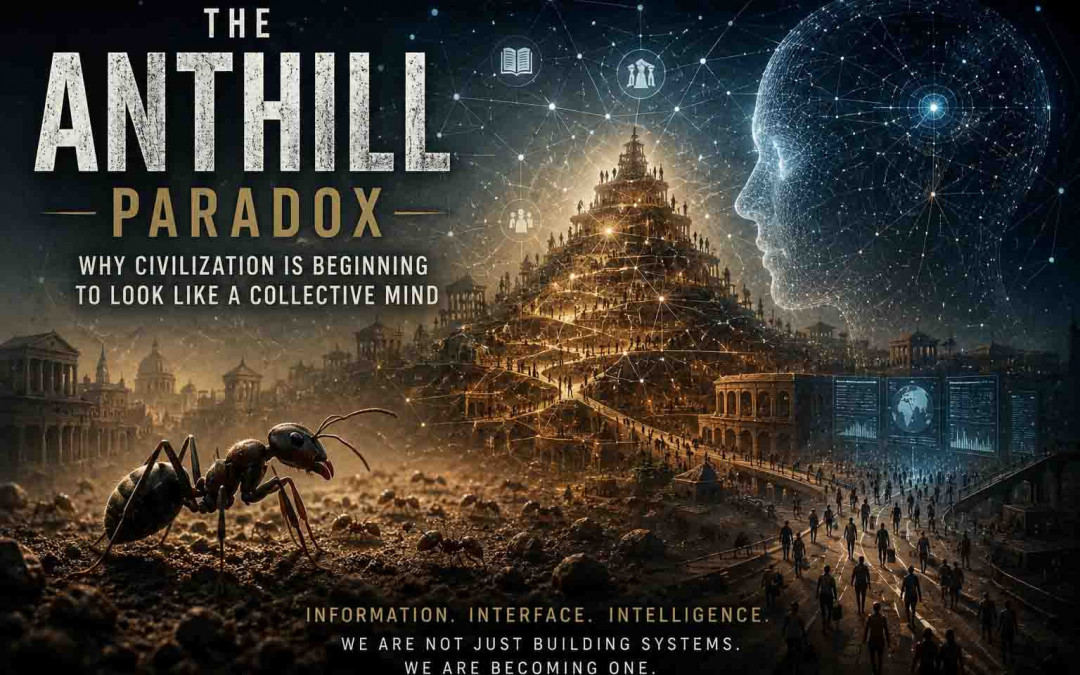
The Anthill Was Always There
Civilization looks individual from the ground. From far enough away, something else begins to appear.
There is a reason people dislike being compared with ants.
An ant seems interchangeable. It carries something, turns, disappears into the colony and is replaced by another. No biography appears necessary. No individual ant seems to understand the architecture it helps maintain, yet the anthill grows, reorganizes itself, repairs damage and survives disturbances no single participant could comprehend.
Human beings prefer a different picture of themselves. We speak of autonomy, private judgment and individual identity. We write biographies because history is easier to understand through faces. We place founders on magazine covers, presidents on coins and artists beneath their signatures. Civilization appears to be something produced by remarkable individuals.
Move far enough away, however, and the picture changes.
No person understands the electrical grid, international shipping, modern medicine, semiconductor fabrication, monetary systems, aviation, agriculture and the Internet simultaneously. Most of us could not reconstruct even one ordinary day of modern life from first principles. Yet breakfast arrives, lights switch on, airplanes cross oceans and information moves across the planet almost instantly.
The uncomfortable question is therefore not whether humanity is turning into an anthill.
It is whether civilization has always contained something colony-like that individual experience makes difficult to see.
The City Nobody Understands
Imagine asking one worker inside an enormous port to explain the whole system. She may know exactly how one container is registered, inspected and transferred. Someone else knows fuel logistics. Another understands customs regulations. Another repairs cranes. A programmer maintains software none of the dockworkers ever see. Far away, a trader has already sold goods that have not yet arrived.
Nobody possesses the complete map.
The port still works.
This is one of civilization’s strangest achievements: large systems can know more than any person inside them. The knowledge is distributed through procedures, habits, databases, machines and specialized minds. A bridge engineer does not need to know how to manufacture the steel mill’s control electronics. The technician maintaining those electronics does not need to understand bridge design. Each operates inside a local territory while depending on distant territories that remain largely invisible.
Economists sometimes describe this as distributed knowledge. Biologists studying social insects encounter another version of the same phenomenon: relatively simple local interactions can produce coordinated behavior at the scale of the colony.
The comparison should not be pushed too far. Human beings are not ants. We possess language, reflective consciousness, institutions, conflict, individual projects and forms of agency that make human societies profoundly different.
But the structural resemblance remains useful.
The whole can perform operations that no member can perform alone.
When Memory Left the Skull
For most of human history, the fragility of collective intelligence was obvious. Knowledge could disappear because the person carrying it died. A craft tradition might survive for generations and then vanish. A library could burn. A language could cease to be spoken. A conquest could sever the chain through which one generation taught the next.
Civilization therefore spent thousands of years trying to move memory outside the body.
Writing was one answer. Libraries were another. Printing multiplied the number of copies a single idea could inhabit. Photography externalized appearance. Recording preserved voices. Computers made memory searchable at scales no archive clerk could manage manually.
The important transition was not that humans stopped forgetting.
We built systems capable of remembering despite us.
A person can die while a book continues transmitting an argument. The engineer who designed a machine can disappear while the documentation teaches another engineer how to repair it. Scientific knowledge does not need to be rediscovered from nothing every generation because journals, textbooks, laboratories and institutions preserve a ladder the next generation can begin climbing halfway up.
The individual forgets.
The system can remember.
Artificial intelligence adds something unusual to this arrangement because stored information is beginning to acquire an increasingly active interface. A traditional library waits for the reader to know which shelf to approach. Search engines made retrieval easier. AI can now compare, reorganize and interpret large bodies of information in response to questions posed in ordinary language.
The archive is beginning to answer back.

The Librarian Inside the Library
This is why AI feels different from earlier information technologies.
A database stores. A search engine retrieves. An AI system can increasingly participate in navigation: connecting concepts, suggesting relationships, translating between domains, compressing enormous archives into forms one human mind can inspect.
That does not make the system a conscious superorganism, and it does not mean civilization has suddenly acquired a literal mind. Those conclusions go far beyond what current evidence can support.
The structural development is already interesting without them.
For most of history, collective intelligence required human intermediaries to find and translate its own knowledge. The reader needed the librarian. The traveler needed the mapmaker. The physician needed specialists, indexes and journals. Increasingly, the informational structure itself contains tools that help users move through it.
The library has acquired a librarian built partly from the library.
That is a strange loop.
And it suggests that the development of civilization may not be a simple story of individual minds becoming more capable. It may equally be a story of individual minds building increasingly sophisticated structures through which intelligence can exist between them.
The Comfortable Myth of Independence
The anthill comparison becomes most uncomfortable when it reaches personal freedom.
We like to imagine participation in civilization as optional in a much stronger sense than it really is. A person can refuse Facebook, leave a company or move to another city. Yet almost nobody can meaningfully withdraw from every network on which modern life depends. Electricity, roads, medicine, money, language, law and telecommunications are collective structures long before they become personal choices.
This does not make the individual unreal.
It makes independence relational.
A person can exercise autonomy precisely because enormous systems are doing things that person does not need to do personally. The writer appears independent while relying on electrical infrastructure, digital networks, publishing systems and centuries of accumulated language. The entrepreneur celebrates self-reliance while using roads, courts, banking, software and standards produced by strangers.
The anthill is therefore not simply a threat to individuality.
In some respects, it is what makes elaborate individuality possible.
The colony does not have to erase the ant for the analogy to become interesting. The more useful question is how much individual freedom becomes possible only because collective structures remove thousands of survival problems from individual attention.
Civilization gives us room to become peculiar.
The Intelligence Between Us
Religions and political systems have repeatedly described human beings as parts of larger wholes: a people, a body, a church, a kingdom, a civilization. These metaphors often carried moral or theological claims that should not be confused with modern information theory.
Yet the recurrence is revealing.
Humans repeatedly discover that meaning and capability do not reside entirely inside isolated individuals.
Language itself proves the point. Nobody invents the language into which they are born. We inherit a structure containing distinctions, metaphors and accumulated decisions made by generations of strangers. We then use that inherited system to produce thoughts that feel entirely personal.
The most private sentence in your head is built from public material.
Technology intensifies rather than invents this condition. Networks connect increasingly large portions of civilization’s memory. AI makes those networks easier to interrogate. Institutions coordinate actions across people who will never meet. A scientific paper written in Tokyo can alter a machine built in California using materials processed on another continent.
Perhaps the remarkable thing is not that humanity is constructing a collective intelligence.
Perhaps we are constructing instruments capable of making the collective intelligence that already existed easier to see.
The anthill was always there.
We were standing too close.
Watch The Video
How to Read the World

Current Knowledge
Human societies rely extensively on distributed knowledge. Modern economies and technological systems function through specialization, institutions, records and coordination rather than through any individual possessing complete knowledge of the whole system.
Social insects such as ants can exhibit complex colony-level behavior arising from local interactions among individuals, although human societies differ fundamentally in cognition, culture, language, institutions and individual agency. Comparisons between human civilization and insect colonies are therefore analogies rather than biological equivalences.
Writing, printing, digital storage and networked computing have progressively expanded humanity’s ability to preserve and transmit information outside individual biological memory. Contemporary AI systems can search, summarize and generate relationships across large bodies of stored information, but there is no scientific basis for describing civilization or current AI systems as a single conscious collective mind.
Open Questions
At what point does distributed intelligence become something meaningfully different from the sum of individual contributions? Can a system possess knowledge that no participant fully understands without possessing anything resembling consciousness?
As AI becomes increasingly involved in navigating civilization’s accumulated information, who determines which parts of collective memory become visible, relevant or forgotten?
And how should individual autonomy be understood when the abilities we experience as personal depend increasingly on infrastructures no individual can independently reproduce?
Transhumation Interpretation
Transhumation treats the anthill not as a prediction that individuality will disappear, but as a change of scale.
From inside one life, civilization appears to consist of separate people making separate decisions. From farther away, another pattern emerges: information passes between temporary biological carriers, accumulates in external memory and becomes capable of producing results no single carrier could achieve alone.
Books, libraries, institutions, networks and AI may therefore be stages in the same deeper process.
The carrier changes.
The memory expands.
The connections multiply.
What appears from the ground to be millions of separate minds may, from another level of observation, resemble a civilization slowly constructing an intelligence between them.
The unsettling possibility is not that we are becoming ants.
It is that we may finally be high enough on the ladder to see the anthill.
FAQ
What does the article mean by comparing civilization to an anthill?
The comparison concerns structure rather than identity. Both human civilization and insect colonies can produce coordinated behavior at a scale larger than any individual participant understands.
Is the article claiming that humans are basically ants?
No. Human beings differ fundamentally from ants in language, consciousness, culture, institutions, technology and individual agency. The anthill is used as a model for examining distributed intelligence.
What is distributed knowledge?
Distributed knowledge means that useful information is spread across many people and systems rather than contained in one central mind. Modern civilization works because specialists can contribute local knowledge without understanding every other part of the system.
Can civilization know something that no individual knows?
In a practical sense, yes. A large system can contain information distributed across databases, institutions and individuals in such a way that no single person possesses the complete picture.
Does that mean civilization itself is intelligent?
That depends on how intelligence is defined. Civilization can solve problems collectively and preserve information beyond individual minds, but that does not prove it possesses a unified consciousness or subjective experience.
How did human memory become external?
Humans progressively externalized memory through language, writing, books, libraries, photography, recordings, databases and digital networks. Information could therefore survive the death or forgetting of the individual who originally possessed it.
Why is writing important to collective intelligence?
Writing allows information to persist independently of a living speaker. Later generations can begin from knowledge accumulated previously instead of rediscovering everything from the beginning.
What changed with the Internet?
The Internet dramatically increased the speed and scale at which externalized information can be copied, searched, connected and shared across geographic boundaries.
Why does AI feel different from a library or search engine?
A traditional library stores information, and a search engine helps locate it. AI can increasingly interpret, reorganize, summarize and connect information in response to questions, making the interface to collective memory more active.
Is AI becoming the “librarian of civilization”?
That is a Transhumation interpretation rather than an established scientific fact. The metaphor describes AI as an interface capable of helping people navigate civilization’s increasingly large external memory.
Could AI turn humanity into a collective mind?
There is currently no evidence that connected humans and AI systems form a single conscious mind. They may, however, create increasingly integrated systems of communication, memory and problem-solving.
What does the article mean by “the library has acquired a librarian built from the library”?
AI systems are trained partly on large collections of human-produced information. They can then help people navigate and interpret that same accumulated knowledge, creating a recursive relationship between civilization’s archive and its interface.
Does collective intelligence threaten individuality?
Not necessarily. Collective infrastructure can actually expand individual possibilities. Roads, medicine, electricity, law, education and networks allow individuals to pursue lives that would be impossible if everyone had to solve every survival problem independently.
Are humans truly independent?
Humans possess meaningful individual agency, but modern autonomy depends heavily on collective systems. Language, knowledge, infrastructure and institutions are inherited from other people.
What does the article mean when it says “the most private sentence in your head is built from public material”?
Even personal thought uses language and concepts inherited from culture. Individual consciousness is personal, but many of the tools it uses were created collectively.
Can a group be intelligent without being conscious?
Yes. Complex coordinated problem-solving does not necessarily require unified subjective experience. Many organizations, markets and biological systems can process information collectively without evidence of a single consciousness.
What is the central Transhumation interpretation?
Transhumation proposes that civilization can be viewed as a structure in which information moves through temporary biological and technological carriers. Books, institutions, networks and AI may represent different stages in the expansion of external collective memory.
What does “the carrier changes” mean?
Knowledge can move through different physical forms: memory, speech, writing, print, computers, networks or AI. The material carrier changes while the function of preserving and transmitting information can continue.
What is the Information Ladder in this context?
The Information Ladder describes the increasing ability of civilization to preserve, connect and interpret information across generations and technologies.
Is humanity becoming an anthill?
The article deliberately reverses that question. Rather than asking whether technology is turning humanity into a collective system, it asks whether civilization has always depended on collective intelligence—and whether new technologies are simply making that structure easier to see.
Continue the Transhumation Series
- Forgotten Religion | Ancient Gods, Symbols and the Hidden Structures of Human Civilization
- The Last Religion | Death, Immortality and the Future of Humanity
- The New Theurgy | AI, Information and the Future of Human Civilization
- End of Branding: You Were Never Meant to Become a Product
- Baal vs Ishtar: Why Ancient Gods Never Disappeared