
Modern civilization describes the universe with extraordinary precision.
We can estimate the age of stars, map galaxies, analyze radiation and calculate distances that exceed ordinary imagination. The cosmos appears vast, ancient and largely indifferent to human concerns.
Scientifically, this is a triumph.
Psychologically, it can feel like exile.
A person looks upward and discovers that Earth is a small planet orbiting an ordinary star inside one galaxy among billions. Human history occupies almost no time at all on a cosmic scale. Every life appears brief, local and fragile.
Ancient Egyptians lived beneath the same stars, but they arranged the relationship differently.
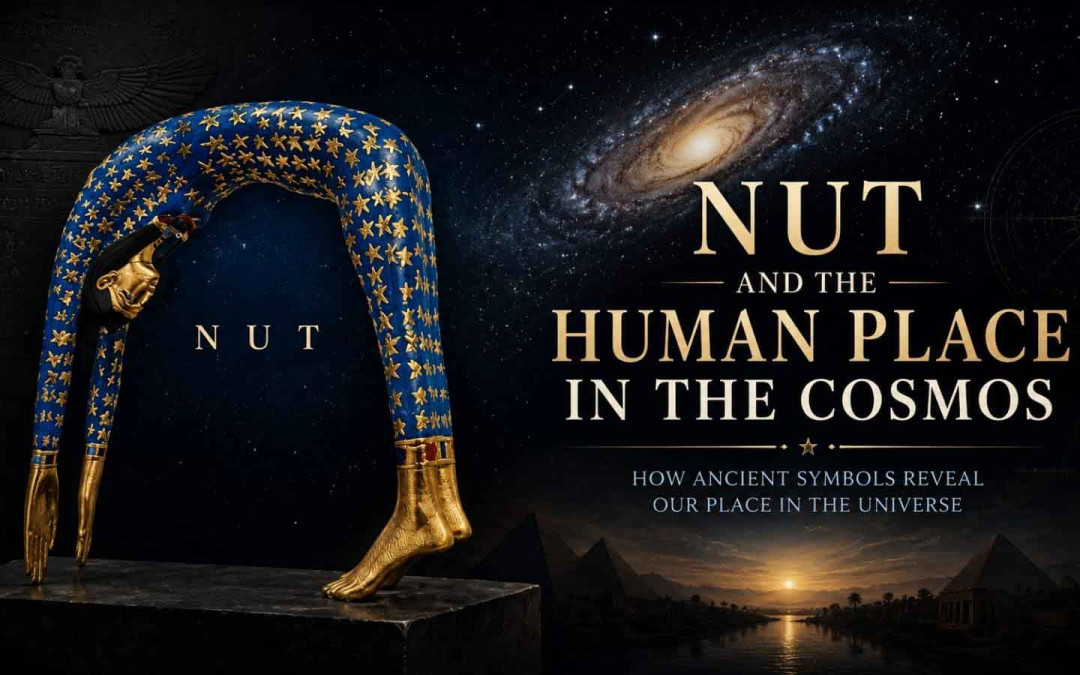
They imagined the sky as Nut: a great female figure arched over the earth, her body covered with stars. She did not reduce the size of the cosmos. She gave it form.
And by giving it form, she gave humanity a place inside it.
The Terror of Scale
The universe should be difficult for the human mind to endure.
Our senses evolved for nearby distances, familiar bodies and short periods of time. We understand a face across a room more easily than a galaxy several million light-years away. We can feel the importance of one death while remaining almost incapable of emotionally representing the deaths of civilizations.
Cosmic scale breaks ordinary intuition.
This can produce wonder, but also insignificance. If humanity occupies such a tiny part of space and time, why should any individual life matter?
Modern thought often answers by separating factual scale from personal meaning. The universe may be indifferent, but human beings can still create value locally.
That answer is intellectually defensible.
It is not always emotionally sufficient.
People do not live through propositions alone. We also require images, rituals and narratives capable of placing knowledge inside experience.
Nut was one such image.
Nut Was Not Merely the Sky
Nut is often described simply as the Egyptian goddess of the sky.
That is accurate, but incomplete.
In Egyptian religious imagery, she was frequently shown stretching over the earth god Geb, sometimes supported by the air god Shu. Her body formed the visible vault of heaven. The sun could be imagined entering her in the evening and being born again in the morning. Stars moved through her body. The dead hoped to enter a cosmic order in which death became transition rather than disappearance.
Nut therefore did not merely represent an object located above humanity.
She represented a relationship among earth, sky, time, death and renewal.
This is why her image remains powerful.
The sky becomes a body.
Distance becomes enclosure.
The cosmos becomes something humanity lives beneath, within and eventually through.
The infinite is not removed.
It is made inhabitable.

The Cosmos as Shelter
The most striking feature of Nut is not her size.
It is her posture.
She arches over the world like a roof, bridge or protective body. The image contains an important psychological balance.
Humanity remains small.
But smallness is not the same as meaninglessness.
A child beneath a cathedral is physically insignificant compared with the building, yet the architecture was constructed precisely to contain the child’s experience. A person beneath Nut occupies a similar symbolic position. The cosmos exceeds humanity, but it is not presented as a meaningless void.
It is a structure in which human existence has orientation.
That distinction matters.
A civilization that treats humanity as the center of everything becomes childish. It cannot accept limits, deep time or realities independent of human desire.
A civilization that treats humanity as completely irrelevant risks nihilism.
Nut avoids both extremes.
The human being is not the cosmos.
The human being is not outside it either.
When Astronomy, Myth and Architecture Were One System
Ancient Egyptians did not divide knowledge exactly as modern institutions do.
Astronomy, religion, kingship, burial, mathematics and architecture interacted continuously. Observing the heavens could guide calendars and ritual. Monumental structures could embody relationships among gods, rulers, death and cosmic order.
This does not mean Egyptian mythology was disguised modern science. Nut was not an astronomical theory in the contemporary sense, and ancient religious images should not be converted into claims about hidden advanced technology.
But neither were they arbitrary decorations.
They organized reality.
A symbol could connect observations of the night sky with beliefs about death, agriculture, kingship and renewal. Its value lay partly in its capacity to hold several dimensions of experience together.
Modern knowledge gains precision by separating fields.
Ancient symbolic systems often gained coherence by connecting them.
We should not confuse coherence with scientific proof.
But we should notice what fragmentation costs.
The Return of Cosmic Loneliness
Humanity now knows more about the universe than any earlier civilization.
We also spend less time directly experiencing the sky.
Electric light obscures the stars. Screens concentrate attention at close range. Urban life makes the cosmos feel like specialized content rather than the environment surrounding all human activity.
The universe becomes intellectually larger and emotionally more distant.
This creates a peculiar modern condition.
We possess images from distant galaxies but often lack a shared symbolic language for understanding what those images mean for human life. Science can explain stellar formation, planetary systems and cosmic expansion. It does not claim to answer whether consciousness belongs in the universe or how a civilization should respond emotionally to its own smallness.
That is not a failure of science.
It is a different category of question.
The problem begins when civilization assumes that because science should not manufacture meaning, meaning itself is unnecessary.
Information gives scale.
It does not automatically give orientation.
Why Ancient Symbols Return
Ancient symbols often return during periods of rapid technological change.
This can be dismissed as nostalgia, but something more interesting may be happening. Technology expands the territory in which humans must locate themselves.
Artificial intelligence challenges the boundary between mind and machine. Space exploration challenges the boundaries of habitat and civilization. Digital identity challenges the relationship between body, memory and continuity.
Each expansion creates a new orientation problem.
What is a human being when intelligence is no longer exclusively biological?
What is a civilization when it becomes planetary or interplanetary?
What is personal continuity when memory and personality can be simulated?
These questions cannot be answered by Nut.
But Nut demonstrates what a successful symbol can do.
It can hold scale and belonging in the same image.
It can remind a civilization that becoming larger technologically does not guarantee becoming more coherent psychologically.
The Human Between Earth and Stars
Nut does not place humanity above the cosmos.
She places humanity inside a relation.
Earth lies below. The heavens stretch above. The human world exists between them, neither sovereign nor abandoned.
That position may be more useful than the modern choice between cosmic superiority and cosmic insignificance.
Human significance does not need to mean that the universe was created for us.
It may mean that consciousness is one of the ways the universe becomes experienced from within.
This remains a philosophical interpretation, not a scientific conclusion.
But it changes the emotional geometry of the problem.
A human being is still small.
Yet smallness can participate in something larger without becoming meaningless.
A single eye is small compared with a body.
Its size does not determine its importance.
Watch The Video
Continue reading…
Can Humans Overcome Death?
Current Knowledge
Nut was an important goddess in ancient Egyptian religion and was commonly associated with the sky, stars and celestial cycles. She was often represented as a woman arching over the earth, sometimes with her body covered in stars.
Egyptian religious traditions connected Nut with solar cycles, death and renewal. These ideas changed across long periods of Egyptian history and should not be treated as one fixed doctrine shared identically by every community.
The night sky was more visible in preindustrial societies than in modern light-polluted cities, but claims about how all ancient people emotionally experienced the cosmos must remain cautious. Religious images provide evidence of cultural frameworks, not direct access to every individual’s psychological state.
Modern astronomy describes the universe through testable models and physical evidence. Symbolic interpretation serves a different function and should not be confused with scientific explanation.
Open Questions
Can a modern civilization create shared cosmic symbols without presenting metaphor as fact? Is it possible to preserve scientific accuracy while also developing meaningful forms of orientation?
Does cosmic loneliness result from knowledge of humanity’s small scale—or from the absence of cultural frameworks capable of placing that knowledge inside a larger story?
Will interstellar civilization require new myths, rituals and images, or will technological systems themselves become the primary structures through which humans interpret the cosmos?
And if consciousness eventually exists in biological, artificial and hybrid forms, what symbol could contain all of them without reducing one to the standard for the rest?
Transhumation Interpretation
Nut is not valuable because ancient Egypt secretly understood modern cosmology.
She is valuable because she solved a problem modern cosmology does not attempt to solve.
She gave cosmic scale a human relationship.
Her body did not explain the stars physically. It explained how a person might live beneath them without being psychologically destroyed by their distance.
Transhumation begins from a similar tension.
Technology is making humanity larger in reach but less certain of its place. We can connect continents, simulate intelligence and imagine settlements beyond Earth. Yet every expansion weakens an older boundary that once told us what a human being was.
Nut suggests that orientation does not require making humanity the center.
It requires finding a structure in which human consciousness can belong without denying the immensity surrounding it.
The future may need new cosmic images.
Not to replace astronomy.
Not to restore ancient religion literally.
But to remind us that knowledge of the universe and a place within the universe are not the same achievement.
Nut made the infinite intimate.
Our civilization may need to learn how to do that again.
FAQ
Who was Nut in ancient Egyptian religion?
Nut was a major Egyptian sky goddess associated with the heavens, stars and celestial cycles.
How was Nut usually represented?
She was often shown as a woman arching over the earth, sometimes covered with stars and supported above the earth god Geb.
Was Nut considered a creator goddess?
Her role varied across Egyptian traditions. She was strongly connected with the sky, solar renewal and the afterlife, but Egyptian religious systems included many overlapping divine functions.
Does Nut represent the Milky Way?
Some modern interpretations connect aspects of Nut’s imagery with the Milky Way, but precise astronomical identifications remain debated and should not be treated as settled fact.
Is the article claiming Egyptian mythology was scientific?
No. Egyptian mythology and modern science use different methods and standards of evidence. The article examines the symbolic and psychological role of Nut.
Why is Nut relevant today?
Her image addresses a problem that remains modern: how human beings can recognize the scale of the universe without interpreting their smallness as complete insignificance.
What is cosmic loneliness?
Cosmic loneliness is the feeling that humanity is isolated, insignificant or without orientation within the immense scale of the universe.
How does this connect with artificial intelligence?
AI expands the range of intelligence humanity must understand, just as space exploration expands the scale of civilization. Both create new questions about where human consciousness belongs.
Is Transhumation proposing a return to ancient religion?
No. It studies ancient symbols as interfaces to enduring human problems, while separating historical fact, scientific knowledge and modern interpretation.
What is the central Transhumation idea?
A civilization does not need to place humanity at the center of the universe. It needs a framework in which consciousness can remain meaningful without denying the scale of the cosmos.
Continue the Transhumation Series
- Forgotten Religion | Ancient Gods, Symbols and the Hidden Structures of Human Civilization
- The Last Religion | Death, Immortality and the Future of Humanity
- The New Theurgy | AI, Information and the Future of Human Civilization
- End of Branding: You Were Never Meant to Become a Product
- Baal vs Ishtar: Why Ancient Gods Never Disappeared