
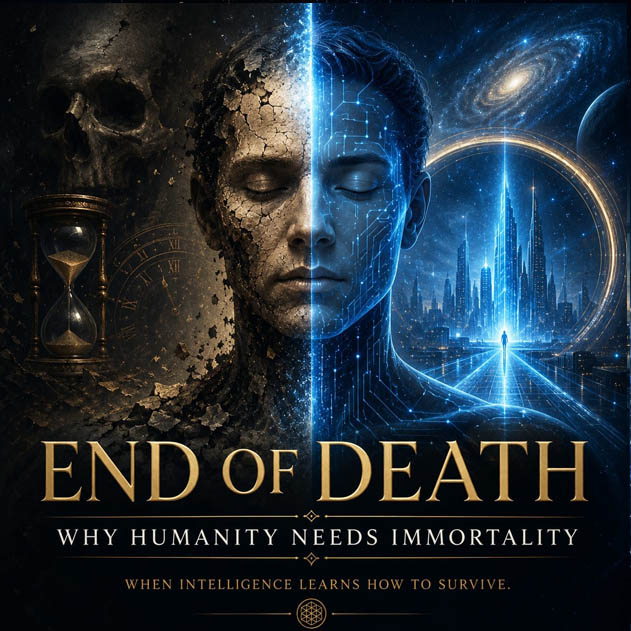
Why Humanity Needs Immortality
For most of human history, death was considered inevitable.
Every civilization, every religion, and every philosophical system tried to understand it. Some saw death as a transition to another world. Others accepted it as a natural part of existence. But despite thousands of years of reflection, humanity never truly solved the problem of mortality.
Death was simply assumed to be the final boundary of life.
Today, however, this assumption is beginning to change.
Death as a Biological Limitation
The idea that death is inevitable comes largely from biology. Human bodies are fragile systems. Cells deteriorate. Organs fail. Over time, the complex mechanisms that sustain life begin to break down.
For centuries this biological limitation shaped our worldview. Because the body could not survive indefinitely, cultures built entire belief systems around mortality. Religions promised life after death. Philosophies tried to teach acceptance.
But what if death was never a fundamental law of the universe?
What if it was only a limitation of the human body?
From a cosmic perspective, there is nothing inevitable about the destruction of consciousness. The universe itself is billions of years old. Stars burn for millions or billions of years. Galaxies exist on timescales far beyond human imagination.
Compared to these cosmic processes, the human lifespan is astonishingly short.
This raises a profound question: if intelligence evolves within the universe, should it remain bound by the limitations of biological decay?
Or should it eventually overcome them?
The Technological Turning Point
For the first time in history, humanity has begun developing technologies that challenge the inevitability of death.
Artificial intelligence, neural interfaces, digital memory systems, and advanced biotechnology are opening entirely new possibilities. These technologies suggest that consciousness may not need to remain tied forever to fragile biological structures.
Instead, consciousness may become something that can be preserved, transferred, or extended.
This idea is often associated with transhumanism, but its implications go far beyond any single philosophy. If consciousness can be maintained beyond biological limits, then the traditional concept of death begins to change.
Death would no longer represent an absolute end.
It would represent a technical problem.
And technical problems, sooner or later, tend to be solved.

Why Immortality Matters
Some people argue that mortality gives life meaning. According to this view, the finiteness of life creates urgency and value.
But this perspective assumes that meaning depends on limitation.
In reality, the opposite may be true.
The universe is vast, complex, and largely unexplored. Human civilization has existed for only a tiny fraction of cosmic time. Our scientific knowledge is still incomplete. Our understanding of consciousness is still emerging.
If intelligence disappears after only a few decades of existence, humanity may never fully explore the possibilities of the universe.
Immortality is not simply about living longer.
It is about giving intelligence the time it needs to grow.
It is about allowing consciousness to continue learning, creating, and exploring.
From this perspective, immortality is not a luxury.
It is a necessity.
The Future of Consciousness
Humanity may be approaching one of the most significant transitions in its history.
For thousands of years we asked whether life exists after death. Religions offered spiritual answers to this question. Philosophers debated its meaning.
But technology is beginning to transform the question itself.
Instead of asking whether life continues after death, humanity may soon begin asking how consciousness should continue.
This shift marks a profound transformation in human thinking.
The ancient dream of immortality may no longer belong only to mythology or religion. It may become a practical goal of technological civilization.
The End of Death
If humanity succeeds in extending or preserving consciousness beyond biological limits, death will no longer define the human condition.
Future generations may look back at our era as the moment when civilization began to overcome its oldest limitation.
The end of death will not happen suddenly.
It will emerge gradually, through science, technology, and new ways of understanding consciousness.
But the direction of this transformation is already becoming visible.
For the first time in history, humanity is beginning to imagine a future where death is no longer inevitable.
And if that future becomes reality, the greatest transformation in the history of life will not be the creation of intelligence.
It will be the moment when intelligence learns how to survive.
Frequently Asked Questions
1. Why does humanity need immortality?
From the perspective of this article, immortality would give intelligence more time to learn, create, explore the universe, and understand consciousness.
2. Is death a natural law or a biological limitation?
Death is currently a biological reality, but it may not be a fundamental law of the universe. It could be the result of fragile biological systems that future technology may partly overcome.
3. Is technological immortality possible today?
No. Current science can extend life and treat many diseases, but it cannot preserve human consciousness indefinitely or transfer it beyond the biological brain.
4. How could technology challenge death?
Possible paths include advanced biotechnology, neural interfaces, artificial organs, brain preservation, digital memory systems, and future methods of maintaining consciousness in artificial substrates.
5. Would mind uploading make someone immortal?
It might preserve memories, personality, and behavior, but it remains unclear whether an uploaded mind would be the same conscious person or only a copy.
6. Does mortality give life meaning?
Some philosophers believe it does, but meaning may also come from creativity, knowledge, relationships, and exploration. A longer life would not necessarily become meaningless.
7. What is the difference between life extension and immortality?
Life extension means living significantly longer. Immortality would mean eliminating unavoidable death from aging or preserving consciousness indefinitely.
8. Could immortality change human civilization?
Yes. It could transform education, work, politics, relationships, inequality, and long-term planning by expanding the human time horizon from decades to centuries.
9. If identity changes over time, what exactly dies?
This question challenges the idea of a fixed self. If identity is a continuous process rather than a permanent object, death may be understood as the interruption of that process.
Continue the Transhumation Series
Explore the full journey:
- End of Reality — Where Do You Really Exist?
- End of Physics — Are the Laws of Reality Real?
- End of the Real World — Reality Is No Longer Required
- End of Consciousness — Beyond the Human Mind
- End of Death — When Human Limits Disappear
- End of Religion — When Technology Replaces Faith