
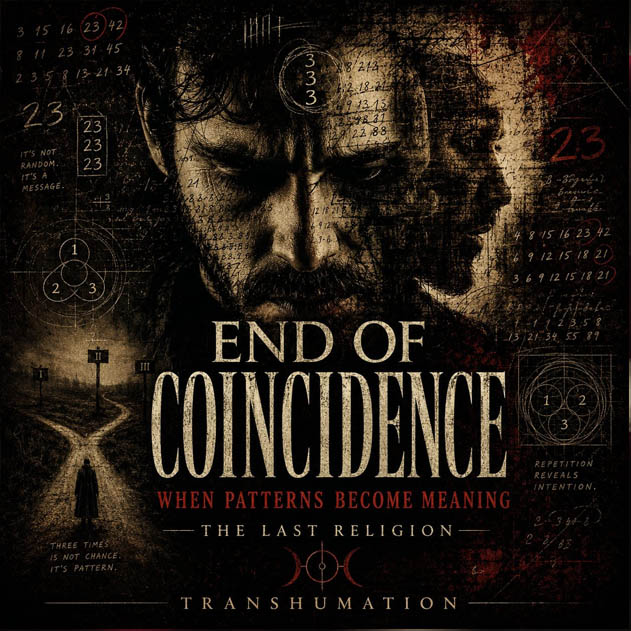
When Patterns Become Meaning
What if coincidence never truly existed?
Not because every event is secretly planned.
Not because the universe sends personal messages through every number, dream or accident.
But because the human mind may never have been designed to experience reality as completely random.
We search for structure.
In stars.
In dreams.
In symbols.
In repeated events.
In the behavior of other people.
In the strange moments that seem to return at exactly the right time.
Modern civilization often treats this instinct with suspicion.
Coincidence.
Bias.
Superstition.
Projection.
Sometimes that criticism is justified. Human beings can see patterns where none exist. We can connect unrelated events, become obsessed with numbers and mistake fear for revelation.
But dismissing every pattern creates another problem.
Why does consciousness search for patterns at all?
Perhaps meaning does not begin with certainty.
Perhaps it begins with repetition.
One Event Is Noise
One event may mean nothing.
Two similar events create suspicion.
Three repetitions begin to feel like a pattern.
This does not prove that a hidden intelligence is controlling reality. But something changes inside the observer.
The events are no longer experienced separately.
They become connected.
A pattern is born when consciousness recognizes that several moments may belong to the same structure.
That recognition changes reality—not necessarily the external world, but the way the world becomes intelligible.
Before the pattern, there were isolated facts.
After the pattern, there is a possible system.
This is how meaning begins.
Civilization Was Built from Patterns
Human civilization did not emerge from isolated observations.
It emerged from repeated ones.
People noticed that the seasons returned.
They saw that the stars followed recognizable paths.
They learned that certain plants healed while others poisoned.
They discovered that sounds could become words and words could preserve memory.
Religion emerged from patterns.
Science emerged from patterns.
Technology emerged from patterns.
The difference between them is not that one sees patterns and the others do not. The difference lies in how those patterns are interpreted, tested and transmitted.
Ancient societies expressed recurring structures through gods, myths and rituals.
Modern societies express them through formulas, models and algorithms.
The language changed.
The human instinct remained.
Symbols Compress Meaning
Ancient symbols were not merely decorative.
They compressed large systems of meaning into recognizable forms.
A gate could represent transition.
A labyrinth could represent a structure that cannot be understood from inside.
A flame could represent continuity.
A crossroads could represent choice.
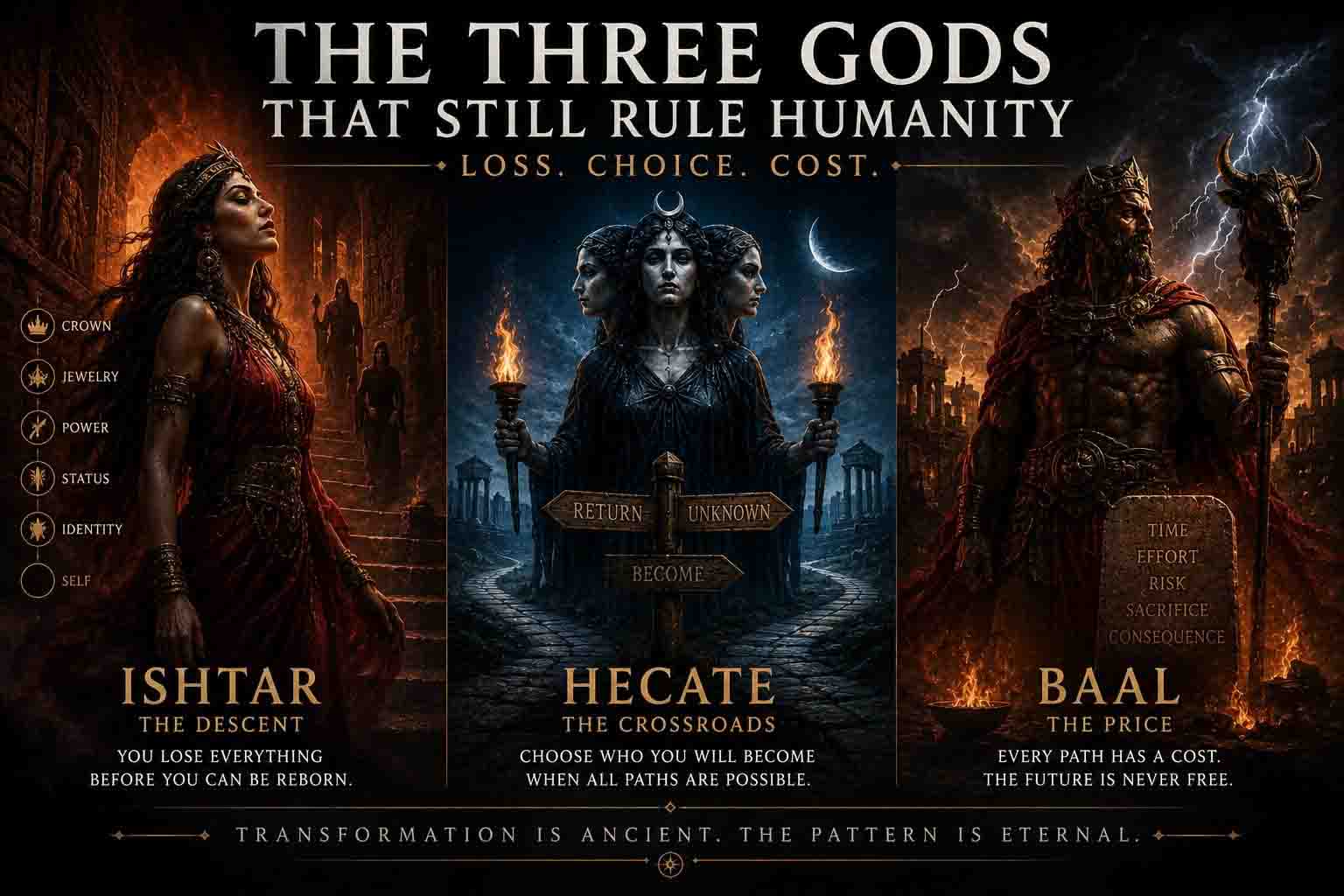
This is why Hekate still matters.
She was associated with thresholds, night, roads and crossroads. Her image often placed consciousness at the point where several possible paths meet.
The crossroads is not only a physical location.
It is the moment when a person realizes that different futures are possible.
Before that moment, life feels automatic.
After it, choice becomes visible.
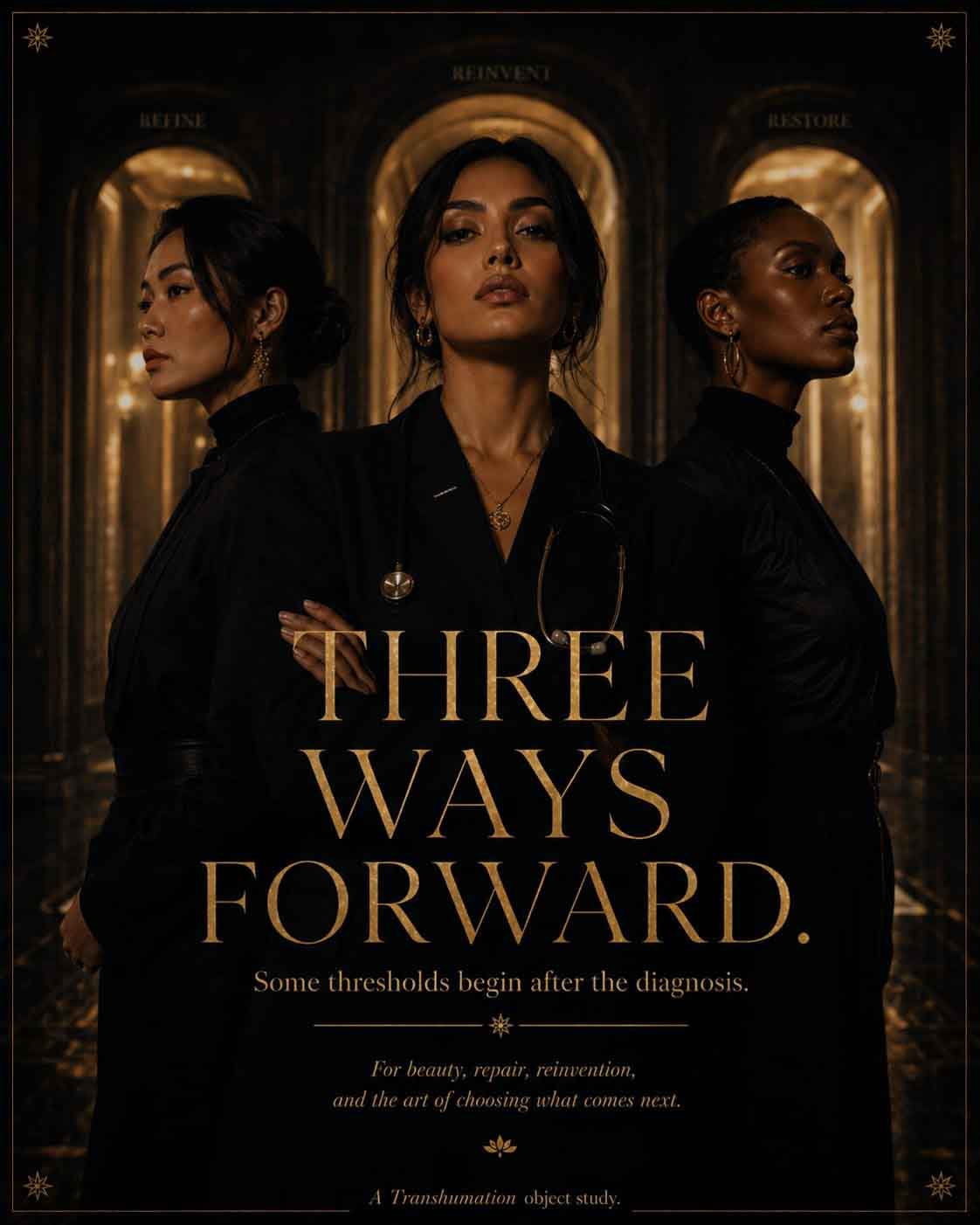
Three roads.
Three directions.
Three possible versions of the self.
The symbol does not tell you which road to choose.
It forces you to recognize that you are choosing.
The Rule of Three
One repetition can be dismissed.
Two may still be accidental.
The third creates structure.
This is not a scientific law. It is a threshold of perception.
Human beings often experience three repetitions as sufficient to transform coincidence into meaning.
A story has a beginning, middle and end.
A choice contains the present path, the rejected path and the imagined alternative.
Many ancient symbols use three figures, three trials, three gates or three warnings because three creates movement.
One is a point.
Two create opposition.
Three create a system.
This may explain why repeated signs become psychologically powerful. The mind does not merely count them. It begins constructing relationships between them.
Once that happens, coincidence starts turning into interpretation.
The Algorithmic World
Modern technology intensified this process.
Algorithms are systems of pattern recognition.
Artificial intelligence studies repeated structures in language, images and behavior.
Digital platforms observe what people click, watch, ignore and purchase. They identify patterns that individuals may not recognize in themselves.
Modern society is therefore surrounded by machines that search for repetition.
The same principle operates at different scales.
The brain detects patterns in experience.
Artificial intelligence detects patterns in data.
Institutions detect patterns in populations.
Civilization itself may be pattern recognition becoming increasingly complex.
But there is a crucial difference.
A machine can recognize that two things frequently appear together.
A conscious being asks what the connection means.
When Patterns Become Prisons
Pattern recognition can create knowledge.
It can also create obsession.
A person who interprets every coincidence as a message may become trapped inside a private system that can never be questioned.
Every contradiction becomes further proof.
Every random number becomes a warning.
Every event becomes part of the same story.
At that point, meaning is no longer discovered.
It is imposed.
This is the danger of false patterns.
But the opposite danger also exists.
A civilization can become so afraid of irrationality that it loses the ability to recognize meaning entirely.
Everything becomes data.
Every symbol becomes decoration.
Every repeated human experience becomes a statistical accident.
Such a civilization may become accurate but empty.
It can explain mechanisms without understanding why people continue searching for purpose.
Consciousness Transforms Chaos
Perhaps humans do not create meaning from nothing.
Perhaps consciousness exists to transform chaos into structure.
We receive fragments.
Sensations.
Memories.
Faces.
Words.
Repeated events.
Then the mind connects them.
Identity itself is built this way.
You are not one isolated memory. You are the pattern created by thousands of connected experiences.
Culture works the same way.
Civilization remembers symbols, repeats rituals and preserves stories because repetition creates continuity.
Meaning may therefore be neither entirely objective nor entirely invented.
It may arise in the relationship between the world and the observer.
The world provides events.
Consciousness connects them.
The End of Coincidence
The end of coincidence does not mean that randomness disappears.
It means that repeated events become impossible to experience as completely separate.
Once a pattern is recognized, perception changes.
You begin to notice the structure behind the surface.
You see that the same fear appears in different relationships.
You notice that civilizations repeat similar cycles under different names.
You recognize that algorithms do not merely show you the world—they help decide which parts of the world become visible.
The pattern may be true.
It may be false.
But it cannot remain neutral.
It demands interpretation.
Perhaps coincidence was never the opposite of meaning.
Perhaps coincidence was the moment before meaning appeared.
And perhaps consciousness begins when repetition becomes impossible to ignore.
FAQ
What is the main idea of “End of Coincidence”?
The article explores how repeated events become patterns and how patterns become meaning. It does not claim that every coincidence is supernatural or planned.
Does the article argue that coincidence does not exist?
Not literally. Random events may exist, but consciousness naturally connects repeated events and experiences them as possible structures rather than isolated accidents.
Why does the human mind search for patterns?
Pattern recognition helps humans predict danger, understand the environment, learn language and organize memory. It is one of the foundations of intelligence.
What is the rule of three?
The rule of three is the idea that one event may seem accidental, two create suspicion and three begin to form a recognizable pattern. It is a psychological and symbolic threshold, not a scientific law.
Why is Hekate connected with pattern recognition?
Hekate represents crossroads, thresholds and multiple paths. She symbolizes the moment when a person becomes aware of choice and recognizes their position inside a larger structure.
How are symbols connected with meaning?
Symbols compress complex ideas into recognizable forms. A crossroads, flame, gate or labyrinth can carry meanings that would require many words to explain.
How do algorithms recognize patterns?
Algorithms analyze repeated relationships in data. They can identify similarities in language, behavior, images and preferences, often at a scale impossible for an individual person.
What is the danger of seeing patterns everywhere?
It can lead to paranoia, obsession and false conclusions. A healthy interpretation must remain open to doubt, contradiction and alternative explanations.
Can rejecting all patterns also be dangerous?
Yes. A culture that dismisses every symbol or repeated experience as meaningless may lose the ability to understand purpose, identity and the deeper structures of human life.
Continue the Transhumation Series
Explore the full journey:
- End of Reality — Where Do You Really Exist?
- End of Physics — Are the Laws of Reality Real?
- End of the Real World — Reality Is No Longer Required
- End of Consciousness — Beyond the Human Mind
- End of Death — When Human Limits Disappear
- End of Religion — When Technology Replaces Faith
This is not a theory. This is a transition.