
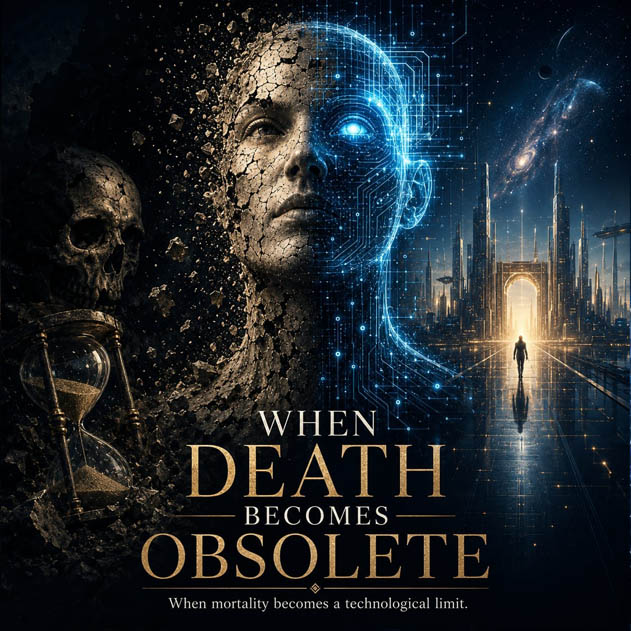
When Death Becomes Obsolete
For most of human history, death was treated as an absolute law of nature.
Every civilization, religion, and philosophy tried to explain it, accept it, or imagine some form of escape from it. Yet no matter how advanced a culture became, death remained the final boundary of individual existence.
It marked the end of the body, the end of personal experience, and perhaps the end of consciousness itself.
But what if death is not a fundamental property of the universe?
What if it is only a technological limitation?
Humanity has repeatedly mistaken the limits of its technology for the limits of reality. There was a time when human flight appeared impossible, when crossing the ocean seemed like reaching the edge of the known world, and when communication across continents belonged to fantasy.
Every era believed that certain boundaries could never be crossed.
Then technology crossed them.
Death may be the last and greatest of these boundaries.
1. Death as a Biological Limitation
Death is often described as a natural and necessary part of life.
But from a biological perspective, death is not a single universal event. It is the result of many different failures: cellular damage, disease, organ failure, genetic deterioration, injury, and the gradual breakdown of systems that keep the body alive.
These processes may be natural, but that does not mean they are untouchable.
Many conditions that once caused inevitable death can now be prevented or treated. Infections, injuries, and organ failures that would have ended a life centuries ago are now routinely managed through medicine.
Technology has already changed the boundary between life and death.
The question is how far that process can continue.
2. When Natural Laws Become Engineering Problems
Throughout history, humanity has transformed seemingly permanent limitations into technical challenges.
The inability to fly became a problem of aerodynamics and engineering.
Distance became a problem of transportation and communication.
Disease became a problem of biology, chemistry, and medicine.
Even the limits of human calculation became problems for computers and artificial intelligence.
This pattern suggests that some boundaries appear absolute only because we do not yet understand the mechanisms behind them.
Once a mechanism becomes visible, intervention becomes possible.
If aging, degeneration, and the loss of consciousness can eventually be understood at a sufficient level of detail, death itself may begin to look less like destiny and more like system failure.
3. The Real Meaning of Death
The death of the body is not necessarily the deepest problem.
The deeper loss is the disappearance of the conscious perspective that experienced the world through that body.
A person is not only a collection of organs. A person is also memory, identity, emotion, attention, personality, and the continuous experience of being present.
This is why replacing a damaged heart does not create a new person.
The organ is important, but it is not usually considered the location of identity.
The central problem of mortality is therefore not simply preserving biological matter.
It is preserving the continuity of consciousness.
If consciousness could continue beyond the failure of its original biological structure, then the traditional meaning of death would change.
4. Separating Consciousness from Biological Fragility
The human brain is extraordinarily complex, but it is also physically fragile.
A small injury, a lack of oxygen, disease, or degeneration can permanently alter memory, personality, and awareness.
This creates a strange situation.
The most valuable phenomenon known to us — conscious experience — depends on a vulnerable biological organ shaped by evolution for survival and reproduction, not for indefinite existence.
Transhumanism asks whether consciousness must remain permanently tied to this original substrate.
Future neuroscience, brain-computer interfaces, artificial intelligence, neural prosthetics, and digital simulation may gradually allow parts of mental activity to be supported or extended outside the biological brain.
The transition would probably not happen through one dramatic invention.
It may begin with memory support, artificial sensory systems, neural implants, digital identities, cognitive assistants, and increasingly direct links between minds and machines.
Over time, the boundary between biological and technological consciousness could become less clear.
5. Death as Information Loss
One way to understand death is as the irreversible loss of information.
The brain contains patterns representing memories, habits, emotional responses, learned skills, relationships, and personal history.
When the brain is destroyed, those patterns disappear with it.
From this perspective, the challenge of immortality is not merely keeping cells alive forever. It is finding a way to protect, reconstruct, or continue the informational processes that produce identity and awareness.
This does not automatically solve the philosophical problem of personal continuity.
A digital reconstruction of a person might behave like the original, remember the same childhood, and express the same personality. Yet it would still be necessary to ask whether it was truly the same consciousness or only an accurate successor.
This may become the central question of technological immortality.
Not whether a mind can be copied, but whether the original stream of experience can continue.
6. A Civilization Without Scarcity of Time
Human civilization has always been shaped by scarcity.
There is scarcity of food, energy, territory, attention, and knowledge.
But perhaps the most influential scarcity is time.
Human beings know that their lives are limited. This gives urgency to ambition, relationships, creation, and decision-making.
A short lifespan determines the rhythm of education, work, family, politics, and culture.
If conscious existence could continue for centuries or millennia, this entire structure would change.
Education might no longer be concentrated in the first decades of life.
Careers could last for centuries or be repeatedly reinvented.
Long-term projects could be pursued by the same minds that began them.
Political decisions might be made by individuals who expect to experience their consequences hundreds of years later.
A civilization of long-lived consciousness could develop a radically different sense of responsibility.
7. When Meaning Is No Longer Built Around Death
Many philosophers have argued that mortality gives life meaning.
Because time is limited, choices matter.
Because opportunities disappear, moments become valuable.
Because life ends, it demands direction.
This argument is powerful, but it may confuse scarcity with meaning.
A book does not become meaningful only because its final page exists. A relationship does not matter only because it will end. Knowledge does not become worthless when there is more time to pursue it.
Immortality would not necessarily remove meaning.
It could change the source of meaning.
Instead of building life around survival, inheritance, and fear of disappearance, conscious beings might organize existence around creativity, understanding, exploration, and transformation.
The central question would no longer be how to fit a meaningful life into a few decades.
It would be how to create meaning across an almost unlimited future.
8. New Risks of an Immortal Civilization
The disappearance of death would not automatically create paradise.
It could produce new forms of inequality, stagnation, psychological exhaustion, and political control.
If only some people gained access to extreme life extension, power could remain concentrated in the same hands for centuries.
If societies stopped renewing themselves through generations, cultural and political change might slow down.
Long-lived individuals might struggle with memory, identity, boredom, or the emotional weight of centuries of experience.
Digital consciousness could also become dependent on infrastructure controlled by governments or corporations.
Immortality would therefore create a new kind of vulnerability.
A biological person can be imprisoned or killed.
A digital person could potentially be copied, altered, paused, monitored, or deleted.
The conquest of death would not eliminate danger.
It would transform it.
9. The Transformation of Existence
If death becomes obsolete, humanity will face the greatest transformation in its history.
Not the conquest of space.
Not the creation of artificial intelligence.
Not even the mastery of biology.
The deeper transformation would be the separation of intelligence from the short biological cycle that created it.
A civilization of potentially immortal consciousness would think on a different scale.
Exploring distant galaxies could become a practical project rather than an impossible dream.
Understanding the deepest laws of the universe could become a task pursued across millennia.
Entire worlds could be built inside digital reality.
Identity itself might become flexible, existing across multiple bodies, environments, or forms of perception.
In such a future, humanity would not simply live longer.
It would redefine what it means to exist.
Religions once promised immortality beyond death.
Technology may offer another path — not through supernatural intervention, but through the gradual evolution of consciousness beyond its original biological form.
The future may not belong entirely to biological bodies.
It may belong to minds no longer permanently bound by them.
When death becomes obsolete, humanity will not merely defeat an ancient enemy.
It will enter a form of existence for which history has no precedent.
Frequently Asked Questions
1. Could death really become obsolete?
Not with current technology. However, future advances in medicine, biotechnology, neuroscience, and artificial intelligence may significantly extend life or alter the way consciousness relates to biological death.
2. Is aging considered a disease?
Aging is usually treated as a biological process rather than a single disease. However, many researchers study its underlying mechanisms in order to delay or prevent age-related damage.
3. What does transhumanism say about death?
Transhumanism generally views death and aging as limitations that may eventually be reduced or overcome through science and technology.
4. Would life extension be the same as immortality?
No. Life extension would increase the human lifespan, while immortality would imply indefinite existence or the elimination of unavoidable death from aging and biological failure.
5. Could consciousness exist outside the brain?
There is currently no proof that human consciousness can exist independently of a living brain. The possibility remains theoretical and depends on future discoveries about the nature of consciousness.
6. Would an uploaded mind still be the same person?
This is unresolved. An uploaded mind might preserve memories and personality, but it is uncertain whether it would preserve the original continuity of conscious experience.
7. Would immortality remove meaning from life?
Not necessarily. It could weaken meanings based on scarcity and limited time, but new forms of meaning could emerge through creativity, relationships, exploration, and knowledge.
8. What risks could technological immortality create?
Possible risks include inequality, political stagnation, corporate control, psychological exhaustion, identity problems, surveillance, and dependence on technological infrastructure.
9. Is immortality the final goal of transhumanism?
Not always. Transhumanism is more broadly concerned with overcoming human limitations and expanding physical, intellectual, and conscious possibilities. Immortality is only one possible direction.
Continue the Transhumation Series
Explore the full journey:
- End of Reality — Where Do You Really Exist?
- End of Physics — Are the Laws of Reality Real?
- End of the Real World — Reality Is No Longer Required
- End of Consciousness — Beyond the Human Mind
- End of Death — When Human Limits Disappear
- End of Religion — When Technology Replaces Faith