
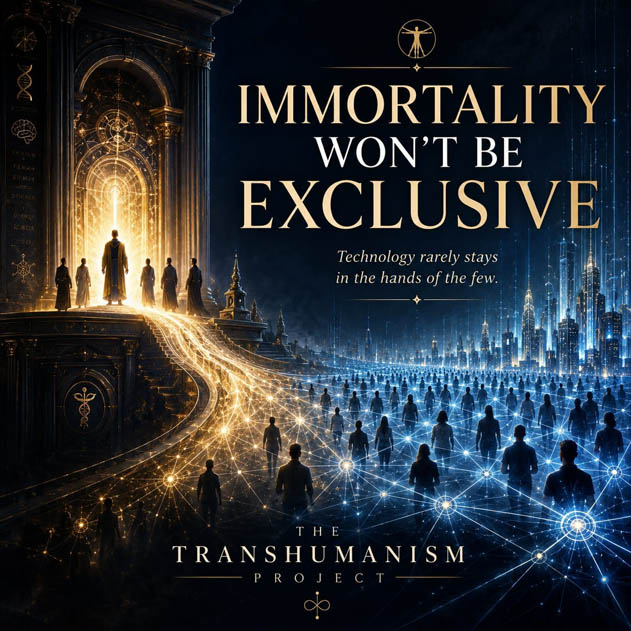
Immortality Won’t Be Exclusive
Throughout history, immortality has often been imagined as something reserved for a select few.
In ancient myths, only gods possessed eternal life. In religious traditions, eternal existence was promised only to the righteous. Even in modern science fiction, immortality is often portrayed as a privilege available only to the wealthy elite.
But if we look at the history of technology, a very different pattern emerges.
Technological breakthroughs rarely remain exclusive for long.
The Pattern of Technological Expansion
Many innovations begin as rare and expensive. The first computers filled entire rooms and were accessible only to governments and large institutions. Early mobile phones were luxury devices used by a small number of people. Even the internet was once limited to a handful of research centers.
Yet over time, these technologies spread rapidly.
As production scales increase and knowledge becomes widespread, the cost of new technologies drops dramatically. What once belonged to a small elite gradually becomes available to billions of people.
Today, powerful computers fit into our pockets. The internet connects most of the planet. Technologies that were once unimaginable are now ordinary parts of daily life.
If immortality ever becomes technologically possible, it is likely to follow the same pattern.

The Economics of Survival
There is also a powerful economic reason why immortality would not remain exclusive.
Technologies that preserve life or extend human capabilities create enormous demand. When demand becomes global, industries expand to meet it. Competition drives innovation, and innovation drives accessibility.
The same forces that made smartphones and medical treatments widely available could eventually apply to technologies that extend or preserve consciousness.
Once the infrastructure for such systems exists, scaling them to millions — or even billions — of users becomes a natural next step.
The Role of Digital Existence
If immortality eventually involves digital environments or artificial substrates for consciousness, scalability becomes even more plausible.
Digital systems can be replicated and expanded far more easily than biological resources. Servers, networks, and computational systems can grow continuously as technology advances.
Unlike physical immortality, which might depend on scarce biological materials, digital forms of existence could theoretically be distributed on a massive scale.
In such a scenario, the continuation of consciousness would not depend on privilege alone, but on the availability of technological infrastructure.
A New Social Question
Of course, the emergence of technological immortality would raise enormous ethical and political questions.
Who would gain access first? How would societies regulate technologies capable of extending life indefinitely? Would new inequalities appear, or would access eventually become universal?
These questions will likely shape the future debates surrounding transhumanism.
Yet the historical trend of technology suggests that exclusivity rarely lasts forever.
The Future of Immortality
If humanity develops the ability to preserve consciousness beyond biological limits, immortality may begin as a rare and experimental achievement.
But history indicates that transformative technologies tend to spread.
What begins with a few pioneers often becomes part of everyday life for billions.
In this sense, immortality — if it ever becomes real — may not remain the privilege of a chosen few.
It may become one of the defining features of an advanced civilization.
And for the first time in history, the promise of eternal existence might no longer belong only to myth or religion, but to the shared future of intelligent life.

Frequently Asked Questions
1. Will immortality be available only to the rich?
It may begin as an expensive technology, but history suggests that important innovations usually become cheaper and more widely available over time.
2. Why do new technologies become more accessible?
Mass production, competition, better infrastructure and scientific progress usually reduce costs and expand access.
3. Could digital immortality be scaled globally?
In theory, digital systems could be copied and expanded more easily than biological treatments, although they would still require enormous computing power and infrastructure.
4. Would everyone gain access at the same time?
Probably not. Early access would likely be limited, creating a period of significant inequality before the technology became more common.
5. What could prevent immortality from becoming universal?
High costs, limited resources, political control, regulation, energy demands and unequal infrastructure could all restrict access.
6. Why would companies want to make immortality widely available?
Global demand would create a huge market. Competition between companies and governments could encourage cheaper and more scalable solutions.
7. Could immortality create new forms of inequality?
Yes. The greatest risk may not be permanent exclusivity, but a long transition in which some people gain decades or centuries of additional life before others.
8. Is technological immortality currently possible?
No. Radical life extension, mind uploading and digital continuation of consciousness remain speculative possibilities rather than existing technologies.
Continue the Transhumation Series
Explore the full journey:
- End of Reality — Where Do You Really Exist?
- End of Physics — Are the Laws of Reality Real?
- End of the Real World — Reality Is No Longer Required
- End of Consciousness — Beyond the Human Mind
- End of Death — When Human Limits Disappear
- End of Religion — When Technology Replaces Faith
This is not a theory. This is a transition.