
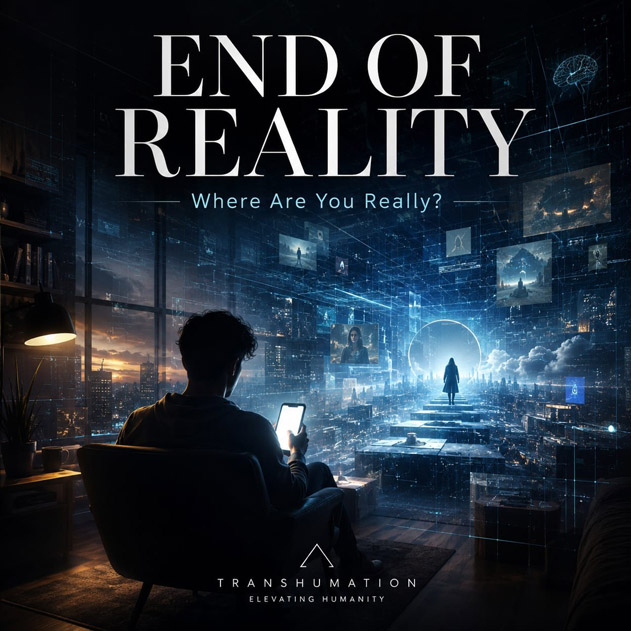
Where Are You Really?
For most of human history, reality seemed simple. You were where your body was, and the world existed around you as a stable physical environment. Space had clear boundaries, presence meant occupying a particular place, and if you were sitting in a room, then that room was where you existed.
Technology is beginning to weaken this assumption. Your body may still be sitting in one place, but your attention can be somewhere else entirely. You can speak to someone on another continent, explore a digital world, attend a meeting with no physical location, or become absorbed in events taking place far beyond your immediate surroundings. The body remains still, but experience moves.
You Are No Longer in One Place
Right now, you may be holding a phone or looking at a screen. Physically, you are surrounded by walls, furniture, light, and objects, yet your awareness is interacting with a digital environment that does not exist inside the room.
So where are you? Are you where your body is located, inside the interface, or somewhere between physical and digital space? This is no longer only a philosophical question. It has become an ordinary part of daily life.
We increasingly exist across several layers at once: physical environments, digital interfaces, social networks, and informational systems. We move between these layers so quickly that we rarely notice the transition.
Reality Is Becoming an Interface
For thousands of years, reality was defined mainly by matter. Something was real because it could be touched, occupied, or physically encountered. Today, many of the most important parts of human life are no longer tied to stable physical objects.
Money exists inside databases. Friendships develop through messages and profiles. Careers are built through digital platforms. Communities form without territory, and reputations can be created or destroyed inside systems that have no physical location.
Reality is therefore becoming defined not only by matter, but also by access. What matters is no longer only what physically surrounds you, but what your interface allows you to perceive, enter, and influence. Reality becomes programmable, expandable, and increasingly personalized.

The End of Location
Location once determined human possibility. Where you lived shaped what you knew, whom you could meet, and which opportunities were available to you. Distance separated people, cultures, and information.
Digital civilization is gradually reducing the importance of geography. You can work in one country while living in another, attend a class without entering a classroom, or participate in a community whose members may never meet physically.
To enter a place no longer always requires moving the body. Sometimes it requires only activating the correct connection. This does not mean that physical location has disappeared. Bodies still need shelter, food, energy, and protection. But conscious participation is becoming less dependent on where the body happens to be.
Consciousness Without Coordinates
If experience is no longer completely tied to physical location, what determines where a person is? Biologically, the answer appears simple: you remain wherever your brain and body are located. Lived experience, however, is more complicated.
When you become absorbed in a film, game, conversation, or digital environment, the physical room can temporarily disappear from awareness. You stop noticing the walls, the temperature, and the passage of time. Your body remains present, but your experienced reality changes.
This suggests that presence is not identical to location. Presence may depend on where consciousness is active. You are not only where your body stands, but also where your attention, intention, and perception are being organized.
The Illusion of One Shared Reality
We still speak about reality as though everyone experiences the same world. Physically, we share one planet. Informationally, however, reality is already fragmented.
Different people receive different news, recommendations, images, and interpretations of events. Algorithms construct personalized environments based on previous behavior. Two people can sit beside one another while inhabiting completely different informational worlds.
One person sees danger while another sees opportunity. One sees evidence while another sees manipulation. There may still be one physical world, but there is no longer one universally shared experience of it. Reality is becoming layered.
Reality as Something You Enter
As virtual reality, artificial intelligence, and augmented environments develop, reality may increasingly become something a person enters rather than something passively received.
Different environments could be designed for work, education, entertainment, relationships, or exploration. Each could have its own appearance, social rules, identities, and sense of time. Some worlds may imitate physical reality, while others may have no physical equivalent at all.
At that point, the distinction between real and artificial may become less important. A virtual event can create a real memory. A digital relationship can produce real attachment. A simulated environment can cause real fear, joy, or grief. The environment may be artificial, but the experience is not.
Who Controls Reality?
A programmable reality also creates a problem of power. Whoever controls the interface can influence what people see, what they can access, and how they understand the world.
A physical government controls territory. A digital platform controls visibility. It can amplify certain ideas, hide others, change the rules, or remove someone from a community entirely.
Future virtual worlds could control even more: identity, appearance, movement, information, and the structure of interaction itself. The future of reality will therefore depend not only on technology, but also on ownership. Who builds the environment, who writes its rules, and who has the power to switch it off?
The End of Reality
The end of reality does not mean that the physical universe disappears. Matter will still exist, bodies will still occupy space, and objects will still follow physical laws. What changes is the privileged position of physical reality.
It may no longer be the only environment in which meaningful existence can occur. Reality becomes layered rather than singular, dynamic rather than fixed, and interactive rather than passive. The physical world may remain the foundation beneath all other realities, but it will no longer be the only one.
For centuries, philosophy asked: what is real? Technology introduces a different question: where does reality happen?
Perhaps reality is not simply the place where the body exists. Perhaps it is wherever consciousness becomes active.
So the final question is no longer what is real, but where are you inside it?
Frequently Asked Questions
1. What does “the end of reality” mean?
It means that physical reality may no longer be the only environment in which meaningful human experiences take place.
2. Are digital experiences real?
They can create genuine memories, emotions, relationships, decisions, and consequences, even when the environment itself is virtual.
3. Can a person exist in more than one place?
The body remains in one physical location, but attention, identity, and activity can operate across several digital environments.
4. Is consciousness tied to the body?
Current human consciousness depends on the biological brain, but conscious attention can be directed far beyond the body’s immediate surroundings.
5. Why is reality becoming fragmented?
Personalized media, algorithms, cultures, and digital networks expose people to different versions and interpretations of the world.
6. Could virtual reality replace the physical world?
It may replace some activities, but it is more likely to create additional layers of experience rather than eliminate physical reality.
7. Who may control future digital realities?
Technology companies, governments, platform owners, and system designers may control access, rules, visibility, and identity within them.
8. What is the main question of the article?
The article asks whether reality should be defined by physical location or by the place where consciousness and experience become active.
Continue the Transhumation Series
Explore the full journey:
- End of Reality — Where Do You Really Exist?
- End of Physics — Are the Laws of Reality Real?
- End of the Real World — Reality Is No Longer Required
- End of Consciousness — Beyond the Human Mind
- End of Death — When Human Limits Disappear
- End of Religion — When Technology Replaces Faith