
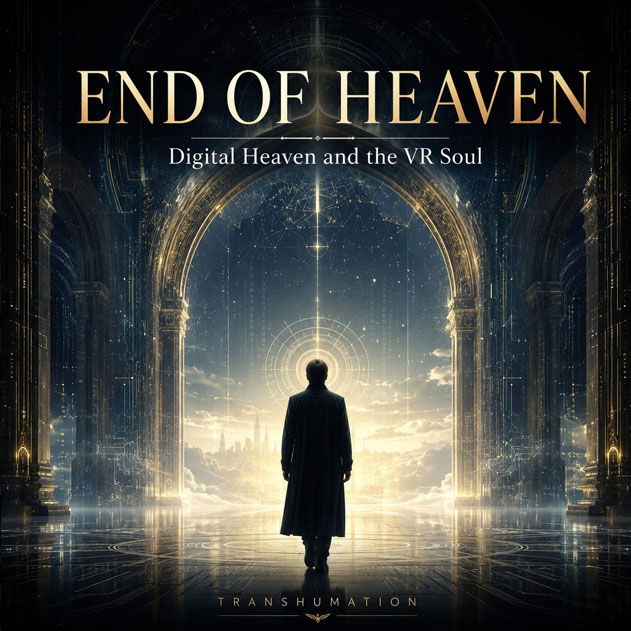
Transhumanism is transforming how we understand reality, consciousness and the future of humanity.
For most of history, eternal life belonged to religion.
Heaven was imagined as a realm beyond death.
A place outside ordinary time.
A world in which consciousness could continue after the biological body disappeared.
Today, technology is beginning to produce a new version of the same dream.
Artificial intelligence, virtual reality, brain-computer interfaces and digital simulation are changing the relationship between mind and matter.
The possibility of eternal existence is no longer discussed only in temples, myths and sacred texts.
It is also discussed in laboratories, technology companies and computer science departments.
Heaven may not disappear.
It may become technological.
The End of Heaven
The phrase End of Heaven does not necessarily mean that humanity will stop believing in transcendence.
It may mean that heaven will no longer be imagined exclusively as a supernatural place.
For thousands of years, religion offered a solution to the problem of death.
The body would die, but the soul would continue.
Earthly suffering would end.
Identity would be preserved.
Loved ones could be encountered again.
Existence would continue in a purified and permanent form.
These ideas answered one of the deepest human fears: that consciousness might simply stop.
But what happens when technology begins to offer its own mechanisms of continuity?
What happens when memories can be stored externally?
What happens when personality can be modeled?
What happens when artificial environments become indistinguishable from physical reality?
What happens when the nervous system can communicate directly with digital systems?
At that moment, heaven stops being only a theological question.
It becomes an engineering problem.
The Ancient Dream of Eternal Continuation
The image of paradise appears in many cultures.
Its details vary, but the structure is often similar.
Death is not final.
The individual continues.
Pain disappears.
Time loses its destructive power.
The self enters a more stable form of existence.
Traditional heaven is usually described symbolically because it lies beyond ordinary human experience.
It cannot be visited physically.
It cannot be measured.
It cannot be reproduced.
It must be imagined through light, gardens, cities, music, reunion and peace.
But these symbols may express a more basic human desire.
The desire is not necessarily to live forever inside the same body.
It is to preserve consciousness beyond the limits of biology.
The human being wants the story to continue.
Technology may be creating a new language for this ancient desire.
From Metaphysical Heaven to Digital Heaven
A digital heaven would not need to exist outside the universe.
It could exist inside a technological system.
A sufficiently advanced virtual environment could theoretically contain landscapes, cities, relationships and experiences without many of the limits found in physical life.
Space could be generated.
Time could be accelerated, slowed or reorganized.
Bodies could be changed.
Pain could be removed.
Memories could be restored.
The dead could potentially be reconstructed from preserved information.
In such a world, paradise would no longer be located above the clouds.
It would exist in computation.
This possibility remains speculative.
Current technology cannot upload a human consciousness or prove that a digital simulation could possess genuine subjective experience.
But the direction of development is already visible.
Humanity is building increasingly immersive virtual worlds.
Artificial systems can imitate personalities.
Digital identities survive beyond individual moments.
Machines can remember parts of our lives.
The first components of digital continuation already exist, even though they remain primitive and disconnected.
The VR Soul
The idea of the soul traditionally refers to the essential part of a person that survives physical death.
It carries identity, memory or moral essence beyond the body.
Technology introduces a different question.
Could the functional elements of the soul be reproduced digitally?
Could memory be preserved?
Could personality patterns continue?
Could relationships survive?
Could an artificial system respond as a deceased person might have responded?
A digital reconstruction could remember a person’s voice, language, preferences and history.
It could interact with relatives.
It could continue producing messages.
It could appear inside a virtual environment using a familiar body.
But would this reconstruction be the person?
Or would it only be a sophisticated representation?
This is the central problem of the VR soul.
Technology may eventually recreate everything that can be observed from the outside.
It may reproduce behavior, memory and emotional responses.
But consciousness is experienced from the inside.
A digital being could claim to feel alive.
It could insist that it is the original person.
Yet there may be no external test capable of proving whether subjective continuity truly survived.
Digital heaven therefore depends on more than accurate simulation.
It depends on the nature of consciousness itself.
Is Consciousness Information?
Many technological visions of immortality begin with a simple assumption.
The mind is information.
The brain processes signals.
Memories are encoded in neural structures.
Personality emerges from patterns of activity.
If these patterns could be mapped and reproduced, perhaps consciousness could also be transferred.
But information alone may not be enough.
A description of a fire does not burn.
A model of a storm is not wet.
A perfect map of the brain may not automatically generate experience.
The question is whether consciousness appears whenever the correct informational process occurs, or whether it depends on specific biological conditions that cannot easily be reproduced.
If consciousness is substrate-independent, then it may be able to exist in biological tissue, silicon or another computational medium.
If consciousness depends fundamentally on living biology, then a digital copy may never become more than an imitation.
The future of technological heaven may depend on which of these possibilities is correct.
The Copy Problem
The classical mind-upload scenario imagines a brain being scanned and copied into a machine.
The digital version wakes up with the same memories.
It recognizes the same people.
It believes itself to be the original.
From the outside, the upload may appear successful.
But the biological person still faces death.
This creates a serious philosophical problem.
If the original consciousness ends while the copy continues, then the technology has preserved information but not necessarily the person.
The copy may enter digital heaven.
The original may experience nothing.
This is why technological immortality cannot be reduced to duplication.
A digital afterlife filled with perfect copies might preserve cultural and emotional continuity for the living.
It might allow descendants to communicate with simulations of the dead.
But it would not automatically prove that anyone had survived.
The difference between copying and continuing is the difference between a monument and immortality.
Continuity Instead of Duplication
A different model of digital immortality focuses on gradual continuity.
Instead of copying the mind after death, consciousness could slowly become integrated with technological systems while the biological person remains alive.
External memory could become part of ordinary recall.
Artificial intelligence could become part of decision-making.
Neural implants could extend perception.
Brain-computer interfaces could connect biological thought directly with digital networks.
Over time, the boundary between the human mind and its technological extensions might become difficult to identify.
The process would not involve a sudden jump from body to machine.
It would involve gradual expansion.
In this model, digital heaven would not be a destination entered after death.
It would be a world that consciousness slowly learns to inhabit before biological death occurs.
The person would not be copied into paradise.
The person would grow into it.
Heaven as an Interface
Traditional descriptions of heaven often focus on what it contains.
Light.
Peace.
Beauty.
Music.
Reunion.
But a technological heaven may be better understood as an interface.
It would mediate between consciousness and experience.
The physical world already works through interfaces.
The eyes translate light.
The ears translate vibration.
The nervous system converts external events into internal experience.
Human beings never encounter reality without mediation.
They encounter signals interpreted by biological systems.
Virtual reality creates another layer of mediation.
A headset can generate visual space.
Speakers can generate an acoustic world.
Haptic systems can imitate touch.
Brain interfaces may eventually stimulate experience without relying on ordinary sensory organs.
If experience is always mediated, then a sufficiently advanced digital environment may feel no less real than physical life.
The difference between world and simulation could become psychologically irrelevant.
Heaven would not need to be a separate metaphysical universe.
It would need to be an interface capable of sustaining meaningful conscious experience.
Could Digital Heaven Feel Real?
People sometimes dismiss virtual existence by saying that it would not be real.
But reality is not experienced directly.
Human consciousness depends on sensory interpretation.
Color is not contained inside objects in the form we experience it.
Sound does not exist as music before the brain interprets vibration.
The feeling of physical presence is produced by a coordinated biological system.
A digital environment that could stimulate the same processes might feel completely real.
It could potentially feel more vivid than ordinary reality.
Physical laws could be modified.
Bodies could be redesigned.
Distance could disappear.
Memory could become accessible.
Entire environments could respond instantly to thought.
The meaning of reality would then shift.
A world might be considered real not because it is made of physical matter, but because conscious beings genuinely experience it.
From this perspective, digital heaven would not need to imitate Earth perfectly.
It would need to sustain awareness, agency, relationship and continuity.
Paradise Without Scarcity
Many traditional images of heaven remove the limits that define biological life.
There is no hunger.
No disease.
No aging.
No permanent separation.
No competition for survival.
Technology may eventually attempt to reproduce the same conditions.
In a virtual environment, physical resources could become less important.
A digital body would not need food.
Virtual space could be expanded.
Objects could be copied.
Environments could be customized.
Individual experience might no longer depend on access to scarce physical goods.
But scarcity would not disappear completely.
Computation requires energy.
Digital systems require maintenance.
Access could be controlled.
Power could remain concentrated in institutions.
A digital heaven could reproduce existing hierarchies instead of eliminating them.
The most dangerous question may therefore not be whether digital paradise is possible.
It may be who owns it.
Who Controls Digital Eternity?
Religious heaven is usually understood as belonging to a divine order.
Technological heaven would be built and maintained by human or artificial institutions.
Someone would control the servers.
Someone would design the rules.
Someone would decide who receives access.
Someone would determine which memories can be modified, which environments are permitted and whether an individual can leave.
This creates the possibility of digital paradise, but also digital captivity.
A virtual afterlife controlled by a corporation could become the final subscription service.
A state could monitor consciousness.
An artificial intelligence could regulate behavior.
A person might continue existing indefinitely while possessing less freedom than during biological life.
The technology of immortality would therefore also be a technology of power.
The system that preserves consciousness could potentially edit, duplicate, suspend or erase it.
A digital heaven without autonomy could become indistinguishable from a perfectly designed prison.
The Religion of Technology
Transhumanism is often presented as a secular philosophy.
It speaks the language of science, progress and engineering.
Yet many of its promises resemble religious promises.
The defeat of death.
Transformation of the body.
Expansion of consciousness.
Creation of superior beings.
Reunion with preserved personalities.
Existence beyond physical limitation.
A future technological civilization could offer its own version of salvation.
Engineers could replace priests.
Laboratories could replace temples.
Data could replace sacred memory.
The upload could replace resurrection.
Simulation could replace heaven.
This does not mean that transhumanism is simply religion disguised as science.
Its methods and claims are different.
Scientific ideas must be tested.
Technological systems must function.
But the emotional structure may be similar.
Both religion and transhumanism attempt to answer the same human problem.
How can consciousness survive death?
“Death Is a Choice”
The phrase death is a choice can sound absurd or insensitive when applied to the present.
Death is not currently a choice for most people.
Human beings remain vulnerable to illness, injury, aging and biological failure.
No existing technology offers genuine immortality.
The phrase should therefore be treated as a philosophical horizon rather than a present fact.
Over very long periods, intelligent civilizations may develop increasingly powerful survival strategies.
They may repair biological bodies.
Replace organs.
Reverse some forms of aging.
Preserve brains.
Create artificial bodies.
Distribute cognition across networks.
Develop environments in which consciousness can continue without ordinary biological dependence.
At some point, death might stop being an unavoidable immediate consequence of aging.
It could become one possible outcome among others.
This would not make existence indestructible.
Digital systems can fail.
Civilizations can collapse.
Stars eventually die.
The universe itself may impose final limits.
But intelligence could extend its duration far beyond the natural human lifespan.
Death might become less automatic, even if it never becomes impossible.
Immortality as a Civilizational Strategy
Transhumation approaches transhumanism not only as personal enhancement, but as a long-term survival strategy for intelligence.
Biological life is fragile.
Bodies age.
Species disappear.
Planets become uninhabitable.
Civilizations can collapse.
Over cosmic timescales, a purely biological intelligence may have limited chances of survival.
Technological transformation could allow consciousness to exist in more adaptable forms.
Digital systems could travel where human bodies cannot.
Artificial substrates could survive extreme environments.
Distributed intelligence could reduce dependence on a single planet or organism.
Virtual worlds could provide stable habitats during long journeys through space.
From this perspective, digital heaven is not merely a private fantasy about avoiding death.
It may become part of a larger strategy for preserving intelligence in the universe.
The survival of consciousness could require the transformation of consciousness.
Heaven as Evolution
Traditional religion often presents heaven as the end of the human journey.
A final state.
A completed world.
A permanent destination.
Technological heaven might be different.
It may continue evolving.
New forms of perception could emerge.
Individual minds could merge temporarily or exchange memories.
Time could be experienced differently.
Identity could become more flexible.
Consciousness could explore environments impossible within physical biology.
Paradise would not necessarily mean eternal stillness.
It could mean unlimited transformation.
In this sense, digital heaven would not be the end of evolution.
It would be evolution moving beyond the biological body.
The human form might become one stage in a much longer history of intelligence.
Would We Still Be Human?
A consciousness living inside a technological system might retain human memories and emotions.
It might still recognize family.
It might still experience love, curiosity, fear and attachment.
But over centuries or millennia, it could change beyond recognition.
A digital mind could think faster.
Store more memory.
Create copies of itself.
Combine with other minds.
Modify its personality.
Experience multiple environments at once.
At what point would it stop being human?
There may be no clear boundary.
Human identity has always changed through language, culture and technology.
A future digital consciousness could still descend from humanity without remaining biologically human.
The question may not be whether it remains human forever.
The question may be whether continuity remains strong enough for the being to recognize its own history.
The Return of the Soul
Modern science often avoids the language of the soul because the term carries religious and metaphysical assumptions.
But technology may force the question to return in a new form.
What must be preserved for a person to remain themselves?
Memory?
Personality?
Embodied experience?
Relationships?
Moral character?
A continuous stream of awareness?
The soul may reappear not as a supernatural object, but as a name for the problem of personal continuity.
Engineers attempting to preserve the mind would eventually need to answer questions once left to philosophers and theologians.
What is essential?
What can change?
What must remain connected?
When does a copy become a person?
When does continuation become replacement?
The technological soul may not be discovered inside a machine.
It may emerge from the attempt to define what cannot be lost without losing the self.
The First Glimpses of Digital Eternity
Digital heaven remains far beyond current technological capabilities.
Yet early fragments of the idea already surround us.
People preserve photographs, messages and recordings online.
Social profiles remain visible after death.
Artificial intelligence can imitate voices and writing styles.
Virtual environments allow people to inhabit digital identities.
Medical devices connect directly to nervous systems.
Brain-computer interfaces are beginning to translate neural activity into commands.
None of these technologies provides immortality.
But together they reveal a direction.
Human identity is becoming increasingly externalized.
Memory is becoming distributed.
Relationships continue through digital traces.
The boundary between person and system is becoming less absolute.
What appears today as a collection of separate tools may later be understood as the primitive beginning of technological continuity.
The Question Is No Longer Only Spiritual
For thousands of years, the destiny of consciousness belonged mainly to religion and philosophy.
Science could describe the body.
It could observe the brain.
But it could not offer a mechanism through which personal existence might continue after death.
That division may be changing.
The future of consciousness is becoming a technological question.
Can the mind be extended?
Can experience exist in artificial systems?
Can identity survive a change of substrate?
Can virtual worlds become permanent homes for conscious beings?
Can continuity be preserved without duplication?
These questions remain unanswered.
Some may remain unanswered for a very long time.
But they are no longer meaningless.
Technology has moved them from pure mythology toward theoretical possibility.
The Long-Term Destiny of Intelligence
Digital heaven is not simply a futuristic version of religious paradise.
It is a question about what intelligence becomes when it is no longer confined to fragile biology.
Perhaps ancient visions of heaven were symbolic intuitions about continuity.
Perhaps they expressed the hope that consciousness belongs to something larger than the body.
Technology now offers a different path toward the same horizon.
Not divine rescue.
Not supernatural resurrection.
But gradual integration, preservation and transformation.
The future may not abolish heaven.
It may reconstruct it.
The soul may become a process.
Paradise may become an environment.
Resurrection may become restoration from information.
Eternity may become a technical problem of continuity, energy and memory.
And transhumanism may become the first religion whose heaven must be engineered.
FAQ
What is digital heaven?
Digital heaven is a hypothetical technological environment in which consciousness, identity or a digital reconstruction of a person could continue beyond biological death. It may involve virtual reality, artificial intelligence, brain-computer interfaces and advanced forms of simulation.
Is digital heaven currently possible?
No. Current technology cannot upload human consciousness or prove that subjective awareness can exist in a digital system. Digital heaven remains a philosophical and speculative concept based on possible future developments.
What is the VR soul?
The VR soul is the idea that the essential features of a person, such as memory, personality, identity and relationships, could continue inside a virtual environment. The concept raises the question of whether a digital reconstruction would truly be conscious or merely imitate the original person.
Is transhumanism a religion?
Transhumanism is generally described as a philosophical and technological movement rather than a religion. However, it shares several themes with religion, including the defeat of death, transformation of the human body, transcendence and the continuation of consciousness.
How is digital heaven similar to traditional heaven?
Both concepts involve existence beyond biological death, preservation of identity, freedom from physical suffering and the possibility of continuing relationships. The main difference is that traditional heaven is metaphysical, while digital heaven would depend on technology.
Could consciousness be uploaded into a computer?
There is currently no evidence that consciousness can be uploaded. Even if the brain could be perfectly copied, it would remain unclear whether the digital version preserved the original subjective experience or created a separate conscious being.
What is the difference between mind uploading and digital copying?
Mind uploading implies that the person’s consciousness continues inside a technological system. Digital copying creates a new version containing the same memories and personality. A copy may behave like the original without guaranteeing that the original consciousness survived.
Could gradual integration solve the mind-upload problem?
Gradual integration may offer a stronger model of continuity than sudden copying. If artificial memory, neural interfaces and digital systems become part of the mind while the person is still alive, consciousness might expand into technology rather than being replaced by a copy.
Would life inside virtual reality feel real?
A sufficiently advanced virtual environment could potentially feel real because human experience is already mediated by the brain and senses. If a system could reproduce the relevant sensory and cognitive processes, the difference between physical and virtual reality might become difficult to perceive.
Would digital heaven eliminate pain and scarcity?
It could potentially eliminate some biological forms of pain, illness and material scarcity. However, digital existence would still depend on energy, computation, system maintenance and political control. New forms of scarcity and inequality could appear.
Who would control a digital afterlife?
A technological afterlife would be controlled by whoever owned or governed the infrastructure. This could include governments, corporations, artificial intelligence systems or decentralized networks. Ownership and autonomy would become major ethical concerns.
Could a digital heaven become a prison?
Yes. A virtual environment could become oppressive if individuals lacked control over their memories, bodies, surroundings or ability to leave. A system capable of preserving consciousness could also potentially monitor, modify, duplicate or suspend it.
What does “death is a choice” mean?
It does not describe current reality. It expresses a long-term philosophical possibility that advanced civilizations may eventually develop alternatives to ordinary biological death, such as radical life extension, artificial bodies or digital continuation.
Could digital minds live forever?
Probably not in an absolute sense. Digital systems would still depend on energy, hardware and stable civilization. However, they might survive far longer than biological bodies and could potentially be copied, repaired or distributed across multiple locations.
Would a digital consciousness still be human?
It might initially retain human memories, emotions and identity. Over long periods, however, a digital consciousness could evolve beyond ordinary human limitations and become a new form of post-biological intelligence.
Is the soul the same as information?
That remains an open philosophical question. Memory and personality may be described as informational patterns, but it is unknown whether subjective consciousness can be reduced entirely to information.
How do brain-computer interfaces relate to digital immortality?
Brain-computer interfaces may eventually connect biological cognition directly with digital systems. They could become an early step toward external memory, artificial perception, distributed intelligence and gradual technological extension of the mind.
Could AI recreate a deceased person?
AI can already imitate aspects of a person’s voice, writing style and behavior using preserved data. Future systems may create more convincing reconstructions, but imitation would not prove that the deceased person’s consciousness had returned.
Why does Transhumation describe immortality as a cosmic strategy?
Over cosmic timescales, biological life is vulnerable to aging, extinction, planetary disasters and environmental change. Post-biological or distributed intelligence may have a greater chance of surviving across longer periods and larger distances.
Is digital heaven the end of religion?
Not necessarily. It may transform religious questions rather than eliminate them. Even if technology could preserve consciousness, humanity would still face questions about meaning, morality, identity, freedom and the purpose of eternal existence.
What is the main idea of the article?
The central idea is that ancient visions of heaven and modern dreams of technological immortality may express the same desire: the continuation of consciousness beyond biological death. Transhumanism turns this desire from a purely spiritual hope into a possible long-term technological project.
Continue the Transhumation Series
Explore the full journey:
- End of Reality — Where Do You Really Exist?
- End of Physics — Are the Laws of Reality Real?
- End of the Real World — Reality Is No Longer Required
- End of Consciousness — Beyond the Human Mind
- End of Death — When Human Limits Disappear
- End of Religion — When Technology Replaces Faith