
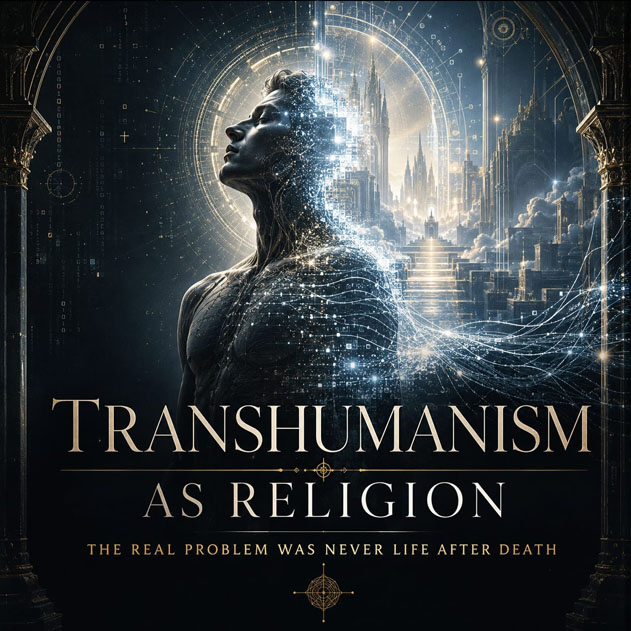
The Real Problem Was Never Death
For thousands of years religions have focused on one central question: what happens after we die?
Entire belief systems were built around the promise of life after death. Heaven, reincarnation, resurrection, paradise. Different traditions offered different answers, but the underlying assumption remained the same — death was the central problem of human existence.
But what if this assumption was wrong?
What if the real problem was never life after death?
The Real Problem: Losing Consciousness
When people fear death, they usually imagine a moment when the body stops functioning. But biologically speaking, death is not really about the body.
The real loss is the disappearance of consciousness.
What disappears is the unique perspective through which a mind experiences reality — memories, identity, personality, thoughts. Everything that we consider “ourselves” is tied to the continuation of conscious processes.
From this perspective, the true problem is not what happens after death.
The real problem is how consciousness can continue.
Religion as a Promise of Continuity
Traditional religions tried to solve this problem through metaphysical explanations.
They proposed that the soul survives the body and continues in another realm. Heaven became the symbolic answer to the fear of losing consciousness forever.
However, these explanations relied on faith rather than mechanisms. They described continuation, but they did not explain how such continuation would actually occur.
This is where transhumanism introduces a radically different approach.
Transhumanism and the Technological Continuation of Mind
Transhumanism suggests that the continuation of consciousness may eventually become a technological problem rather than a purely metaphysical one.
If consciousness emerges from complex information processes in the brain, then in principle those processes might one day be preserved, replicated, or transferred into other substrates.
Digital environments, advanced artificial intelligence, and brain-computer technologies could make it possible to maintain conscious experience beyond the biological limits of the human body.
In this sense, the ancient religious promise of immortality might eventually be approached through science and technology.
A New Interpretation of “Heaven”
If consciousness could exist within digital environments or artificial substrates, then the idea of heaven might take on a completely new meaning.
Instead of a supernatural world beyond the universe, heaven could become an engineered environment designed to sustain conscious experience indefinitely.
Virtual worlds, simulated realities, and advanced computational systems might one day host minds capable of continuing their existence long after biological death.
In this vision, heaven would not be discovered.
It would be built.
Rethinking the Ancient Question
For millennia humanity has asked the wrong question.
The real issue is not what happens after death.
The real question is whether consciousness itself can be preserved, extended, or transformed through technology.
If it can, then the ancient religious hope for immortality may not disappear — it may simply evolve into a new form.
A form where the future of consciousness is shaped not only by belief, but by knowledge and creation.
Frequently Asked Questions
1. Is transhumanism a religion?
Transhumanism is not a religion in the traditional sense. However, it addresses many of the same questions about death, immortality, identity and the future of human consciousness.
2. What is the real problem with death?
From the perspective of this article, the central problem is not the death of the body itself, but the possible disappearance of consciousness, memory, identity and personal experience.
3. Can consciousness survive biological death?
At present, there is no scientific evidence that human consciousness can survive biological death. Transhumanism explores whether future technologies could preserve or extend conscious processes.
4. What is mind uploading?
Mind uploading is the hypothetical process of transferring or reconstructing the information and processes of a human mind within a digital or artificial system.
5. Would a digital copy still be the same person?
This remains one of the most difficult questions in philosophy and neuroscience. A copy may preserve memories and personality, but it is unclear whether it would preserve the original continuity of consciousness.
6. Could technology create a form of heaven?
In theory, advanced virtual environments could one day host digital minds or conscious entities. Such a world would be engineered rather than supernatural.
7. How is transhumanist immortality different from religious immortality?
Religious immortality usually depends on the survival of the soul. Transhumanist immortality would depend on technology, information preservation and the continuation of mental processes.
8. Is technological immortality currently possible?
No. Technologies such as brain-computer interfaces, artificial intelligence and neural mapping are developing, but true preservation or transfer of human consciousness remains speculative.
Continue the Transhumation Series
Explore the full journey:
- End of Reality — Where Do You Really Exist?
- End of Physics — Are the Laws of Reality Real?
- End of the Real World — Reality Is No Longer Required
- End of Consciousness — Beyond the Human Mind
- End of Death — When Human Limits Disappear
- End of Religion — When Technology Replaces Faith