
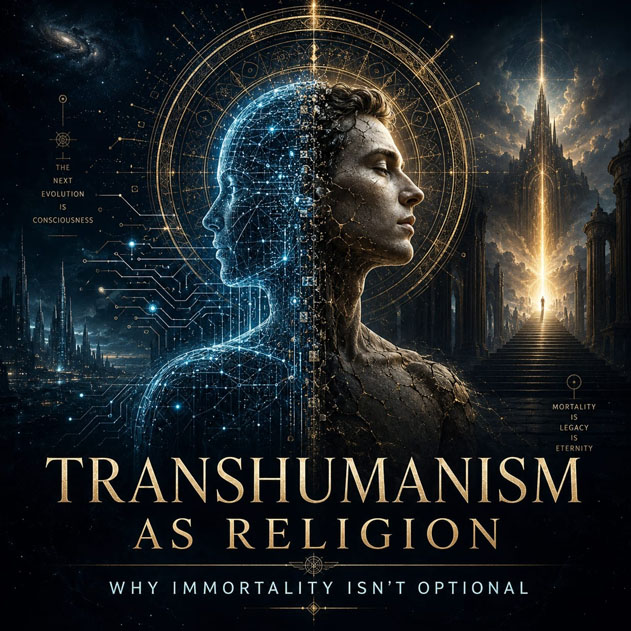
Why Immortality Isn’t Optional
For most of human history, immortality was treated as a dream, a myth, or a divine reward reserved for the afterlife. Religious traditions promised eternal life, but always in a world beyond this one.
In modern times, however, a new perspective has begun to emerge. Through science and technology, immortality is no longer discussed only as a spiritual idea, but as a potential future of intelligent life.
From the perspective of transhumanism, the question is no longer whether immortality would be desirable.
The deeper question is whether immortality might actually be necessary.
The Fragility of Biological Life
Human life is built on an extremely fragile biological foundation. Our bodies age, deteriorate, and eventually stop functioning. Evolution never designed humans to live indefinitely. Its only goal was reproduction and survival long enough to pass genes to the next generation.
But intelligence changes the equation.
Once a species becomes aware of its own existence, mortality begins to appear less like a natural feature of life and more like a technical limitation.
The ability to think about the future creates a fundamental tension: intelligent beings want continuity, yet their biology guarantees an ending.
Intelligence and the Drive to Continue
Throughout history, humans have always tried to extend life.
Medicine, science, and technology have consistently pushed the boundaries of survival. Vaccines eliminated diseases that once devastated populations. Modern medicine dramatically increased human life expectancy. Biotechnology and artificial intelligence are now opening possibilities that would have been unimaginable a century ago.
This pattern suggests something important.
Intelligence naturally moves toward preserving itself.
Once a civilization reaches a certain level of technological development, extending the duration of conscious existence becomes one of its most logical goals.
Immortality as a Technological Path
Transhumanism proposes that immortality may not require mystical forces or supernatural intervention. Instead, it may emerge from advances in fields such as neuroscience, artificial intelligence, and digital computation.
If consciousness arises from information processes within the brain, then preserving or recreating those processes could allow conscious experience to continue beyond biological limitations.
Digital environments, advanced simulations, and artificial substrates might eventually host minds capable of existing independently of fragile biological bodies.
In that sense, immortality becomes less like a miracle and more like an engineering challenge.
A New Evolutionary Stage
If technological civilizations eventually achieve the ability to preserve consciousness indefinitely, the nature of evolution itself could change.
Biological evolution operates through slow genetic changes across generations. Technological evolution, however, can happen at an accelerating pace. Digital minds, artificial intelligence, and advanced computational systems might allow intelligence to expand far beyond its original biological form.
From this perspective, immortality is not simply about avoiding death.
It may represent the transition from biological life to a new stage of intelligent existence.
The Future of Consciousness
The idea that immortality might become possible raises profound philosophical questions. What would it mean to exist without a fixed lifespan? How would identity evolve across centuries or millennia? How would societies change if death were no longer inevitable?
Yet regardless of how these questions are answered, one thing appears increasingly clear.
The continuation of consciousness may become one of the central goals of advanced civilizations.
For a species capable of understanding its own existence, immortality may not be merely an optional dream.
It may be the natural direction of intelligence itself.
Frequently Asked Questions
1. Why might immortality not be optional?
From a transhumanist perspective, intelligent life naturally attempts to preserve itself. Once a civilization understands mortality and develops the tools to resist it, extending conscious existence may become a logical goal rather than a personal luxury.
2. Is immortality scientifically possible today?
No. Modern science can extend life and treat many diseases, but indefinite biological life or the technological continuation of consciousness is not currently possible.
3. What does transhumanism mean by immortality?
Transhumanist immortality may include radical life extension, biological rejuvenation, replacement of failing organs, digital consciousness, or existence within an artificial substrate.
4. Why is biological life considered fragile?
Human bodies are vulnerable to aging, disease, injury and environmental conditions. Biological systems also deteriorate over time, placing natural limits on human lifespan.
5. Could artificial intelligence help humans achieve immortality?
Artificial intelligence could support medical research, drug discovery, brain mapping and the development of advanced simulations. However, it is still unknown whether AI could help preserve genuine human consciousness.
6. Would mind uploading make a person immortal?
Mind uploading could theoretically preserve memories, personality and mental patterns. The unresolved problem is whether the uploaded mind would be the original person or only a highly accurate copy.
7. How could immortality change human evolution?
Immortality could shift evolution away from slow biological change toward technological modification. Intelligence might increasingly exist in digital, artificial or hybrid forms.
8. Would immortality solve every human problem?
No. It could create new problems involving identity, inequality, resources, power and psychological adaptation. A longer existence would not automatically guarantee a better one.
Continue the Transhumation Series
Explore the full journey:
- End of Reality — Where Do You Really Exist?
- End of Physics — Are the Laws of Reality Real?
- End of the Real World — Reality Is No Longer Required
- End of Consciousness — Beyond the Human Mind
- End of Death — When Human Limits Disappear
- End of Religion — When Technology Replaces Faith