
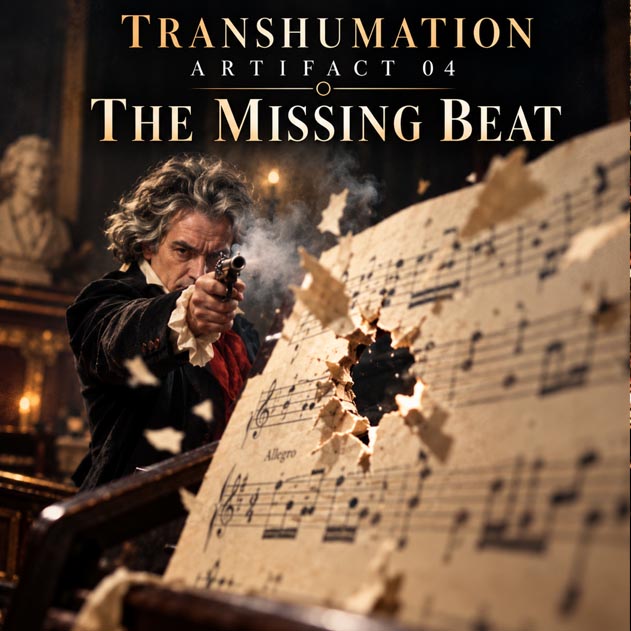
The Missing Beat
There are moments in science when a complicated theory can be demonstrated with astonishing simplicity. Galileo did not require a particle accelerator to challenge centuries of accepted wisdom. Newton needed only a falling apple to ask a better question. In much the same way, one of the deepest questions in information theory can be explored with an object that most people have forgotten even exists: a mechanical metronome. It produces no melody, tells no story and expresses no emotion. It merely divides time into perfectly regular intervals. Yet if you listen carefully, that little machine reveals something profoundly unsettling. Remove a single beat from its rhythm and the human mind immediately begins manufacturing information that is not physically present.
This observation seems almost trivial until one asks where that missing beat came from. No sound wave reached the ear. No vibration travelled through the air. The metronome remained silent. Nevertheless, almost every listener experiences a distinct sensation that something should have happened. We do not merely notice the absence of sound; we experience the absence as an event in its own right. Somehow nothing has become something. The silence has acquired weight.
For centuries we have tended to imagine information as a property of objects. A book contains information because words have been printed upon its pages. A hard drive contains information because microscopic electrical states have been arranged in meaningful patterns. A musical score contains information because ink marks indicate which notes should be played. This intuition is useful, but it is also incomplete. The missing beat demonstrates that information cannot reside exclusively inside the object itself. If it did, removing one element would simply reduce the amount of information available. Instead, something rather unexpected occurs. The listener contributes what the object no longer provides.
The Brain Is Always One Step Ahead
The metronome works because repetition teaches the observer a rule. After only a handful of beats, the brain stops listening passively and begins predicting the future. This ability is one of the defining characteristics of human perception. We rarely experience the world as a stream of disconnected sensations. Instead, we continuously construct expectations about what is likely to happen next. Vision predicts where moving objects will appear. Language predicts which word will complete a sentence. Music predicts the next note long before it arrives.
That predictive machinery usually remains invisible because reality obligingly behaves as expected. Only when the prediction fails do we become aware that our minds were doing so much work behind the scenes. A delayed train, a misplaced comma, an unexpected silence in a familiar melody—these moments expose the invisible architecture of expectation. The surprise is not created solely by the external event. It arises because our internal model of the world has been contradicted.
This is precisely why the missing beat feels so powerful. The metronome has already persuaded us to believe in its rhythm. When the expected sound fails to appear, the discrepancy exists not in the machine but in us. The silence becomes informative because it collides with a prediction we have already built.

Great Music Is an Exercise in Controlled Absence
Every accomplished composer eventually discovers that precision alone is incapable of sustaining attention. Absolute regularity teaches the listener the pattern with remarkable efficiency, but once that lesson has been learned, further repetition contributes progressively less information. The audience no longer hears individual beats. They anticipate them. Predictability becomes both the strength and the weakness of perfect order.
This is where artistry begins. The greatest moments in music are often created not by adding complexity but by knowing exactly when to remove something. A brief hesitation before a resolution can create more emotional tension than an entire crescendo. A carefully placed rest can feel heavier than the loudest chord. Conductors understand this instinctively. They are not merely organising sounds. They are shaping expectation itself.
One might even argue that silence is among the most sophisticated instruments ever invented. Unlike a violin or a trumpet, it produces nothing at all. Yet in the right context it transforms the emotional meaning of everything surrounding it. The silence does not communicate independently. It borrows its power from the structure that came before it.
Every Illusion Depends Upon the Same Principle
The architecture of magic differs remarkably little from the architecture of music. A magician succeeds not because impossible things happen, but because the audience has first been persuaded to expect something entirely ordinary. The spectator believes they understand the rules of the performance. Only then can those rules be quietly violated.
Beginners often imagine that the secret of illusion lies in dexterous hands or hidden compartments. Experienced performers know better. The true secret is expectation. The trick begins long before the impossible event occurs. It begins when the audience unconsciously accepts a model of reality that the magician has carefully constructed.
The missing beat belongs to the same family of phenomena. It is, in effect, a magic trick performed without deception. The metronome teaches a rule, removes one expected event, and quietly allows the observer to complete the performance. The audience unknowingly becomes a collaborator.

Civilizations Are Built Upon Invisible Rhythms
Once this principle becomes visible, it appears almost everywhere. Language depends upon words that remain unspoken because everyone already understands them. Legal systems function because millions of people carry the same assumptions about rules they rarely stop to examine. Markets operate because buyers and sellers share expectations about value that cannot be touched or weighed. Even trust itself consists largely of predictions about future behaviour.
Seen from this perspective, civilization resembles an immense conversation sustained by missing beats. Much of what holds society together never appears explicitly within laws, books or institutions. It exists inside the minds of the people participating in them. Remove enough of those shared expectations and the visible structures remain standing for a while, much like the shell of an abandoned theatre after the orchestra has left.
History repeatedly reminds us that institutions rarely collapse because their buildings disappear. They collapse because the invisible rhythm connecting individuals quietly changes first.
The Conversation Between Structure and Mind
The Missing Beat ultimately proposes a simple but far-reaching idea. Information is not merely stored. It is completed. A message contributes only part of its own meaning. The remainder emerges through the expectations, memories and predictions carried by the observer. Communication is therefore less like transporting a physical object from one place to another than participating in a conversation between structure and consciousness.
This may explain why two people can witness precisely the same event and walk away with entirely different understandings. The message remained unchanged. The minds receiving it did not. Every observer arrives carrying a different history of patterns already learned, different expectations already formed, and different rhythms already internalised.
The missing beat is therefore not an exception. It is a reminder. It reveals that information has never lived entirely inside books, computers or musical scores. It has always occupied the mysterious territory between the world and the mind attempting to understand it.
Perhaps that invisible territory is where civilization itself begins.
How to Read the World

By Alistair Brightworthton
Current Knowledge
Modern neuroscience, cognitive psychology and information theory all support the idea that perception is fundamentally predictive. Rather than passively recording reality, the brain continuously generates expectations and compares incoming sensory information against them. What surprises us often carries more informational value than what merely repeats the established pattern.
Open Questions
If meaning partly exists inside the observer, where exactly does information reside?
Could consciousness itself depend upon predicting reality rather than simply observing it?
How much of what we call memory, identity and culture consists not of stored facts but of learned expectations waiting to be confirmed—or violated?
Transhumation Interpretation
The Missing Beat suggests that information is not an object but a relationship.
Messages do not travel alone.
They recruit minds capable of completing them.
Perhaps every civilization, religion and technology functions in exactly the same way. The visible structure teaches the rule. The invisible observer supplies the rest.
If that is true, the most important part of every message has never been written.
It has always existed inside the person reading it.
FAQ
What is The Missing Beat about?
It explores how the human mind reconstructs missing information once it has learned a pattern. The film demonstrates this principle through rhythm rather than simply explaining it.
Why is silence important in communication?
Silence is meaningful only after a pattern has been established. Once expectations exist, absence becomes information rather than emptiness.
Is this episode about music?
No. Music is used as a laboratory for understanding information, prediction and human perception.
What does „Part of the code is inside the receiver” mean?
It means communication depends on both the message and the observer. Meaning emerges from their relationship rather than from the message alone.
Why does this matter outside music?
The same principle appears in language, history, technology, economics, psychology and everyday life. We constantly complete patterns that are only partially presented.
Continue the Transhumation Series
- Forgotten Religion | Ancient Gods, Symbols and the Hidden Structures of Human Civilization
- The Last Religion | Death, Immortality and the Future of Humanity
- The New Theurgy | AI, Information and the Future of Human Civilization
- End of Branding: You Were Never Meant to Become a Product
- Baal vs Ishtar: Why Ancient Gods Never Disappeared