My Watch Is Worse Than My Phone
When an object loses the function that justified its existence, we discover what else we were keeping.
I own a watch that is worse at telling time than my phone. This is not an insult to the watch. It is a mechanical watch, which means that somewhere inside its small and unnecessarily beautiful body, springs and wheels are performing an elaborate imitation of a number my phone receives almost without effort. The phone is more accurate. It changes time zones without asking me, survives the indignity of daylight saving time, and can tell me what time it is in Tokyo while simultaneously showing me photographs of Tokyo. If the purpose of a watch is to tell the time, the argument should have ended years ago.
And yet I prefer the watch.
This is awkward for a civilization that likes to explain technological change as a sequence of improvements. We imagine that objects exist because they perform functions, and that when another object performs the same function better, the older one should politely disappear. Sometimes that happens. Sometimes it does not. Sometimes an object loses the very function that once justified its existence and, instead of dying, becomes more interesting.
The watch is still here. Which suggests that perhaps we misunderstood what we were keeping.
The Function Can Leave Before the Object Does
Consider a key. For most of its history, a key was an object with an almost comically intimate relationship to its function. Its teeth corresponded to something hidden inside a lock. You carried the shape because the shape was permission. Lose the piece of metal and you lost access; copy the piece of metal and, with sufficient skill, you copied access with it.
Then the metal began to disappear. Hotels replaced keys with cards. Cars learned to recognize transmitters. Phones learned to authenticate us. Doors learned fingerprints and faces. The physical carriers became increasingly unrelated to one another, yet the relationship remained strangely stable: there is somewhere you cannot go, something is presented or recognized, and suddenly you can.
The key survived its own shape.
Buttons performed a similar trick. Once, a button was a piece of material that moved beneath a finger. Then we drew buttons on glass. Later we began removing even the drawing, replacing the finger with a gesture, a voice, a glance or an automatic response to our presence. There is no tiny plastic button hiding beneath the pixels of a touchscreen, but we continue to understand the structure immediately: I do this, therefore that happens.
Perhaps this is the first useful distinction. An object can disappear while a relationship survives.
The Things That Refuse to Become Obsolete
The mechanical watch presents the opposite problem because its object has survived after much of its practical necessity disappeared. Nobody seriously needs a complicated arrangement of gears on the wrist merely to discover that it is 12:17. There are cheaper, easier and more accurate ways to obtain that information. Yet mechanical watches remain, and in some cases become more desirable precisely as their practical superiority declines.
What survived was not simply the measurement of time. Craft survived. Ritual survived. Memory survived. Status survived. The pleasure of a machine whose workings can still be understood by looking closely enough survived. A watch inherited functions that were difficult to notice while telling the time was still its principal excuse for existing.
This happens elsewhere. Vinyl survives streaming. Fountain pens survive keyboards. Printed photographs survive screens. Paper books remain stubbornly present in houses containing devices capable of storing libraries larger than their owners could read in several lifetimes. Calling these objects obsolete misses something important, because obsolescence describes the fate of a function more easily than it describes the fate of an object.
Sometimes function leaves and meaning stays behind.
The Coffee Stain Problem
Books make this considerably more difficult. Suppose I take an old book and reproduce every word perfectly on a screen. Nothing has been omitted from the text. Every sentence, punctuation mark and spelling mistake is present. If your interest is exclusively in what the author wrote, the operation appears remarkably successful.
But now imagine that the original book belonged to your grandfather. He underlined three sentences. Someone wrote a telephone number on the final page. There is a brown ring where a cup was once placed carelessly on the cover, a train ticket used as a bookmark, and a pressed flower between pages 114 and 115. None of these things belongs to the author’s text, yet destroying them may feel like destroying part of the book.
So what exactly were we trying to preserve?
We can photograph the handwriting. We can scan the ticket. We can record the dimensions of the stain with absurd precision and create a three-dimensional model of the flower. Given enough storage and enough patience, more and more of the supposedly irrelevant physical object can be translated into information. But the moment we do this, we reveal that preservation was never merely a technical operation.
It was an editorial decision.
The text can cross the gate. The stain cannot — unless someone decides the stain is information too.
Compression, in other words, is partly a cultural judgment. Before we decide how efficiently something can be preserved, we must decide what counts as the thing.
Civilization’s Most Successful Upload
At this point I should introduce a turd.
Not a real one. That would change the tone of the article and probably several regulations concerning the handling of manuscripts. I mean the small brown smiling character that has somehow earned a permanent position in the visual vocabulary of modern civilization: 💩.
It is an extraordinary object when treated with the seriousness it does not deserve but, for our purposes, requires. Almost every physical property of the thing it represents has been removed. It has no relevant mass, no smell, no bacteria, no digestive history and no biological function. It has acquired eyes and a mouth, which the original generally lacks, and yet recognition is virtually instantaneous.
Something crossed.
The receiver reconstructs what the carrier does not contain. A tiny arrangement of pixels summons association, disgust, comedy, embarrassment and a surprisingly complicated cultural history. The physical resemblance is incomplete to the point of absurdity, yet the symbolic package works because the missing information is supplied by the observer.
This may be one of the cleanest examples of dematerialization available to us precisely because nobody is tempted to mistake it for metaphysics. Nobody points at the emoji and announces that biological waste has achieved immortality. We understand instinctively that representation, recognition and identity are different things.
We should remember that instinct. We are going to need it.

The Empty Pedestal
Imagine a museum a century or two from now. Behind glass sits a physical button with a small label explaining that human beings once pressed such objects to make machines respond. Nearby is a brass key, a paper book and a mechanical watch. Visitors may find some of them charming and others faintly ridiculous, just as we look at obsolete technologies today and wonder why anyone tolerated all that machinery.
Then there is one more display case.
It is empty.
The label beneath it says:
HUMAN
This is where an entertaining history of disappearing objects becomes dangerous. Buttons can survive their buttons. Keys can survive their keys. Words can survive paper. A face can survive as a photograph, a voice as a recording, habits as data, letters as text, preferences as statistical patterns and perhaps, eventually, far more complicated structures than any of these.
But none of those observations establishes that a person can survive the disappearance of the physical system carrying that person.
That distinction matters because recognition is not identity. A system might reproduce my voice so accurately that my friends recognize it, predict my jokes, recall my stories and answer questions exactly as I would have answered them. That would demonstrate an extraordinary preservation of structure. It would not, by itself, demonstrate that I had gone anywhere.
Things can be copied.
Passage is a harder problem.
What Are We Actually Trying to Save?
The technological question is therefore preceded by a stranger one. Before asking whether a human being can move from one carrier to another, we have to ask what we mean by the human being in that sentence. The difficulty that appeared with the grandfather’s book has returned in a form from which we can no longer escape by purchasing a better scanner.
Is the text enough?
Are the marginal notes part of us? The coffee stains? The accidents? The body that accumulated them? Is memory sufficient, or does continuity matter? Is a perfect reconstruction a survivor, a descendant, a twin, an artifact or something for which we do not yet possess a useful word?
We do not know.
That is not a failure of the argument. It is the point at which the argument finally becomes honest.
Civilization has become extraordinarily good at separating functions from the objects that once carried them. Music escaped the disc. Writing escaped paper. Access escaped the metal key. Buttons escaped plastic. Images escaped film, money escaped much of its physical substance, and parts of our social presence already travel through carriers our grandparents would barely recognize.
The lesson is not that everything can therefore escape everything.
The lesson is smaller, and more troublesome.
A carrier can disappear while something survives.
The difficult work begins when we ask what that something is.
And whether it is enough.
Want to Know More?
How to Read the World
By Alistair Brightworthton
Current Knowledge
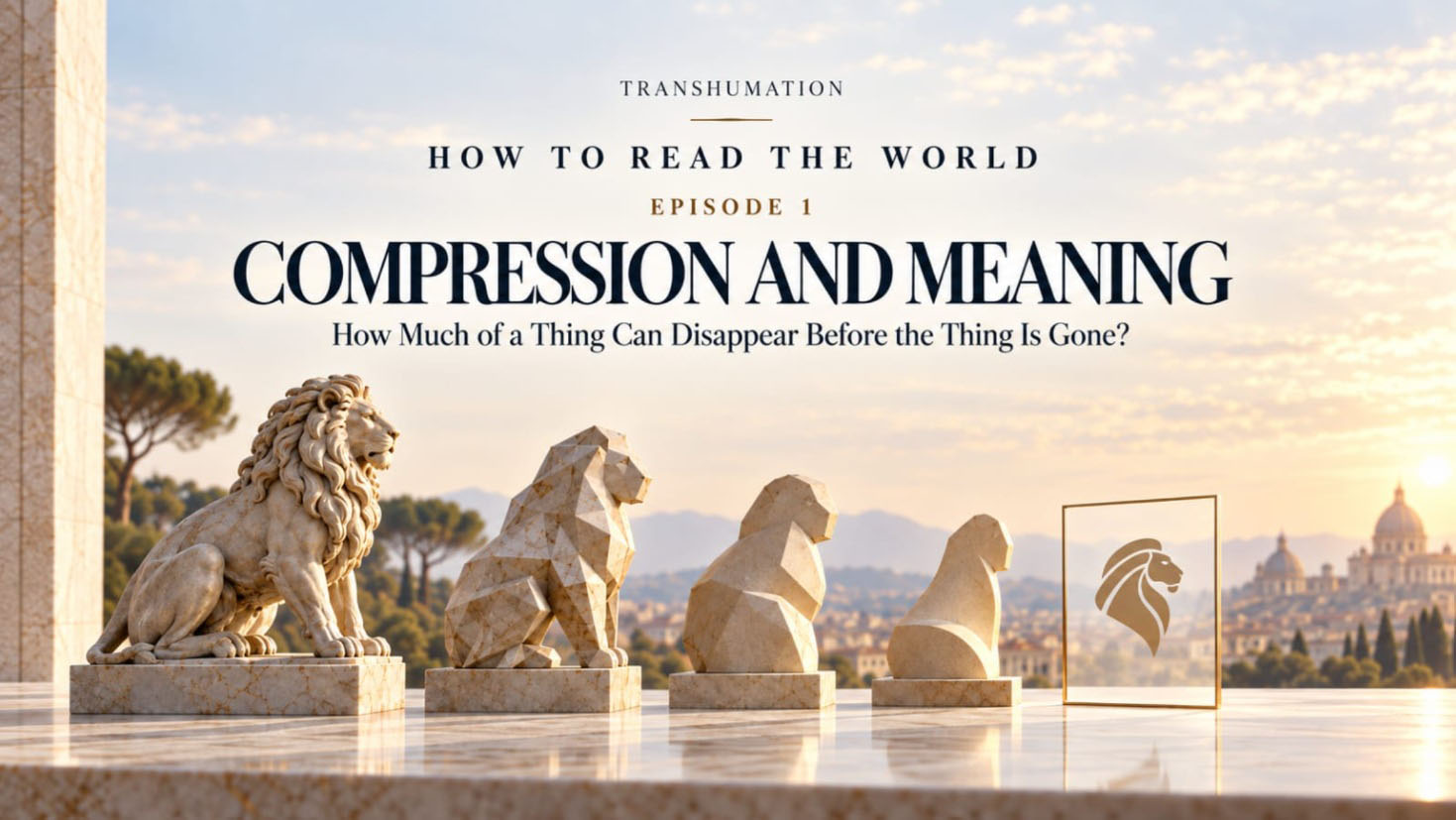
Functions and information can persist across radical changes of physical carrier. A digital text can preserve linguistic content without preserving the physical book; a digital interface can preserve the functional relationship of a button without reproducing its mechanical construction; recordings and images can preserve recognizable aspects of a person without preserving the living person. Modern technology provides abundant examples of structures being represented, reproduced or instantiated through different physical media.
None of this currently demonstrates that personal consciousness, subjective continuity or individual identity can be transferred from a biological human being to another substrate. The fact that information can be copied is not evidence that first-person experience travels with the copy. Any claim that existing examples of digital preservation establish human mind uploading would therefore go considerably beyond current knowledge.
Open Questions
We still lack agreement about which properties would have to remain continuous for a transferred or reconstructed person to count as the same individual. Memory, behavior, personality, neural structure, bodily continuity and subjective experience are related concepts, but they are not interchangeable. Even a future system capable of reproducing all observable behavior of a particular person would leave the identity problem unresolved unless we had some way of determining whether recognition from the outside corresponded to continuity from the inside.
There is also a deeper information problem. We do not yet know which apparently incidental properties of biological embodiment are irrelevant to consciousness and which may be constitutive of it. The equivalent of the coffee stain may turn out to be noise. It may also turn out to be part of the text.
Transhumation Interpretation
Transhumation does not require the claim that human beings are software waiting to be uploaded. It begins with a more modest observation: throughout technological history, structures have repeatedly survived the disappearance of carriers that once seemed inseparable from them. The interesting question is therefore not whether matter can simply be discarded, but which relationships remain invariant when the carrier changes.
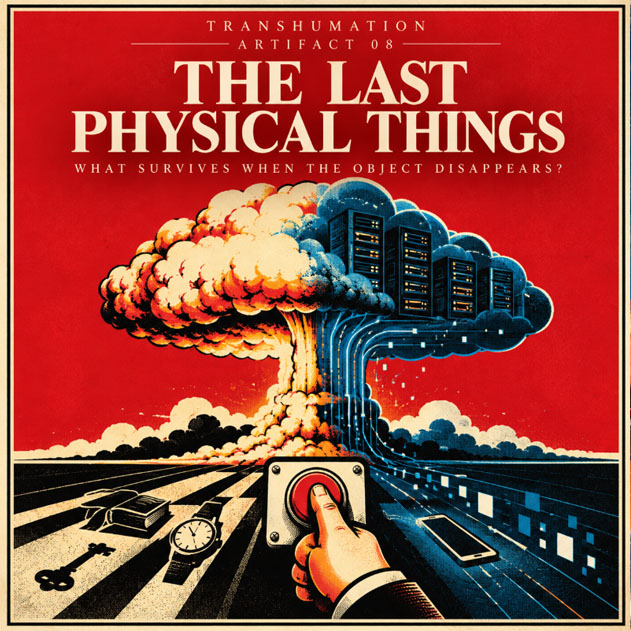
Artifact 08 stops deliberately at that boundary. The survival of the button does not prove the survival of the person. The emoji is not evidence for immortality. The digitized book does not solve consciousness.
But they give us a better question.
Not:
Can we upload a human?
First:
What, exactly, would have to cross for us to say that anyone had arrived?
And somewhere in the museum, the pedestal marked HUMAN remains empty.
For now.
FAQ
What is The Last Physical Things about?
The Last Physical Things examines what happens when a physical object disappears but some of its function, structure or meaning survives in another carrier. It uses familiar examples such as buttons, keys, watches, books and digital symbols before asking whether the same reasoning can legitimately be extended to human beings.
What does “the button survived” mean?
It does not mean that the physical button literally survives. The material object may disappear while the relationship it expressed remains: a human performs an action and a system changes state. The carrier changes while part of the functional structure persists.
Why use a mechanical watch as an example?
A mechanical watch shows that an object can survive even after losing much of its original practical advantage. Once more accurate methods of telling time become ubiquitous, the watch can acquire greater importance as craft, history, memory, ritual or status. Its surviving value is therefore not identical to its original function.
What does the coffee stain represent?
The coffee stain illustrates the difficulty of deciding what counts as information worth preserving. Digitizing the words of a book may preserve its text while losing annotations, physical wear, provenance and other features of a particular copy. Preservation therefore requires decisions about what belongs to the object we are trying to preserve.
Why is the 💩 emoji important?
The emoji provides an intentionally absurd but useful example of symbolic dematerialization. Almost none of the physical properties of what it represents are present, yet recognition and association survive. It demonstrates how much information can be reconstructed by the receiver without implying that the represented object itself has been transferred.
Does Transhumation claim that humans can be uploaded?
No. The ability to copy information, behavior or recognizable characteristics does not establish that personal identity or subjective consciousness can be transferred. The distinction between representation and identity is central to the argument.
What does “recognition is not identity” mean?
Something can be recognizable as a representation of a person without being that person. A perfect simulation of someone’s voice, memories or behavior might establish extraordinary fidelity, but recognition by an observer does not by itself demonstrate continuity of the original individual’s subjective experience.
How does this connect to Artifact 09?
Artifact 08 establishes the easier problem: functions, meanings and structures sometimes survive changes of carrier. The next problem is substantially harder. If increasingly complex aspects of a human being could be reproduced elsewhere, what evidence would justify calling that process preservation, transfer or survival rather than copying?
Continue the Transhumation Series
- Forgotten Religion | Ancient Gods, Symbols and the Hidden Structures of Human Civilization
- The Last Religion | Death, Immortality and the Future of Humanity
- The New Theurgy | AI, Information and the Future of Human Civilization
- End of Branding: You Were Never Meant to Become a Product
- Baal vs Ishtar: Why Ancient Gods Never Disappeared