
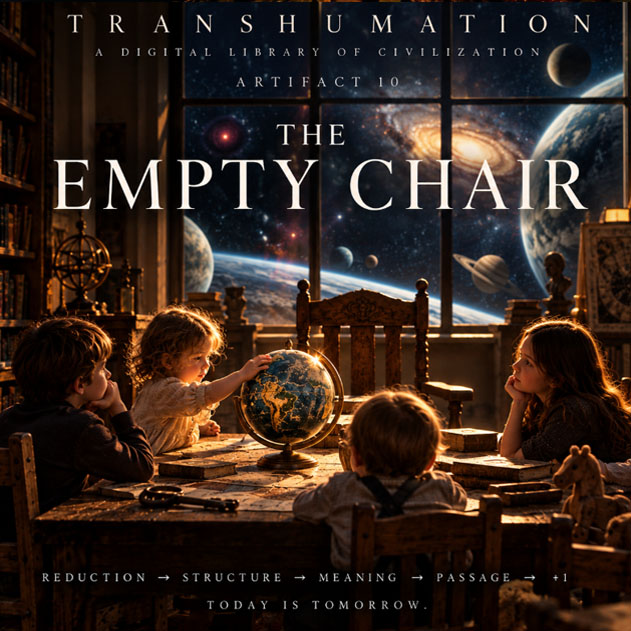
The Empty Chair
There is an empty chair in the room, which is rarely an innocent piece of furniture. At dinner it belongs to someone who did not come. In an office it belongs to someone who left. Beside a hospital bed it can become an entire biography without anybody saying a word. Human beings have always been exceptionally talented at loading ordinary objects with meanings they were never designed to carry, and a chair may be the easiest of all because its shape already contains an absence. It was made for somebody. The moment nobody sits in it, we begin wondering who should.
This particular chair stands opposite a polished metal sphere. We have seen the sphere before. It appeared at the beginning of the first Transhumation Artifact, when we asked where the perfect sphere actually exists: in the metal object on the table, in the mathematical description of it, in the mind capable of recognizing its imperfections, or somewhere else entirely. We did not answer the question then, and ten films later there would be something suspicious about suddenly pretending that we can. Instead, we have returned to the same room, the same table and the same object. There is only one significant difference. There are now two chairs.
That difference is the end of Season One.
Every Answer Opened Another Room
The ten Artifacts were never intended to form a ladder toward one grand revelation. If anything, they have behaved more like a sequence of badly designed hotel rooms in which every door turns out to lead to another corridor. We began by removing information from music and discovered that structure could survive the loss. We removed a beat and found that the mind was perfectly capable of hearing something that had not been played. We used a mirror as evidence, passed through gates while abandoning possessions and interfaces, went to sleep beside an ordinary iron, and eventually arrived at a screen so convincing that the remaining technological problem was no longer the world behind the glass but the glass itself — and the inconvenient human being standing on the wrong side of it.
There was a temptation in each experiment to believe that one more reduction would reveal the thing underneath. Remove enough noise and perhaps structure appears. Remove enough possessions and perhaps the self appears. Remove enough interface and perhaps reality appears. This is an old intellectual instinct and often a useful one, but it contains a trap. The thing underneath may itself turn out to have an underneath. Reduction gives us access to structure, but structure does not guarantee a basement.
That is why the most important sentence in The Empty Chair is not a declaration at all. It is an observation: every answer opened another room. This is not an argument against answers. A civilization that confuses uncertainty with sophistication becomes merely fashionable in its ignorance. Answers matter enormously. The problem is that good answers tend to alter the location of the question rather than abolish it.
The empty chair is where that movement finally becomes visible.
The Most Difficult Seat in Civilization
For most of recorded history, human beings have attempted to identify the occupant of that chair. Different cultures supplied different names, personalities and metaphysical systems, while philosophers later developed increasingly sophisticated versions of the same problem. Perhaps the universe was created by God or gods. Perhaps it emerged necessarily from a deeper order. Perhaps what we call creation is the wrong category altogether. Perhaps reality is mathematical, cyclical, eternal, computational, accidental or simply the sort of thing that does not owe human beings an explanation.
These possibilities are not interchangeable, and it would be intellectually lazy to place several thousand years of theology, philosophy and science into a bag labelled Things People Guessed Before We Arrived. Transhumation has no reason to do that. The dispute matters precisely because we do not know its final outcome.
But imagine, for a moment, that the dispute ends tomorrow. Suppose we discover a creator of our universe with evidence so overwhelming that theologians, physicists and the gentleman in the comments section finally have to agree. It would probably be the greatest discovery in human history. We would celebrate for approximately twenty-four hours before somebody ruined everything by asking where the creator came from.
There may be an excellent answer. Perhaps causality has no meaning outside our universe. Perhaps the creator is eternal, necessary or exists in a category to which words such as before and after cannot sensibly be applied. The point is not that these answers fail. The point is that an answer at one level reveals the possibility of another level. We discover the creator and acquire what might be called God +1.
Now perform the opposite experiment. Suppose we establish, with equal confidence, that there is no creator. No programmer, no parent civilization, no intelligence waiting behind the machinery and no librarian at the end of the corridor who has kept the catalogue all along. The metaphysical question does not disappear. It changes direction. We no longer ask only what stands above us. We have to ask what follows from there being nobody above us at all.
Either way, there is another floor.
The Television Problem
One way of describing the disagreement between religion and science is to imagine an old television set. Religion has traditionally been interested in whether anyone is broadcasting. Science, at its best, takes the back panel off and asks how the television works. These questions can conflict when either side begins making claims inside the other’s territory, but they are not automatically identical questions. A complete circuit diagram does not by itself tell us whether there is a programme, just as believing in a programme does not explain the circuit board.
Nihilism can enter the room and make a third observation: perhaps nobody is broadcasting especially for you. This possibility deserves to be taken seriously, but it is sometimes presented with more drama than it has earned. If the universe was not constructed with humanity in mind, gravity continues to operate, breakfast remains advisable and the television is still sitting in the room. Meaning may have become a more difficult problem, but difficulty is not the same thing as disappearance.
At this point Julian, quite reasonably, asks where the remote is.
The joke matters because it prevents metaphysics from becoming theatrical. Whether the universe loves us, ignores us or is incapable of holding an opinion, we still find ourselves inside it with a peculiar and expanding ability to manipulate local conditions. Whatever is happening at the level of ultimate explanation, somebody eventually has to decide what to do with the machinery.
This is where the old idea of theurgy unexpectedly returns.
Theurgy Without Magic
The word theurgy belongs to a world very different from ours. In late Neoplatonic traditions it described practices through which human beings sought participation in or proximity to the divine. It would be historically absurd to pretend that Iamblichus was secretly describing aerospace engineering or that Proclus had been waiting patiently for somebody to invent a semiconductor. Yet the old word contains an intuition worth recovering: some powers appear divine until the boundary between what humans can and cannot do begins to move.
Our ancestors lived in a world in which distance, infection, darkness, weather, memory and physical limitation possessed a degree of authority that modern people can easily underestimate. They did not merely lack technologies. They inhabited a different map of possibility. A voice could not cross an ocean in an instant. A stopped heart was not a technical event surrounded by protocols and equipment. The surface of another world could not send photographs home. A person could not place billions of pages of human knowledge inside a device carried in a pocket.
None of these achievements required us to repeal a law of nature. That distinction is crucial. We did not defeat gravity in order to fly; we learned enough about the world to discover that gravity did not prohibit flight. We did not abolish electromagnetism in order to communicate across continents; we exploited it. Again and again, the apparent wall turned out not to be a wall but a rule we had not understood well enough.
This is the version of theurgy that belongs in Transhumation. It does not mean becoming supernatural. It means refusing to confuse the presently impossible with the fundamentally impossible. Find what is truly immutable. Learn the rules. Test the rest. The dangerous word in that sentence is truly, because civilizations have a long history of granting permanent status to temporary limitations.
The future has a long past partly because many futures begin as ancient impossibilities.
The Orphan Civilization
There remains, however, the colder interpretation of the empty chair. Perhaps nobody has ever occupied it. Perhaps there is no parent intelligence, no final explanation addressed specifically to us and no cosmic adult who will eventually enter the room and explain why everything had to happen this way. Humanity may be, in the most literal metaphysical sense available to us, an orphan civilization.
At first this sounds like a conclusion about loss. The orphan has no parent, and so the story appears to end with absence. But this is an oddly childish way to understand an orphan. Having no parent present tells us something about where a person came from and what was denied to them. It tells us almost nothing about what they may eventually become. An orphan can grow old. An orphan can build a house. An orphan can become responsible for another person.
Even an orphan can have children.
That sentence changes the geometry of the empty chair. Humanity has traditionally directed its deepest questions backward: Who made us? Why are we here? What did they intend? Why did they permit this? These may remain permanent questions, and there is no reason to abandon them. But a technological civilization eventually acquires another direction in which to look. It begins creating environments, altering organisms, preserving minds outside biological memory, constructing increasingly autonomous machines and determining conditions under which people not yet born will have to live.
We should be careful here. We have not created conscious artificial life. We do not know whether consciousness can be manufactured, transferred or reproduced in an artificial substrate. We have not become immortal, escaped the physical universe or earned any sensible right to call ourselves gods. The point is much less grandiose and therefore much harder to dismiss: we have become ancestors with tools no previous generation possessed.
At that moment, Who created us? is no longer the only question available.
Another appears beside it.
Whose ancestor might we become?
Watch the Video
How to Read the World
by
Current Knowledge
Modern science has given us increasingly powerful descriptions of how the observable universe develops and behaves, but it has not established why there is something rather than nothing, why the laws have the form they do, or whether asking for an ultimate explanation is itself meaningful. We do not know whether consciousness can be exhaustively explained in physical terms, whether our universe is the whole of reality, or whether the chain of explanation terminates in necessity, mathematics, mind, divinity or a category we have not yet invented.
What we do know is that understanding regularities produces agency. Knowledge of nature has repeatedly allowed human beings to change conditions once experienced primarily as fate. That does not establish that every limitation will eventually fall, and it certainly does not establish that technological power carries its own moral justification. It establishes something narrower and more important: the border between fate and engineering has moved before.
There is no good reason to assume that it has stopped moving simply because we happen to be alive now.
Open Questions
The final questions of Season One therefore remain deliberately unresolved. Does explanation have an endpoint? Are there genuinely immutable limits to intelligence, life and civilization, and can we distinguish them from temporary technological barriers before attempting to cross them? Could humanity eventually create beings whose relationship to us resembles, even faintly, our imagined relationship to a creator? If so, would creation give us ownership, responsibility, both or neither?
Behind all of these sits a question that is less spectacular but more immediate. If there is an intelligence above us, what responsibilities remain ours? If there is no intelligence above us, how much more difficult do those responsibilities become?
The two metaphysical possibilities look like opposites, yet they produce a strangely similar practical result. Neither gives us permission to stop thinking about what comes next.
Transhumation Interpretation
The empty chair is therefore not God’s chair, and it is not a throne prepared for humanity. Treating it as either would destroy the experiment. It is an unresolved position: a deliberate space left for an answer we do not possess. There may be someone there. There may be something there. There may be nothing there at all. Intellectual honesty requires that those possibilities remain open for as long as the evidence requires them to remain open.
Responsibility is different. Responsibility does not require us to solve ontology first.
If there is a creator, we are still responsible for what we create. If there is no creator, that responsibility does not conveniently disappear with the creator. If humanity is a cosmic orphan, then perhaps adulthood begins precisely when we stop treating orphanhood as an excuse to remain children.
This is why The Empty Chair returns to the room from The Perfect Sphere. The first Artifact began with a human being looking at an object and asking where perfection resides. The final Artifact leaves the object in the room and turns the question around. The sphere is still there. We have crossed ten experiments and have not made it more perfect, nor have we discovered where its perfection ultimately lives.
What has changed is the person standing opposite it.
At the beginning of the season, we were asking reality to explain itself to us. At the end, reality has not answered. The chair remains empty, the sphere remains silent, and the universe has declined to provide a closing statement.
Perhaps that is not a failure of the experiment.
Perhaps that is the experiment.
Do not sit in the chair because you think you are God. That would be vanity masquerading as philosophy. Sit there because, whatever ultimately occupies the level above us, nobody has relieved us of responsibility for the level below.
And if there is a smaller chair somewhere behind ours, waiting for someone who does not yet exist, then the oldest question in civilization may finally have acquired its +1.
We have spent thousands of years asking who our parent is.
It may be time to ask what kind of ancestor we intend to become.
REDUCTION → STRUCTURE → MEANING → PASSAGE → +1
TODAY IS TOMORROW.
FAQ
What does the empty chair symbolize?
The empty chair represents an unresolved position rather than a confirmed absence. It does not prove that God, a creator, or a higher intelligence does not exist. It asks what happens when human beings can no longer assume that someone else occupies the position of ultimate authority. The chair remains empty because Transhumation does not claim to know who, or what, belongs there.
Is The Empty Chair an argument that God does not exist?
No. The experiment deliberately avoids that conclusion. Saying that we cannot see who occupies the chair is very different from proving that nobody does. The more important question is what follows from uncertainty: if no higher authority visibly intervenes, human responsibility does not disappear while we wait for an answer.
Why does The Empty Chair return to The Perfect Sphere?
The first Artifact asked whether the human mind can conceive of something that physical reality may never perfectly instantiate. The final Artifact returns to the same room because the question has expanded. After examining reduction, identity, absence, dreams, interfaces and technological transcendence, the problem is no longer simply what reality can contain. It is what human beings should do with the powers they are beginning to acquire within it.
What does “Even an orphan can have children” mean?
The line separates origin from responsibility. Even if humanity never discovers its creator—or discovers that there was none—that uncertainty does not prevent us from becoming creators ourselves. We already construct artificial environments, intelligences, simulations and increasingly autonomous systems. Not knowing what stands above us does not remove our responsibility toward what may eventually stand below us.
Why does Julian tell the viewer to sit in the chair?
Julian is not asking the viewer to become God. He is asking the viewer to accept responsibility without pretending to possess divine knowledge. Sitting in the chair means recognizing that some decisions can no longer be deferred to an invisible authority, future generation or technological system. The chair is therefore less a throne than a position from which consequences can no longer be ignored.
How does The Empty Chair end Season One of Transhumation Artifacts?
Season One begins with a human being looking at a seemingly perfect object and asking what it reveals about reality. It ends with an empty object waiting for a human being to take a position. The direction has reversed: the first experiment asks what the universe can tell us; the last asks what we are prepared to do with what we have learned. The questions remain unresolved, but responsibility has moved closer.
What does “Today is tomorrow” mean?
Technology repeatedly turns yesterday’s metaphysical questions into today’s practical decisions. Creating minds, constructing artificial worlds, modifying bodies and determining the rules under which intelligent systems operate are no longer exclusively subjects for mythology or distant speculation. “Today is tomorrow” means that some questions we expected future generations to confront have already arrived in operational form.
Will there be another season of Transhumation Artifacts?
The Empty Chair closes the first sequence, but it does not close the questions introduced by it. That is part of the structure of the series: each answer exposes another layer rather than producing a final doctrine. The empty chair is therefore an ending, but deliberately not a conclusion.
Continue the Transhumation Series
- Forgotten Religion | Ancient Gods, Symbols and the Hidden Structures of Human Civilization
- The Last Religion | Death, Immortality and the Future of Humanity
- The New Theurgy | AI, Information and the Future of Human Civilization
- End of Branding: You Were Never Meant to Become a Product
- Baal vs Ishtar: Why Ancient Gods Never Disappeared