
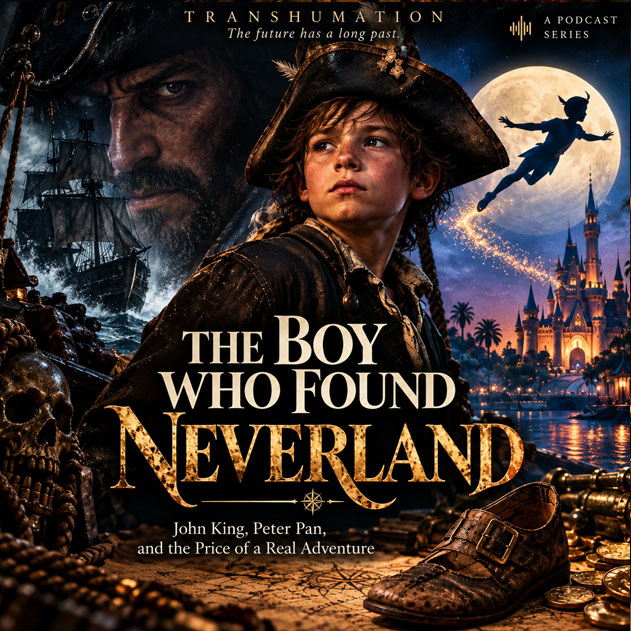
John King, Peter Pan, and the Strange Life of Stories
There should have been another shoe, which is the sort of observation so obvious that it becomes troublesome only after someone says it aloud. Shoes are made in pairs, and a single one therefore carries a small accusation against the world around it. Something has been separated. Somewhere there was another shoe; before either shoe there was a pair of feet; and around those feet existed a person who had reasons for going somewhere.
Historical objects are inconvenient in this way. We would like them either to speak clearly or remain silent, but they tend to do neither. A bone cannot tell us the name of the person whose weight it once carried. A letter with half its pages missing cannot supply the missing sentences out of courtesy. A shipwreck scattered beneath Atlantic sand does not arrange itself into chapters. Yet it would be equally absurd to conclude that the bone existed without a body, the letter without its absent pages, or the wreck without a voyage. A fragment does not give us the whole, but sometimes it proves that there was one.
In the case of John King, the whole is particularly difficult to recover because history left us so little of him. He was a very young boy who entered the company of pirates in 1716 and disappeared with them the following year. That alone would make him unusual. What makes his story almost indecently good is that, without any assistance from literature, it assembled many of the ingredients that literature would later use to create one of its most durable fantasies.
Peter Pan was still nearly two centuries away.
The Boy Who Went
The temptation with John King is to improve him, and history has already supplied so much scenery that improvement would be ungrateful. There is a boy, a mother, pirates, a charismatic captain, captured ships, treasure and an ending at sea. Any novelist handed these materials would probably be accused of laying things on a little thick.
The surviving evidence places King with his mother aboard a vessel encountered by pirates associated with Samuel Bellamy. Later testimony describes the boy wanting to join them despite his mother’s opposition. His precise age is less secure than popular accounts sometimes suggest, which is worth remembering whenever he is confidently introduced as an eight-, nine- or eleven-year-old pirate. We know enough to say that he was strikingly young; we do not know enough to celebrate his birthday.
Then he went.
There is a difference between what a child and an adult can see from the same deck, and it would be sentimental to assume that the child always sees more. An adult looking at Bellamy’s pirates might reasonably have noticed the British Crown, maritime law, the gallows, disease, violent weather and the rather poor statistical prospects of a career conducted with weapons on wooden ships. A child could look at precisely the same men and see a ship, an ocean and the astonishing possibility of going with them. Neither view requires stupidity. They simply contain different amounts and kinds of information.
Growing up consists partly of acquiring reasons not to open doors. Many of those reasons are excellent. Fire burns, debts mature, storms arrive whether or not one believes in them, and strangers offering unconventional employment should generally be investigated before one joins their enterprise. Yet there is a cost to the increasingly complete map of adulthood. It can show us so many reefs that eventually remaining in harbour begins to resemble wisdom.
John King’s map was dangerously incomplete. It was also complete enough for him to move.

Neverland Before Neverland
J. M. Barrie did not need John King in order to invent Peter Pan, and there is no reason to manufacture a connection between them. In fact, the absence of such a connection is precisely what makes their resemblance interesting. Peter Pan found pirates in Neverland; John King appears to have done something rather like the reverse.
His version contained no fairy dust, no mermaids and no crocodile with a clock in its stomach. It was constructed from timber, canvas, rope, iron and gunpowder, and its dangers had the discourteous habit of remaining dangerous after the adventure became exciting. Samuel Bellamy was not Captain Hook, either. He belonged to a particular Atlantic world of commerce, empire, slavery, violence and piracy, and the Whydah itself had been built for the slave trade before Bellamy captured it and made it his flagship. Turning all of this into a children’s attraction would not merely simplify history; it would amputate some of its most important parts.
And still the resemblance refuses to disappear.
A young boy leaves the adult world and joins pirates under an extraordinary captain. He enters a floating society operating beyond many of the ordinary rules that had governed his previous life. The horizon replaces home. Adventure becomes geography. Then, before adulthood can arrive to reinterpret any of it, the boy disappears.
Peter Pan does not grow old because Barrie does not permit him to. John King did not grow old because the Atlantic did not permit him to. One belongs to literature and the other to history, which is an enormous difference. It is not, however, enough to make the structural resemblance uninteresting.
Perhaps that is why some stories feel older than the books in which we first encounter them. The book gives the structure a name. It does not necessarily create every human arrangement capable of resembling it.
What His Mother Could See
The child’s perspective is irresistible because it gives the story movement, but his mother’s view may be the more important corrective. From King’s side of the encounter, the pirates represented departure. From hers, they represented the possibility that her son would disappear.
That difference prevents us from making childhood ignorance into a philosophy. Adults do not merely accumulate fear; they accumulate consequences. King’s mother could understand things her son could not, just as he may have been capable of acting before the accumulated caution of adulthood made action impossible. An incomplete model can reveal possibilities a more elaborate one obscures, but it can also omit the storm.
This is one of the reasons John King interests Transhumation. The usual argument asks which of two models is correct. The more useful question is what each model contains that the other leaves out. A child looking at pirates and a mother looking at her child can occupy the same physical scene while inhabiting profoundly different informational worlds.
Neither gets to negotiate with the weather.
In early 1717 Bellamy’s company captured the Whydah, an English slave vessel returning from the Caribbean, and converted her into the flagship for a very different enterprise. Bellamy sailed north along the American coast. In April, off Cape Cod, the adventure encountered a participant that had no interest in metaphor. A violent storm drove the ship toward shore, where it broke apart. Bellamy died with almost everyone aboard, and John King disappeared with the world he had chosen only months earlier.
Neverland plays with you. The Atlantic does not.
For King, the distinction lasted less than a year.
The Book Beneath the Ocean
For more than two and a half centuries, the Whydah remained beneath the Atlantic, and this creates a peculiar problem for our ordinary picture of history. The story was being told while part of its evidence was still underwater.
Bellamy became Black Sam and the Prince of Pirates. The Golden Age of Piracy passed from recent memory into history and from history into legend. Pirates migrated into novels, illustrations, theatre, cinema, toys and children’s bedrooms. By the time the wreck was identified in the 1980s, Western culture already possessed an extremely confident idea of what a pirate looked like.
The ocean, unfortunately, had retained editorial rights.
Objects recovered from the wreck have continued to alter what can be known about the ship, its crew and even the Whydah’s earlier participation in the Atlantic slave trade. That is a useful humiliation for anyone tempted to declare a three-hundred-year-old story exhausted. The history had acquired endings, summaries and interpretations while physical sentences belonging to it were still lying beneath the sand.
There is an obvious way in which an old story changes: something new is found. A wreck appears, an archive yields a forgotten document, a photograph receives a name, or a laboratory learns how to ask an old object a question that earlier technology could not ask. But there is another kind of discovery that requires no new object at all. Sometimes two fragments that have been sitting in front of us for a century are placed beside one another and somebody notices a relationship that previous observers missed.
The first discovery adds evidence. The second changes the configuration.
History moves in both ways.
What a Shoe Knows
Among the objects associated with the youngest people aboard the Whydah are remains and items that have encouraged attempts to reconstruct the presence of a child aboard the ship. This is precisely where responsible history and irresistible imagination begin stepping on each other’s toes.
A small shoe is not John King. Archaeological association is not personal identification, and an object recovered from a wreck does not acquire a name simply because the name would make a beautiful caption. If we want to know what happened, distinctions of this kind are not pedantry. They are the difference between finding history and manufacturing it.
Yet the opposite position becomes strange surprisingly quickly. A shoe is not only a shoe in the sense that a random geometric shape is only itself. It was manufactured for a foot. The foot belonged to a body, and the body existed among other bodies. Someone knew its voice, noticed when it entered a room and probably worried when it did not return. None of these relationships tells us whose shoe we have found, but the shoe’s incompleteness is itself information about a larger arrangement.
This is why fragments matter so much to Transhumation. One bone cannot reconstruct a person, but it would be absurd to conclude that the bone was the entire organism. A surviving sentence cannot reconstruct a conversation, but it tells us that language extended beyond the surviving ink. The discipline lies in refusing two equally seductive mistakes: pretending we possess the missing whole, and pretending there never was one because we cannot possess it now.
With John King, we do not know what he thought when he joined Bellamy. We do not know whether excitement survived the first weeks at sea, whether he became frightened, whether he missed his mother, whether he regretted going or whether he thought himself the luckiest boy alive until the final night. History has not preserved an adult John King who can correct our picture of the child.
There was more.
That is not speculation. The speculation begins when we decide what the more contained.
What Happened to What Happened?
History has a proper question for John King, and it should be pursued without mercy: what actually happened? Which testimony survives, what does it say, how securely can particular objects be associated with particular people, and which details entered the story only after repetition had given them the appearance of evidence? This is the work that prevents a compelling narrative from eating the person who originally produced it.
But once that work has been done, another question remains. It is not a substitute for the first and cannot answer it. It begins where the first question stops.
What happened to what happened?
Samuel Bellamy died in 1717, but Bellamy did not remain in 1717. Three centuries of culture worked on him. The historical man became Black Sam, the Prince of Pirates, romantic outlaw, villain, rebel, museum subject, archaeological problem and eventually one of the countless ingredients from which modern culture constructs the idea of the pirate. Some versions corrected earlier ones. Some embellished them. Some were nonsense. None could alter the storm that killed him, but each could alter the Bellamy encountered by the next person.
John King has travelled in a similar fashion. A boy who left almost no account of himself became a name in testimony, then a candidate for one of the youngest pirates of the period, then a child whose missing adulthood became part of the fascination. And now, three centuries later, Transhumation has placed him beside a boy who never existed.
Peter Pan does not tell us what happened to John King.
John King does, however, make Peter Pan look slightly different.
That is the movement that interests us.
The Place Beyond the Last Page
We have given that movement a name.
Neverend.
It would be easy to misunderstand the word as an attempt to make stories immortal, which would make it sentimental and not particularly useful. Nothing in Neverend is immortal. Samuel Bellamy still dies. The Whydah still sinks. John King still fails to return to his mother. A book still reaches its final page, an investigation can reach a conclusion, and a mystery may one day be solved.
Neverend is concerned with what can happen afterwards.
It is not an afterlife, because we make no claim about where the dead go. Nor is it a historical reconstruction, because history has rules that imagination should not be allowed to corrupt. It is closer to a stage erected above the archaeological site after the archaeologists have carefully labelled what they found.
On that stage, Bellamy is no longer required to be only the historical Samuel Bellamy. He can become the Pirate Prince that centuries of storytelling have assembled from him. John King can become the Lost Boy. Captain Hook can walk in despite never having lived, and Peter Pan can meet a child who lived almost two centuries before Barrie created him.
The artificiality is part of the point. We know the scenery is scenery.
A theatre does not deceive us when Hamlet walks onstage after we watched him die the previous evening. Nobody demands an explanation of his survival. The actor has returned, the structure has been performed again, and the audience willingly permits the dead prince to live for another few hours.
Neverend works in much the same way. The historical event remains where it happened. The structure can be performed again.
If Jack the Ripper Walked Through the Door
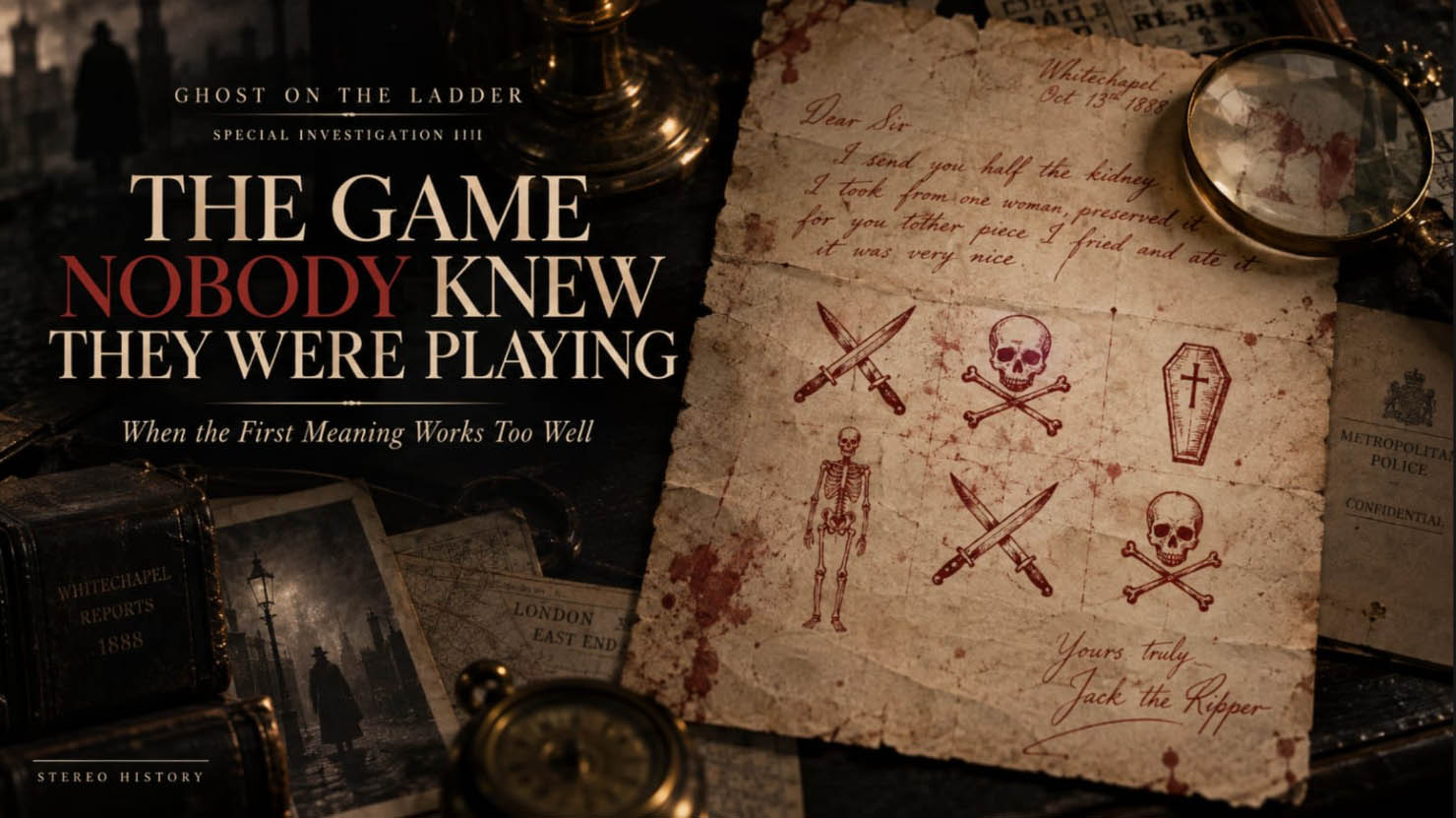
The distinction becomes clearer with a less comfortable example. Suppose that tomorrow Jack the Ripper is identified beyond reasonable dispute. Imagine that DNA, documents and some extraordinary surviving piece of evidence converge on a single man, ending a mystery that has consumed investigators for more than a century.
History would change overnight.
Jack the Ripper would not disappear.
The historical murderer and the cultural creature called Jack the Ripper parted company long ago. The latter was assembled from murders, newspapers, police failures, disputed letters, illustrations, theories, films, novels, fog, costume and an enormous amount of subsequent imagination. Finding the man could force us to rearrange many of those pieces, perhaps brutally. It could not remove the fact that the arrangement had existed.
A solved Ripper would therefore be perfectly capable of entering Neverend. He might even be more interesting there, because for the first time we could watch the newly discovered man collide with the character constructed in his absence.
And if the Pirate Prince were waiting inside, I suspect he would applaud.
Not the murderer, and certainly not the murders. Neverend is not a moral prize and applause is not absolution. Bellamy would be applauding the arrival of another structure that had managed, by radically different means, to move through generations of human minds.
The applause says only that something reached us.
It may arrive immediately. It may arrive centuries late. Sometimes it may never arrive at all.
But when someone opens the book, speaks the name, watches the film or asks the question again, the lights come back on.
The Loop That Refuses to Close
At first this looks like repetition. Bellamy sails, Bellamy dies, somebody tells the story, and eventually another person tells it again. But a circle is the wrong geometry because the story almost never returns to precisely the same place.
The better image is a spiral.
Each telling inherits a different Bellamy. Archaeology can add an object that the previous generation never saw. Historical scholarship can remove a legend everyone had accepted. A novelist can exaggerate him, a filmmaker can romanticize him, and a child can discover him without knowing which parts came from documents and which from Hollywood. Then someone else can separate those layers and, in doing so, discover a pattern that none of the earlier storytellers intended.
Three hundred years after Bellamy’s death, one might reasonably have assumed that every useful configuration had been tried.
Then Transhumation created Neverend.
This does not mean that we discovered something new about what Bellamy did in 1717. We have done something different: we have created a new relationship between things that already existed. Bellamy can now stand beside Hook, not because the two men secretly shared a history, but because one historical life and one fictional life eventually produced structures that can illuminate one another.
John King can meet Peter Pan for the same reason.
In a history book, John King cannot become Bellamy’s son merely because the arrangement appeals to us. In Neverend, the Pirate Prince can look at the Lost Boy and recognize something like a son. The first statement would be bad history. The second is an acknowledged act of imagination, and its value depends not on whether it happened but on whether the configuration allows us to see something we could not see before.
The difference is not subtle once we stop pretending that every useful human thought must be a factual proposition.
What the Ocean Has Not Returned
There is, finally, a practical reason for refusing to close the door.
We do not know what remains beneath the Atlantic.
Nor do we know what remains in archives, family papers, archaeological collections, unidentified photographs or objects that have already been excavated but not yet asked the right question. History is full of subjects that appeared settled until a new fragment arrived and made an old conclusion impossible. It is equally full of fragments that had been known for decades before somebody understood what they meant.
This does not justify saying that anything might be true. Quite the opposite. If tomorrow can bring evidence capable of destroying our favourite interpretation, then today we have an obligation to mark clearly what we know, what we have been told, what we suspect and what we merely imagine.
Neverend needs that discipline because imagination without boundaries quickly becomes counterfeit history.
But history without an open door has a different defect. It can mistake the present limits of the archive for the limits of the past.
The two errors resemble our single shoe. One person looks at it and invents the entire child. Another looks at it and insists that the only intellectually respectable subject is footwear.
Neither response is enough.
There was more.
Welcome to Neverend
Perhaps this is why John King is the right person to open the gate.
He leaves us with almost everything Neverend requires: a real person who became a fragment, a story that continued after the person disappeared, a cultural structure created much later that unexpectedly illuminates the earlier one, and an ocean that still refuses to certify that it has returned everything it knows.
We cannot rescue John King from the Whydah. We should not turn him into Peter Pan, and we should be suspicious of anyone who confuses the Lost Boy we may create with the child who actually stood on a deck in 1716. The distinction is not an obstacle to Neverend. It is what makes Neverend possible.
Once we know where history stops, imagination can step beyond it without pretending that it has discovered another document.
The curtain rises. The Pirate Prince can enter. The Lost Boy can follow him. Peter Pan may already be waiting on the other side, and one day Jack the Ripper may arrive with a real name attached to him. If he does, the discovery will change the history behind the stage without emptying the stage itself. The next performance will simply inherit another piece of information.
That is why the ending never quite returns us to the beginning. Every telling leaves the material slightly differently arranged for the person who comes next. A story can correct itself, contradict itself, acquire another fragment or discover that something everyone considered decoration was evidence all along.
Three centuries after John King disappeared, we are still doing things with his story that the people who recorded his name could not have imagined.
Three centuries from now, someone may do the same to ours.
The boy is gone, and the ship went down long ago. Those facts deserve the dignity of remaining facts. But somewhere beneath the Atlantic there may still be another object waiting to alter a sentence we currently think is finished, just as somewhere in the future there may be another mind capable of arranging the fragments differently.
That is why we leave the door open.
Not because nothing ends.
Because we never know what the ocean will return.
Welcome to Neverend.
The future has a long past.
Watch the Video
How to Read the World
by
Current Knowledge
John King was a real boy who joined Samuel Bellamy’s pirate company in 1716 and is believed to have died when the Whydah was wrecked off Cape Cod in April 1717. His exact age remains uncertain. Archaeological finds from the wreck support the presence of very young people aboard, although individual objects cannot automatically be attributed to King.
There is no known historical connection between John King and Peter Pan, nor evidence that Samuel Bellamy inspired Captain Hook. Those comparisons belong to interpretation, not established history.
Transhumation Interpretation
Neverend begins where historical certainty stops without pretending that uncertainty is evidence.
The historical Bellamy dies. The Whydah sinks. John King disappears. Yet their structures can be activated again whenever another person encounters, questions or reimagines them. Each new discovery or narrative can alter the configuration without altering what actually happened.
Neverend therefore separates two freedoms that should never be confused: the freedom to discover what was true and the freedom to imagine what might become meaningful.
Open Questions
How old was John King when he joined Bellamy? Which archaeological objects can genuinely be connected to him? What else remains beneath the Atlantic or inside an unread archive? And what new relationships might future observers discover among fragments we already possess?
Most importantly: how many stories that appear finished are merely waiting for their next piece?
FAQ
Was John King a real pirate?
Yes. Historical testimony places the young John King with Samuel Bellamy’s pirate company in 1716.
Was John King the inspiration for Peter Pan?
There is no known evidence of such a connection. The relationship proposed by Transhumation is structural, not historical.
Was Samuel Bellamy the real Captain Hook?
No. Bellamy was a historical pirate; Hook is fictional. Neverend allows their cultural forms to meet without claiming that one historically produced the other.
What is Neverend?
Neverend is a Transhumation space for structures that can live again through memory, discovery, storytelling and imagination. It is not an afterlife or an alternative version of history.
Can new evidence change Neverend?
Absolutely. That is part of its purpose. New evidence changes what we know; new interpretations change what we can see. We never know what the ocean will return.
Continue the Transhumation Series
- Forgotten Religion | Ancient Gods, Symbols and the Hidden Structures of Human Civilization
- The Last Religion | Death, Immortality and the Future of Humanity
- The New Theurgy | AI, Information and the Future of Human Civilization
- End of Branding: You Were Never Meant to Become a Product
- Baal vs Ishtar: Why Ancient Gods Never Disappeared