
Education of Desire
There was a time when a photograph had to be somewhere. It sounds almost quaint now. Today an image has no obvious address. It appears on a telephone in Warsaw, is copied in California, cropped in Seoul, sent to Madrid and forgotten everywhere before lunch. We speak of photographs as though they were objects, but most of them no longer possess the elementary dignity of having a place in the world.
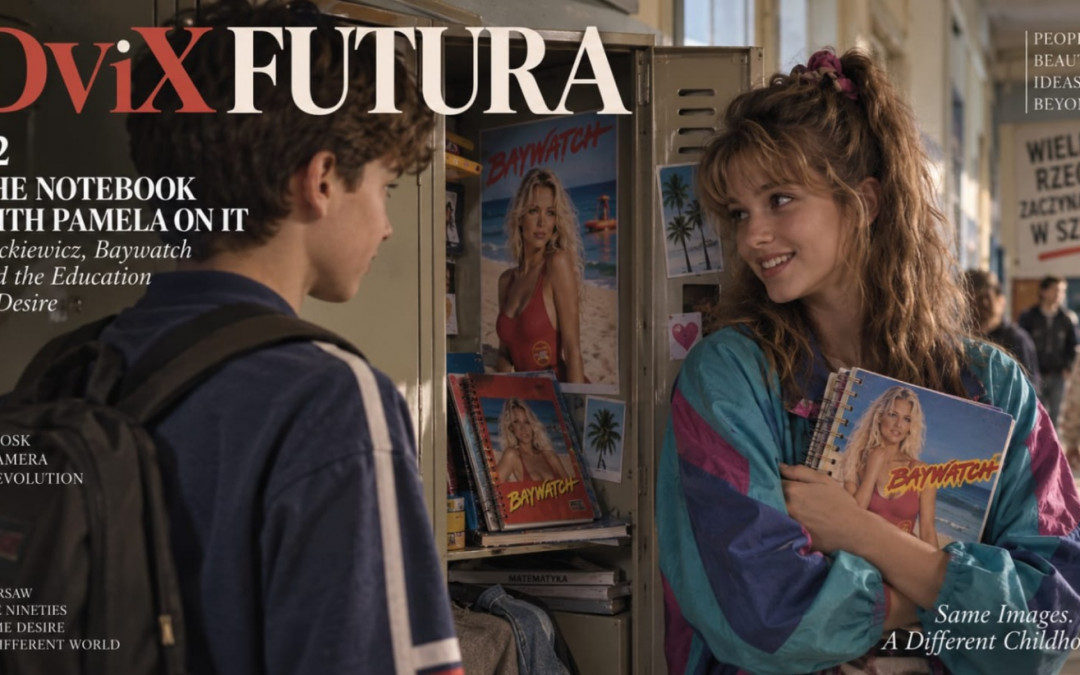
In the 1990s, they did. Images lived in magazines and calendars. They were taped to bedroom walls. They came inside chewing-gum wrappers, accumulated in sticker albums and travelled through school corridors in the pockets of children who understood perfectly well that one picture might be worth two others. They appeared on VHS boxes whose films were sometimes considerably less interesting than their covers. And, for reasons that become stranger the longer one considers them, they appeared on school notebooks.
Somewhere in Poland, a child could sit down at a wooden desk, open a notebook with Pamela Anderson on the cover and begin writing about Adam Mickiewicz. Nobody called this a philosophical event. It probably was.
Before We Knew What We Were Looking At
Childhood contains a peculiar interval during which we understand that an image is important before we understand why. Adults have already assigned value to it. Television has assigned value to it. Older children have noticed that value. Advertising has repeated it often enough for the signal to become unmistakable. The child arrives late and discovers that everybody else seems to know something.
Pamela Anderson was unusually suited to this kind of transmission. At the height of Baywatch, her public image became globally recognizable, while the programme itself grew into an enormous international television phenomenon. The red swimsuit, blonde hair and California beach became visual shorthand that travelled far beyond the episodes in which they originally appeared. Anderson’s image circulated through magazine covers, posters, calendars, merchandise and the unofficial ecosystem that forms around any face sufficiently famous to become a symbol.
But the interesting thing about a symbol is that you do not have to understand it in order to recognize it.
A Polish child in the 1990s did not necessarily see what an adult saw. A girl might simply think Anderson was beautiful. A boy might notice that older boys behaved differently when her picture appeared. Another child might want the notebook because everybody else seemed to want that notebook. The adult sexual code was not required for the image to possess cultural value.
That distinction matters. Meaning could arrive later. The image arrived first. And when it arrived, it did not announce itself as a lesson in American soft power, celebrity culture, gender, capitalism or desire. It simply sat beside the multiplication table.
Two for One
Then there were the cards. Anyone who traded them in a school corridor already understood several principles of economics without needing the vocabulary. Scarcity, liquidity, speculation, irrational valuation and the peculiar human pleasure of possessing something another person wants could all be demonstrated between the bell for mathematics and the bell for Polish.
You opened your collection. The other person opened theirs. Negotiations began. Two of mine for one of yours.
Some cards were common enough to be almost worthless. Others became precious because nobody seemed to have them. Sometimes the hierarchy made sense; sometimes one particular picture became desirable for reasons nobody could articulate. None of this required a central bank. The school corridor had discovered the market independently.
Yet there was one rule so obvious that nobody needed to state it. If I gave you my card, I no longer had it.
That small physical fact separates much of twentieth-century image culture from ours. A poster, magazine, photograph or trading card obeyed the old physics of possession. It could be mine or yours. It could be stolen, exchanged, torn, lost, confiscated or hidden. Even when mass-produced, each individual copy remained an object occupying a particular place.
Digital reproduction weakened that relationship almost to the point of absurdity. I can give you a photograph and retain an identical one. Ten thousand people can receive it without exhausting the supply. Ten million can do the same. The body represented in the photograph remains radically scarce — one person, one place, one life — while the representation approaches abundance.
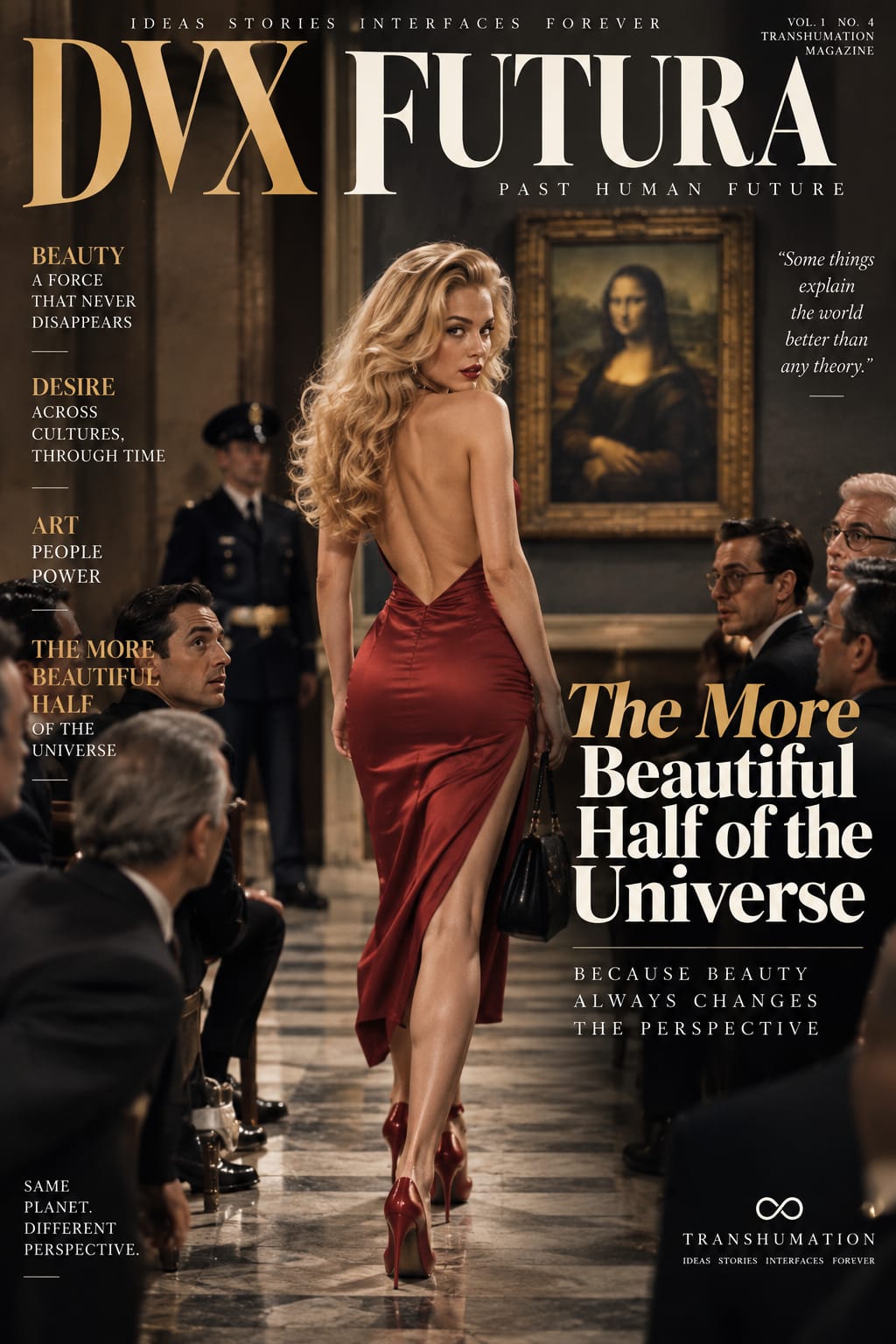
This is the crack into which DViX FUTURA places its finger. The woman made of stone had one body. The woman made of paper could have millions of bodies.
And by the 1990s, those paper women were no longer confined to spaces clearly marked as adult. Their images had entered ordinary commercial culture, where the borders between television celebrity, glamour, fashion, advertising and merchandise were considerably less tidy.
One of them was sitting beside Mickiewicz.

Pamela Meets Mickiewicz
Years later, a husband and wife can have an argument that neither Adam Mickiewicz nor Pamela Anderson could reasonably have anticipated.
“You always liked big breasts and stupid blondes.” Perhaps. There is, however, a respectable historical defence. You wrote notes about Mickiewicz in a notebook with Pamela Anderson on it.
The joke works because nobody in the argument owns the meaning of the image. The husband remembers one Pamela. The wife remembers another. The child who carried the notebook knew a third. The manufacturer knew that a famous face might sell stationery. And somewhere behind all of those versions was Pamela Anderson herself, an actual human being living an actual life while simplified copies of her travelled through bedrooms, kiosks and school corridors she would never see.
Here we encounter one of the governing rules of DViX FUTURA:
My Tommy? First I’ve heard of it.
The phrase comes from a school meeting. A mother was informed of something her son had apparently done and answered with the magnificent disbelief of somebody discovering an unauthorized edition of her own child: “My Tommy? First I’ve heard of it.”
She knew Tommy. The teacher also knew Tommy. His friends presumably knew several additional Tommys.
The comedy comes from the assumption that one of these versions must be fraudulent when all of them may be perfectly real. Human beings change according to room, company, age, fear, desire and opportunity. We know people in slices and routinely mistake the slice available to us for the entire person.
Celebrity industrializes that error.
“Pamela Anderson? Of course I know her.” What we usually mean is that we recognize her: a face, a swimsuit, a collection of familiar pictures. Recognition arrives so easily that we mistake it for acquaintance. The notebook preserves that mistake alongside something more useful: evidence of how an image entered an ordinary life.
The Lowest Shelf of the Library
A serious history of Poland in the 1990s should discuss governments, economic transformation, unemployment, privatization, NATO, new media and the difficult reorientation of a country emerging from communism. Those things matter enormously.
They still cannot tell us exactly what it felt like to be twelve years old on a Tuesday. For that, the historian sometimes has to kneel.
The interesting evidence is several shelves lower: the notebook, the sticker album, the VHS cassette with somebody’s handwriting on the label, the football card, the cheap magazine hidden in a wardrobe, the poster whose corners still carry the marks of adhesive tape. These are poor candidates for museums because they were manufactured as disposable things. They were meant to be touched rather than preserved.
That is precisely what makes them useful.
High culture is often a record of what a civilization decided was worth remembering. Disposable culture is sometimes a record of what people actually looked at while nobody thought history was watching.
A notebook with Pamela Anderson on its cover is almost embarrassingly trivial. Yet put it beside a school anthology and an entire cultural collision appears. Mickiewicz represents a canon inherited from adults, teachers and institutions. Pamela represents a different canon arriving through television, advertising, celebrity and commerce. One is assigned. The other seems spontaneous.
But was it? The child did not select from every possible human face. Somebody had already selected the faces available for selection. Here are the covers. Choose. Freedom often begins after somebody else has designed the menu.
The Woman Nobody Chose
So who chose Pamela Anderson?
Anderson herself participated in creating and managing her public persona. Photographers made choices. Television producers made choices. Magazine editors, advertisers, merchandisers and manufacturers made choices. Audiences made choices by watching, buying and talking. Popular culture was not a conspiracy in which one invisible executive decided what an entire generation would find beautiful. It was a feedback system involving producers and consumers, commerce and imitation, opportunity and chance.
But the child entering a stationery shop in September joined that system very late. Most of the selection had already happened.
This architecture should feel familiar because it survived the disappearance of the notebook. A magazine editor once selected the photograph. A television scheduler selected the hour. A shopkeeper selected what occupied the shelf. The gate was obvious because the gatekeeper was visible.
The digital feed appears to abolish him. There is no kiosk owner standing beside the screen. No editor appears before every photograph to say, Look at this woman. The shelf seems infinite and the movement through it feels voluntary. Yet something still arranges the shelf. The crucial difference is that the shelf can now watch the customer.
A paper notebook never knew whether somebody stared at its cover for two seconds or twenty. A poster could not record that a visitor looked away. A trading card did not know it had become desirable. The image remained mute about its own reception.
Digital platforms can register a response and use it to influence what appears next. Selection becomes a continuing exchange between the system and the viewer, rather than a decision completed before the customer reaches the shop. The gatekeeper did not necessarily disappear.
The gate learned.
When the Cards Began Trading Us
This is why the old schoolyard exchange deserves more respect than nostalgia usually gives it. Those children were not merely swapping pictures. They were operating in one of the last ordinary image economies in which the object could not observe the transaction.
The card knew nothing. That innocence has become technologically unusual.
We once measured the value of an image partly by what somebody would give us to obtain it. Digital platforms can measure another kind of value through the attention and behaviour surrounding the image. The currency is no longer merely possession. It may be time, a click, a pause, a return, a search or a sequence of actions from which preferences can be inferred.
The reversal is subtle enough to feel natural because it happened gradually. First we chose images. Then systems became increasingly capable of choosing images for us according to what our previous behaviour suggested we might choose next.
The cards began trading us.
Not completely, of course. Human beings remain capable of surprise, boredom, rejection and deliberate choice. Recommendation systems are not clairvoyant, and behavioural data is not identical to desire. A pause may mean attraction, disgust, confusion or simply that the telephone rang.
But that uncertainty makes the system more interesting, not less.
It is trying to infer an interior state from exterior behaviour.
Human beings have been attempting the same trick on one another forever.
Technology merely acquired a larger notebook.
The Girl Behind the Cover
There is another reason to keep Pamela’s old notebook.
It reveals the violence — and necessity — of compression.
A human being becomes a face. The face becomes a photograph. The photograph becomes a recognizable code. The code becomes decoration on a piece of stationery. Eventually a child carries that compressed person to school while knowing almost nothing about the life from which the image originated.
This is not something culture does only to beautiful women.
Che Guevara became a face on a T-shirt. Albert Einstein became white hair and a tongue. Charlie Chaplin became a bowler hat, moustache, cane and walk. Mickiewicz himself became the portrait above the poem that generations of bored pupils were instructed to interpret.
Civilization compresses people because it has to. Nobody can carry another human being whole. Names are compression. Portraits are compression. Professions are compression. Obituaries may compress ninety years into six paragraphs.
The map must discard almost everything or it ceases to function as a map.
The trouble begins when the map starts believing it is the territory.
Pamela Anderson on the notebook was real. It was a real object containing a real photograph of a real woman.
Pamela Anderson was also real.
Those statements are not equivalent.
The photograph never gets tired. The woman does. The photograph does not wake up and become bored with being Pamela Anderson. It cannot object to the expectations attached to yesterday’s image. The print may fade or crease in a drawer, but the face it depicts remains the same age. It does not discover that the public prefers a version of itself that existed twenty years earlier.
The woman can do all of those things. That is the price of being alive. Paper has no such problem.
First I’ve Heard of It
Perhaps this explains the strange force of encountering an old school object decades later.
The notebook has barely changed.
We have.
Its cover may restore an entire room with almost indecent efficiency: varnished desks, wet coats in winter, chalk, cheap deodorant, the corridor, the sound of chairs dragged across a floor, the peculiar melancholy of September. An object worth almost nothing becomes a machine for retrieving somebody who no longer exists.
The child who owned it.
And that is when the mother at the school meeting gets her revenge.
Me?
I liked that?
I wore that?
I traded three cards for that one?
My Tommy? First I’ve heard of it.
Only now Tommy is us.
Memory is a talented editor. It removes scenes, improves motives, simplifies embarrassments and quietly brings the protagonist closer to the person we currently believe ourselves to be. Objects are less courteous. A notebook does not care about the latest edition of our autobiography.
It simply sits there. Evidence.
That may be why the lowest shelf of the library deserves its own history. Civilizations preserve constitutions deliberately. They preserve school notebooks by accident. One records the rules a society officially gave itself. The other may preserve the face a child wanted on his desk.
Neither tells the whole truth. But only one of them still has a coffee stain on it.
The first woman in our story was made of stone. The next was made of paper. Somewhere between those materials, humanity discovered that an image could do more than preserve an object of desire.
Given enough copies, enough repetition and enough time, it could participate in teaching us what desire was supposed to look like.
And then we gave the image a computer.
Watch the Video
How to Read the World
by Lucius Dempsey
Current Knowledge
Pamela Anderson became one of the most recognizable international television celebrities of the 1990s through Baywatch, and her public image circulated far beyond the programme itself through magazines, advertising, posters and other forms of popular merchandise. The specific Polish school-notebook scene in this essay is a cultural-memory device rather than a claim that one officially documented notebook defined an entire generation; the broader historical point is the extraordinary portability of celebrity imagery during the expansion of global television and post-Cold War consumer culture.
The technological distinction is firmer. Physical images remain tied to individual carriers even when mass-produced, whereas digital files can be copied without transferring the original copy away from its owner. Contemporary recommendation systems add another layer: platforms can use behavioural signals to personalize subsequent content. The image is therefore no longer merely reproducible and distributable. Its surrounding system can respond to the viewer.
Open Questions
How much of what we call personal taste emerges privately, and how much develops through repeated exposure to a limited menu of culturally available images? Does algorithmic personalization give us greater freedom than the old magazine editor because the selection responds to us, or does it produce a gatekeeper so intimate that we cease to notice the gate?
And beneath both questions sits an older one. If repeated exposure makes a representation feel familiar enough to resemble knowledge, how much of another human being can disappear before we become uncomfortable saying, I know her?
Transhumation Interpretation
Stone made the image permanent. Paper made it portable. Mass culture made it familiar. Digital reproduction made it almost inexhaustible.
Then the direction of the gaze began to change.
The notebook with Pamela on it knew nothing about the child carrying it.
The next generation of images would know considerably more.
FAQ
Why was Pamela Anderson such a recognizable figure in the 1990s?
Her role in Baywatch, combined with extensive magazine, television and popular-media exposure, made her image recognizable far beyond the programme’s regular audience. She became one of the visual symbols of 1990s celebrity culture.
What does a school notebook have to do with mass culture?
A notebook shows how celebrity imagery escaped its original medium. A television image could become a poster, magazine cover, sticker or ordinary consumer object, allowing the same visual code to appear in contexts completely unrelated to the original programme.
Why were physical trading cards different from digital images?
A physical card has individual scarcity: if you give your copy away, you lose possession of it. A digital image can be copied and distributed while the previous holder retains an identical copy. That changes the economics of images from scarcity of copies toward scarcity of attention.
Can repeated images actually influence what people find attractive?
Repetition alone does not mechanically determine desire, and individual preferences vary enormously. But media exposure can contribute to cultural standards, familiarity and expectations. The more interesting relationship is therefore reciprocal: people select images, while the available images can also influence the categories through which people learn to recognize beauty and desirability.
What changes when an image can “look back”?
The image itself is not conscious. The phrase describes the surrounding digital system. Unlike a printed notebook, digital platforms can collect behavioural signals about how users interact with content and use those signals in recommendation. Representation therefore acquires something historically unusual: a feedback loop between viewer and distribution system.
Continue the Transhumation Series
- Forgotten Religion | Ancient Gods, Symbols and the Hidden Structures of Human Civilization
- The Last Religion | Death, Immortality and the Future of Humanity
- The New Theurgy | AI, Information and the Future of Human Civilization
- End of Branding: You Were Never Meant to Become a Product
- Baal vs Ishtar: Why Ancient Gods Never Disappeared