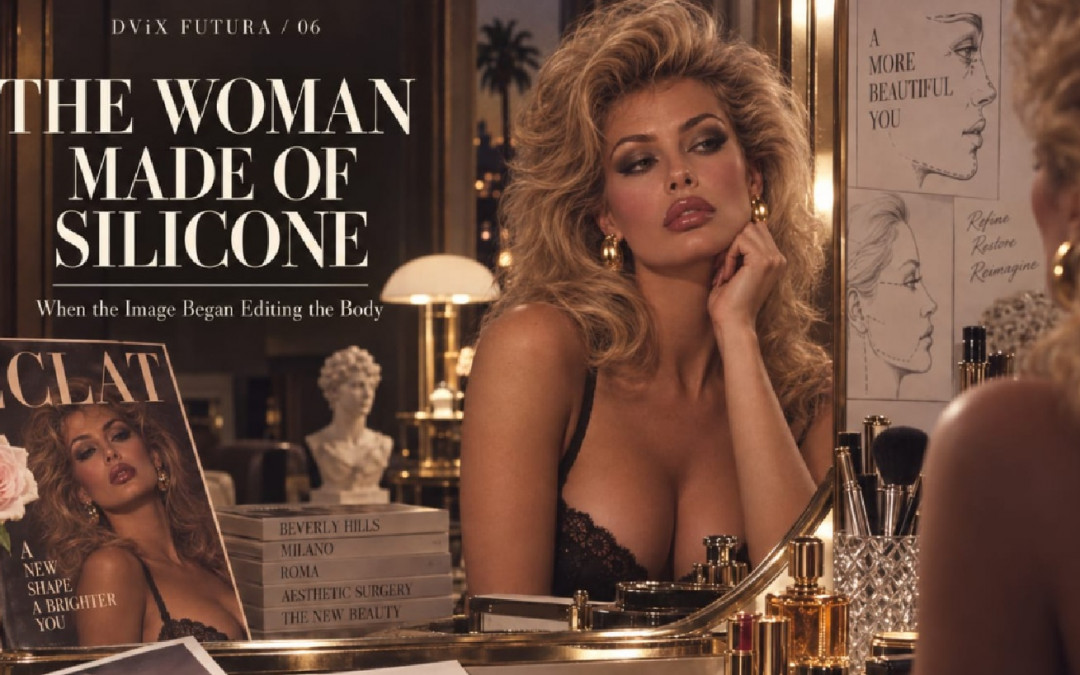
The Woman Made of Silicone
The package arrived looking expensive. It had curves, symmetry, excellent lighting and the sort of confidence normally associated with products whose instructions have been translated into twelve languages. I opened it carefully. There was no manual.
This happens more often than civilization admits. We improve the packaging, refine the surface, add features, remove inconveniences and only afterwards ask the vulgar little question that should probably have appeared on page one: what is this for?
In 1993 an American advertising campaign reduced an ancient commodity to two words: Got Milk? It was brilliant partly because it did not lecture anyone about calcium. It made absence the problem. You had the cookie, the cereal, the peanut butter sandwich. The milk was missing.
Thirty years later the question has acquired possibilities its creators could hardly have intended. Got milk? Yes, perhaps. But for what? I do not have a man. Got a man? Yes, but no children. Got children? They grew up. Got silicone? Excellent. Excellent for what?
Somewhere between the breast, the billboard and the surgeon’s catalogue, the instruction sheet appears to have fallen out of the box.
Got Milk? But for What?
A large breast is not simply a larger milk container. Breast size is strongly influenced by fatty tissue, while milk production depends on functioning glandular tissue and physiology; appearance is therefore a poor instruction manual for function. This should not be surprising, yet culture is unusually talented at confusing a visible signal with the thing it imagines the signal means.
That does not make beauty fraudulent. A feather can be spectacular without being useful for flight. A cancan dancer can wear enough plumage to alarm an ornithologist and still be doing exactly what the evening requires. Burlesque, Las Vegas showgirls and Liberace understood something modern minimalism occasionally forgets: spectacle can be a function.
The peacock is useful here as a metaphor, not a complete theory of human sexuality. A conspicuous trait can matter because it is seen. Human culture then takes the principle and adds lighting, sequins, a camera crew and a credit card. Biology supplies a body; culture discovers the volume control.
So Got Milk? is not an accusation. A breast does not need to justify its existence by feeding a child any more than sex must justify itself by producing one. The more interesting question is what happens when the signal can be detached from one function, amplified for another, and finally engineered back into the body.
Paper could show the dream. Plastic could reproduce it. Silicone could make someone carry it under her skin.
The Peacock Goes to Vegas
We say we want less. Less friction, less waiting, fewer buttons, cleaner lines. Less is more became so successful that even luxury learned to whisper. And yet Las Vegas has spent decades making a persuasive counterproposal: sometimes more is more, and occasionally too much is almost enough.
The phrase matters because of the word almost. A finished desire is commercially awkward. The perfect telephone would be a minor catastrophe for anyone hoping to sell the next one. The permanently perfect manicure would be equally unfortunate for the salon. A beautician once answered a complaint about how quickly nails grow with the most economical theory of capitalism imaginable: good. Otherwise we would go out of business.
The human body has the same economically magnificent defect. It will not stay finished. Hair grows. Nails grow. Skin changes. Muscles disappear if neglected. Gravity keeps its appointment. Age ignores the warranty.
Silicone enters this world not as villain but as promise: perhaps one part of the package can be made closer to the specification. The trouble is that specifications have a habit of moving.
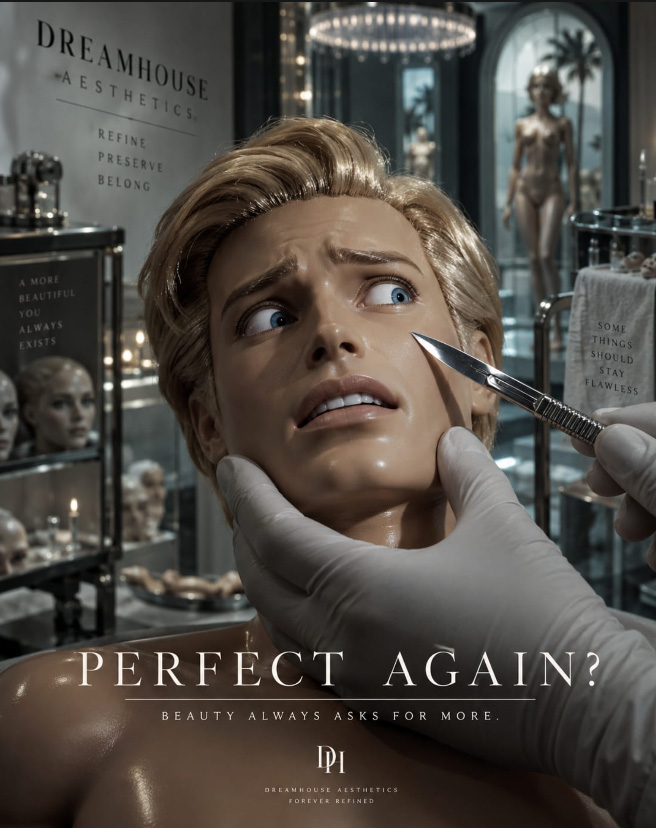
Do Perfect Balls Make a Perfect Man?
Men have enjoyed discussing the ideal female body for so long that symmetry requires a small administrative correction. If perfect breasts make a perfect woman, do perfect balls make a perfect man?
The question is ridiculous, which is why it is useful. Perfect in what sense? Larger? Rounder? More symmetrical? More fertile? More attractive? Better at their biological job? The moment function enters the room, geometry becomes nervous.
This is the problem of the Perfect Sphere in flesh. A mathematical sphere enjoys an enormous advantage over a human body: it does not have to breastfeed, make love, run from danger, recover from surgery, grow old or stay alive. It can devote itself entirely to geometry. Biology cannot.
The sphere can afford to be perfect. The body has to work.
And yet the dream of the sphere keeps returning. Stone could obey it without complaint. Paper could improve it. Plastic could manufacture it. Silicone marks the stranger threshold at which the ideal can cross back into living tissue. The fake becomes real without becoming natural.
That is not automatically a tragedy. Reconstruction after mastectomy, correction after injury and elective aesthetic surgery are not the same human situation merely because some tools overlap. Human beings have always modified bodies. The question is not whether modification is permitted. The question is when an image stops being a proposal and becomes a technical specification.
The Woman Made of Silicone
Stone began with a woman and asked what the artist wanted her to become. Paper added the editor, photographer and publisher. Plastic allowed a company to manufacture an ideal by the million. Silicone appears, at first, to return authority to the woman herself: this is how she wants herself.
Good. Edith would like to keep that sentence. She would also like to inspect the box.
Where did the wanting come from? That is not a trick question and it is not an argument that women cannot know their own minds. Nobody’s desires arrive untouched by other people. Taste is assembled from bodies we have seen, people who desired us, people who did not, films, lovers, jokes, magazines, fear, fashion, memory and whatever happened at school when we were fourteen.
Choice can be genuine and influenced at the same time. The difficult question is therefore not, Did she choose? It is: how do any of us discover where our choice begins when the catalogue arrived years before we knew we were shopping?
Men do not escape the catalogue. Hair, height, jaw, teeth, muscle, penis, testosterone, the increasingly elaborate architecture of the gym: the male body has its own aftermarket department. Hence the usefulness of perfect balls. The joke stops the essay from pretending that women invented insecurity.
There is a point when the symbol goes under the skin. Silicone is interesting because it makes that crossing literal.
As Little Responsibility as Possible
In American Beauty, Lester Burnham dreams of a life with as little responsibility as possible. The line is funny because it is adolescent, and attractive because almost every adult understands it. Civilization itself can sometimes look like a long engineering project devoted to separating desired effects from inconvenient costs.
Light without tending the fire. Travel without walking. Sex without necessarily producing children. Communication without physical presence. Beauty without having to explain what practical service beauty performs. None of this is inherently decadent. Freedom from a function can create another function entirely.
That is why Got Milk? cannot be the prosecution’s closing argument. Perhaps there is no milk. Perhaps milk was never the point. The showgirl’s feathers do not help her fly; they help her become a showgirl. Ornament is not failed engineering simply because an engineer cannot find its load-bearing purpose.
But technology creates a new question: where did the responsibility go? When the body was largely received, many features could be answered with a shrug: that is how I am. When more of the body becomes editable, the shrug becomes harder. Every new option creates not only freedom but the possibility of wondering whether one chose correctly.
The manual is still missing. The customization menu is getting longer.

Strong Enough
After all this geometry, Sheryl Crow asks a wonderfully inconvenient question in Strong Enough. Not whether a man is symmetrical enough, rich enough or photogenic enough. She asks whether he is strong enough to be her man. Later the song becomes more vulnerable: the speaker can be contradictory, difficult, broken, even willing to believe a lie if the alternative is abandonment.
That does not cancel independence. It exposes the difference between I do not need you to survive and I do not want you. Freedom from necessity is not freedom from desire. A person can become economically, sexually and socially autonomous and still discover that reciprocity is one product no individual can manufacture alone.
I choose you. Now choose me back.
There is no cosmetic procedure for that. You can redesign the peacock; you cannot redesign the other peacock’s answer. Technology can increasingly control the signal while leaving the response stubbornly outside the package.
This may be why the word enough matters more than perfect. Perfect breasts, perfect skin, perfect teeth, perfect balls, perfect photographs: all can remain insufficient if the question underneath them was never geometric.
Some Assembly Required
Perhaps the strangest thing about the Woman Made of Silicone is that she is not fake. The implant may be manufactured, but the person carrying it is real. The weight is real. The tissue around it is real. The desire may be real. The pleasure may be real. So may the regret. Artificial and unreal are not synonyms.
That is the threshold. For most of the history of representation, we changed the image to resemble the dream. Now we can change the body. Soon, in some domains, biotechnology may let us alter parts of the instructions from which bodies develop. The direction of influence has reversed: the copy can return to the original carrying specifications.
Frankenstein asked whether an imperfect human being could create life. Our version may be more vain: once we learn to alter the creature, what happens when we refuse to accept how the creature looks?
The answer should not be a sermon against alteration. Beauty does not have to earn its existence by being useful. A woman is not a feeding apparatus, a man is not a reproductive tool, and neither sex owes nature an untouched original. But neither are we blank products designed in isolation from the catalogue around us.
The box is beautiful. The accessories are extraordinary. Partner sold separately. Ageing unfortunately pre-installed. Silicone available as an aftermarket option. Instructions missing.
Some assembly required.
And perhaps that leaves one final advertising question.
Got enough?
Of course not.
That is why the shop is still open.
Watch the Video
How to Read the World

Current Knowledge
Human beings have modified appearance for thousands of years through clothing, cosmetics, tattooing, piercing, scarification and other practices. Modern medicine expanded the depth and precision of possible interventions, but reconstructive surgery, elective cosmetic surgery and non-surgical procedures can serve very different purposes and should not be treated as one ethical or psychological category.
Breast size is not a simple measure of milk-producing capacity. Visible size reflects several tissues, including fat, while lactation depends on functioning glandular tissue, hormones and other physiological factors. Appearance therefore cannot be used as a straightforward proxy for function.
The American Got Milk? campaign was created for the California Milk Processor Board by Goodby, Silverstein & Partners in 1993. Its original strategy focused on milk deprivation: familiar foods became frustrating when milk was absent. The use of the slogan in this essay is a later cultural inversion, not the campaign’s original meaning.
Research on body image indicates that social comparison and exposure to appearance ideals can influence body satisfaction, but effects vary with individual vulnerability, age, context and media use. Social influence does not by itself make a preference false, nor does elective body modification automatically imply coercion or pathology.
Open Questions
Where does correction end and design begin? Is that boundary defined by medical function, personal intention, degree of intervention, cultural expectation, or something else?
How much authorship can anyone claim over desire? Human preferences are socially shaped, but socially shaped choices can still be authentic. The unresolved problem is how to distinguish influence, persuasion, fashion, pressure and coercion without pretending that an untouched self exists outside culture.
What does “perfect” mean when a body has several functions at once? An aesthetically optimized feature may be neutral, helpful or costly with respect to other goals. Geometry alone cannot specify a perfect human being because the body is not built for a single measurable task.
As biotechnology makes more traits editable, will freedom from biological constraint reduce responsibility, or increase it by turning inherited features into possible choices?
Transhumation Interpretation
The Woman Made of Silicone marks the moment when representation can cross back into the represented.
Stone allowed an artist to idealize the body. Paper allowed editors and photographers to select and distribute an image. Plastic allowed an ideal to be manufactured repeatedly. Silicone allows an idea about the body to become part of a living body.
This does not make the artificial unreal. It makes the boundary more interesting. The implant is artificial; the person, consequences, choices and experience are real.
The Perfect Sphere exposes the deeper problem. A sphere can be perfect because its criteria can be specified. A human being has competing functions, desires, relationships and histories. “Perfect” therefore keeps collapsing into the harder word: “enough.”
The Transhumation question is not whether humans should remain natural. Humans have never lived that way. It is what happens when the image becomes an instruction, the body becomes increasingly editable, and the instruction manual still does not arrive.
FAQ
What does “The Woman Made of Silicone” mean?
It describes a threshold at which an ideal represented in images can be engineered back into a living body. Silicone is both a literal material and a symbol of that reversal.
Is the article arguing against cosmetic surgery?
No. Reconstructive and elective procedures serve different purposes, and body modification can be freely chosen and beneficial. The essay asks how choice, culture, technology and function interact once bodies become more editable.
Why does the article use “Got Milk?”
The 1993 advertising slogan originally dramatized the inconvenience of not having milk. Here it becomes a joke about function: a visible biological feature, its cultural meaning and its practical uses do not necessarily remain attached to one another.
What does the Perfect Sphere have to do with the body?
A sphere can satisfy a precise geometric definition without needing to perform biological tasks. Human bodies must live, heal, age and perform many competing functions. The contrast shows why aesthetic perfection and functional perfection are not the same thing.
Why bring men and “perfect balls” into the argument?
Because the mechanism is not uniquely female. Men also encounter ideals involving muscle, hair, height, genital size, teeth and other traits. The joke exposes the difficulty of defining “perfect” without first specifying a function.
What is the deeper Transhumation question?
When technology allows an image or ideal to become a specification for modifying the body, how do we decide what to change, what to preserve and what “enough” means?
Continue the Transhumation Series
- Forgotten Religion | Ancient Gods, Symbols and the Hidden Structures of Human Civilization
- The Last Religion | Death, Immortality and the Future of Humanity
- The New Theurgy | AI, Information and the Future of Human Civilization
- End of Branding: You Were Never Meant to Become a Product
- Baal vs Ishtar: Why Ancient Gods Never Disappeared