
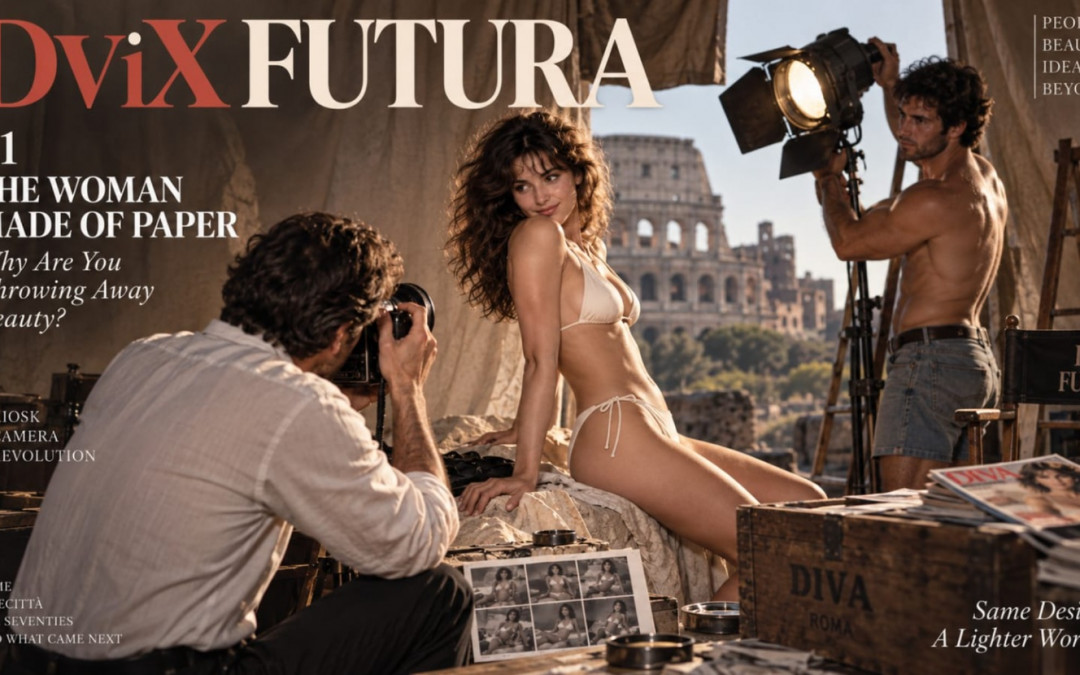
The Woman of Stone
There was a woman before there was paper. She was made of stone. Someone had spent months finding her inside a block of marble: the turn of a shoulder, the weight resting on one leg, the small softness at the waist that kept perfection from becoming geometry. Marble was expensive, difficult and absurdly heavy, which was partly the point. You did not carve a woman into stone because you wanted her until Tuesday. You chose stone because Tuesday would pass. So would you. Perhaps that was the first bargain between beauty and time: I will give you something harder than I am, and you will carry this face farther than I can. Sometimes it worked. Sometimes another man arrived centuries later, broke the statue apart and burned the marble for lime. Time had not defeated her. Another human being had. Someone made her to survive. But she didn’t.
Why Are You Throwing Away Beauty?
Riccardo Schicchi grew up with a lighter material. He remembered the strange treatment given to images of beautiful women: adults could accept a newspaper filled with politicians, footballers, advertisements and disasters, yet certain pictures had to disappear before the paper reached a child. I am less interested in what the adults thought they were protecting than in the simplicity of the question left behind. Why are you throwing away beauty? Adulthood can improve a question until almost nothing remains of it. We add morality, exploitation, liberation, censorship, commerce, feminism, obscenity and art. Schicchi would eventually meet all of them. But before the arguments came, there was a boy watching an adult remove something he wanted to keep looking at. Perhaps that is where his entire story begins. Not with sex. Not with rebellion. With the suspicion that someone had mistaken beauty for something that needed to be thrown away.
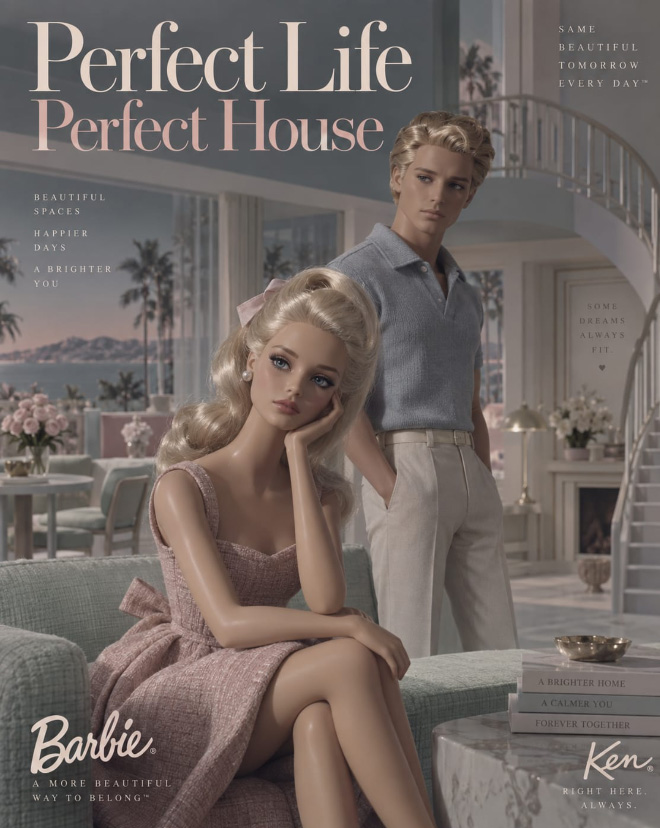
The Woman of Paper
Paper had discovered something marble never could. The stone woman survived by remaining one extraordinarily durable object. The paper woman could survive by becoming a thousand fragile ones. Tear one magazine in half and another copy was already on a train, beneath a mattress, inside a kiosk, in somebody’s suitcase. A statue needed men and a cart to cross a city; a photograph could cross Europe under one arm. Schicchi arrived precisely at this intersection of beauty and reproduction. Through photography and later Diva Futura, women such as Ilona Staller and Moana Pozzi could exist in two different ways at once. The biological woman remained singular. She slept, became tired, changed her mind and grew older. Her paper counterpart did none of those things. The first woman survived because she was difficult to destroy. The second discovered another strategy. She survived because there were millions of her.
The Trick Has to Survive the Body
Picasso had an advantage Schicchi did not. Picasso could move an eye, rotate a breast, place profile and full face in the same instant and make a woman occupy several perspectives at once. The painting did not fail because no biological woman could reproduce the pose. A circus performer lives under a harsher contract. The costume may sparkle, the music may promise miracles and the lighting may hide the wire, but when the acrobat releases the trapeze, gravity gets a vote. The photographed body lives somewhere between Picasso and the circus. Light can flatter it. Makeup can alter it. Surgery, silicone, pose, lens and editing can push it surprisingly far from an ordinary Tuesday morning. Yet somewhere the representation encounters a border. The feathers eventually fall. The trick must still be performed by a human body. Perhaps that is what makes these images uncomfortable and fascinating at once. Beneath all the decoration waits the oldest subject in art. Ecce homo.
The Camera Points Both Ways
For years I assumed a camera pointed at whatever stood before its lens. Schicchi makes me less certain. There is another person inside every successful image who never appears in the frame: the person who wants to see it. A rock star can be accused of excess and reply that the audience paid to watch the excess; the accusation becomes uncomfortable because the stage suddenly behaves like a mirror. Desire gives us even less distance. Not everyone is a rock star, but the impulse to look, attract, pose, compare, fantasize and be desired is hardly the property of an exotic tribe. If millions of people repeatedly choose an image, their choice does not tell us everything about them, but it tells us something. Schicchi photographed beautiful women. His circulation figures were doing something else. He photographed the women with his camera. The pictures photographed everyone looking back.
A Mirror Cannot Say No
That is where the pleasant idea of a mirror becomes troublesome. A mirror cannot be blamed for the face placed before it because a mirror cannot refuse. A human being can. As the market around Schicchi changed, the simple promise of showing what people wanted to see encountered a harder question: what happens when people want to see something the person holding the camera does not want to make? Every successful medium eventually discovers this problem. An audience does not merely accept images; it asks for novelty, then stronger novelty, then something it has not yet seen. One answer is to follow desire wherever it goes. Another is to decide that desire itself needs a border. I am not sure which answer is more honest. I am interested in the man standing between them. He began with a question about why adults threw beauty away. Eventually he faced the opposite question: is everything we want to look at worth keeping?
Diva Futura
Perhaps this is why Diva Futura now sounds less like the name of an agency than a description of something approaching. The future diva was becoming progressively less dependent on the place occupied by her body. Woman of stone. Woman of paper. Woman altered by silicone. Woman recorded on tape and disc. Woman reconstructed from information. It is not a perfect sequence, but the direction of the arrows is difficult to ignore. Each transformation makes the representation easier to move, reproduce or rebuild while making it less dependent on one particular carrier. Digital information is not immaterial; servers, cables and electricity remain stubbornly physical. But we do not need to know what information ultimately is to notice something becoming lighter. Marble weighs hundreds of kilograms. A magazine weighs grams. A file passes from one machine to another until asking how much the woman in the image weighs begins to sound like a question from the wrong century.
The Things We Thought Would Matter
The strangest part is how badly we predict what will survive us. At twenty-five there are serious things to worry about: the apartment, the car, the promotion, the mortgage, the children’s school, the holiday we cannot afford and the person who has not called back. A photograph made one afternoon can seem ridiculous beside them. Perhaps the light was good. Perhaps somebody wanted it. Perhaps for ten minutes a woman simply liked the way she looked. Then fifty years perform their ordinary edit. The car becomes scrap. The apartment belongs to strangers. The children leave and have children. The holiday collapses into three memories. Even the person for whom the photograph was taken may have disappeared decades earlier. Then an old woman opens a drawer and meets someone she knows immediately. The young woman has been waiting without ageing. She was never the most important thing in the drawer. Of all the things she tried to keep, she had accidentally kept herself.
The Man Behind the Camera
It does not happen only to women. Riccardo Schicchi may be the better demonstration. He lived an entire life, and an entire life contains far more boredom, illness, breakfast, paperwork, disappointment and waiting than any biography admits. He grew older. He became ill. He died in 2012. Yet when I go looking for him, death seems strangely difficult to find. There he is again with a camera, smiling, standing beside beautiful women in the world he helped construct. Memory has no obligation to preserve a life proportionally. It chooses frames. The biological man continued towards the ordinary conclusion awaiting every body; the man inside the photograph did not accompany him. There is something almost indecently appropriate about it. Schicchi spent his life selecting the instant in which another person would remain young, beautiful and alive after the instant itself had vanished. In the end, the same machinery selected him. He spent his life choosing the moment in which other people would survive. Time eventually returned the favour.
Watch the Video
How to Read the World
by
Current Knowledge
Human beings have tried to preserve their appearance for thousands of years. Sculpture, painting, photography, film and digital media did not merely improve the accuracy of representation. They progressively changed the relationship between an image and its physical carrier.
A marble figure survives primarily through the endurance of a particular object. A printed photograph can survive through multiplication: the loss of one copy does not destroy the image if others remain. Digital representation takes this further. The same image, recording or text can be reproduced across many physical devices without remaining tied to any single original carrier.
Photography also introduced a peculiar separation between biological and represented time. The person depicted continues to age, while the recorded moment does not. A photograph therefore preserves not simply a person, but a particular state of that person.
Riccardo Schicchi worked during an important transition in this history. Through photography, magazines, film and the Diva Futura agency, he participated in a culture in which human appearance could be reproduced and distributed on an increasingly large scale. The people photographed remained singular biological individuals; their representations could become numerous.
Digital networks have accelerated this separation. Images can now persist, migrate and multiply independently of the particular camera, screen or storage device on which they first appeared.
The physical infrastructure has not disappeared. Every digital image still requires matter and energy for storage, transmission and reconstruction. What has changed is the decreasing dependence of the represented pattern on one particular physical carrier.
Open Questions
If a photograph survives after the person depicted has died, what exactly has survived?
Is increasing reproducibility equivalent to increasing durability, or does it merely replace one form of vulnerability with another?
When thousands or millions of representations of a person exist, who determines which version becomes culturally dominant?
Does an image preserve part of a person, or only information from which an observer constructs an impression of that person?
As representation becomes progressively easier to copy, modify and eventually generate, where is the boundary between preserving a person and creating a new representation that no longer requires the original person at all?
And if the historical direction really is stone → paper → recording → digital information, is decreasing dependence on a particular carrier merely a technological convenience — or evidence of a deeper pattern in how information survives?
Transhumation Interpretation
Transhumation does not propose that information is immaterial, nor that a digital copy somehow contains the person from whom it originated.
The narrower observation may be more interesting.
Across several major technologies of representation, survival has become progressively less dependent on the survival of a particular physical object.
Stone survived by being hard.
Paper survived by becoming many.
Digital information survives by remaining reproducible.
The direction matters.
Human beings once attempted to defeat time by making the carrier stronger. Increasingly, we attempt to defeat loss by making the carrier replaceable.
This suggests a different definition of durability.
Perhaps the most resilient structure is not the one that cannot be destroyed.
Perhaps it is the one that can be reconstructed after destruction.
A statue asks us to protect the stone. A photograph asks us to preserve a copy. A digital image asks us to preserve enough information to make the image appear again.
Riccardo Schicchi himself illustrates the strange consequence. The biological man aged and died. Yet particular recorded versions of him remain available: standing beside a camera, surrounded by the people and images of the world he helped create.
The same mechanism applies to everyone whose image is recorded.
The body continues through time.
The representation does not have to.
And perhaps this is one of the directions worth watching most carefully on the Information Ladder:
the carrier becomes less permanent precisely as the pattern becomes easier to preserve.
We do not yet know what stands at the end of that process.
We can only see the direction of the arrows.
FAQ
Who was Riccardo Schicchi?
Riccardo Schicchi was an Italian photographer, filmmaker and entrepreneur best known as the founder of Diva Futura, the agency associated with figures including Ilona Staller and Moana Pozzi. His career coincided with a period when erotic imagery was moving from magazines and photography toward video, television and eventually digital media.
What was Diva Futura?
Diva Futura was the agency founded by Riccardo Schicchi in the 1980s. It helped turn several performers into widely recognized figures in Italian popular culture. In this article, however, the name also becomes a metaphor: the “future diva” is a human image becoming increasingly independent of the physical location of the person it represents.
Why does the article compare marble statues with photographs?
A marble statue survives largely because one physical object survives. Photography introduced another strategy: reproduction. A single photograph can exist in thousands or millions of copies, so destroying one carrier does not necessarily destroy the image. The comparison asks whether durability gradually shifted from the strength of an object toward the ability to reconstruct its information.
What does “The Woman Made of Paper” mean?
It describes the moment when the representation of a person becomes reproducible. The woman herself remains a single biological individual, while her photographed image can appear simultaneously in thousands of places. Paper therefore changes not only how beauty is represented, but how a representation can survive.
Why are Picasso and the circus mentioned?
They reveal different limits of representation. Picasso could rearrange a human body without obeying anatomy because a painting does not need to be physically possible. An acrobat, however, ultimately has to obey gravity. Photography of the human body lies somewhere between these worlds: illusion can transform what we see, but eventually the representation encounters physical reality.
Why does the article say that the camera “points both ways”?
An image contains information not only about its subject but indirectly about the people who choose to look at it. When an image is repeatedly selected, purchased or shared, the audience becomes part of its story. In that sense, Schicchi photographed women while the popularity of those photographs also revealed something about their viewers.
Is this article about pornography?
Not primarily. Schicchi’s work makes sexuality impossible to remove from his story, but the article is concerned with a broader question: why humans create images of one another and what happens when those images become reproducible. Desire is treated here as part of human behavior rather than as a separate world inhabited by somebody else.
What does “Woman of Stone → Woman of Paper → Woman of Information” mean?
It describes a change in carriers. Stone ties representation closely to a single durable object. Print allows an image to multiply. Digital systems allow the same recognizable pattern to be reconstructed across different physical devices. The sequence does not claim that information is immaterial; it asks why representation appears to become progressively less dependent on any particular carrier.
What is the main idea of the article?
Human beings once tried to preserve themselves by making durable objects. Increasingly, we preserve representations by making them reproducible. A person still ages and dies, but a selected image can remain unchanged and continue moving between carriers. Riccardo Schicchi becomes the final example of his own medium: a man who spent his life selecting images in which other people would remain young and alive, and who is now remembered through selected images of himself.
Continue the Transhumation Series
- Forgotten Religion | Ancient Gods, Symbols and the Hidden Structures of Human Civilization
- The Last Religion | Death, Immortality and the Future of Humanity
- The New Theurgy | AI, Information and the Future of Human Civilization
- End of Branding: You Were Never Meant to Become a Product
- Baal vs Ishtar: Why Ancient Gods Never Disappeared