
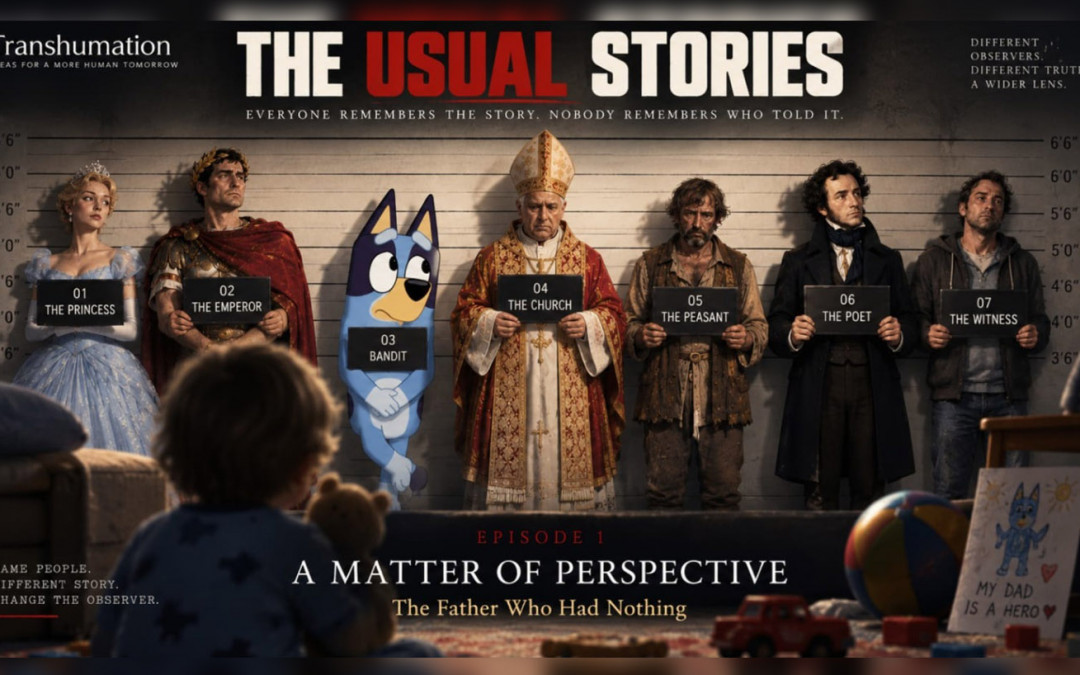
The Father Who Had Nothing
There is a peculiar kind of wealth in Bluey, and almost none of it has anything to do with money. Bandit rarely needs elaborate equipment. A sofa will do. So will a pen, a patch of carpet or a hallway. Nothing physical happens to these objects, yet within seconds the room can acquire borders, danger, laws and geography.
From adult height, this looks like play. The sofa remains upholstered furniture and the floor remains a floor. From three feet lower, however, Bandit may be captain of the only ship that matters and the carpet may be lava. The objects have not changed. The experienced world has.
This may be one reason Bluey occasionally feels less like children’s television than a camera placed at an inconvenient height. It does not explain parenthood to adults. It lowers the lens until the adult has to look from somewhere else.
The father has acquired nothing. The room contains nothing new. And yet, from the child’s position, the world is suddenly richer.
The Sofa Is Still a Sofa
Adults are trained to notice absence. A better toy, a larger screen, another subscription, a more impressive holiday: much of consumer life begins with the suggestion that something is missing. Children are often capable of asking a cheaper and more dangerous question: what can this become?
A sofa can become a fort, a mountain, an island or a ship. The last cushion can become the only safe territory above a floor declared to be lava. None of this changes the molecular structure or market price of the furniture. What changes is the relation between the observer and the thing observed.
Bandit’s wealth lies partly in his willingness to enter that relation. He gives his children time, attention and permission to let another frame become temporarily operational. If the floor is lava, he does not need to believe in molten rock. He needs to understand that, for the game to exist, the rule must matter.
This distinction is small enough to miss. The floor is objectively not lava, yet the game is real. Children jump, negotiate routes, rescue one another and avoid touching it. An invented layer has produced real behaviour without changing the underlying floor.
That does not mean imagination can make anything true. It means something more interesting: knowing what an object is does not exhaust what the object can mean.

Move the Camera Downstairs
Imagine a princess waking in a palace. The curtains are open. Her clothes have been prepared. Breakfast is waiting. The hallway is warm, the carriage ready and the horses brushed. Nothing in this description needs to be false.
Now move the camera downstairs.
Someone woke before dawn, lit the fire, carried water, prepared the food, brushed the horses and opened the gates. The princess still woke to find breakfast waiting. The servant also woke hours earlier to make that sentence true.
The second story does not cancel the first. It enlarges it.
This is where perspective becomes more serious than opinion. The breakfast either existed or it did not. The fire was lit or it was not. Moving the camera does not dissolve facts into “your truth” and “my truth.” It changes which facts enter the frame and which remain scenery.
The front entrance and the servants’ stairs belong to the same palace. A complete building can contain radically different mornings.
The Palace Did Not Have to Lie
History has often preferred the front entrance for a practical reason: that is where the names were. Rulers commissioned inscriptions, governments kept records, property generated contracts and institutions preserved correspondence. Other lives often survived in thinner traces: a wage entry, a court record, a grave, a tool, a line in somebody else’s account.
This does not mean history is merely propaganda or that historians are prisoners of whatever powerful people chose to record. Sources can be compared. Archaeology can contradict texts. Administrative records can reveal what official narratives ignore. Evidence pushes back.
But even a completely true sentence can have a blind side. “The princess ate breakfast” tells us something real while saying nothing about the kitchen. The palace does not need to invent breakfast in order to make the labour behind it disappear from the story.
This is why the camera matters. A frame can contain nothing false and still leave something important outside it.
What Does Bluey Know About History?
Almost nothing directly. That is why the example works.
There is no conspiracy in the Heeler household. Nobody is hiding an archive or forging a document. There is only a father, two children and an ordinary room. Yet moving the observer changes what the room contains as experience.
That gives Lucius Dempsey a surprisingly useful historical method. When we read about an emperor, where is the camera? When we admire a palace, who is outside the photograph? When a family remembers its past, which person became the narrator? When a society calls an event triumph, catastrophe or liberation, from whose position does the word make sense?
These questions do not make every answer equally good. A forged document remains forged. A massacre does not become harmless because its perpetrator uses another word. Perspective is not an acid that dissolves evidence. It is a discipline for locating the observer while leaving the evidence intact.
There Is No View From Nowhere
The temptation is to imagine that, with enough intelligence and enough information, we could eventually rise above perspective altogether. The historian dreams of the complete archive. The journalist dreams of the perfectly neutral camera. The parent dreams of finally understanding what the child will remember.
Perhaps the better ambition is smaller. Do not pretend the camera has disappeared. Learn where it stands.
Move it higher and the street becomes a map. Move it lower and the map becomes a wall in front of a child. Walk behind the palace and a symbol of royal elegance becomes a workplace. Sit on the floor and a tired father becomes a mountain. The object can remain where it was while the structure visible to the observer changes.
This is not a defect in human perception that can simply be engineered away. It is part of having a position at all. We encounter the world from somewhere.
The Father Who Had Nothing
Bandit did not buy the ship. He did not build the mountain. He did not replace the floor. In the crude accounting of objects, he contributed almost nothing.
But a relationship appeared between the same objects, and the relationship changed what the room could contain. That may be the quiet trick hidden inside the title. The father who had nothing could still give something because value was not located entirely inside the objects.
The same discipline scales upward. Before deciding that an old story is false, move the camera. It may remain true. Before deciding that it is complete, move the camera again.
Sometimes nothing in the world needs to move.
Only the observer.
Watch the Video
How to Read the World
by
Current Knowledge
Human perception is selective. Attention, prior knowledge, expectations, physical position and social context influence what people notice and how they organize information. This does not make perception arbitrary: external reality constrains interpretation, but observers can have access to different parts of the same event.
Historical evidence is also uneven. Literate, wealthy and institutionally powerful groups often produced and preserved more records, while other lives may survive through archaeology, legal or administrative traces, material culture and indirect testimony. Historical method uses source criticism and comparison to test claims and recover context.
No narrative can include every event, participant and causal factor. Selection is therefore unavoidable. Objectivity does not require pretending that selection disappears; it requires making claims answerable to evidence, chronology, provenance and competing explanations.
Open Questions
How much distortion comes from deliberate manipulation, and how much from the ordinary limits of a frame? Something can disappear from a story because somebody hid it, because nobody recorded it, because the evidence was lost, or simply because another fact occupied the foreground.
Can adding perspectives produce a more accurate account without producing an unusable pile of fragments? More cameras can expose omissions, but interpretation still requires synthesis. The difficult task is to widen the frame without pretending that every frame is equally well supported.
There is also a deeper question: if meaning changes with relationships and observers while physical objects remain stable, which parts of experienced reality belong to the object and which emerge from the interface between object and observer?
Transhumation Interpretation
The Father Who Had Nothing introduces a simple method: move the camera. A sofa can remain a sofa while becoming a ship inside a real relationship. A palace can remain a palace while becoming a workplace when the observer walks downstairs.
Transhumation treats this not as permission for relativism but as a warning against confusing an interface with the whole. Facts remain constrained by reality. Meaning, emphasis and experienced structure can nevertheless change when the observer changes position.
Lucius Dempsey does not need to begin with metaphysics. A sofa is enough. If changing the observer can reveal a structure that was present but invisible from the previous position, the sensible response is not to declare the first view false. It is to move the camera before declaring the story complete.
FAQ
What does Bluey have to do with perspective?
It provides a simple demonstration: the physical room can remain unchanged while a child’s position, rules and relationship with a parent radically alter what the room means and how people behave inside it.
Does perspective mean everyone has their own truth?
No. The floor in the game is not literally lava. Perspective changes access, emphasis and meaning; it does not give an observer unlimited power to change external facts.
Why move the camera downstairs in the palace?
Because the princess and the servants can inhabit the same factual event from different positions. Breakfast can genuinely be waiting upstairs because somebody genuinely worked downstairs.
Can a true story still be misleading?
Yes. A statement can be factually accurate while omitting context that changes its significance. The frame matters even when everything inside the frame is true.
Is this historical relativism?
No. Historical interpretations remain constrained by evidence, chronology, provenance and explanatory power. Moving the camera is a way to look for omitted evidence, not a reason to abandon standards of evidence.
What is the deeper Transhumation question?
How much of the world we experience belongs to objects themselves, and how much emerges from relationships, interfaces and the position of the observer? The first view may be true. The second may enlarge it.
Continue the Transhumation Series
- Forgotten Religion | Ancient Gods, Symbols and the Hidden Structures of Human Civilization
- The Last Religion | Death, Immortality and the Future of Humanity
- The New Theurgy | AI, Information and the Future of Human Civilization
- End of Branding: You Were Never Meant to Become a Product
- Baal vs Ishtar: Why Ancient Gods Never Disappeared