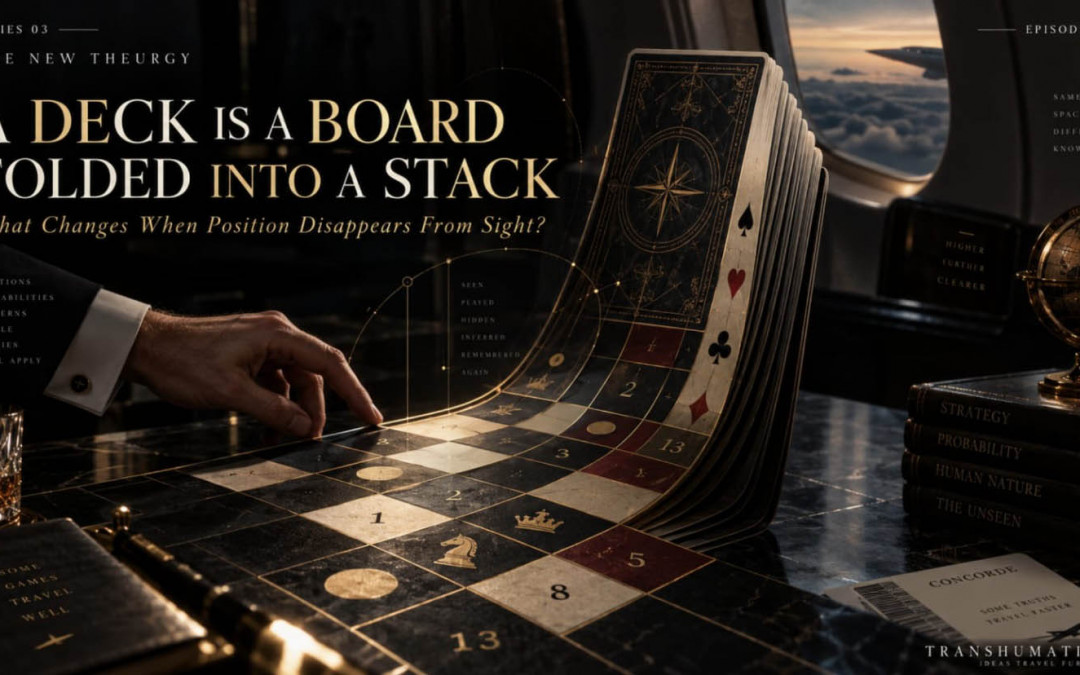
When Position Disappears From Sight?
There is something reassuring about a chessboard.
Everything is there.
The king is visible. The queen is visible. Every pawn occupies a square that can be inspected by both players. The position may be complicated, but it is not hidden. If you lose, you cannot complain that half the board existed behind a curtain.
A deck of cards feels different.
It contains positions too, but the positions have been folded inward. There is still a first place, a second, a middle, a bottom. There is still order. There is still structure. But most of that structure has disappeared from view.
This changes the nature of the game.
On a board, you usually ask:
What can I do from here?
With a deck, the more disturbing question is:
Where am I, if I cannot see the whole arrangement?
That difference may be more important than it looks.
A board makes strategy visible.
A deck makes uncertainty structural.
Why Does a Board Feel More Honest?
A board presents its geometry openly.
In chess, the current position is public. The bishop is blocked or free. The knight can reach certain squares and not others. The king is safe or exposed. The information may be difficult to interpret, but both players are looking at the same arrangement.
The mystery lies mainly in the future.
What will the opponent do?
Which visible weakness matters?
Which sacrifice is real and which is bait?
The board creates uncertainty through consequence.
A deck creates uncertainty one step earlier.
The problem is not only what someone will do.
It is what already exists outside your view.
The cards are there, but most are concealed. The order exists, but you do not know it. Your opponent may hold information you do not have. The next draw may already be determined by the present arrangement of the stack, while remaining completely unavailable to you.
The board says:
Here is the world. Choose.
The deck says:
Choose before the world has fully revealed itself.
That is a much harsher proposition.
It is also much closer to ordinary life.
Is a Deck Really a Hidden Board?
In a structural sense, yes.
A deck contains positions just as a board does.
The difference is that board positions are distributed across visible space, while deck positions are compressed into sequence. A queen on square D4 can be seen by everyone. A queen twenty-seven cards deep in a shuffled deck occupies a perfectly real position, but that position is concealed.
The space has not disappeared.
It has become inaccessible.
This is why drawing a card feels like chance.
The card does not materialise from nowhere. It was already somewhere in the sequence. Drawing merely converts hidden position into visible information.
From the player’s perspective, the card arrives unexpectedly.
From the deck’s perspective, nothing unexpected happened.
That difference is extraordinary.
It means chance can sometimes be experienced as an epistemic condition rather than as the absence of structure.
The player experiences uncertainty because the structure is hidden.
Whether the universe itself is uncertain is a different question.
That distinction will matter later.

Why Shuffling Does Not Destroy Order
A shuffled deck looks like disorder.
But this is imprecise.
Shuffling does not eliminate order. It replaces one arrangement with another arrangement that the players do not know.
The deck before the shuffle has a sequence.
The deck after the shuffle has a sequence.
What changes is not the existence of structure but the accessibility of structure.
This is one of those small observations that becomes much larger when carried outside the game.
Humans often confuse what they cannot predict with what has no order.
Those are not the same thing.
A system can be fully structured and still be unpredictable to an observer with limited information.
A shuffled deck is a clean example because the distinction is obvious after the fact. If someone secretly records the sequence, the mystery disappears for that observer while remaining intact for everyone else.
The cards did not become less random in any metaphysical sense because one person knows the order.
What changed was the distribution of information.
That is why card tricks feel magical.
The magician does not need to violate causality.
He only needs to occupy a different informational position.
Why Information Becomes a Form of Power
Chess often gives both players almost the same visible data.
Card games frequently do not.
One player knows one hand.
Another knows another.
The dealer may know the procedure.
A skilled player remembers what has already appeared.
A cheater may know what should remain hidden.
This makes information part of the game itself.
Power no longer comes only from what you possess.
It comes from what you know about what others possess, what has already disappeared from the deck and what may still be waiting.
Poker makes this obvious.
A weak hand can win if it is interpreted as strong.
A strong hand can lose if played badly.
A bluff works because the opponent must act on a model of your hidden state.
The game therefore exists on two levels at once.
There is the actual structure.
And there is the structure each player believes exists.
Those two can diverge dramatically.
A player does not respond directly to reality.
He responds to his model of reality.
That is true far beyond cards.
The Hand Is a Temporary Territory
A hand of cards is not merely a collection.
It is a temporary region of possibility.
Some cards can be used immediately. Others acquire value only in relation to what is already visible. A seemingly weak card can become decisive because of timing. A powerful card can become useless because the context has changed.
This resembles positional value on a board.
A queen is not absolutely powerful in every position.
A pawn on the seventh rank can become more important than a queen trapped behind its own pieces.
Likewise, a card’s value depends on rules, sequence, combinations and what remains concealed.
This matters because it challenges one of the simplest human habits: treating value as if it were stored inside the object.
Often it is not.
Value is relational.
A key is valuable because there is a lock.
Money is valuable because a system recognises it.
A passport matters because borders exist.
A card matters because a game gives it function.
The object carries potential.
The structure determines what that potential becomes.
Does the Deck Model Freedom Better Than the Board?
A board gives a player freedom through movement.
The position is visible, and the player chooses where to go within the rules.
A deck imposes something different.
You usually do not choose the card you receive.
You choose what to do with what arrives.
That difference sounds trivial until applied to human life.
We do not select the country of our birth.
We do not choose our genetics.
We do not choose every historical event that occurs during our lifetime.
We do not choose when another person appears, disappears or changes.
Much of life arrives as a deal rather than a move.
The freedom begins afterward.
In interpretation.
Timing.
Response.
This makes the deck a surprisingly strong model of constrained agency.
A person can possess limited control over initial conditions while retaining significant control over reaction.
The deck therefore tells a darker story than the board.
On the board, the world is visible and movement is the problem.
In the deck, the world is incomplete and action must begin anyway.
That is much closer to history.
And perhaps much closer to consciousness.
When Does Chance Stop Being Chance?
This is where card games become philosophically dangerous.
Suppose the deck is shuffled.
To you, the next card is uncertain.
To a magician who controls the sequence, it may not be.
To a camera recording the shuffle perfectly, the order may be reconstructible.
To someone with complete information about every physical motion, perhaps the sequence is theoretically traceable.
The appearance of randomness therefore depends partly on the observer.
But only partly.
This must be handled carefully.
Classical hidden ignorance is not the same thing as fundamental quantum uncertainty. A shuffled deck is a macroscopic system. Its unpredictability usually comes from limited information and complex physical dynamics, not from the same mechanisms that produce quantum probabilities.
Still, the deck gives us an important conceptual distinction:
unknown does not automatically mean undetermined.
Sometimes chance is genuine.
Sometimes it is hidden structure viewed from the wrong position.
The difficulty is knowing which kind we are facing.
That is one of the central problems of science, economics, history and ordinary life.
A Deck Remembers by Subtraction
The deck also has memory.
Not because it thinks.
Because every revealed card changes the structure of what remains.
If a particular card has already appeared, it is no longer waiting below. If several high cards are gone, the probability distribution of the remainder changes. In games where cards are not immediately replaced, the past physically alters the future state.
This is one of the most elegant properties of a finite deck.
It remembers through absence.
What happened before changes what can happen next.
The game evolves even if nobody touches the remaining cards.
Every revelation changes the meaning of the concealed portion.
The deck’s future is therefore not independent of its past.
This makes it a miniature model of path dependence.
History works like this too.
A society that has already spent resources cannot spend them again.
A decision closes alternatives.
A war removes people from future possibilities.
A law creates expectations that constrain later choices.
The past does not merely sit behind us.
It changes the composition of the future.
The deck demonstrates this with brutal clarity.
Why Visible Structure and Hidden Structure Produce Different Minds
A chess player learns to scan.
A card player learns to infer.
The difference is subtle but profound.
The board trains attention toward relationships that can be inspected directly.
The deck trains attention toward what is missing.
What has not appeared?
What might remain?
What is someone else concealing?
What does the current information imply about the invisible structure?
One game privileges calculation over visible position.
The other privileges inference under incomplete information.
Neither is purely one thing, of course. Chess contains uncertainty about intention, while card games can contain visible tactical structures. But the contrast is still useful.
Board logic says:
the world is visible; understand it.
Deck logic says:
the world is partial; estimate it.
Much of modern life is deck logic.
Financial markets.
Intelligence analysis.
Medicine.
Politics.
Relationships.
Scientific inference.
We act constantly before the full state becomes visible.
The problem is rarely only what to do.
It is what we believe the hidden board looks like.
Is the Universe More Like a Board or a Deck?
This question becomes tempting very quickly.
Are we living on a visible board whose laws can eventually be mapped completely?
Or inside a deck where most positions remain hidden in a sequence we only reveal locally?
The safe answer is that this is a metaphor.
Physics does not tell us that the universe is literally a deck of cards. Nor does uncertainty in human knowledge automatically imply that reality itself is withholding information in some intentional way.
But the analogy reveals a useful distinction.
Some problems are difficult because the relationships are complex but visible.
Other problems are difficult because critical information is inaccessible.
Those are not the same problem.
A scientific theory can fail because the system is complicated.
It can also fail because the required variables cannot be observed directly.
A historical argument can fail because the evidence is contradictory.
It can also fail because the evidence never survived.
A person can make a bad decision because the reasoning was poor.
Or because the hand was incomplete.
This distinction matters morally too.
Judgment becomes easier after revelation.
That is why history so often looks simpler than life.
The historian sees cards that were hidden from the people who had to play them.
The Board and the Deck Ask Different Questions
The board asks:
What can be done from this position?
The deck asks:
What position am I actually in?
Civilization requires both forms of intelligence.
When the structure is visible, the problem is strategy.
When the structure is hidden, the problem is inference.
Confusing them creates predictable mistakes.
People sometimes seek more information when the real problem is indecision.
At other times they demand decisive action when the real problem is that nobody yet knows the state of the game.
The first mistake produces paralysis.
The second produces confidence without knowledge.
Wisdom may begin with identifying which game we are actually playing.
Watch the Video
How to Read the World

Current Knowledge
Board games and card games differ in how they distribute information. Many classical board games present most or all relevant state information openly, while card games often rely on hidden hands, unknown sequences and incomplete knowledge. Game theory distinguishes between games of perfect information, where all players can observe the full relevant state, and games of imperfect information, where some information remains private or concealed. Chess is a familiar example of the former; poker is a familiar example of the latter.
A shuffled deck also illustrates the distinction between unpredictability and lack of structure. Physical shuffling produces a definite arrangement, even if participants do not know what it is. The resulting uncertainty is therefore largely epistemic: it concerns the player’s knowledge. This differs from claims about fundamental indeterminacy in quantum mechanics and should not be treated as a direct analogue.
Probability in card games changes as information is revealed, especially when cards are drawn without replacement. The appearance of one card changes the distribution of what remains. Skilled play can therefore depend on memory, conditional probability and the ability to update beliefs as the hidden state becomes partially visible.
Modern decision theory extends this principle far beyond games. Humans routinely make decisions under incomplete information, using estimates, prior beliefs and new evidence to update their understanding of uncertain situations. The structure is not uniquely human, but the deck provides a remarkably intuitive model for it.
Open Questions
The first open question is epistemic: how do we know whether uncertainty comes from limited knowledge or from a genuinely indeterminate process? A shuffled deck is an easy case because we know the cards have a definite physical order. Many real-world systems are harder. Complex dynamics, inaccessible variables and fundamental physical uncertainty can produce similar experiences of unpredictability while arising from very different causes.
Another problem concerns agency. If a person’s starting conditions are largely dealt rather than chosen, how much responsibility belongs to the player and how much to the hand? The deck metaphor is useful precisely because it avoids both extremes. It does not imply that human beings choose everything, but it also does not imply that they choose nothing. Freedom may exist primarily in how constraints are interpreted and acted upon.
There is also a deeper question about hidden structure. Human beings are remarkably prone to assuming that what they cannot see must nevertheless possess a coherent order. Sometimes that intuition is correct. Sometimes it generates conspiracy theories, superstition and false pattern recognition. A hidden structure should therefore not be inferred merely because hidden structure would make a story satisfying.
Finally, there is the problem of revelation. Every new piece of information changes the model we use to interpret what remains unseen. How quickly should we update? When should a surprising card overturn the entire theory of the deck, and when should it be treated as an anomaly? This question connects directly with scientific reasoning.
Transhumation Interpretation
Transhumation treats the deck as a model of hidden structure, not as a metaphysical claim about reality.
A board displays position in space. A deck compresses position into sequence and conceals most of it. The structure remains, but the observer loses access.
That distinction is useful because human beings often confuse uncertainty with absence. We say that something is random when what we really mean is that we cannot see enough of the system to predict it.
The deck therefore asks one of the project’s recurring questions in a new form:
How much of the structure must remain hidden before choice begins to feel like chance?
A board shows us where we are.
A deck asks whether we know.
FAQ
How is a deck similar to a board?
Both organise positions, relationships and possible actions. The difference is that a board distributes position visibly across space, while a deck hides position inside sequence.
Why does drawing a card feel random?
Because the card’s position is concealed from the player. The revelation is unpredictable from that informational position even though the deck itself has an arrangement.
Does shuffling remove order?
No. Shuffling replaces one arrangement with another and usually makes the new arrangement unknown to the players.
Why is information so important in card games?
Because players often act without access to the entire state of the game. Knowledge of one’s own hand, previously played cards and probable remaining cards changes what decisions are rational.
Is all randomness just hidden order?
No. A shuffled deck is mostly an example of uncertainty caused by limited knowledge. Fundamental quantum uncertainty is a different problem and should not be reduced to the card analogy.
What is the deeper argument of the article?
That strategy changes when structure becomes hidden. A board asks what can be done from a visible position; a deck asks what position the player is actually in. The difference turns information itself into part of the game.
Continue the Transhumation Series
- Forgotten Religion | Ancient Gods, Symbols and the Hidden Structures of Human Civilization
- The Last Religion | Death, Immortality and the Future of Humanity
- The New Theurgy | AI, Information and the Future of Human Civilization
- End of Branding: You Were Never Meant to Become a Product
- Baal vs Ishtar: Why Ancient Gods Never Disappeared