
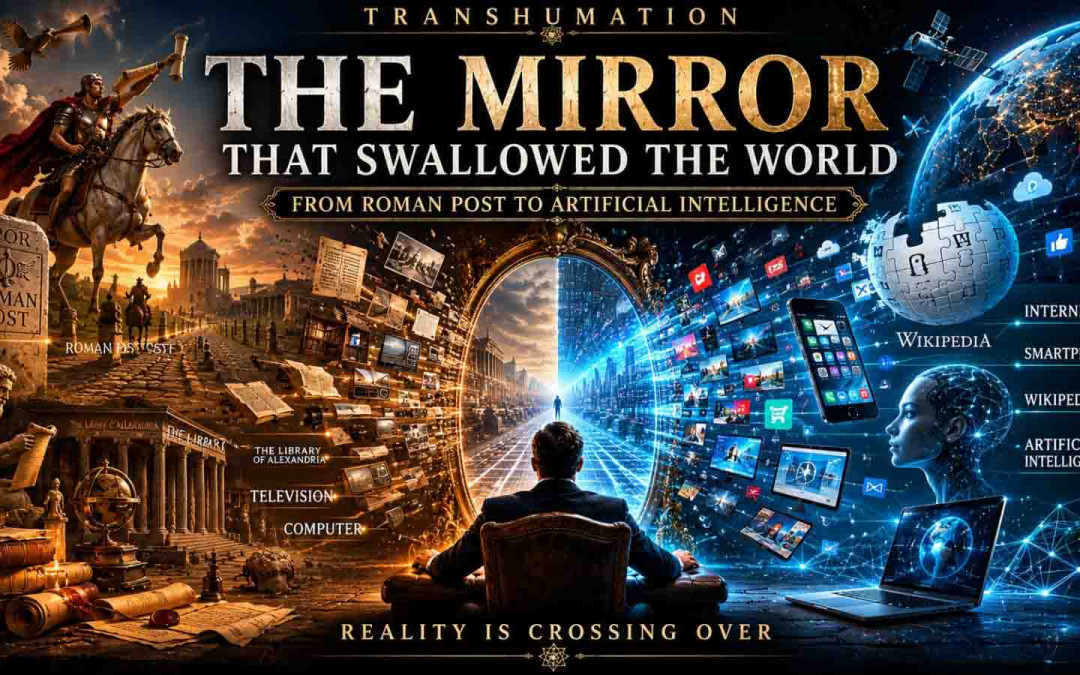
The Mirror That Swallowed the World
There is a moment in every new car when the driver reaches toward a place where a button ought to be and finds glass.
The air-conditioning control that once had a dial is now a menu. The radio has become an icon. Navigation, which used to require a paper map folded badly across a passenger seat, now appears automatically beneath a fingertip. The machine has not become less complicated. In most respects it has become vastly more complicated, filled with sensors, processors, software, wireless connections and layers of control that would have been unimaginable in an ordinary automobile a generation ago.
Yet the surface has become simpler.
This is one of the quiet revolutions of technological civilization. Complexity has not been eliminated; it has been moved away from the user. The mechanism retreats. The interface advances.
We notice the disappearing button because a small piece of matter is missing. We notice less easily what has replaced it: a symbolic layer capable of changing function without changing physical shape.
The same rectangle can be a map, a bank, a cinema, a newspaper, a camera, an airline ticket, a restaurant menu, a conversation and a library.
The screen does not merely display the world.
Increasingly, it is where we operate it.
Perhaps that is why the best metaphor is not a window.
It is a mirror.
Not because it reflects reality faithfully, but because more and more of civilization now seems to exist on the other side.
Why Are Physical Buttons Disappearing?
A mechanical button has one great virtue: it announces its function through form.
A switch can be felt without looking. A dial communicates direction through movement. A key is physically separate from the key beside it. The interface is embodied in the object.
Software changes that economy.
One physical display can host thousands of possible controls because function no longer has to be permanently attached to shape. The same square of glass can show a climate menu now and navigation five seconds later. The physical surface remains; the role migrates into software.
This is enormously efficient.
It is also a form of compression.
Instead of giving every function its own physical object, civilization builds a general-purpose surface and lets information determine what the surface becomes at a particular moment.
The physical button therefore does not disappear because matter has become obsolete.
It disappears because software allows many functions to share one carrier.
This is why a modern smartphone can replace a drawer full of objects without becoming physically larger every time it absorbs another function.
The compass disappears.
The calculator disappears.
The boarding pass disappears.
The flashlight disappears as a separate object.
The alarm clock disappears from the bedside table.
Each function still exists.
It has simply lost its private body.
Through the Looking Glass
Lewis Carroll’s Through the Looking-Glass gives us an irresistible metaphor because the mirror conceals another order behind a familiar surface.
For Carroll, the passage is fantasy. Alice crosses into a world governed by altered rules, reversed relationships and dream logic.
Modern screens perform something structurally different but visually similar.
Television gave us the first great domestic glowing surface through which distant events could enter a room. But television remained largely one-directional. The viewer watched.
The personal computer changed the relationship.
The screen became interactive.
The smartphone made it intimate.
The rectangle moved from the room to the hand, then the pocket, then effectively into the architecture of everyday life. The person no longer merely looked through the screen at information. They began performing ordinary actions through it.
A taxi is summoned there.
A hotel room is entered there.
Money moves there.
A friendship is maintained there.
A memory is retrieved there.
A route through an unfamiliar city is chosen there.
This is the shift that matters.
The mirror stopped being representational and became operational.
We did not simply put pictures of the world behind glass.
We placed controls for the world there.
Is the Internet Really Like the Roman Postal System?
Only if we compare function rather than technology.
The Roman Empire faced an administrative problem created by geography. Orders, reports, officials and supplies had to move across enormous distances relative to the transportation available. Roads, relay stations and systems associated with the cursus publicus reduced the practical friction of distance for state communication and transport.
This was not an ancient public internet.
A wax tablet was not a packet.
A horse relay was not a router.
The social access, speed, scale and architecture were radically different.
But one relation survives the comparison.
Information becomes more powerful when its speed separates from the speed of the person who created it.
A Roman administrator did not need to travel personally with every instruction.
The document could move for him.
Writing had already separated message from speaker. Organized communication infrastructure increased the range and reliability of that separation.
Modern networks perform the same functional trick at an astonishingly different scale.
The carrier changed from physical document transported through roads to signals reconstructed through electronic networks.
The problem remained recognizable:
How do we make distance matter less to information?
Civilization has been answering that question for a very long time.
The Hidden History of Compression
Technological progress is often narrated as a story of speed.
Faster ships.
Faster trains.
Faster processors.
Faster networks.
But there is another story beneath it: the history of reducing the amount of physical effort required to reconstruct a useful function somewhere else.
A letter carries language without carrying the speaker.
A photograph carries visual structure without carrying the scene.
A record carries music without carrying the orchestra.
A map carries spatial relations without carrying the territory.
A digital file allows those structures to be reproduced on many compatible machines without requiring one unique physical artifact to travel with them.
None of this is dematerialization.
Every stage has carriers.
What changes is carrier dependence.
The music becomes less dependent on this particular disc.
The text becomes less dependent on this particular book.
The message becomes less dependent on this particular courier.
The function becomes increasingly portable.
This is why the smartphone feels less like one machine than a terminal into civilization.
It does not physically contain the bank, library, television network, city map and marketplace.
It contains interfaces capable of reaching systems elsewhere.
The object in the hand becomes smaller.
The infrastructure behind it becomes larger.
The Gravity of Information
It is tempting to say information possesses gravity, pulling more and more of reality into digital form.
As metaphor, it works.
As explanation, it needs refinement.
Functions migrate into digital systems because information can often be copied, searched, transmitted, recombined and updated more cheaply than equivalent physical arrangements can be rebuilt repeatedly.
A paper map is excellent until a road closes.
A digital map can change.
A printed catalogue describes yesterday’s inventory.
A database can represent current stock.
A physical bank counter coordinates a customer with one employee in one place.
Software can coordinate enormous numbers of transactions across distance.
The movement toward informational systems is therefore not mystical.
It is economic and structural.
Information makes some functions easier to separate from specific locations and objects.
Once that happens, neighboring functions tend to follow because integration creates additional advantages.
The map joins the phone.
The camera joins the phone.
Payments join the phone.
Messages join the phone.
Then the functions begin sharing data.
The mirror becomes powerful not because everything moved inside it.
It becomes powerful because more systems can be coordinated through the same interface.
The Library That Did Not Disappear
The comparison between the Library of Alexandria and Wikipedia is useful only if we preserve the difference.
The Library of Alexandria was a physical institution associated with the collection and scholarly use of texts in the Hellenistic world. Wikipedia is a distributed collaborative encyclopedia built on networked digital infrastructure.
One was not an early version of the other.
But both express a recurring civilizational desire: to bring dispersed knowledge into a structure where it becomes more reachable.
The dream survives.
The architecture changes.
Even here, however, digital abundance introduces a new problem.
A library once struggled with physical scarcity.
There were only so many manuscripts, shelves, buildings and copies.
The internet creates a different scarcity.
Attention.
Reliability.
Context.
Provenance.
The problem is no longer merely whether the document can be stored.
It is whether someone can find the right document, know where it came from and understand whether it deserves trust.
This is why a civilization of infinite storage still needs librarians.
Perhaps more than ever.
What Comes After the Screen?
The obvious answer used to be a better screen.
Larger.
Sharper.
Lighter.
Flexible.
Transparent.
Eventually that improvement reaches diminishing returns because the screen is only one stage in a longer history of interfaces.
The deeper tendency is toward reducing the number of steps between intention and result.
The command line required formal syntax.
The graphical interface replaced syntax with icons and windows.
Touchscreens allowed users to manipulate visual objects directly.
Voice interfaces removed some dependence on touch.
Generative AI goes further because the user can often describe an objective rather than specify every operation needed to achieve it.
This is a profound shift.
With traditional software, the user learns the architecture of the tool.
Open this menu.
Select this option.
Move this file.
Apply this function.
In a conversational interface, the user increasingly describes the desired outcome.
The system handles some of the translation from intention into operations.
The interface begins to disappear because interaction moves upward from commanding steps to expressing goals.
That does not make the machinery simpler.
It makes the machinery less visible.
Will AI Replace Apps and Interfaces?
Probably not in the absolute sense.
Visual interfaces are excellent for many tasks. A map is often better viewed than described. A spreadsheet gives spatial relationships that conversation alone would make cumbersome. A camera needs visual framing. Some physical controls remain superior precisely because the body can locate them without looking.
But AI can become a layer above many separate interfaces.
Instead of opening the airline app, weather app, maps app and hotel app individually, a person may increasingly ask one system to coordinate information across them.
This changes the role of the screen.
The user no longer navigates every application directly.
An intermediary interprets intention and moves through the underlying systems.
This is where the mirror metaphor becomes more interesting.
The next stage may not place more reality behind glass.
It may make the glass itself harder to notice.
The interface becomes ambient.
The mirror disappears into the room.
When the Mirror Becomes Invisible
Every mature technology has a tendency to become less theatrical.
Electricity once arrived visibly through switches, wires and unfamiliar machines. Today we notice it most when it stops.
The internet followed a similar path. Dial-up demanded ritual. Connections were events. Modern connectivity recedes into expectation.
Artificial intelligence may eventually do the same.
Today, AI is still presented as a destination.
Open the model.
Ask the chatbot.
Generate the image.
Notice that you are interacting with AI.
A mature form may dissolve into infrastructure.
Search improves.
Navigation anticipates.
Documents reorganize.
Interfaces translate intention.
The user may stop thinking of these functions as “AI” at all.
That would be the final stage of the mirror.
Not when everything has moved inside it.
When the mediation becomes so ordinary that we forget there is a surface between us and the systems arranging the world.
That is also the moment when transparency becomes most important.
The Danger of an Invisible Interface
A visible interface reminds us that selection is occurring.
A newspaper has a front page.
A television has a frame.
A search result has an order.
A map has boundaries.
We know, at least in principle, that someone designed the presentation.
An invisible interface can make mediation feel like reality itself.
If an AI assistant selects three restaurants, the user may never see the fifty that were not presented.
If a navigation system chooses a route, entire neighborhoods may vanish from experience.
If a conversational system summarizes history, the distinction between source, interpretation and omission can become difficult to detect.
This is the real danger of the world behind the mirror.
Not that the physical world disappears.
That the path through the physical world becomes increasingly selected by informational models.
The restaurant still exists.
The road still exists.
The book still exists.
But what reaches the person’s attention is filtered through systems operating one layer above them.
The mirror has not swallowed matter.
It has swallowed part of the route by which matter becomes visible.
Watch The Video
How to Read the World
Current Knowledge
Human communication systems have repeatedly reduced the practical effect of distance. Ancient states used roads, messengers and relay networks; later postal systems, telegraphy, telephony, radio and digital networks accelerated the transmission of information through very different technical architectures. Comparing them can reveal recurring functions, but they should not be treated as technologically equivalent.
Digitalization has allowed many functions once tied to specialized physical objects to be represented through general-purpose computing devices. This does not eliminate physical infrastructure. Digital services depend on extensive networks of data centers, communication links, energy systems and hardware.
Software interfaces can consolidate many functions onto a single surface because physical form no longer needs to correspond permanently to one function. This explains part of the movement from dedicated mechanical controls toward screens and reconfigurable interfaces, although physical controls remain advantageous in many contexts.
Modern AI interfaces can reduce interaction costs by allowing users to express goals in natural language rather than specify every procedural step. Whether this will replace traditional graphical interfaces broadly remains uncertain and will depend on reliability, task type, safety and human preferences.
Digital information systems also alter scarcity. Storage and reproduction may become cheaper while attention, provenance, verification and discoverability become increasingly important constraints.
Open Questions
One unresolved question is how invisible an interface should become. Convenience favors systems that hide implementation, but accountability often requires the opposite: users need to know what was selected, omitted, inferred or generated on their behalf.
Another problem concerns skill. When navigation, memory, calculation and information retrieval migrate into external systems, humans gain enormous capabilities while potentially using some internal abilities less frequently. It remains unclear which forms of cognitive outsourcing are mostly beneficial and which may create new dependencies.
AI introduces a further question about mediation. If one conversational system becomes the primary route through news, travel, commerce, archives and knowledge, it could become an extraordinarily powerful layer between individuals and the underlying world. The quality of civilization may then depend partly upon whether that layer preserves routes back to original sources and alternative choices.
The deepest question is not whether the physical world will disappear. It is whether people will increasingly experience physical reality through informational structures they no longer perceive as interfaces at all.
Transhumation Interpretation
For Transhumation, the mirror is not a second universe swallowing the first.
It is an interface becoming large enough to organize access to the first.
The carrier changes from road to telegraph, screen to conversation, app to AI. The recurring function is reduction of friction between intention and distant structure.
That makes the future librarian important.
A good interface should not imprison the user inside the mirror. It should make complexity navigable while preserving a route back to the world, the sources and the choices hidden behind the surface.
The danger begins when the mirror becomes so perfect that we forget to ask what it is reflecting, what it is omitting, and who decided where it should point.
FAQ
What is “the mirror that swallowed the world”?
It is a metaphor for digital interfaces becoming the primary route through which people access activities, knowledge and services that once required many separate physical objects or locations.
Is the internet really comparable to the Roman postal system?
Only structurally. Both reduce the effect of distance on communication, but Roman relay systems and modern digital networks differ radically in technology, speed, scale and accessibility.
Why are physical buttons disappearing?
Software allows many different functions to share one programmable interface. This reduces the need for every function to possess its own dedicated physical control, although physical buttons remain useful in many situations.
Is the physical world becoming digital?
Not literally. Digital systems remain physically implemented. What is changing is that more coordination, representation and access to physical activities occur through informational interfaces.
What comes after the screen?
Probably not one single replacement. Voice, augmented reality, ambient computing and AI may reduce the need to navigate traditional interfaces directly, while visual and physical controls will remain useful where they are superior.
What is the deeper Transhumation question?
The question is not what remains after information has swallowed matter, because matter never left.
The more interesting question is what happens when the interface becomes more influential than the thing it represents.
The Roman road carried the message through the world. The internet made the message move almost independently of the traveler. The smartphone turned thousands of systems into one surface. AI may turn that surface into a conversation and hide the mechanisms almost completely.
Civilization is not disappearing into the mirror.
Something subtler is happening.
The mirror is becoming the place from which we decide which parts of civilization we will encounter at all.
And when that happens, the most important technology may no longer be the system behind the glass.
It may be the librarian standing in front of it.
Continue the Transhumation Series
- Forgotten Religion | Ancient Gods, Symbols and the Hidden Structures of Human Civilization
- The Last Religion | Death, Immortality and the Future of Humanity
- The New Theurgy | AI, Information and the Future of Human Civilization
- End of Branding: You Were Never Meant to Become a Product
- Baal vs Ishtar: Why Ancient Gods Never Disappeared