
Randomness is a limit, not a law
Randomness appears wherever understanding stops.
A single event looks accidental. Two similar events suggest coincidence. A third begins to create a pattern. The events themselves may not have changed, but the observer has. What first appeared disconnected now seems structured.
This is one of the basic operations of intelligence. The mind does not merely receive information. It compares, groups, predicts, and interprets. It searches for repetition because repetition makes the world easier to understand.
From this perspective, randomness may not always be a property of reality itself. It may be the name we give to events when our knowledge, perspective, or resolution is too limited to reveal the system behind them.
Randomness and the Limits of Knowledge
Human beings have often mistaken ignorance for chaos.
Disease once appeared to strike without explanation. Weather seemed to follow the moods of gods. Heredity looked mysterious because the mechanisms of genetics were invisible. In each case, events appeared random until a deeper structure became visible.
This does not prove that every event has a hidden cause that humans will eventually discover. Some processes may be genuinely probabilistic. Others may be too complex to predict even if their underlying rules are known.
But it does reveal an important principle: the appearance of randomness is not proof that no pattern exists.
It may only show that the observer cannot yet see enough.
The Rule of Three
One point is an event.
Two points create a relation.
Three points create the first visible structure.
In geometry, three points can form a triangle, one of the simplest stable forms. In storytelling, three events establish rhythm. In reasoning, repeated evidence begins to feel more meaningful when it appears for the third time.
This is not a universal scientific law. It is a cognitive pattern.
The mind often needs repetition before it recognizes structure. The first signal can be ignored. The second may be dismissed as coincidence. The third forces interpretation.
At that moment, randomness begins to collapse into meaning.

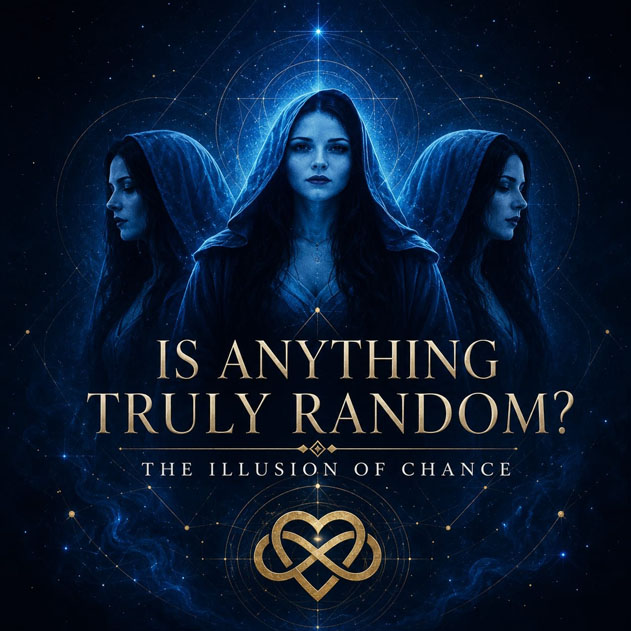
The Hekate Pattern
Hekate is often associated with crossroads, thresholds, and multiple directions. Her threefold form makes her a powerful symbol for the moment in which a single path becomes a structure of possibilities.
The importance of the third direction is not that it reveals one correct answer. It creates a field of interpretation.
With only one path, there is movement.
With two paths, there is opposition.
With three paths, there is a system.
In this philosophical reading, Hekate represents the point where the observer can no longer remain passive. Several possible directions appear, and interpretation becomes unavoidable.
The symbol does not eliminate uncertainty. It gives uncertainty a form.
The Observer Creates Meaning
Observation does not always change the physical event being observed, but it changes the event’s place within a system of meaning.
A pattern without an observer is only a set of relations. It becomes information when something can detect it, compare it, and respond to it.
This is why two people can encounter the same sequence of events and understand it differently. One sees coincidence. Another sees intention. A third sees a statistical pattern.
The events may remain identical, but the reality experienced by each observer is different.
Meaning does not exist only inside the event.
It emerges through the relationship between the event and the mind interpreting it.
What Quantum Physics Does — and Does Not — Say
Quantum physics is often used to suggest that consciousness creates reality. That claim goes much further than the science supports.
In quantum mechanics, measurement affects what can be observed because interaction with a system changes its physical state. But this does not necessarily mean that a human mind produces the universe through attention.
The more useful lesson is narrower.
Observation is not always passive. The method used to examine a system can influence the information that becomes available.
This reminds us that every description of reality depends partly on scale, instruments, and perspective. What looks random at one level may reveal regularity at another.
The observer may not create the universe.
But the observer helps determine which structure becomes visible.
Randomness as Unresolved Information
Randomness can be understood as unresolved information.
Imagine looking at a message written in an unknown language. The symbols appear meaningless, even though they may contain a precise structure. The problem is not necessarily the absence of information. It is the absence of a decoder.
The same may be true of many systems we call chaotic.
Weather contains structure, but its variables are too numerous for perfect prediction. Human behavior follows patterns, but no individual action can be reduced completely to a simple formula. Biological systems are organized, yet small variations can produce unexpected results.
Complexity can make structure appear random.
The pattern exists, but it is hidden beneath more information than the observer can process.
Artificial Intelligence and Hidden Patterns
Artificial intelligence demonstrates how quickly apparent randomness can become prediction.
A collection of isolated data points may look meaningless to a human observer. A machine trained across millions of examples can discover relationships that were previously invisible.
It can identify patterns in images, language, disease, markets, and behavior. It does not necessarily understand these patterns in the human sense, but it can detect regularities at a scale beyond ordinary perception.
This creates a new problem.
A system may recognize a pattern without being able to explain it clearly. The prediction works, but the structure remains partially hidden from human understanding.
Randomness may disappear for the machine while remaining unresolved for us.
From Chaos to System
A chaotic system is not necessarily a system without rules.
It may be a system in which tiny changes produce enormous consequences, making long-term prediction extremely difficult. The structure exists, but its behavior exceeds our practical ability to follow it.
This distinction matters.
Unpredictable does not always mean unstructured.
Unknown does not mean meaningless.
Random does not always mean without cause.
When enough information becomes visible, chaos can begin to look like a system. When the correct scale is found, separate events can become part of a larger pattern.
The universe may not be completely chaotic.
It may simply be incomplete from our point of view.
The Danger of Seeing Too Much
The search for patterns also creates risk.
Human beings are so strongly driven to find meaning that they often see patterns where none exist. Coincidences become signs. Repetition becomes destiny. Unrelated events are forced into a single explanation.
A mind that cannot detect patterns cannot learn.
A mind that detects patterns everywhere becomes trapped by them.
The challenge is therefore not simply to reject randomness. It is to distinguish between real structure and imagined structure.
A useful pattern must survive testing. It should explain more than one event, allow comparison, and remain open to correction.
Otherwise, interpretation becomes superstition.
Randomness as the Beginning of Understanding
Randomness is often treated as the end of explanation.
We say that something happened by chance, and the investigation stops.
But randomness can also be the beginning of a question.
What information is missing?
What scale are we using?
Which relationship have we failed to notice?
Is the event truly without structure, or do we lack the tools to recognize it?
This changes the role of science, consciousness, and interpretation.
Science becomes the search for stable patterns.
Consciousness becomes the process that turns difference into meaning.
Reality becomes the interaction between what exists and what can be understood.
Randomness is not always the absence of order.
Sometimes it is the border of perception.
Final Thought
Nothing appears random from every possible perspective.
Some events may remain unpredictable. Some systems may contain genuine probability. Some patterns may be impossible for human intelligence to decode.
But the word “random” often tells us as much about the observer as it does about reality.
It marks the point where explanation breaks down.
The point where resolution becomes too low.
The point where the pattern disappears from view.
Randomness may not be the opposite of understanding.
It may be the place where understanding begins.
Frequently Asked Questions
-
Is everything in the universe determined?
We do not know. Some processes appear deterministic, while quantum mechanics describes outcomes probabilistically. The article explores the limits of observation rather than claiming that everything has a predictable cause.
-
Does randomness mean that no pattern exists?
Not necessarily. Randomness may indicate a genuine probabilistic process, but it can also result from missing information, excessive complexity, or limited perspective.
-
What is the rule of three?
It is the idea that the third related event often causes the mind to recognize a pattern. It is a cognitive and symbolic principle, not a strict scientific law.
-
What does Hekate represent in the article?
Hekate functions as a philosophical symbol of thresholds, multiple paths, and the moment when uncertainty becomes a structure that demands interpretation.
-
Does the observer create reality?
An observer creates meaning and selects a perspective on reality. This does not prove that human consciousness physically creates the universe.
-
Does quantum physics prove that consciousness affects matter?
No. Quantum measurement involves physical interaction with a system, but it does not prove that conscious thought alone creates physical outcomes.
-
How can artificial intelligence detect hidden patterns?
AI can analyze enormous datasets and identify statistical relationships that may be too subtle or complex for human observers to notice.
-
Can people imagine patterns that are not real?
Yes. Humans are vulnerable to seeing meaning in coincidence. Patterns should therefore be tested rather than accepted only because they feel significant.
-
What is the main idea of the article?
The article argues that randomness often marks the limit of our knowledge or perception rather than proving the complete absence of structure.
Continue the Transhumation Series
Explore the full journey:
- End of Reality — Where Do You Really Exist?
- End of Physics — Are the Laws of Reality Real?
- End of the Real World — Reality Is No Longer Required
- End of Consciousness — Beyond the Human Mind
- End of Death — When Human Limits Disappear
- End of Religion — When Technology Replaces Faith
This is not a theory. This is a transition.