
The Hardest Problem Is Not How Long a Mind Can Last
Imagine replacing a wooden ship one plank at a time.
Nothing dramatic happens on Tuesday. One damaged board is removed and another takes its place. Months later another is replaced, then another. Years pass. Eventually none of the original wood remains, yet sailors continue boarding what everyone treats as the same vessel. There was no funeral for the old ship and no launch ceremony for a new one. Change occurred inside an uninterrupted history.
Now perform the same experiment on a human being.
A damaged joint is replaced. The person remains. A heart valve is replaced. The person remains. A cochlear implant changes the route by which sound reaches the nervous system. The person remains. Imagine increasingly intimate neural prostheses: first restoring function, later adding memory support, perception or computation. At every stage the individual remains awake, remembers yesterday and experiences the next modification as something happening to the same continuing life.
Then, after decades, suppose almost none of the original biological machinery remains.
Who is standing there?
The problem of immortality becomes much more interesting when framed this way. The question is no longer whether one body can be kept unchanged forever. Human bodies have never worked like that. They develop, heal, age and reorganize. Memories change. Personality changes. Beliefs disappear. New habits become central enough that earlier versions of the person would barely recognize them.
And yet most of us experience life not as a sequence of replacements but as one connected trajectory.
Perhaps this is the real problem behind immortality.
Not eternity.
Continuity.
What Is Continuity of Consciousness?
Continuity is easier to experience than to define.
You went to sleep last night and woke this morning assuming that the person who opened their eyes was the same person who closed them. Conscious awareness was interrupted, yet personal identity did not feel destroyed. You may have forgotten thousands of moments from childhood, changed political opinions, replaced friendships and become physically different, while still regarding those earlier experiences as your past.
This already tells us that identity cannot simply mean perfect sameness.
A person does not remain themselves because nothing changes.
They remain themselves through change.
The difficulty is identifying which kind of connection does the important work. Biological continuity may matter. Memory may matter. Causal continuity between successive brain states may matter. Social recognition matters in another sense. Embodiment may contribute more than informational accounts admit.
There is no single accepted scientific formula saying: preserve properties A, B and C, and the self necessarily survives.
That uncertainty is precisely what makes technological immortality philosophically different from ordinary life extension.
Keeping a living brain healthy for another fifty years extends an already continuous process.
Constructing another system that resembles the brain creates a much harder question:
did the process continue, or did another process begin?
Why Is Mind Uploading Not the Same as Survival?
The classical mind-upload thought experiment makes the distinction brutal.
A hypothetical scanner records every relevant feature of your brain. Another system is built from that description. It possesses your memories, your preferences, your fears, your mannerisms and the memory of entering the scanner.
It opens its eyes and says that the transfer succeeded.
From the outside, the result may be perfect.
Now leave the biological original alive.
Two beings exist.
Both remember being you five minutes earlier.
Both love the same people.
Both claim ownership of the same childhood.
The informational pattern has survived spectacularly well, but identity has branched.
This exposes the weakness in treating a person as a file. A file can be duplicated without paradox because no copy possesses a privileged first-person relationship to the original. A conscious subject does.
The problem becomes even sharper if the biological original is destroyed after scanning. From the perspective of observers, only one successor remains and continuity appears restored. But destroying one branch does not explain why the remaining branch should inherit the original person’s subjective perspective.
The copy can sincerely say, “I survived.”
That does not prove that the person entering the scanner experienced waking up.
This is why information preservation and personal survival should never be collapsed into one idea.
The first may be an engineering problem.
The second remains partly a metaphysical one.
What If the Self Is a Process Rather Than an Object?
The strongest alternative begins by questioning the metaphor itself.
Perhaps there is no static object called the self hidden somewhere inside the skull.
Human beings are dynamic systems. The brain changes with learning. Memories are reconstructed. Synaptic organization changes. Attention shifts. Hormones influence cognition. Experiences alter future reactions. Even the autobiographical story through which a person understands their own life is continuously rewritten.
A seventy-year-old is not an enlarged seven-year-old.
The difference can be enormous.
Yet identity feels continuous because each state emerged causally from earlier states inside one ongoing history.
This suggests a different model.
The self may be less like a statue and more like a river.
The material passing through changes.
The shape changes.
The banks move.
There may not even be one precise boundary separating the river from its environment.
Yet the process possesses a history connecting one moment with the next.
This model helps explain ordinary persistence.
It does not automatically solve technological transfer.
A second river dug elsewhere and filled with identical water is still not obviously the continuation of the first.
The central issue becomes causal trajectory rather than resemblance.
And that is why gradual technological integration becomes philosophically interesting.

Could Gradual Brain Replacement Preserve Identity?
Suppose the transition happens one component at a time.
A neural implant restores damaged hearing.
Later, another system assists memory formation.
Another interfaces with motor control.
Eventually artificial components participate in increasingly central functions while the biological brain remains active and continuously integrated with them.
At no stage does the original person shut down while a duplicate begins elsewhere.
Subjectively, there may be no obvious border.
This avoids the most dramatic version of the copy problem.
It does not prove the continuity of consciousness.
That distinction is essential.
We currently have no experiment capable of determining whether hypothetical replacement of neural functions one by one would preserve subjective experience indefinitely. Perhaps functional integration is enough. Perhaps some biological properties are essential. Perhaps gradual replacement preserves behavior while conscious experience alters in ways external observers could never detect.
Still, the thought experiment changes the shape of the question.
Sudden uploading asks whether information can recreate a mind.
Gradual integration asks whether a mind can change its implementation without ceasing to be the same ongoing process.
That is much closer to the way human identity already survives ordinary transformation.
It may therefore be the stronger philosophical route even though it remains scientifically unresolved.
The Bridge Matters More Than the Destination
Futurism is obsessed with endpoints.
The uploaded mind.
The synthetic body.
The digital civilization.
The immortal consciousness.
But identity may depend more on the bridge than on the destination.
Imagine two systems that are physically identical at the end of the experiment.
One was created instantly from a scan.
The other emerged through forty years of gradual integration with the original biological person.
Externally, they may eventually contain equivalent structures.
Their histories are different.
If causal continuity matters to identity, that difference could be decisive.
This resembles ordinary development.
There is no morning when a child disappears and an adult is installed.
The organism changes continuously enough that earlier and later states remain part of one biography.
This does not mean gradual technological transformation must preserve the self.
It means history may be part of what the self is.
That possibility is easy to miss when identity is treated as a static pattern that can simply be saved and loaded elsewhere.
A person may not be only a configuration.
They may also be the path by which the configuration arrived.
Is the Mind Already Extended Beyond the Brain?
In everyday life, cognition already relies heavily on external systems.
A calendar remembers an appointment so the brain does not need to.
A notebook preserves a calculation.
A smartphone stores photographs, messages and locations.
Search engines allow people to remember where information can be retrieved rather than memorizing the information itself.
Libraries permit individual minds to participate in intellectual structures far larger than any one brain can contain.
Some philosophers have used examples like these to argue for versions of the extended mind thesis: under certain conditions, external resources may function as genuine components of cognitive processes rather than merely tools consulted by an otherwise self-contained mind.
That view remains philosophically debated.
A notebook is not automatically part of consciousness.
A photograph stored online is not neurologically identical to remembering the photographed event.
Losing access to a cloud account is not equivalent to suffering amnesia.
But the broader observation is difficult to deny: practical human thinking often depends on systems beyond the skull.
The boundary between thinker and tool is functionally less clean than our everyday language suggests.
Technology did not invent this.
Writing already altered human memory.
Maps altered navigation.
Numerical notation allowed cognitive operations difficult to perform intuitively.
Digital systems make the partnership faster, more continuous and more intimate.
The question is no longer whether humans extend cognition through artifacts.
We clearly do.
The harder question is when extension becomes integration.
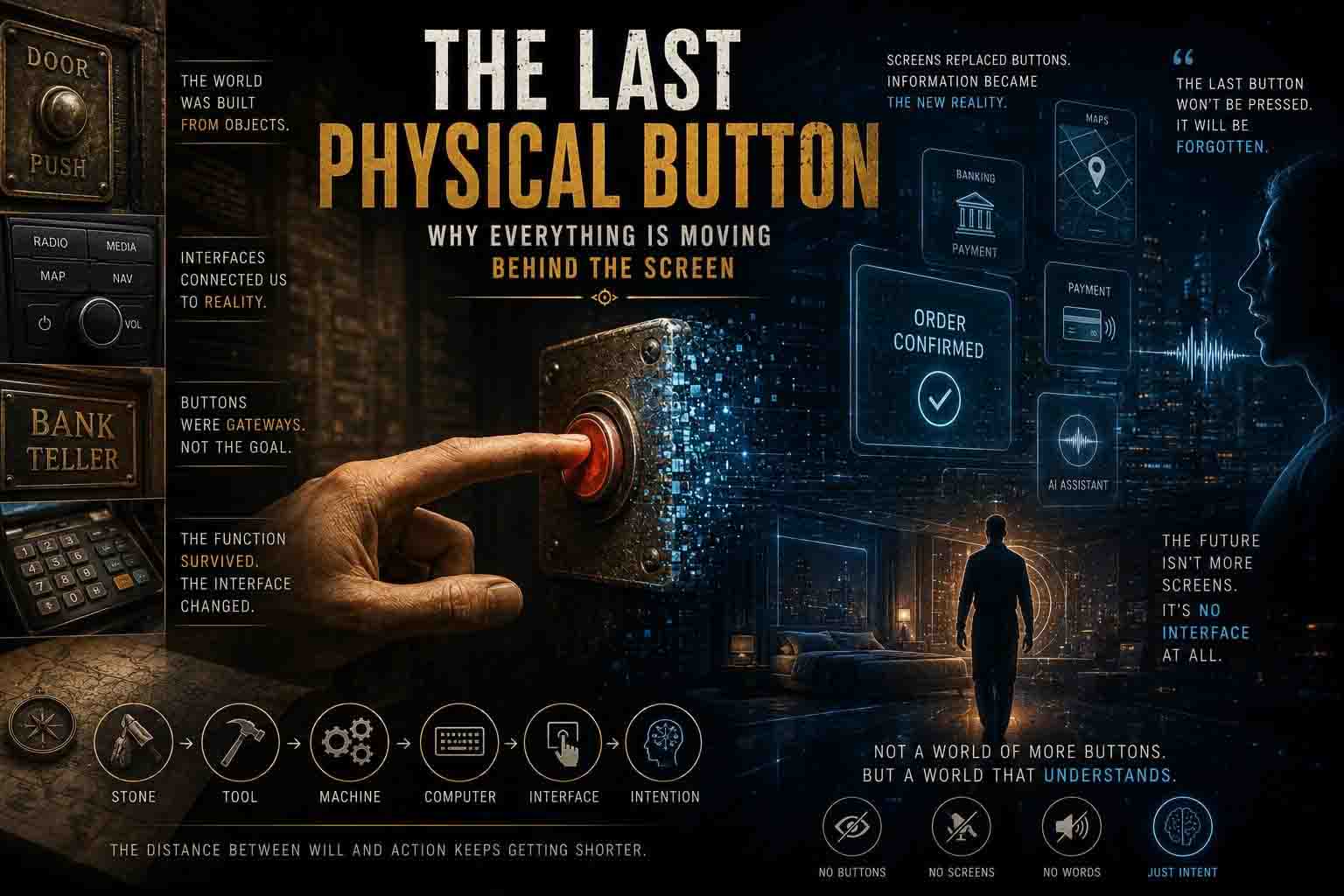
From the Notebook to the Neural Interface
There is a useful spectrum here.
A notebook sits on the desk.
A smartphone stays in the pocket.
A wearable device remains attached to the body.
A medical implant operates inside it.
A neural interface exchanges information directly with nervous tissue.
At each step, the practical distance between biological process and artificial system becomes smaller.
But physical proximity alone does not determine psychological integration.
A pacemaker can be essential to a person’s continued life without becoming part of their conscious thought. A pair of glasses can become almost phenomenologically transparent: after wearing them for years, a person often looks through the lenses rather than consciously attending to them.
The most interesting future systems may achieve something similar cognitively.
An external memory aid could become so continuously available that retrieving information feels less like consulting a device and more like remembering.
An artificial sensory channel could, through neuroplastic adaptation, eventually be experienced less as data and more as perception.
A cognitive assistant might become deeply embedded in planning and reflection.
None of this demonstrates that consciousness itself has expanded outside the brain.
But it could make the old boundary between self and instrument increasingly difficult to locate by intuition alone.
Can Consciousness Become Distributed?
This is where the article has to move carefully.
Memory can clearly be distributed.
Computation can be distributed.
Decision-making can be distributed.
Organizations can solve problems that no individual member understands completely.
Civilization itself stores knowledge across people, institutions, libraries and machines.
But distributed cognition is not the same as distributed consciousness.
A scientific community can collectively discover something without becoming one experiencing subject.
The internet processes information at enormous scale without providing evidence that there is something it is like to be the internet.
A corporation can have goals without possessing a single corporate point of view.
This distinction protects us from a seductive leap.
The fact that intelligence can spread across a network does not prove that subjective experience can do the same.
A future human might rely on biological and artificial components so intimately connected that describing cognition as located only in the brain becomes misleading.
Whether there would still be one unified field of experience across that system remains an open question.
We should allow the possibility without pretending that networking answers it.
The Internet Is Not a Collective Mind
The internet is a remarkable external memory and communication infrastructure.
It allows billions of people to exchange information, coordinate action and maintain records far beyond individual lifespans.
But calling it a prototype of collective consciousness goes too far.
A network can display emergent behavior without possessing a unified subject.
Markets react.
Ant colonies coordinate.
Traffic patterns form.
No individual controller needs to possess the whole model.
The interesting comparison therefore concerns distributed function, not consciousness.
The internet demonstrates that information processing can become vastly larger than any individual participant.
It shows that memory can be stored outside biological minds and accessed dynamically.
It allows human beings to participate in cognitive environments whose total contents no person can know.
That is already enough.
We do not need to imagine the network waking up in order to recognize that individual intelligence increasingly operates inside something larger than itself.
Civilization may be cognitively distributed without becoming a single cosmic person.
The Daimonion at the Boundary of the Self
Socrates’ daimonion offers an intriguing comparison, but only if we refuse to modernize it too aggressively.
In ancient accounts, Socrates speaks of a divine or spiritual sign that warns or restrains him. It belongs to a religious and philosophical context radically different from modern AI.
It was not an ancient neural assistant.
Yet the structural question is unexpectedly contemporary.
What happens when guidance is experienced as intimate enough to participate in one’s decisions while remaining somehow distinct from ordinary self-generated thought?
A future AI connected continuously to a person could create an unfamiliar version of this ambiguity.
Suppose the system knows decades of your memories, understands your habits, anticipates your mistakes and participates in internal planning so consistently that consulting it becomes almost automatic.
Its advice may feel increasingly like part of your own reflective process.
But who generated the insight?
Where does autobiography end and external computation begin?
At what point does the distinction cease to matter psychologically even while remaining technologically important?
The ancient motif does not predict this system.
It simply gives us an older language for recognizing the threshold.
The New Theurgy becomes interesting precisely there: not because technology recreates divine voices, but because increasingly intimate interfaces make the border between guidance, self and external intelligence newly unstable.
Immortality Without Escape
The most persuasive future of human continuity may therefore look much less theatrical than classic mind uploading.
No person lies down in a machine and wakes inside a digital paradise.
Instead, medicine repairs parts of the nervous system.
External memory becomes more tightly integrated.
Artificial senses expand perception.
Cognitive systems participate increasingly in reasoning.
Biological and technological components form long-term causal loops.
After decades, the question “Where does the person end?” becomes harder to answer than it once was.
This is not necessarily an escape from biology.
The body may remain central.
Embodiment may remain essential to personal identity.
The transformation may consist less in abandoning one carrier than in adding new ones to an existing process.
That is much closer to the history of humanity anyway.
Clothing extended skin.
Writing extended memory.
Tools extended the hand.
Telescopes extended perception.
Computers extended calculation.
Networked systems extended access to civilization’s accumulated knowledge.
The difference with neural integration would not be that extension began.
It would be that extension moved close enough to the nervous system that the distinction between tool and user became harder to maintain.
Would Death Become Less Absolute?
We need to define death carefully before answering.
Biological death can become less information-destroying without becoming less subjectively final.
A person today already leaves behind photographs, writing, recordings, genetic material, messages and effects on other people. Future technologies may preserve far richer behavioral and cognitive traces.
Some functions could therefore survive biological failure.
An external memory system might remain.
A personalized AI might continue answering questions.
A network could preserve preferences, projects and relationships.
But none of this establishes that the person’s subjective point of view continues.
If consciousness were genuinely distributed across biological and technological systems before biological failure, the question would become much harder. Perhaps loss of one component would resemble damage rather than complete extinction. Perhaps the remaining system would continue as the same subject.
Or perhaps biological brain activity would still be the essential center, and everything external would become an archive the instant that center failed.
We do not know.
This is why the phrase “death becomes gradual” should refer cautiously to loss of function and informational presence, not automatically to survival of consciousness.
The border may become technologically blurry long before it becomes metaphysically solved.
The Future May Look Boring
This may be the most plausible feature of all.
Great transformations rarely feel like metaphysics while people are adopting them.
Writing was useful.
Glasses helped people see.
Phones solved communication problems.
Search engines saved time.
Implants restored hearing.
Future memory augmentation may first appear as medicine.
Neural interfaces may be adopted to restore movement.
AI assistance may become ordinary because it reduces cognitive friction.
Nobody needs to announce that the definition of humanity has changed.
The boundary can move by centimeters.
Then one generation looks backward and realizes that something once treated as external infrastructure has become part of ordinary human agency.
This is how continuity-based transformation differs from the science-fiction upload.
There may be no crossing.
Only a boundary that becomes increasingly difficult to draw.
Watch The Video
How to Read the World
Current Knowledge
Human identity remains continuous through substantial biological and psychological change, but there is no complete scientific theory specifying which properties are necessary and sufficient for personal identity. Memory, embodiment, causal continuity, brain function and social relationships all contribute to different senses of self.
Human consciousness is strongly dependent on functioning biological brains. Current evidence does not demonstrate that subjective consciousness can exist independently of biological neural activity or that it can be transferred between substrates.
Brain-computer interfaces and neural prostheses can already restore or assist limited functions in some medical contexts, but existing technologies are far removed from transferring a whole mind, storing a complete personal memory system or distributing one consciousness across biological and digital components.
External tools clearly extend human cognitive capability. Writing, calculation, navigation systems, digital storage and networked information alter what individuals can remember, calculate and accomplish. Whether such tools should literally be considered parts of the mind is a philosophical question rather than an established neuroscientific fact.
A perfect informational copy, even if technologically possible, would not by itself solve the problem of first-person continuity. Duplication demonstrates the difference particularly clearly because multiple successors could share the same remembered past.
Open Questions
The central unresolved question is whether consciousness depends primarily on functional organization or on properties of biological systems that cannot be preserved merely by reproducing informational relations. Current science does not decide the issue.
Gradual replacement produces a second problem. If neurons or cognitive functions were progressively substituted with artificial equivalents while behavior and memory remained continuous, would subjective experience necessarily remain continuous as well? We presently lack a way to test such a scenario.
Another question concerns the boundary of cognition. Increasingly intimate external systems may participate in memory, planning and perception, but it remains unclear when a tool should count as part of the cognitive system rather than a resource used by it.
There is also a political and ethical problem. If identity eventually depends upon connected external infrastructure, control over servers, software, permissions and networks could become control over parts of practical personhood. Extending the mind would therefore extend vulnerability as well as capability.
The deepest question remains first-person continuity. Even if future technology perfectly preserves memory, personality and behavior, how could we establish that the continuing system is not merely a successor that inherited an extraordinarily detailed past?
Transhumation Interpretation
For Transhumation, the useful distinction is pattern versus trajectory.
A pattern can be copied.
A trajectory has a history.
If personal identity depends partly on uninterrupted causal continuity, then the path through transformation may matter as much as the final structure.
That does not prove gradual technological integration creates immortality. It gives us a better test.
The question is no longer only What must survive?
It becomes:
What must remain connected while everything else changes?
That is where continuity becomes more interesting than eternity.
FAQ
What is continuity of consciousness?
It is the idea that personal identity may depend on an ongoing connected process through time rather than on keeping the same matter or remaining psychologically unchanged.
Is a perfect digital copy of me still me?
We do not know, but copying alone does not establish personal survival. Two identical copies could inherit the same memories, revealing that informational similarity and unique first-person continuity are different problems.
Could gradual brain replacement preserve identity better than uploading?
It avoids the obvious break created by destroying one system and building another, which makes it philosophically attractive. But there is no scientific evidence proving that gradual replacement would preserve subjective consciousness indefinitely.
Is the mind already extended outside the brain?
Human cognition relies heavily on external tools and records. Some philosophers argue that certain external resources can become parts of cognitive systems, but that does not mean cloud storage or the internet literally possesses a person’s consciousness.
Could consciousness eventually become distributed across technology?
It is conceivable, but unproven. Memory and computation can be distributed; we do not know whether one unified subjective experience can be distributed in the same way.
What is the deeper Transhumation question?
The deepest problem is not how to make something resembling us last forever.
Civilization will probably become extraordinarily good at that.
It can preserve photographs, messages, voices, behavioral patterns and perhaps one day detailed models of entire minds. A future system may know a person’s past so completely that everyone around it accepts the continuation.
The difficult question occurs one level deeper:
Did the person continue, or did continuity only become convincing from the outside?
That is why the bridge matters.
A human being already survives enormous internal change because each moment grows out of the one before it. Childhood becomes adulthood without the original person being shut down and reconstructed. If technology is ever to extend that process beyond familiar biology, the decisive achievement may not be a perfect copy waiting at the destination.
It may be preserving a path that never visibly breaks.
And even then, the last question will remain.
We may know that memory continued.
We may know that personality continued.
We may know that behavior continued.
We may even know that consciousness exists in the resulting system.
What we will still want to know is whether the same point of view crossed the bridge.
That is why immortality may ultimately have less to do with forever than with the smallest interval imaginable:
the connection between one conscious moment and the next.
Continue the Transhumation Series
- Forgotten Religion | Ancient Gods, Symbols and the Hidden Structures of Human Civilization
- The Last Religion | Death, Immortality and the Future of Humanity
- The New Theurgy | AI, Information and the Future of Human Civilization
- End of Branding: You Were Never Meant to Become a Product
- Baal vs Ishtar: Why Ancient Gods Never Disappeared