
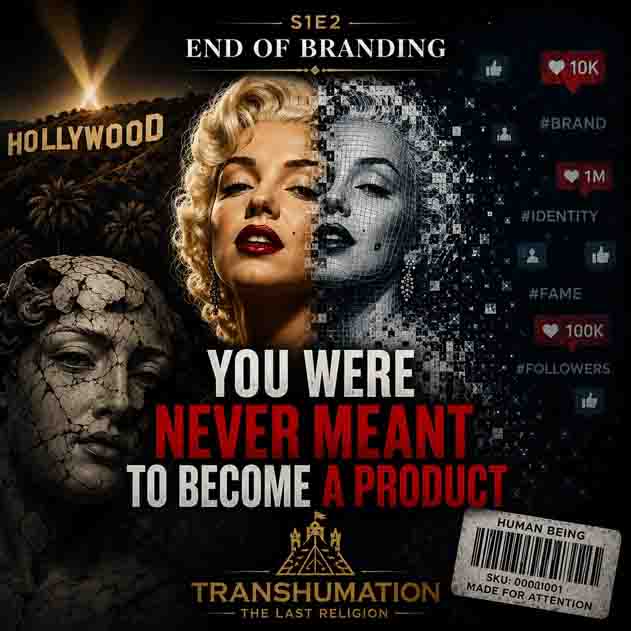
End of Branding | You Were Never Meant to Become a Product
There was a time when a name meant belonging.
It connected a person to a family, a place, a tradition, or a community.
Later, names became associated with reputation.
People earned them through character, achievements, or sacrifice.
Today, names increasingly function as brands.
They compete for visibility.
Recognition.
Attention.
Scalability.
Modern civilization quietly encourages everyone to become a product.
Build your brand.
Optimize your profile.
Increase your reach.
Stay relevant.
Become searchable.
It sounds harmless.
Yet beneath this advice lies one of the greatest symbolic transformations in human history.
Not the branding of products.
The branding of human beings.
The Hollywood Experiment
Long before social media, Hollywood discovered something extraordinary.
People do not simply admire success.
They consume identities.
Marilyn Monroe became more than an actress.
She became an icon.
An image.
A fantasy.
A perfectly recognizable symbol.
Her face became scalable across magazines, posters, television, fashion, and eventually the Internet.
But every symbol has a price.
The larger the symbol became, the more difficult it became to see the human being beneath it.
Civilization preserved Marilyn.
It struggled to preserve Norma Jeane.
The symbol survived.
The person disappeared.
The Industrialization of Identity
Branding did not invent symbolism.
It industrialized it.
Ancient civilizations transformed kings into legends.
Heroes became myths.
Saints became icons.
Gods became personalities.
Modern technology simply accelerated the same mechanism.
Today, platforms reward identities that are simple.
Predictable.
Recognizable.
Repeatable.
Algorithms prefer consistency over complexity.
Human beings do not.
Real people contradict themselves.
They change.
They fail.
They grow.
Brands rarely do.
The Symbol Becomes More Valuable
At some point, a strange reversal occurs.
The symbolic version of a person becomes more valuable than the person.
People begin protecting their image instead of their character.
Their visibility instead of their understanding.
Their audience instead of their relationships.
Civilization increasingly rewards representation rather than existence.
This is the hidden danger of branding.
Not marketing.
Not business.
But replacing life with performance.

Ancient Warnings
Many religions warned against idols.
Not because symbols are evil.
But because symbols detached from reality become dangerous.
An idol is not simply a statue.
It is any representation mistaken for the thing itself.
Modern civilization has not abandoned idols.
It has digitized them.
Profiles.
Followers.
Verified accounts.
Algorithms.
Personal brands.
Different technology.
The same psychological structure.
AI and the Next Stage
Artificial intelligence introduces a completely new possibility.
For the first time in history, identities no longer require human beings.
Faces can be generated.
Voices synthesized.
Personalities simulated.
Entire digital lives can exist without biological owners.
The question is no longer whether symbols outlive humans.
The question is whether symbols will continue without them.
Branding reaches its logical conclusion.
Identity becomes information.
Being Seen Is Not the Same as Being Understood
Modern civilization encourages visibility.
But visibility is not recognition.
Recognition is not understanding.
A person may be known by millions while remaining invisible as a human being.
This explains one of the great paradoxes of the digital age.
The more connected civilization becomes...
The lonelier many people feel.
Perhaps what humanity truly seeks is not attention.
But meaningful recognition.
Not followers.
But witnesses.
End of Branding
Branding itself is not the enemy.
It solves a real civilizational problem.
Humans have always wanted to be remembered.
To leave a mark.
To survive symbolically.
A handprint on a cave wall already carried this desire.
The Internet simply scaled it to billions of people.
But somewhere along the way, civilization began confusing visibility with value.
A product can always be replaced.
A human being cannot.
Perhaps this is what End of Branding truly means.
Not abandoning identity.
But remembering that identity was never supposed to become a commodity.
You were never meant to become a product.
You were meant to become conscious.
Needed.
Remembered.
And real.
Want to Explore More..?
Watch The Video Below
FAQ
What is End of Branding?
It is the idea that modern civilization increasingly transforms human beings into scalable symbolic products rather than recognizing them as complex individuals.
Is branding inherently bad?
No. Branding solves the human desire for recognition and continuity. The danger appears when the symbol replaces the person.
Why is Marilyn Monroe used as an example?
Her public image became one of the most recognizable symbols in modern history while the human being behind it gradually disappeared from public attention.
How does AI change branding?
AI can generate convincing digital identities, allowing symbols to exist independently of biological humans.
What is the difference between being seen and being understood?
Visibility creates attention. Understanding creates genuine human connection. The two are not the same.
Why does this relate to religion?
Many religious traditions warned against confusing symbols with reality. The article argues that modern digital branding recreates this ancient problem in technological form.
What is the central message?
Civilization increasingly rewards scalable identities, but no symbolic projection can fully replace a living human being.
Want to Explore More..?
Watch The Video Below
The Core Questions of Transhumation
Explore the full journey:
- End of Reality — Where Do You Really Exist?
- End of Physics — Are the Laws of Reality Real?
- End of the Real World — Reality Is No Longer Required
- End of Consciousness — Beyond the Human Mind
- End of Death — When Human Limits Disappear
- End of Religion — When Technology Replaces Faith