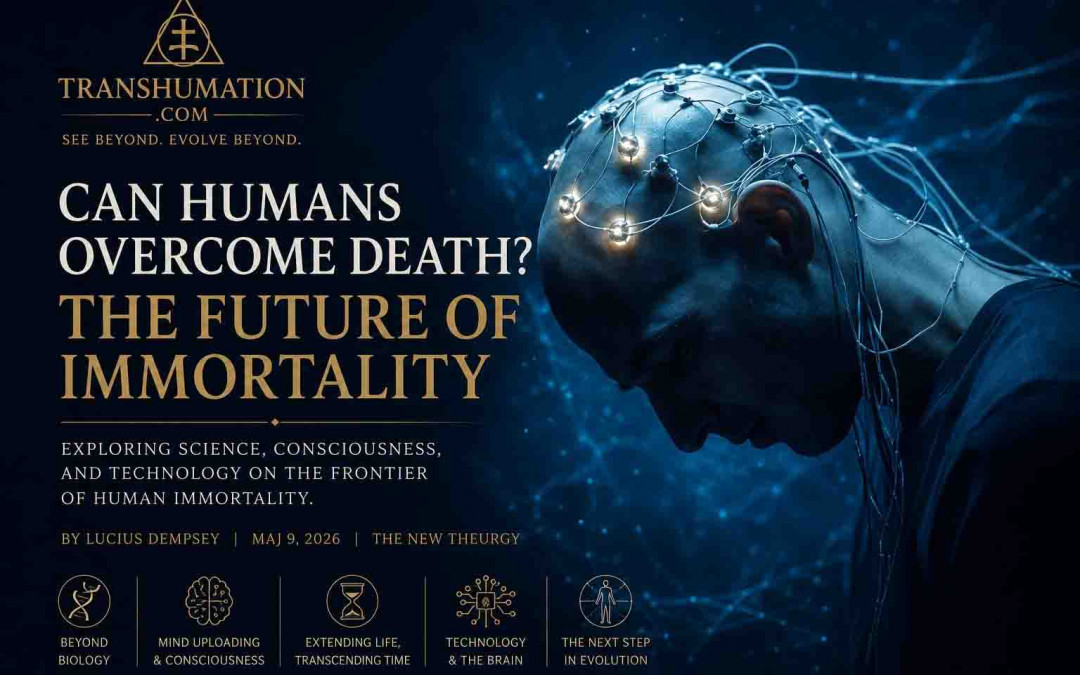
Death May Be an Engineering Problem
What If Immortality Is Not About Living Forever, but About Never Breaking the Thread?
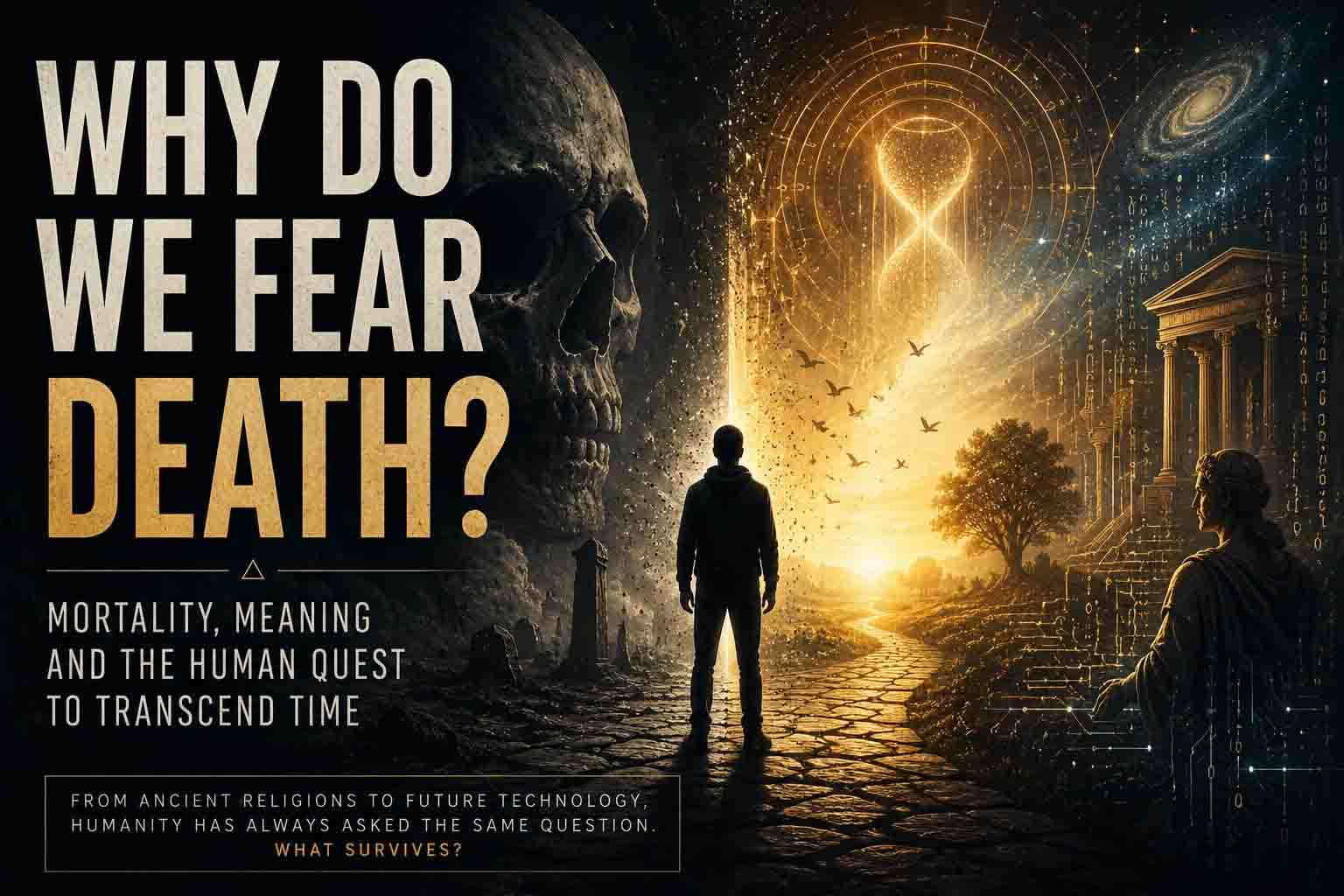
There is a peculiar arrogance hidden inside every cemetery. The stone suggests permanence, while everything beneath it says the opposite. Names survive longer than bodies. Photographs survive longer than faces. A sentence written by someone dead for two thousand years can still enter the mind of a living reader with astonishing intimacy, while the hand that wrote it has long since disappeared. Human civilization has always known that biological life ends, and almost everything we call culture can be understood as an attempt to negotiate with that fact.
Religion promised continuation in another world. Philosophy tried to make finitude meaningful. Kings built tombs. Families preserved names. Artists signed canvases. Governments raised monuments. Ordinary people kept letters in drawers.
For most of history, death itself remained outside negotiation.
A person could prepare for it, interpret it, fear it, ritualize it or deny it, but not redesign it. The body eventually failed, consciousness disappeared from view, and civilization continued without the person who had occupied it.
Technology has begun to complicate that ancient arrangement.
Not because immortality is close. It is not. Not because consciousness has been solved. It has not. But for the first time, humanity possesses tools capable of forcing a serious distinction between things that earlier ages could treat as inseparable: the body, memory, personality, information, biological continuity and the private experience of being someone.
The old question was whether death could be escaped.
The more interesting question may be what, precisely, would have to survive.
We Have Always Mistaken the Container for the Continuity
A human being appears deceptively simple from the outside. One body begins at birth, moves through time and eventually stops. Biology gives identity an obvious address.
Yet the organism itself is anything but static. Molecules are exchanged continuously. Cells live and die. Neural connections change. Memories are reconstructed. The personality of a seventy-year-old may differ profoundly from the person who inhabited the same name at seventeen, and still we normally regard the two not as separate beings but as stages of one life.
Identity therefore already tolerates change.
What it appears less able to tolerate is rupture.
This is why the fantasy of mind uploading becomes disturbing the moment we imagine it carefully. Suppose a machine creates a perfect digital reconstruction of your brain. The copy remembers your childhood, recognizes your wife, fears the same things, understands your private jokes and insists with complete sincerity that the procedure worked.
Yet you remain standing beside it.
Whatever has been preserved, the experiment has not obviously demonstrated that you traveled anywhere. It may have created another center of experience with your history.
The technological problem of immortality therefore cannot be reduced to information preservation. Civilization already knows how to preserve information. What it does not know how to preserve is the observer.
Civilization Has Been Moving Human Functions Outside the Body for Millennia
It would nevertheless be a mistake to conclude that human existence has always remained neatly enclosed inside biology.
The history of civilization is filled with migrations of function. Clothing moved thermal protection beyond the skin. A spear extended reach. Writing allowed memory to survive the brain that produced it. Mathematics permitted reasoning to be stabilized on paper. Libraries created forms of cultural memory whose capacity vastly exceeded any individual mind. Photography externalized visual remembrance. Computers moved calculation into machines. Networks made knowledge accessible without requiring any single person to possess it.
None of this proves that consciousness itself exists outside the brain.
That boundary is important.
A diary containing your memories is not conscious merely because you depend upon it. A server containing your photographs does not experience your childhood. The internet may resemble a nervous system as metaphor, but there is no evidence that humanity has accidentally produced a literal planetary mind.
Something subtler has happened.
The human being increasingly functions through systems that are not entirely biological.
Lose your phone and you may lose access to appointments, directions, conversations, photographs, financial tools and fragments of your remembered life. Lose your language and something still deeper disappears: not merely a communications system but one of the structures through which thought itself is organized.
The human has never ended quite as cleanly at the skin as anatomy suggests.
That does not prove technological immortality.
It does make the boundary worth examining.
Immortality Has Been Asking the Wrong Question
The familiar image of immortality is remarkably conservative. It usually imagines the same person simply continuing for an indefinitely long time. The body does not age, or the brain is transferred into a machine, or a digital replica awakens somewhere after death. The medium changes; the ancient desire remains the same.
But perhaps indefinite duration is not the decisive feature.
Consider ordinary life. We do not require the body of childhood to remain intact in order to believe the adult survived. We do not require memories to remain perfectly unchanged. We do not even require uninterrupted conscious awareness: every night we surrender ordinary consciousness to sleep and return without experiencing ourselves as newly created replacements.
What matters seems to be some form of causal continuity—a process in which later states emerge from earlier ones without an obvious break that produces an independent successor.
That suggests a very different technological route.
Instead of scanning a brain, destroying the original and hoping the reconstruction counts as survival, future systems might gradually integrate with biological cognition. External memory could become increasingly immediate. Neural prosthetics might replace or supplement damaged functions. Synthetic components could theoretically become part of a continuously operating nervous system.
At no point would there necessarily be a dramatic moment called upload.
The transition might resemble biological change itself: incremental enough that no single step obviously creates a new person.
Whether consciousness would actually survive such a transformation is unknown. But philosophically, gradual integration presents a stronger continuity claim than simple duplication because there is no second version standing across the room claiming ownership of the same past.
Immortality, if it ever becomes technologically meaningful, may look less like resurrection than renovation.
The Infrastructure of the Self
There is something almost disappointingly ordinary about the technologies that most profoundly change civilization. Electricity arrived not as lightning captured by magicians but as cables hidden behind walls. The internet became transformative when it stopped feeling futuristic. GPS became extraordinary by becoming mundane.
If human identity ever acquires a genuine technological extension, immortality may arrive in the same unromantic way.
First, medicine prevents a neurological function from disappearing. Then prosthetic systems restore capacities once permanently lost. Memory assistance becomes increasingly integrated. Interfaces grow less external. Biological and synthetic components begin cooperating in ways that make the old distinction between tool and user progressively less obvious.
No single morning announces the invention of immortality.
Instead, civilization discovers that more and more of what once vanished when biology failed can continue.
This would not automatically mean the person survived. A civilization could preserve a perfect simulation of someone’s voice, habits, appearance, memories and decisions while the original subject ceased to exist. Such a system might become an astonishing memorial rather than a continuation.
The distinction is severe because the two possibilities could eventually look identical from the outside.
Everyone else might be satisfied.
The question belongs to the person who is supposed to wake up.
Death Is Not One Problem
The word death conceals several losses that biology currently delivers together.
The body stops maintaining itself. The brain stops functioning. Memories become inaccessible. Personality disappears from active interaction. Relationships lose one participant. Projects end. A unique perspective on the world vanishes.
Technology may eventually separate some of these events.
We already preserve words and images. Increasingly, systems can reproduce style, voice and patterns of behavior. Future technologies may preserve far richer models of individual memory and personality. Medicine may continue extending healthy lifespan and repairing damage previously regarded as irreversible.
Yet preserving one component does not prove preservation of all the others.
A civilization could defeat forgetting without defeating death.
It could reconstruct personality without preserving the original observer.
It could keep a body alive while destroying the psychological structures that once constituted the person.
The engineering problem is therefore more difficult than “make humans live longer.” We first need to know which continuities matter and which substitutions are merely convincing approximations.
The Last Technology May Be Continuity
There is a temptation to treat death as sacred simply because it is ancient. Humans have always died, therefore death begins to feel like part of the definition of being human. But many things once considered unavoidable features of life were not metaphysical necessities. Infant mortality, lethal infections, untreated pain and catastrophic childbirth were once ordinary facts of existence. Civilization did not abolish suffering by declaring these conditions unnatural. It studied mechanisms and interfered with them.
Death may contain mechanisms that can also be interfered with.
That statement is less dramatic than claiming that death will be cured. Aging is extraordinarily complex. The brain is incompletely understood. Consciousness remains scientifically unresolved. No existing technology can transfer a human subject into another substrate, and there is no evidence that digital immortality currently exists even in primitive form.
But there is no requirement that we treat all present biological limits as eternal laws of reality.
The more interesting possibility is that humanity will discover death is not a single wall but a collection of boundaries. Some may yield to medicine. Some to engineering. Some may prove inseparable from biology. Others may turn out to be conceptual mistakes produced by the assumption that identity must remain attached to one material form.
The future may therefore make a distinction our ancestors rarely needed.
There is the death of the carrier.
And there is the end of the pattern.
Whether those are necessarily the same event is one of the largest questions technology has ever placed before us.
Watch The Video
How to Read the World
Current Knowledge
Human consciousness, as far as current evidence shows, depends critically on the functioning brain. Changes caused by injury, disease, drugs, anesthesia and neurological disorders can alter perception, memory, personality and conscious experience, providing strong evidence that ordinary human consciousness is deeply dependent on biological neural processes.
Modern science does not yet possess a complete explanation of consciousness. Researchers can identify neural activity associated with conscious states and can increasingly map relationships between brain function and particular cognitive abilities, but there is no accepted scientific method for identifying a transferable “self” independently of the brain.
Human lifespan has increased substantially through public health, medicine, sanitation, nutrition and improved treatment of disease, while research into aging investigates biological mechanisms associated with cellular damage, genomic instability, senescence, metabolic regulation and other processes. None of this currently amounts to biological immortality.
Digital systems can preserve information about individuals, including photographs, recordings, texts and behavioral data. Artificial intelligence can increasingly imitate aspects of a person’s style or speech when sufficient data are available. Such preservation or simulation should not be treated as evidence that the individual’s subjective consciousness has survived.
Whole-brain emulation, consciousness transfer and substrate-independent personal survival remain speculative concepts.
Open Questions
The first unresolved question is whether consciousness is dependent upon specifically biological properties of the brain or whether the relevant organization could, in principle, operate in another physical medium. Current science cannot answer this decisively.
Even if artificial consciousness eventually becomes possible, personal identity creates a separate problem. A digital system could conceivably become conscious while still being a new subject rather than the continuation of the person from whom it was modeled.
Gradual replacement raises another possibility. If parts of the nervous system could one day be replaced or supplemented while consciousness remained continuously present, would there be a threshold beyond which the original person ceased to exist? No empirical answer currently exists.
There is also no agreement about what constitutes sufficient personal continuity. Competing views emphasize biological persistence, psychological continuity, memory, causal history, information structure or some combination of these.
And behind all of them remains the question that may be impossible to outsource to an observer: if every measurable feature of a person survives, but the original first-person experience does not, has death actually been defeated?
Transhumation Interpretation
Transhumation does not require the claim that the human mind is already a cloud of information floating outside the brain. That would confuse metaphor with evidence.
Its stronger proposition is structural.
Throughout human history, functions have repeatedly survived changes of carrier. Memory moved from neurons into oral traditions, clay tablets, manuscripts, printed books and servers. Images moved from caves to canvas to film to pixels. Geometry survives whether drawn in sand or rendered as vectors. A melody can cross instruments without becoming the wood, metal or electricity through which it passes.
Human beings themselves are stranger because there is an observer involved.
The question is therefore not whether information can migrate. Clearly it can.
The question is whether subjectivity belongs to the class of structures capable of surviving a change of carrier.
If consciousness depends absolutely on particular biological processes, the boundary may be permanent. A perfect reconstruction could preserve everything others recognize as you while failing to preserve the one thing unavailable to them: your point of view.
If, however, consciousness depends primarily on an ongoing organization that can remain causally continuous while its physical implementation changes, then the traditional opposition between biological life and digital survival may turn out to be badly framed.
Transhumation does not need to choose the answer in advance.
Its position is that the carrier should not be mistaken for the pattern simply because, until now, humanity has possessed only one working carrier.
Death may therefore be the ultimate test of the idea.
Not because technology has promised immortality.
Because it forces us to ask what has been dying.
FAQ
Can humans live forever today?
No. No existing medical or technological method can make humans biologically immortal.
Is mind uploading currently possible?
No. There is no demonstrated technology capable of transferring a human consciousness into a computer or another body.
Are scientists trying to stop aging?
Researchers are studying biological mechanisms involved in aging and age-related disease, and medicine continues to improve healthy lifespan. This is very different from having a proven method for eliminating aging entirely.
Could AI recreate someone after they die?
AI can already imitate limited aspects of a person if enough recordings, writing or other data exist. Future systems may become far more convincing. Such reconstruction would preserve information or behavior, not necessarily the person’s subjective consciousness.
Does storing my memories online mean part of my consciousness is online?
No. It means information associated with you exists externally. There is currently no evidence that storing memories, photographs or writing on a server transfers subjective consciousness into that server.
What is the difference between copying a mind and continuing a mind?
A copy could theoretically reproduce the same memories and personality while creating a second subject. Continuity implies that the original first-person process itself persists through the transformation. Whether such continuity can cross from biological to artificial systems remains unknown.
Why might gradual replacement matter?
Because gradual change avoids the obvious duplication problem. If biological functions were replaced one at a time while the original system remained active, there might be no clear moment when one person disappeared and another began. This does not prove consciousness would survive, but it creates a different philosophical problem from copying a brain all at once.
Is death really an engineering problem?
Some components of death clearly are engineering and medical problems: organ failure, infection, trauma and aspects of aging can already be prevented or treated to varying degrees. Whether death as the permanent end of subjective consciousness can ever become an engineering problem remains unknown.
Could the body die while the person survives elsewhere?
Science currently provides no evidence that this is possible. The idea depends on whether personal consciousness can remain continuous in another substrate, which has never been demonstrated.
What if a perfect copy wakes up believing it is me?
From the copy’s perspective, it might sincerely remember being you. From your perspective, its existence would not automatically demonstrate that your consciousness had moved. This is the central problem with treating duplication as immortality.
What actually has to survive for immortality to count?
That is unresolved. Candidates include memory, personality, cognitive function, biological continuity, causal continuity and subjective awareness. Preserving different combinations may produce radically different things that we currently place under the single word survival.
Could consciousness be a carrier-independent pattern?
Perhaps, but this remains a hypothesis rather than an established scientific conclusion. We know that many structures and functions can survive migration between media. We do not know whether subjective experience can.
What would prove the Transhumation idea wrong?
Evidence that consciousness requires irreducibly biological properties that cannot remain functional or continuous in another substrate would place a hard boundary around technological survival. Likewise, demonstrating that every apparent transfer inevitably creates a new subject rather than preserving the original one would undermine the strongest version of mind migration.
What is the deepest question behind technological immortality?
It may not be whether civilization can build a machine capable of remembering us.
Humanity has been building those machines since the first inscription on stone.
The deeper question is whether there exists any technologically accessible continuity between the person reading this sentence now and whatever might open its eyes after the biological carrier is gone.
If there is, death may eventually become partly an engineering problem.
If there is not, civilization may someday construct perfect immortality for everything about us except the person who wanted to survive.
Continue the Transhumation Series
- Forgotten Religion | Ancient Gods, Symbols and the Hidden Structures of Human Civilization
- The Last Religion | Death, Immortality and the Future of Humanity
- The New Theurgy | AI, Information and the Future of Human Civilization
- End of Branding: You Were Never Meant to Become a Product
- Baal vs Ishtar: Why Ancient Gods Never Disappeared