
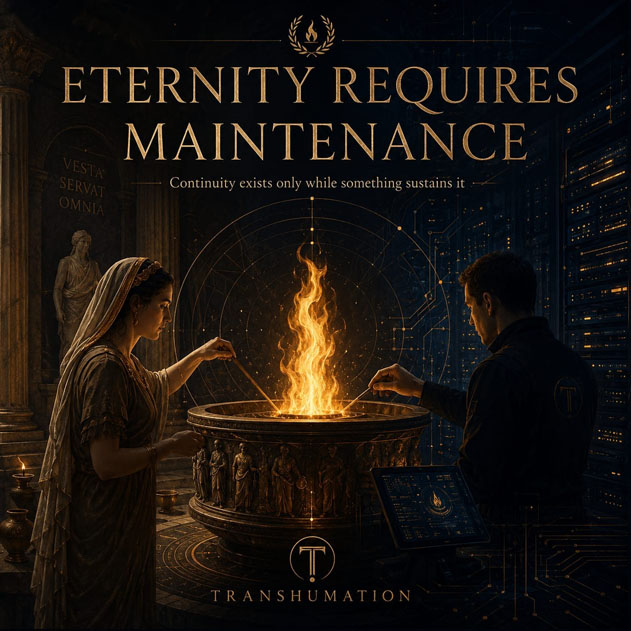
Eternity Requires Maintenance
For thousands of years, humanity imagined eternity as something permanent.
Guaranteed.
Untouchable.
Waiting somewhere beyond death.
Heaven was supposed to endure forever. The soul was supposed to survive automatically. Eternity was imagined as a place outside time, decay and responsibility.
But many ancient civilizations understood continuity in a very different way.
In ancient Rome, the sacred flame of Vesta was never allowed to die.
The fire burned in the Temple of Vesta, near the heart of Roman public life. It was guarded by the Vestal Virgins, whose duty was not symbolic decoration. The flame had to be watched, protected and renewed.
Every day.
The Romans did not preserve it because ordinary fire was magical. They preserved it because the flame represented something larger: the continued existence of Rome itself.
If the fire disappeared, something deeper was believed to disappear with it.
Not merely heat.
Continuity.
The Flame Was a Process
A flame is not an object.
You cannot hold it in your hand and place it safely on a shelf. It exists only while a process continues.
Fuel must be available.
Heat must remain.
Someone must protect it from wind, water and neglect.
The flame survives only because its conditions are maintained.
This makes it a powerful symbol of life, civilization and consciousness.
A civilization is also not a static object. It is not its buildings, monuments or borders alone. It exists through language, memory, institutions, customs and repeated acts of cooperation.
The moment those processes stop, the civilization begins to disappear, even if its ruins remain standing.
Perhaps the Romans understood something modern people often forget:
What looks permanent is usually being maintained by someone.
The Illusion of Passive Immortality
Modern people often imagine immortality passively.
As a reward.
A destination.
A place you simply enter.
You die, cross a threshold and continue forever.
But what if eternity was never passive?
What if continuity has always depended on participation?
This changes the meaning of immortality.
It stops being only a supernatural promise and becomes a process.

Biological life survives through constant repair. Cells
replace damaged components. Organisms regulate temperature, fight infection and restore balance. When these processes stop, the body does not remain stable. It begins to collapse.
Civilizations survive through education, memory and transmission. Every generation must teach the next generation how to read its symbols, use its tools and preserve its knowledge.
Identity also depends on continuity.
Your body changes.
Your memories change.
Your personality evolves.
Yet something remains connected across time.
You call that continuity “me.”
Perhaps the self is not a permanent object hidden inside the body. Perhaps it is an active pattern that must continue long enough to remain itself.
Nothing Survives Automatically
We often speak about preservation as if it means preventing change.
But real preservation usually requires change.
The human body remains alive because its material is constantly replaced. A city survives because it repairs roads, rebuilds structures and adapts its institutions. A language survives because new speakers continue using it in new situations.
To preserve a pattern, its physical parts may need to change.
This creates a paradox.
Continuity does not mean remaining identical.
It means changing without breaking the structure that makes something recognizable as itself.
A flame is never made from exactly the same particles of matter from one moment to the next. Yet we describe it as the same flame.
The same may be true of consciousness.
Continuity may not require the permanent survival of every atom. It may require the uninterrupted continuation of the process.
This is why the question of immortality is more difficult than simply copying information.
A copy may preserve structure.
But does it preserve the original process?
The New Sacred Fires
The modern world has not abandoned sacred flames.
It has replaced them.
Servers must remain active.
Electrical grids must remain stable.
Networks must remain connected.
Archives must be protected.
Software must be updated.
Data must be transferred before hardware fails.
We no longer guard a visible fire in the center of a temple.
We guard information.
The modern sacred flame may be a blinking light inside a data center. It may be a backup system, a power supply, a library, a medical device or an artificial intelligence model carrying knowledge across generations.
These systems often appear permanent because they are hidden behind smooth interfaces.
But digital information does not survive automatically.
Storage devices fail.
Formats become obsolete.
Passwords disappear.
Companies collapse.
Servers are switched off.
The internet does not remember because memory is effortless.
It remembers because enormous systems continuously maintain the conditions of remembering.
The principle remains the same as it was in the Temple of Vesta.
Continuity exists only while something sustains it.
Consciousness as a Living Flame
This may also change how we think about consciousness.
We often imagine consciousness as a thing.
A soul, object or substance located somewhere inside the body.
But consciousness may be closer to a flame.
It exists through activity.
Signals move through the nervous system. Memories are reconstructed. The brain compares the present with the past. The body continuously regulates and updates its internal state.
Consciousness may not be something the brain stores.
It may be something the brain does.
If so, preserving consciousness would require more than preserving information about a person.
A photograph is not a person.
A diary is not a person.
A digital model trained on someone’s words is not necessarily the continuation of that person.
These things may preserve fragments of the pattern.
But continuity may depend on whether the living process remains connected.
The deepest challenge of technological immortality is therefore not storage.
It is continuation.
Eternity Against Entropy
Everything in the universe moves toward disorder.
Bodies age.
Structures weaken.
Memories fade.
Cultures lose their meanings.
Machines break.
Nothing resists entropy forever without energy, organization and repair.
Perhaps eternity is not a natural condition waiting beyond death.
Perhaps eternity is what intelligence attempts to create against entropy.
Life already does this temporarily.
Civilization extends the process.
Technology may extend it further.
Every archive, hospital, power station, library and computer network is part of the same ancient struggle: maintaining structure against collapse.
The Vestal flame was not important because it promised that Rome could never fall.
It was important because it reminded Rome that continuity required responsibility.
Someone had to remain awake.
Someone had to protect the fire.
Who Will Guard the Flame?
The question is no longer simply:
Does eternity exist?
The more useful question may be:
What must be maintained for consciousness to survive?
Is it memory?
Biological activity?
A specific brain structure?
A continuous stream of experience?
The relationship between mind, body and environment?
And who—or what—will maintain it in the future?
Perhaps human beings will guard their own continuity through medicine and technology.
Perhaps artificial intelligence will become the librarian of human identity, helping preserve memories, language and knowledge across generations.
Perhaps entirely new institutions will emerge, designed not merely to store information, but to maintain conscious processes.
Ancient Rome placed its continuity in the hands of guardians.
The future may do the same.
Only the temple will look different.
The flame may become digital.
But the responsibility will remain.
Eternity was never guaranteed.
The fire survives because someone keeps it alive.
FAQ
What was the sacred flame of Vesta?
The sacred flame of Vesta was a continuously burning fire in ancient Rome, protected by the Vestal Virgins. It symbolized the continuity, security and life of the Roman state.
Why was the flame never allowed to die?
Romans believed that the flame was connected symbolically to the survival of Rome. Its extinction could be interpreted as a sign that the order and protection of the civilization were in danger.
What does the flame represent in this article?
The flame represents continuity as an active process. It survives only when energy, protection and attention are continuously provided.
Is immortality presented here as a religious belief?
No. The article examines immortality as a question of continuity, maintenance and structure rather than making a religious claim about life after death.
Why is consciousness compared to a flame?
A flame exists through continuous activity rather than as a fixed object. Consciousness may also depend on an ongoing process of neural activity, memory, perception and bodily regulation.
Is preserving information enough to preserve a person?
Not necessarily. Information may reproduce someone’s memories, voice or behavior, but the central problem is whether the original conscious process continues or whether only a separate copy is created.
How are modern technologies similar to sacred fires?
Digital archives, servers, electrical grids and networks survive only through constant maintenance. Like the Vestal flame, they appear continuous because people and systems keep them operating.
What does entropy have to do with eternity?
Entropy describes the tendency of organized systems to move toward disorder. Any form of long-term survival requires energy, repair and organization to resist decay.
What is the central idea of the article?
The central idea is that continuity is never automatic. Bodies, civilizations, information and perhaps consciousness itself survive only while something actively maintains them.
Continue the Transhumation Series
Explore the full journey:
- End of Reality — Where Do You Really Exist?
- End of Physics — Are the Laws of Reality Real?
- End of the Real World — Reality Is No Longer Required
- End of Consciousness — Beyond the Human Mind
- End of Death — When Human Limits Disappear
- End of Religion — When Technology Replaces Faith
This is not a theory. This is a transition.