
Play..! But Not Football.
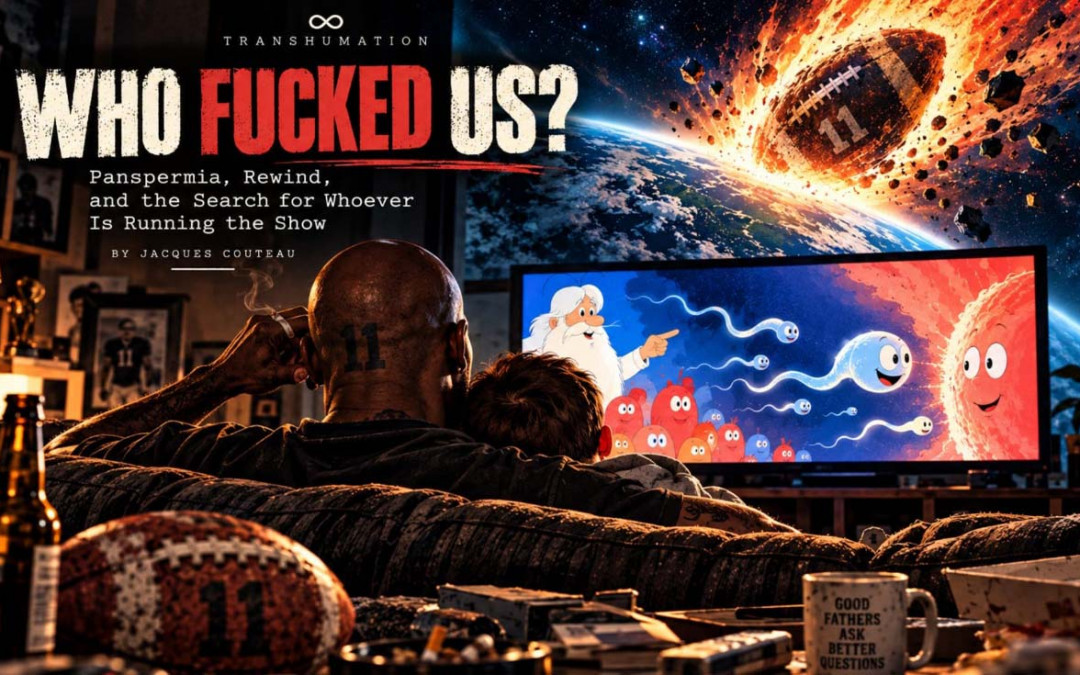
I was watching Once Upon a Time… Life with my kid.
This is one of the strange privileges of having children. Eventually you are forced to watch the same shit again, only from a different seat. When I was his age, the little men running around inside the human body were the most convincing explanation of existence I had ever seen. Now I was forty, sitting at the other end of the sofa, and they looked suspiciously like underpaid French civil servants.
It was French, of course. Il était une fois… la Vie, created by Albert Barillé in the 1980s: cells, blood, bacteria and the magnificent Maestro, an old man with a white beard who seemed to know what the fuck was going on. As a child, I trusted him completely. He had a white beard. At eight, that’s basically peer review.
My kid was fascinated. My wife was going shopping.
“Do you need anything?”
“No.”
“Look at the baby. Look at the baby.”
“I am.”
“You’re not.”
She was right. I was looking at the television. On the screen, a sperm was heading towards an egg.
Rewind
There is something magnificent about explaining reproduction to children because they haven’t yet learned which parts of existence are supposed to be embarrassing. Millions begin the journey, most get nowhere, one particularly determined little bastard reaches the egg, and from there comes division, an embryo, a baby and eventually somebody who leaves wet towels on the bathroom floor.
“That’s how life starts,” my kid said.
“Apparently.”
That should have been the end of it. Except I was forty, and forty is an unfortunate age for simple explanations. At eight, you watch the sperm going forward. At forty, you start wondering where the bastard came from. I wasn’t present at my own conception, obviously. At least I sincerely hope not. So there are already a few minutes missing from the documentary.
I started rewinding. Not literally. My kid would have killed me. I did it in my head, backwards through the embryo, my parents, their parents and thousands upon thousands of people who had managed to meet the right person—or at least an available one—at precisely the right moment. Change one train, one war, one headache, one woman saying not tonight, and eventually I disappear.
People like to say that every one of us has already won the greatest lottery imaginable simply by being born. Mathematically, I can see the attraction of the argument. I’ve always had one small objection: where’s the fucking money? Then I looked at my kid. All right. There’s the million. Sorry. Carry on.
I kept rewinding. Clothes disappeared, then houses, languages and eventually anything recognisably human. Mammals gave way to stranger ancestors; something crawled backwards into the sea; bodies became simpler until sex itself became increasingly difficult to recognise as sex. My kid was still sitting beside me watching television. I had left the room about four billion years ago.
Then I hit a rock.
Not metaphorically. An actual fucking rock.

Who Fucked Us?
There are serious scientific versions of what happened next. Rocks can be blasted from one planet and eventually arrive on another. We know this because meteorites from Mars have reached Earth. Experiments also show that some microorganisms, especially when shielded from ultraviolet radiation, can survive conditions relevant to journeys through space. None of this proves that life arrived on Earth aboard a rock. It does mean that lithopanspermia—the transfer of life between worlds inside rocky material—is a hypothesis that can be investigated scientifically rather than merely imagined.
Then there is the cargo. Samples returned from asteroid Bennu have contained amino acids used by terrestrial life and the five nucleobases used in DNA and RNA. This is not evidence of life on Bennu. It is evidence that some of the chemistry life uses is not confined to Earth.
I stopped rewinding. Looked at the rock. Looked at my kid. Looked back at the rock. What the hell?
Suppose, just for the sake of the story, that something alive really did arrive here that way. Perhaps Earth wasn’t the first house. Perhaps some microscopic ancestor crossed space protected inside stone, landed here and began the absurdly long chain of events that eventually produced France, Maestro, my sofa and a man wondering where his lottery winnings had gone.
After several billion years of evolution and approximately twenty minutes of children’s television, I had finally arrived at the correct scientific question.
Who fucked us?
There are two obvious directions from here, which is inconvenient because humanity has spent a considerable amount of time insisting that you pick one. Someone did it, or nobody did. Intention or accident. Creator or chemistry. God, or a universe that eventually became complicated enough to wonder why it was complicated. I’ve never been particularly good at choosing between two doors when nobody will let me look behind either of them.
So I followed the rock.
We Found the Taxi
The problem with panspermia is that it can feel like an answer several minutes before you realise it isn’t one. Suppose life came from Mars. Excellent. Who fucked Mars? Suppose it came from somewhere else. Fine. Keep going. Another planet, another solar system, another ancient biosphere. Every time I thought I had found a parent, somebody handed me another grandparent.
Eventually it occurred to me that I had confused the passenger with the vehicle. The rock wasn’t the father. We found the taxi.
Panspermia may someday help explain how life or its precursors moved between worlds. It does not, by itself, explain how non-life became life. It can move the crime scene without solving the crime. Anyone who grew up with VHS knows the feeling. You keep going backwards because you assume there must eventually be a beginning. Sometimes you just find another tape.
At some point the animals are gone. Then plants. Then anything we would comfortably call complex life. Keep going and eventually even the word parent begins to fail, because if you’re looking for the first life, you cannot explain it by pointing to its mother. Otherwise it wasn’t first.
Now the question changes. How did matter become something that could reproduce, vary and eventually begin the long process of becoming dissatisfied with airline legroom? That’s the problem of abiogenesis, and we don’t yet have a complete historical account of how it happened on Earth. Panspermia does not make that problem disappear. It merely allows the possibility that part of the story happened somewhere else.
And then I noticed something embarrassing. I’d spent the whole investigation looking for a suspect. The word who was already inside the question.
Who’s in Charge?
Children assume there are adults. This is perfectly reasonable because adults spend an enormous amount of time pretending there are adults. Your parents know what to do. Your teacher knows what to do. The doctor definitely knows what to do. Somewhere above all of them there must presumably be an even more adult adult who understands the entire arrangement.
Then you grow up.
I became a father without ever experiencing the moment when I became qualified to be one. One day there was simply a smaller human being looking at me as though I represented management.
This becomes particularly obvious when the smaller human being gets sick. You find yourself in a pharmacy staring at twelve products for the same blocked nose. One says natural, another sensitive, a third has a photograph of a mother who looks considerably more competent than you. The pharmacist knows more than you. The doctor knows more than you. Your wife has read something you haven’t. Eventually you make a decision.
Your child looks at you as though you knew what you were doing.
This is how civilisation works.
That does not mean nobody knows anything. Quite the opposite. A surgeon may know astonishing amounts about an operation, an engineer about a bridge and a physicist about a narrow corner of reality I couldn’t understand if you gave me a week and removed all the difficult words. Everybody knows something. Nobody knows what we’re doing.
There is no CEO of civilisation. Nobody sits upstairs with the complete drawing. We have billions of specialists carrying tiny pieces of the map while the map itself keeps changing.
I spent years waiting to feel like an adult. It never happened. I became a father. Nothing. I started worrying about cholesterol. Close, but no. Eventually I realised I’d been looking for the wrong evidence.
A moustache.
That’s adulthood. You either have a moustache or you don’t. Grey hair is unreliable. Some men get it at twenty-five, some dye it, some lose the hair before it gets the opportunity. A moustache at least has the decency to make a clear claim: I am a grown man. I have facial administration.
Unfortunately, the universe doesn’t have a moustache. So I kept looking for management.
Chocolate Kills Dogs
Years ago I heard Ricky Gervais doing a bit involving the peculiar fact that chocolate can be dangerous to dogs. I remember the idea more clearly than the wording, which is probably safer for both of us. It stayed with me because it is exactly the sort of thing reality does while everyone else carries on as though nothing strange has happened.
Dogs are good. Chocolate is good. Give the chocolate to the dog and you may need a veterinarian.
There is a perfectly ordinary biological explanation. Dogs process methylxanthines such as theobromine differently from humans, so enough chocolate can poison them. Mystery solved. Except solving one question generally gives me another.
What kind of place works like this?
In a universe without design, there is nothing particularly scandalous about it. Nobody promised compatibility. Plants make chemicals. Animals evolve different metabolisms. Nature has no customer-service department obliged to ensure that everything pleasant to one mammal is safe for another.
But humans have spent thousands of years entertaining another possibility. We have built cathedrals, temples and civilizations around it. Kings have ruled under divine authority. Armies have marched beneath sacred symbols. People have prayed before births, marriages, battles and deaths. Billions of human beings today belong to religious traditions in which reality ultimately contains more than blind mechanism.
And chocolate kills dogs.
This is not an argument against God. It would be a remarkably poor one. It is simply the sort of detail that makes me want to find whoever is running the place and ask a few follow-up questions.
The building is magnificent. The plumbing is fucking weird.
Who’s in charge?
Maybe someone is upstairs. Maybe the house runs itself. Maybe asking for an operator is a category mistake produced by an animal accustomed to cars having drivers and shops having managers. I don’t know. That’s why I keep opening doors.

Look at the Baby
My wife’s voice came back to me. Look at the baby. Look at the baby.
All right. Let’s look at the baby. Not mine this time. Us.
We are an extraordinarily young species crawling around on one wet rock while learning to split atoms, edit genes and build machines that perform tasks once reserved for minds. We point microscopes downward and telescopes outward. One reveals worlds too small to know we are watching. The other searches for worlds so distant that we don’t know whether anyone there is watching us.
That creates an uncomfortable thought. Not a proof. Not an argument for God. Not evidence for extraterrestrials hiding behind Jupiter. Just a thought.
We have repeatedly discovered that changing scale changes what can be observed. A bacterium does not know about the laboratory. An embryo does not know about the ultrasound monitor. For most of human history, we did not know galaxies existed. So where did we acquire the confidence that our present scale is the last interesting one?
If structures sit inside larger structures, observers inside systems and systems inside things their inhabitants cannot perceive, then I find myself asking a question I cannot prove and cannot quite get rid of.
Shouldn’t somebody be looking at the baby?
Maybe nobody is. Maybe somebody is. The honest answer remains irritatingly unfashionable: we don’t know.
The Adults
Perhaps this is why the old argument about God never quite dies. It isn’t only that human beings want immortality or justice or an explanation for suffering. Perhaps some part of us keeps looking around the room for the adults.
Who’s running the show? Who’s got the wheel? Who knows what this is for?
Perhaps the most disturbing possibility isn’t that God doesn’t exist. It is that there may be no level of reality at which somebody finally knows everything. Even our gods may be an attempt to imagine the ultimate adult.
This is where Nietzsche’s famous declaration about the death of God becomes more interesting than the slogan printed on the T-shirt. Remove the highest authority and you haven’t solved the human problem. You’ve inherited part of its job.
At some point the child looks around the room and realises something horrifying.
The adults are us.
I had expected adulthood to involve considerably more supervision.
Play
So far we have been pressing rewind. Maybe it’s time to press play.
Look at what the confused children have done already. We learned to prevent diseases that once killed us routinely. We fly. We transplant organs. We read genetic sequences. We alter DNA. We build machines capable of manipulating language, images and knowledge at scales that would have looked supernatural remarkably recently.
None of this makes us gods. But I wonder if we have the sequence backwards. We imagine gods performing miracles because they are gods. Perhaps, from the perspective of whoever is watching, performing enough miracles is how something begins to look like one.
Show Julius Caesar a modern hospital. Let him see inside a living body without cutting it open. Play him the voice of a dead man. Show him Rome from orbit, translate a foreign language in seconds and let him speak to someone on another continent. Then explain that none of this is divine. Good luck.
The interesting thing about technology is not that it is magic. It isn’t. Technology works precisely because nature permits it. The interesting thing is how quickly miracles become appliances.
Flight became Ryanair. The accumulated knowledge of civilisation became something we use to argue with strangers while sitting on the toilet. Artificial intelligence may become something we shout at because it ordered the wrong pizza.
Same shit. Different Olympus.
Perhaps godhood, if we ever approach anything deserving that ridiculous word, will feel exactly like adulthood. It won’t arrive with trumpets. Nobody will hand humanity a certificate. We will simply discover one morning that we can do something previous generations considered impossible, while still being uncertain which nasal spray to buy for the child.
Maybe adulthood and godhood share the same dirty secret: nobody tells you when you’ve arrived because nobody at the destination feels qualified either.
Fast Forward
Now return to the rock. Panspermia normally points backwards. We imagine something leaving an ancient world, travelling through darkness and arriving here. But there is no reason the thought experiment has to face only one direction.
Space agencies already worry about the accidental version. Spacecraft sent to other worlds are cleaned because terrestrial microorganisms could hitch a ride and contaminate environments we are trying to study.
Now fast-forward. Not fifty years. Not five hundred. Go far enough that prediction becomes useless and only the question remains.
Suppose humanity survives. Suppose one day we possess the ability to send life deliberately across interstellar distances. Whether we should do such a thing would be an enormous ethical question. A lifeless planet is not automatically ours because we found it first.
But suppose one day we do. A vessel leaves our Solar System carrying something alive. Perhaps it fails. Most ambitious things do. Suppose this one doesn’t.
The organism survives. It reproduces. Millions of years pass. Evolution has no obligation to follow our plans, so eventually whatever lives there bears almost no resemblance to what we sent. Ecosystems emerge. Species appear and vanish. Something eventually looks upward.
Much later, it builds a telescope. Then a microscope. And eventually, if the universe has a sense of humour, one of those creatures sits beside its child watching their equivalent of Once Upon a Time… Life.
The child watches life moving forward. The parent starts wondering where the bastard came from.
Rewind.
Parents. Ancestors. Evolution. First cells. Then they find it: something that came from the sky. A machine. Ours.
For thousands of years they may have wondered whether somebody was watching. Their religions may have built temples to whatever they imagined was above them. Their philosophers may have argued that nobody was coming. Their scientists may have insisted that extraordinary claims require extraordinary evidence.
Then somebody digs up the evidence.
And somewhere, perhaps on a sofa, some unpleasant bastard finally asks the correct question.
Who fucked us?
For once, somebody really was looking at the baby.
We were.
Same question. Different planet.
Rewind.
Watch the Video
How to Read the World
By Jacques Couteau
Current Knowledge
Meteorites demonstrate that rocky material can travel naturally between planets, and experiments make the survival of some microorganisms under relevant protected conditions scientifically investigable. Organic molecules important to terrestrial biology have also been detected beyond Earth. None of this establishes that terrestrial life originated elsewhere. Abiogenesis — the transition from non-life to the earliest life — remains an open scientific problem, and panspermia would relocate that problem rather than solve it.
Open Questions
Did life originate independently on Earth? Could life or viable biological material naturally move between planetary environments? How common is the chemistry required for life? And if humanity eventually becomes capable of deliberately transporting living systems beyond Earth, what ethical obligations would accompany that ability?
There is also the larger question the article intentionally leaves unresolved: whether searching for a “who” behind existence is a legitimate question about reality or a cognitive habit inherited from creatures accustomed to parents, drivers and managers.
Transhumation Interpretation
The most interesting move in the article is not backward but forward.
Panspermia initially asks whether something might once have carried life to us. Couteau eventually turns the arrow around. A sufficiently capable civilization might one day become the carrier itself. Life sent elsewhere could evolve for millions of years until its descendants became capable of asking precisely the questions we ask now. Wklejony Markdown
The distinction between creator and created would then become strangely local. To those distant organisms, humanity might occupy a position once reserved for gods without being supernatural at all. We would simply be an earlier intelligence with access to technologies they had not yet recovered.
The article therefore leaves us with the same question at a different scale.
Perhaps nobody is looking at the baby.
Perhaps somebody is.
But if civilization survives long enough, one day the somebody may be us.
FAQ
What is panspermia?
Panspermia is the hypothesis that life, or material associated with life, can travel between worlds. One scientifically investigated version, lithopanspermia, considers whether microorganisms could survive transportation inside rocks ejected from one planetary body and eventually deposited on another. The hypothesis does not by itself demonstrate that life on Earth came from space.
Does panspermia explain the origin of life?
Not by itself. Panspermia could potentially explain how life moved from one world to another, but it does not explain how non-living matter first became a system capable of reproduction and evolution. As Couteau puts it, finding the rock may mean that “we found the taxi” rather than the parent.
Have the building blocks of life been found in space?
The article discusses samples returned from asteroid Bennu containing amino acids used by terrestrial life and the five nucleobases associated with DNA and RNA. This is not evidence that Bennu contained life. It supports the narrower point that some chemistry used by life on Earth also exists beyond Earth.
Is the article arguing that God exists?
No. Couteau deliberately leaves both possibilities open. He considers a universe with intention and one without it, while questioning whether asking “who” created life already smuggles an agent into a question that may ultimately have a non-agentic answer.
Why does the article compare humanity to a child?
The analogy begins with parenthood. Children naturally assume that adults know what they are doing, while adults often discover that expertise is distributed and nobody possesses the complete plan. Couteau extends that experience to civilization: humanity possesses extraordinary specialized knowledge without necessarily having anyone “upstairs” who understands the entire system.
Could humanity spread life to another planet?
The article treats this as a future thought experiment rather than a prediction. If humanity eventually acquired the ability to send life across interstellar distances, organisms originating on Earth might theoretically establish themselves elsewhere and evolve for immense periods of time. Couteau then reverses the original panspermia question: a future species might discover that, in its case, somebody really did send the first life.
What does “The adults are us” mean?
It marks the article’s central reversal. Humanity repeatedly looks for a higher level of authority — parents, governments, gods or some ultimate operator of reality. Couteau suggests that growing up may mean recognizing that at least some of the responsibility we once projected upward has become ours.
Continue the Transhumation Series
- Forgotten Religion | Ancient Gods, Symbols and the Hidden Structures of Human Civilization
- The Last Religion | Death, Immortality and the Future of Humanity
- The New Theurgy | AI, Information and the Future of Human Civilization
- End of Branding: You Were Never Meant to Become a Product
- Baal vs Ishtar: Why Ancient Gods Never Disappeared