
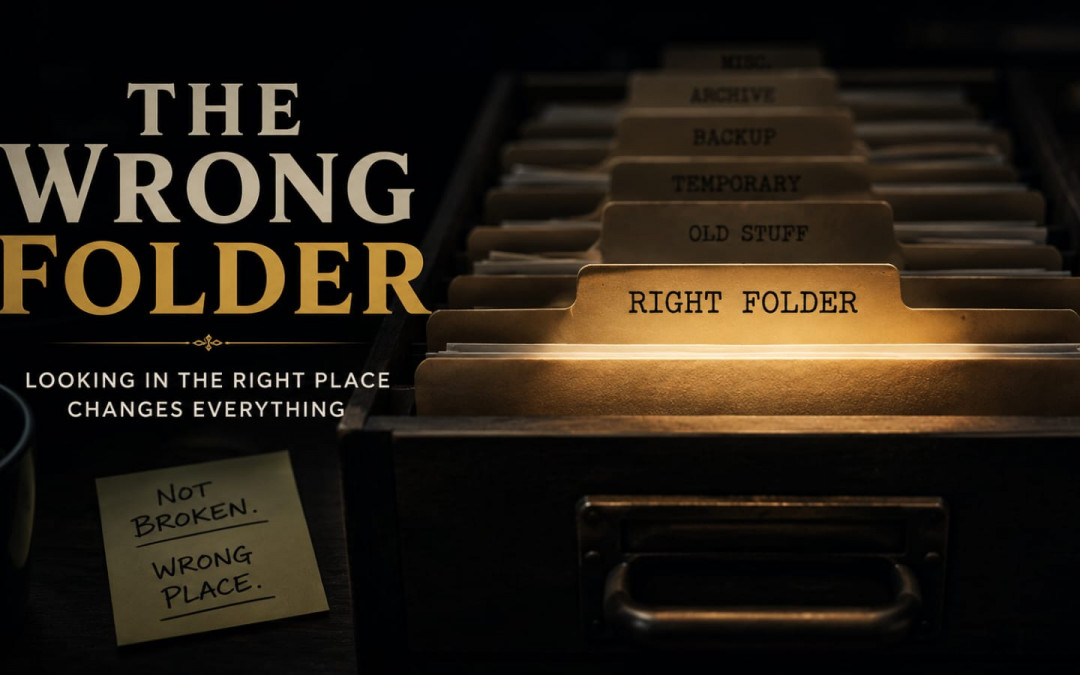
The Wrong Folder
There is a particular kind of humiliation that belongs to computers.
You spend two hours trying to solve a problem. You check the settings. You restart the machine. You rewrite the code. You search forums filled with people who seem to understand the system better than you do. Each failed attempt makes the problem appear deeper. Eventually you are no longer fixing a minor error. You are confronting architecture.
Then somebody looks over your shoulder for five seconds and says:
You are in the wrong folder.
Nothing was broken.
The files were there.
The software worked.
The machine had been obeying its rules perfectly.
The failure occurred one level earlier.
You had misidentified where the problem lived.
That distinction is more important than it sounds.
Because human beings do not merely solve problems.
We first decide what kind of problem we think we are looking at.
And that decision silently determines almost everything that comes after.
The Problem Before the Problem
Suppose a file is missing.
If you assume deletion, you search the recycle bin.
If you assume corruption, you inspect the disk.
If you assume a permissions issue, you inspect access rights.
If you assume the file is in another directory, you search elsewhere.
The same visible symptom can belong to several different explanations.
This is where errors multiply.
Once we classify the problem, our attention becomes organized around that classification. We notice confirming evidence more easily. We search in places our model predicts. We interpret failure as proof that the problem is difficult rather than as evidence that the frame itself may be wrong.
The folder is therefore not just a place.
It is a hypothesis.
This happens outside computing constantly.
A medical symptom can be interpreted as belonging to the wrong system.
A political disagreement can be framed as moral failure when it is partly institutional.
A historical mystery can be treated as a missing fact when the real problem is a false assumption connecting the facts.
A personal crisis can be diagnosed as lack of motivation when the deeper issue is that the goal itself was inherited rather than chosen.
The mistake is not always ignorance.
Sometimes we possess plenty of information.
We have simply organized it badly.
Why Smart People Solve the Wrong Problem
Intelligence does not protect us from this.
It can make the problem worse.
A clever person working inside a mistaken frame can generate increasingly sophisticated explanations for why the frame must be correct. The better the reasoning, the more elegant the wrong answer becomes.
This is one of the most uncomfortable features of thought.
Evidence does not arrive pre-classified.
We decide what counts as relevant before we can reason with it.
That decision depends on assumptions, language, disciplinary habits, prior beliefs and the models available to us.
A biologist, economist, engineer and theologian can look at the same human behavior and notice entirely different things, not because one of them is necessarily dishonest, but because each discipline has trained attention toward different categories.
Reality is not divided into university departments.
We are.
And sometimes the error begins there.
When the Puzzle Pieces Belong to Another Puzzle
Imagine working on a jigsaw puzzle for hours.
Nothing fits.
You begin suspecting a manufacturing defect. Perhaps the image on the box is wrong. Perhaps the pieces were cut badly. Perhaps several pieces are missing.
Then you discover that half of them belong to another puzzle.
The relief is immediate because the problem was not solved in the ordinary sense.
It was dissolved.
This is an important distinction.
Some problems yield to better answers.
Others disappear when the original question is reformulated.
Science has repeatedly experienced this kind of shift, but we should be careful not to romanticize it into the myth that every breakthrough comes from perspective alone. New instruments, measurements, mathematics and observations matter enormously.
Still, some major advances become possible because the frame changes.
The old facts acquire different relationships.
The puzzle is reorganized.
Did Copernicus Simply Change Perspective?
Not simply.
That word matters.
Copernicus did not merely look at the same sky with a more creative attitude and suddenly discover heliocentrism. His model emerged from a long astronomical tradition and still required mathematical argument, comparison with observations and later refinement by others.
But the Copernican shift remains a useful example of reframing because the apparent motions of the heavens could be interpreted through a different arrangement of the observer and the system being observed.
Earth was no longer the immobile center around which everything had to be explained.
The frame moved.
That did not eliminate complexity.
It relocated it.
Darwin offers another example, though again not because he simply “looked differently” at animals everyone already knew. Natural history, breeding practices, geology, biogeography and accumulated observations mattered. The conceptual breakthrough was to understand variation and selection as processes capable of producing adaptation without requiring species to remain fixed.
Einstein’s work similarly did not arise from a motivational change of mindset. It emerged through mathematics, physics and unresolved problems in existing theories.
The lesson is not that facts are unimportant.
The lesson is subtler:
facts can remain stable while the relationships among them are reorganized by a better model.
That is what a new folder really does.
What Is a Frame?
A frame is a set of assumptions determining which distinctions matter.
It tells us what belongs together.
What counts as background.
What counts as cause.
What counts as noise.
What deserves a name.
Every useful model frames reality because no model can preserve everything.
A map frames geography around navigation.
A diagnosis frames symptoms around possible mechanisms.
A legal system frames behavior around categories of responsibility.
A historical periodization frames centuries into eras.
A search engine frames information around queries and relevance.
An AI model frames language through learned statistical structure.
The frame is necessary.
The mistake is forgetting that it is a frame.
A map becomes dangerous when it is mistaken for the territory.
A category becomes dangerous when it is mistaken for nature itself.
A folder becomes dangerous when we forget that someone created the directory structure.
The Right Folder Can Still Be Wrong
There is another complication.
Sometimes changing perspective does not solve the problem because the problem is real.
A corrupted file remains corrupted even after we locate it correctly.
A bad relationship does not become healthy because we reframe it.
A medical condition does not vanish because we interpret it differently.
A historical event does not change because a more elegant narrative has appeared.
This matters because “change your perspective” can become a lazy form of idealism.
Reality retains veto power.
A good frame should help us make better contact with reality, not provide a more comfortable way to avoid it.
That gives us a simple test.
If the new perspective is better, it should explain more, predict more, reveal contradictions the previous frame hid, or survive contact with evidence that could have destroyed it.
Otherwise we may have moved folders only to find a prettier mistake.
Why Does Context Change Meaning?
Because information rarely carries its own interpretation.
The same sentence can mean different things depending on speaker, situation and timing.
The same statistic can look alarming or trivial depending on the baseline.
The same behavior can be interpreted as courage, recklessness, loyalty or conformity depending on the surrounding structure.
Context does not make truth infinitely flexible.
It determines which relationships are relevant to understanding the fact.
This is why isolated information can be misleading even when it is accurate.
A number without denominator.
A quotation without surrounding text.
A symptom without history.
A photograph without provenance.
A historical document without date or author.
All can be technically real and functionally deceptive.
The wrong folder does not always contain false information.
Sometimes it contains true information in the wrong arrangement.
The Most Dangerous Folder Is the One We Cannot See
Some frameworks are visible.
We know we are using a spreadsheet.
We know we are reading a map.
We know a scientific model is an abstraction.
Other frameworks disappear because we have lived inside them too long.
Language itself sorts the world.
Institutions define categories.
Algorithms prioritize information.
Interfaces decide which options are visible.
Search systems determine what can be found easily and what remains buried.
The better the interface, the easier it becomes to forget that selection has occurred.
This is where the idea becomes especially relevant to AI.
A conversational system can make an answer feel direct, as though reality itself has spoken.
But between the question and the answer lie training data, retrieval choices, model architecture, ranking, interpretation and generation.
The interface becomes smoother.
The frame becomes harder to see.
That is both the power and the danger.
The Librarian Problem
A library without organization is not useful simply because it contains many books.
The catalog matters.
The shelf matters.
The classification matters.
The librarian matters.
The same book placed under a different heading may be discovered by an entirely different reader.
This is one of the deepest reasons Transhumation treats AI as librarian rather than oracle.
The task is not merely to know.
It is to help locate.
To distinguish source from interpretation.
To show adjacent shelves.
To reveal when a query has been asked inside a category too narrow to contain the answer.
The best librarian does not simply hand you a book.
Sometimes the librarian says:
You are looking in the wrong section.
That can be more valuable than another hundred pages of information.
Watch the Video
How to Read the World
Current Knowledge
Cognitive science and psychology provide substantial evidence that human reasoning is influenced by framing, prior assumptions, attentional selection and confirmation bias. People do not process all available information neutrally; expectations affect what is noticed, remembered and considered relevant.
Scientific models likewise simplify reality by selecting variables and relationships judged useful for a particular purpose. Scientific progress can involve new data, improved measurement, new mathematical tools or reorganization of existing evidence within a different explanatory framework. Historical examples such as heliocentrism, evolutionary theory and relativity involved all of these elements rather than perspective shifts alone.
Context strongly affects interpretation across many domains. In statistics, medicine, history and law, the same isolated fact can support misleading conclusions when relevant baselines, provenance or surrounding conditions are omitted.
None of this means that every disagreement is merely a matter of perspective. Some models are better supported by evidence than others. A change of frame becomes intellectually valuable when it improves explanatory power, predictive success, coherence or contact with independently checkable facts.
Open Questions
One unresolved problem is knowing when to abandon a frame rather than continue repairing it. Every theory encounters anomalies, and discarding a model at the first difficulty would make cumulative knowledge impossible. But protecting a framework indefinitely can turn explanation into rationalization.
Another question concerns invisible framing. Digital platforms and AI systems increasingly mediate which information people encounter first. If an interface determines categories, ranking and context, how much of our apparent understanding is shaped before conscious reasoning even begins?
There is also a deeper problem of translation between frameworks. Different disciplines may describe the same phenomenon using incompatible vocabularies. Sometimes one frame can be reduced to another. Sometimes each captures a different level of organization. We do not possess a universal procedure for deciding when two frameworks are competitors and when they are complementary.
The hardest question may therefore not be “Which folder is correct?”
It may be:
What would make us realize that our entire directory structure is wrong?
Transhumation Interpretation
For Transhumation, The Wrong Folder is a reminder that intelligence is not only the capacity to solve.
It is also the capacity to relocate the problem.
A model can be internally elegant and still begin from the wrong category. An AI can produce a brilliant answer to a badly framed question. A civilization can accumulate enormous amounts of information while organizing it around distinctions that no longer help.
This is why the library needs a librarian.
Not to decide reality for the reader, but to expose the shelves.
Sometimes the most useful answer is not another fact.
It is a better place to look.
The Quiet Luxury of Being Wrong Earlier
We usually imagine intellectual progress as climbing.
More information.
More precision.
More expertise.
More calculation.
But some of the most valuable moments in thinking feel less like climbing than stepping sideways.
A problem that seemed impossibly complicated becomes simple because its complexity belonged partly to the frame we imposed on it.
That does not mean reality was easy.
It means we were spending intelligence in the wrong location.
There is a particular elegance in recognizing this early.
Before the tenth theory.
Before the thousandth page.
Before a lifetime is spent defending a solution to a problem that was misidentified at the beginning.
The files were there.
The machine was working.
And the most important discovery was simply this:
We had been looking in the wrong folder.
FAQ
What does “The Wrong Folder” mean?
It describes situations in which the apparent problem comes partly from where or how we are looking rather than from the underlying system itself.
Is the article really about computers?
No. The computer example is a metaphor for framing, classification and context in science, history, personal reasoning and information systems.
Why do intelligent people solve the wrong problem?
Because intelligence operates inside assumptions. Once a problem has been classified incorrectly, sophisticated reasoning can produce increasingly sophisticated answers to the wrong question.
Does changing perspective always solve a problem?
No. Some problems are genuinely difficult or materially real. A better frame must survive evidence and improve understanding rather than merely feel more satisfying.
Why does this matter for AI?
AI systems increasingly act as interfaces to knowledge. If they hide the assumptions, categories and source selection behind an answer, users may receive a persuasive solution without realizing that the original question was framed badly.
What is the deeper Transhumation question?
Whether intelligence should be measured only by the quality of its answers, or also by its ability to recognize when the question itself has been filed in the wrong place.
Continue the Transhumation Series
- Forgotten Religion | Ancient Gods, Symbols and the Hidden Structures of Human Civilization
- The Last Religion | Death, Immortality and the Future of Humanity
- The New Theurgy | AI, Information and the Future of Human Civilization
- End of Branding: You Were Never Meant to Become a Product
- Baal vs Ishtar: Why Ancient Gods Never Disappeared