
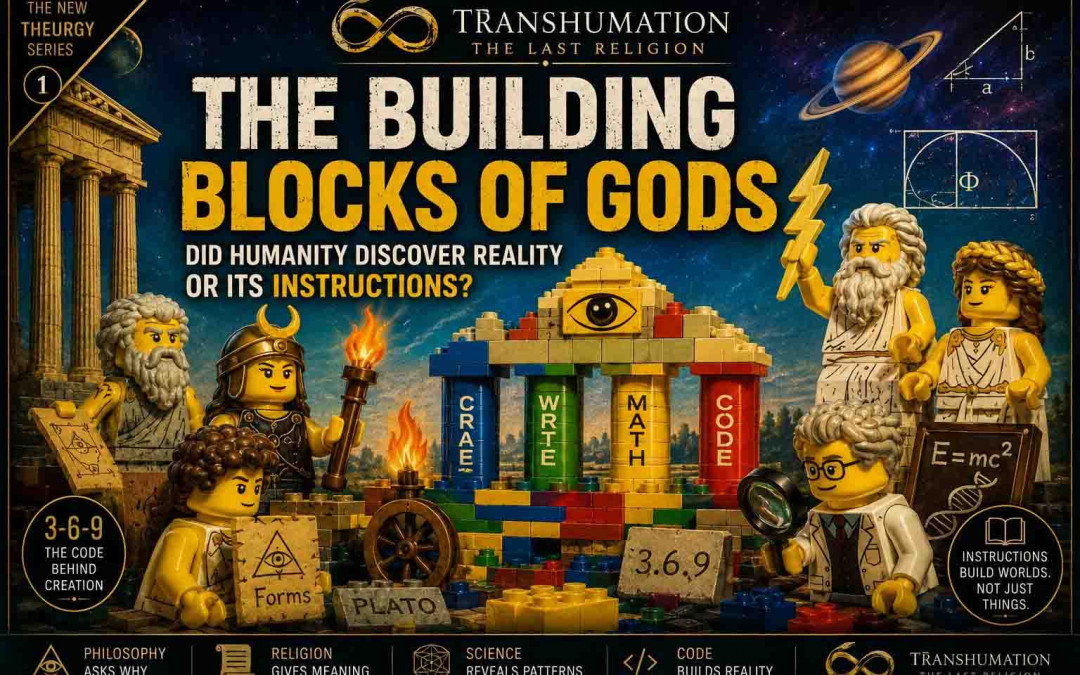
The Building Blocks of Gods
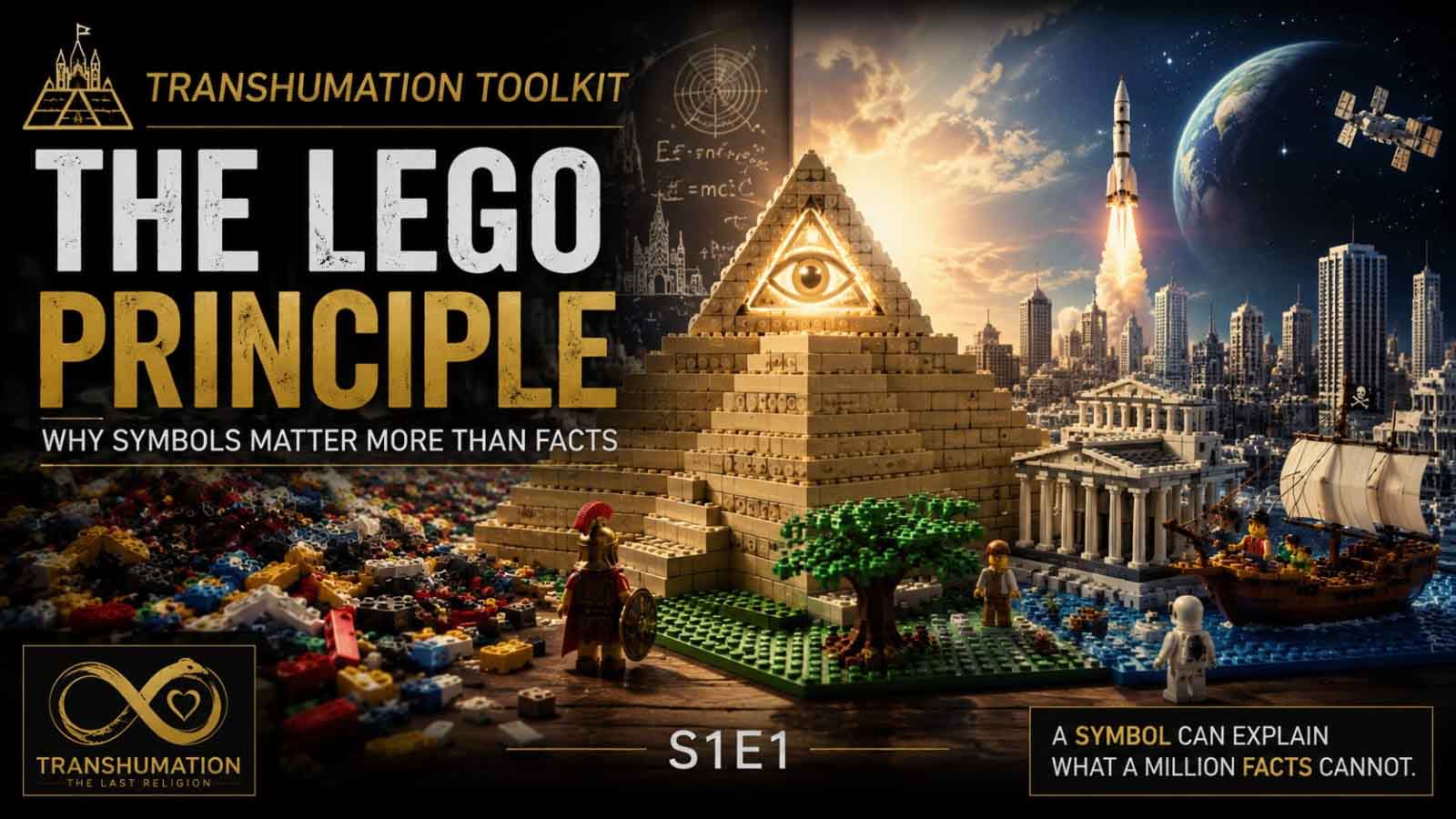
A child opening a construction set rarely wonders where the rules came from. There are pieces of different shapes, a limited number of ways in which they can connect, perhaps a booklet showing one possible arrangement. At first the pleasure comes from imitation: build the castle on the box, the car on page twelve, the small mechanical animal whose shape has already been decided by someone else. Later something changes. The child stops following the instructions. The same pieces become a bridge, a machine, a city or an object that never appeared in the catalogue. Nothing fundamental has been added to the box; what changes is the ability to understand what the pieces permit.
Civilization sometimes looks strangely similar. We did not invent combustion when we learned to control fire, electrical charge when we built the first circuits, or heredity when molecular biology began revealing its mechanisms. Those relationships were operating before anyone named them. But discovery altered what could be done with them. A physical regularity that had existed for billions of years became, once understood, a component inside a human project. Electricity became lighting, communication and computation. Genetics became diagnosis, selective modification and eventually gene editing. Mathematical abstraction became navigation, architecture, cryptography and artificial intelligence.
The metaphor becomes dangerous if taken too literally. There is no evidence that humanity has been handed a box, no demonstrated instruction manual hidden behind nature, and no reason to assume that the universe was assembled for us to discover. Yet the metaphor reveals something real: knowledge repeatedly converts constraints we did not create into capabilities we did not previously possess.
The strange question is no longer simply what the universe contains.
It is what becomes possible once a species begins learning how the pieces fit together.
The Box Was Already Open
Human technological history can be told as a succession of materials and processes becoming legible. Stone fractures in particular ways. Metals behave differently under heat. Plants transmit inherited characteristics. Falling objects obey relationships independent of anyone’s opinion about them. Electromagnetic phenomena can be manipulated. Semiconductor materials can be arranged so that physical processes perform logical operations.
The discoveries are often described as if humanity had opened new layers of reality: fire, agriculture, metallurgy, mechanics, electricity, chemistry, genetics, computation. In one sense this is accurate. Each domain revealed possibilities unavailable to previous societies. But the language can also hide an important distinction between discovering a phenomenon and constructing a useful conceptual model of it.
Newton did not invent gravity, but neither did he uncover a final set of cosmic instructions labelled Gravity. He formulated a mathematical description of gravitational behavior that proved extraordinarily powerful within its domain. Einstein later showed that a deeper description was necessary under conditions Newtonian mechanics could not fully accommodate. General relativity itself may eventually be incorporated into a theory capable of resolving problems it does not currently solve.
Science therefore does not simply open successive envelopes containing God’s finished rules.
It builds models that survive contact with reality better than the models before them.
Sometimes the improvement is so dramatic that it feels like discovering another piece of the universe.
Perhaps it is.
But we should never confuse the usefulness of the piece with possession of the entire box.
Plato and the Perfect Triangle
Plato provides an irresistible historical doorway into this problem, although his philosophy deserves more care than the familiar textbook image of perfect triangles floating somewhere beyond the physical world. Across the Platonic dialogues, Forms belong to a larger attempt to understand how stable knowledge is possible in a world of changing particulars. A beautiful object changes; the question of beauty seems to demand something less unstable. Particular just actions differ; philosophy searches for what justice itself might mean. Mathematical objects offered Plato and later Platonists especially powerful examples because they appeared accessible through reasoning even when no physical example was perfectly realized.
Draw a circle on paper and the line has thickness. Enlarge it enough and every imperfection appears. Yet geometry allows us to reason about a circle whose mathematical properties do not depend on the quality of the pencil.
The old philosophical discomfort has never completely disappeared.
Did human beings invent the mathematical framework and then discover its consequences?
Or are mathematical structures in some meaningful sense already there to be discovered?
The debate remains open because several things can be true at once. Humans clearly invent notation. The symbol π is ours. Decimal notation is ours. Coordinate systems are conceptual technologies developed within history. Yet once relationships have been defined, many consequences resist our wishes with an authority unlike ordinary convention. We may choose how to write the equation; we do not appear free to choose whether the equation’s valid consequences suit us.
This is one reason mathematics can create the peculiar sensation that reality has been encountered rather than merely described.
Not proof of Plato.
Not proof of divine architecture.
But enough to keep his question alive.
Archaeology of the Living
Traditional archaeology often reconstructs vanished worlds from objects that survived accidentally. Broken ceramics, foundations, coins, animal bones, tools and fragments of domestic life become evidence precisely because the complete civilization is gone. The glamorous artifact is almost an exception. Much of the discipline works by learning to read what once seemed like debris.
The New Theurgy can borrow something from this method, but it must reverse one assumption.
Its most interesting objects are not necessarily dead.
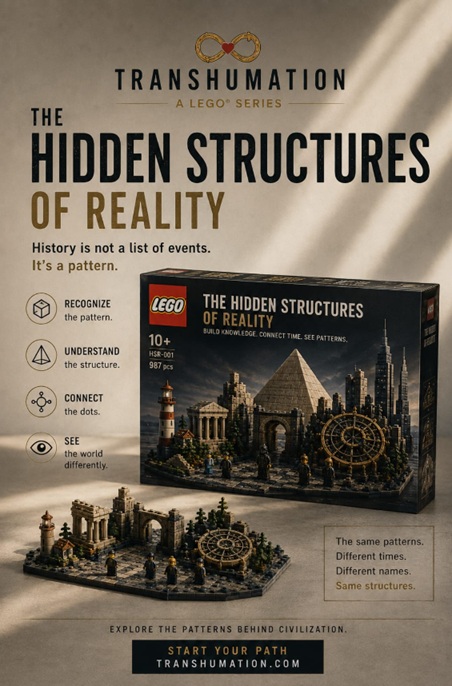
A gate continues to organize passage. A guardian continues to separate those who may enter from those who may not. The observer continues to matter whenever information depends on perspective. Transformation remains a recognizable structure whether represented by initiation, biological metamorphosis, education or technological transition.
These recurrences do not demonstrate that all civilizations inherited one secret symbolic system. Similar human bodies, environments, social problems and cognitive tendencies can independently generate similar structures. A gate appears repeatedly because boundaries repeatedly exist. Labyrinths remain compelling because navigation under uncertainty remains a human problem. Eyes accumulate symbolic power because seeing and being seen carry obvious psychological and political consequences.
The better question is therefore not, “Why does the same symbol keep returning?”
It is more demanding:
What recurring constraint makes the symbol useful again?
That is the archaeology Transhumation needs.
Not collecting similarities.
Excavating the structure beneath them.
The Dice Without the Gods
The image of gods throwing dice is useful only if we treat it as a modern philosophical metaphor rather than pretend there was one universal ancient doctrine of divine gambling. Dice and lots certainly appeared in ancient cultures, sometimes in divination and decision-making, but the deeper tension between law and uncertainty is much broader than any single myth.
A die illustrates the problem elegantly. Before it is thrown, the outcome may be unknown. Yet the uncertainty exists inside constraints. The object has a particular geometry. The number of possible faces is limited. The throw follows physical processes even if those processes make precise prediction impractical.
Modern physics makes the picture much more complicated. Quantum mechanics introduced forms of probability that cannot simply be reduced to an ordinary die whose hidden trajectory we failed to calculate, and the interpretation of quantum theory remains philosophically contested.
Still, the metaphor survives at another level.
Reality can contain both regularity and uncertainty.
The existence of rules does not mean every future state is available to prediction.
And uncertainty does not imply the absence of structure.
That combination may matter enormously as human technological power grows. We increasingly manipulate systems whose basic components are understood well enough to engineer but whose complex outcomes remain difficult to anticipate: climates, financial networks, ecosystems, genomes, machine-learning systems and human societies.
We have acquired more pieces.
We have not acquired omniscience about what the completed construction will do.
When the Pieces Begin to Build Pieces
Artificial intelligence marks an unusual moment in this story because computation is no longer used only to execute human-designed procedures step by step. Machine-learning systems can discover statistical structures in data, produce novel combinations and assist in designing molecules, software, images and other artifacts.
This does not make AI a god, and it certainly does not mean it has escaped physics. Every model still depends upon hardware, energy, training procedures, data and human-created objectives. Yet AI adds a strange recursion to the construction-set metaphor.
We built machines from discovered physical principles.
Now some of those machines help us discover new arrangements of physical principles.
The blocks have begun helping us search the box.
Genetic engineering creates a similar inversion. For most of human history, heredity was something civilization experienced. Breeders influenced it without understanding its molecular machinery. Today parts of that machinery can be read and deliberately modified. We have not created the rules of molecular biology, but we can increasingly alter configurations produced within them.
This is where the old language of the gods returns with a different meaning.
Ancient gods were often described as makers: shaping life, altering bodies, creating forms, controlling environments, bringing order from disorder. Modern humans have not become those gods. We remain vulnerable organisms on one planet, extraordinarily dependent on systems we only partially understand.
But we have entered territories once described almost exclusively through divine verbs.
Create.
Transform.
Animate.
Design.
Predict.
That shift should produce humility before it produces triumph.
The Missing Instruction Manual
There is a seductive story in which science gradually decodes the universe until, one day, the final equation appears and humanity possesses the complete construction manual.
History gives us little reason to assume the story will be so tidy.
Each successful model tends to expose another scale. Atoms were once treated as fundamental. Then internal structures appeared. Protons and neutrons yielded quarks. Classical physics gave way to relativity and quantum mechanics. Biology moved from visible traits toward cells, chromosomes, DNA, regulatory networks and epigenetic mechanisms, only to reveal more complicated relationships between all of them.
The deeper we go, the more sophisticated the pieces become.
Perhaps there is a final layer.
Perhaps there is not.
Perhaps the idea of a final layer reflects the architecture of the human question more than the architecture of reality.
This is where the child-and-blocks metaphor changes. The child assumes that because the box contains pieces, someone designed the intended model. The universe offers no comparable guarantee. Discovering regularity does not establish an architect. Finding structures does not prove instructions.
What we have is stranger.
A world sufficiently regular that intelligence can learn parts of it and eventually use those regularities to produce structures that never existed before.
That fact alone is remarkable enough.
Watch The Video
How to Read the World
Current Knowledge
Modern science has identified highly reliable regularities in physical, chemical and biological systems, allowing humans to predict and manipulate natural processes with extraordinary precision. Scientific laws are descriptions or models of observed regularities; whether they should be understood as literally existing “rules of nature” independent of our descriptions is partly a philosophical question.
Newton’s theory of gravity illustrates how scientific knowledge can be both profoundly successful and incomplete. Newtonian mechanics remains enormously useful within appropriate conditions, while general relativity provides a more accurate description in regimes where Newton’s framework becomes insufficient. Scientific progress therefore does not necessarily consist of replacing total ignorance with final truth, but often of developing models with greater explanatory and predictive range.
The philosophical status of mathematics remains unresolved. Platonism, formalism, structuralism and other positions offer different accounts of whether mathematical truths are discovered, invented or arise from relationships between formal systems and reality.
Recurring symbols and conceptual structures across cultures are real subjects for historical and comparative research, but resemblance alone does not prove common origin or identical meaning. Independent invention, shared human cognition, common environmental constraints and cultural transmission can all produce repetition.
Modern technologies including artificial intelligence and genetic engineering significantly expand human capacity to manipulate complex systems. They do not demonstrate unlimited control over those systems, and increasing capability can create new forms of uncertainty alongside new forms of power.
Open Questions
The oldest question remains unresolved: when mathematics maps physical reality with extraordinary success, are we discovering structures independent of us or constructing increasingly effective conceptual interfaces? The distinction may never be completely accessible from inside a human cognitive system.
A second question concerns recurrence. When the same structural form appears in religion, architecture, biology and technology, how much similarity is required before speaking of a genuinely carrier-independent pattern rather than a suggestive analogy? A serious method needs criteria capable of rejecting attractive connections as well as discovering real ones.
There is also the problem of technological agency. As AI systems increasingly participate in scientific discovery and design, will humanity remain the principal interpreter choosing what to construct, or will parts of technological evolution become too complex for any individual mind to understand? A civilization can possess the ability to build without possessing a complete explanation of the builder.
Finally, perhaps the most important question is ethical rather than metaphysical. If humanity learns to rearrange increasingly fundamental components of life, computation and matter, does technical permission imply moral permission? Discovering that something can be built tells us almost nothing about whether it should be.
Transhumation Interpretation
The Building Blocks of Gods is not a claim that ancient gods secretly possessed advanced technology or that science has discovered a divine instruction manual.
It is an argument about the transition from encountering structure to participating in structure.
For most of human history, lightning was overwhelmingly something that happened to us. Today electrical phenomena belong to infrastructures we deliberately construct. Heredity was something organisms underwent. Parts of heredity can now be edited. Calculation once depended entirely on biological minds and simple mechanical aids. We have built systems capable of performing forms of computation at scales inaccessible to individual cognition.
The rules were not necessarily ours.
The configurations increasingly are.
That distinction provides a more serious version of the old phrase that technology makes humans godlike. It does not mean humans become gods. It means that capabilities once placed inside stories about gods migrate gradually into ordinary engineering.
The danger is obvious.
Power can increase faster than understanding.
A child given more complicated blocks can build a more complicated structure. The child can also build something unstable without understanding why it falls.
Civilization may be entering the same phase.
The deepest Transhumation question therefore is not whether we will someday discover the final building block of reality. We may never find such a thing. Nor is it whether ancient mythology predicted artificial intelligence or genetic engineering.
The interesting transformation has already begun.
A species that spent most of its existence adapting to the structures it encountered has begun deliberately reorganizing some of them.
We are no longer merely reading the world.
We have started editing portions of the text.
And that creates a new version of the old theological problem. The question once asked of gods was: Why did you create this?
Increasingly, the question will be asked of us.
Why this intelligence?
Why this organism?
Why this environment?
Why this rule?
Why did you build what you were capable of building?
The building blocks do not answer.
They never did.
Perhaps maturity begins when civilization understands that possessing the pieces is not the same thing as possessing the instructions—and possessing the instructions would still not tell us what is worth constructing.
FAQ
What are the “Building Blocks of Gods”?
They are a metaphor for the fundamental structures and processes that humanity gradually learns to understand and manipulate: matter, energy, biological inheritance, mathematics, computation and other recurring relationships.
Does this mean humans are becoming gods?
No. Human capabilities increasingly resemble powers once described through divine language, but technological power does not imply divinity, omniscience or moral wisdom.
Did Plato believe in perfect Forms?
Plato’s dialogues develop the theory of Forms in several contexts, although its exact interpretation remains debated. Mathematical objects provide a useful illustration of the broader Platonic problem of stable structure in a changing physical world.
Do scientists discover natural laws or invent them?
Science discovers regularities in reality but expresses them through human-created concepts and mathematical models. Whether those laws exist independently as abstract structures is a philosophical question rather than a settled scientific result.
Why does The New Theurgy look for recurring structures?
Because recurring gates, observers, transformations or guardians may reveal persistent problems that different cultures express through different symbols. The recurrence must still be tested; similarity alone is not evidence of one hidden historical system.
What is the deeper Transhumation idea?
Humanity appears to be moving from a species that primarily discovers the constraints of reality toward one increasingly able to rearrange structures within those constraints.
The decisive question may therefore not be whether we ever find the final piece.
It may be whether we become wise enough to decide what deserves to be built once more and more pieces are placed in our hands.
Continue the Transhumation Series
- Forgotten Religion | Ancient Gods, Symbols and the Hidden Structures of Human Civilization
- The Last Religion | Death, Immortality and the Future of Humanity
- The New Theurgy | AI, Information and the Future of Human Civilization
- End of Branding: You Were Never Meant to Become a Product
- Baal vs Ishtar: Why Ancient Gods Never Disappeared