
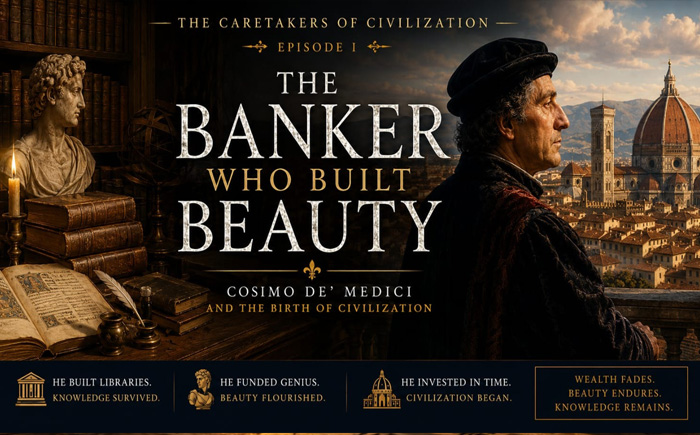
Wealth Into Cultural Memory
There is something almost embarrassing about money when it grows old.
A ledger that once determined who could build a palace, marry into a family or rescue a merchant house from collapse eventually becomes a piece of archival paper. The currencies change. The bank closes. The fortunes divide among heirs. Contracts that once caused sleepless nights become material for historians wearing cotton gloves.
Beauty ages differently.
A stone courtyard can outlive the family that paid for it. A manuscript bought for a private collection can enter a public library centuries later. A chapel commissioned partly for prestige can become part of the cultural inheritance of people who neither know nor care about the original social calculation behind it.
Cosimo de’ Medici understood this asymmetry, whether or not he would have described it in those terms.
He was not an artist. He did not carve Donatello’s figures, design every building associated with Medici patronage or paint the walls of San Marco. He operated through banking, alliances, institutions, commissions and the difficult art of placing resources where other people’s abilities could become durable.
That makes him interesting for reasons larger than Florence.
Cosimo represents a type of historical figure who often disappears behind the masterpiece: the person who does not create the work, but creates the conditions under which the work has time to become possible.
Who Was Cosimo de’ Medici?
Cosimo de’ Medici, later known as Cosimo the Elder, was born in 1389 into a Florentine banking family whose financial influence expanded dramatically under his father, Giovanni di Bicci de’ Medici. Cosimo inherited not only wealth but a network of commercial relationships capable of giving his family unusual political power in a republic formally suspicious of individual domination.
His authority was therefore never quite that of a king.
That distinction matters.
Cosimo exercised power through relationships, patronage, alliances and influence rather than through a crown. His exile from Florence in 1433 and return the following year demonstrated both the vulnerability and the remarkable resilience of that system. After his return, Medici power became increasingly difficult to separate from the political life of the city.
But Cosimo’s reputation cannot be understood through banking and politics alone.
He became an important patron of architecture, religious institutions, manuscripts, humanist scholarship and art. Michelozzo designed the Medici palace and worked on projects associated with Cosimo. The convent of San Marco received significant Medici support and became associated with Fra Angelico’s celebrated frescoes. Cosimo supported scholars and manuscript collecting, and his later relationship with Marsilio Ficino contributed to the Florentine revival of Platonic studies.
None of this means one banker manufactured the Renaissance.
It means one banker understood that wealth could purchase something more durable than luxury.
It could purchase time for other minds.
Did the Medici Create the Renaissance?
No.
The Renaissance becomes less interesting when compressed into the biography of one family.
Florence already possessed an extraordinary civic, commercial and artistic culture. Guilds financed major public works. Religious institutions commissioned art. Merchant families competed through architecture and patronage. Humanist scholarship had been developing before Cosimo’s political dominance. Brunelleschi, Ghiberti, Donatello and other artists worked inside a complicated ecosystem of civic, ecclesiastical and private commissions.
Even the recovery of classical knowledge cannot be reduced to the idea that ancient Greece had disappeared and the Medici suddenly rediscovered it.
Classical texts survived through many routes. Latin traditions remained active in Western Europe; Greek and Arabic intellectual transmission had long preserved, transformed and commented upon ancient philosophy and science. Renaissance humanists intensified the search for manuscripts, improved access to Greek texts and reorganized classical learning within new scholarly environments, but they inherited rather than resurrected civilization from nothing.
Cosimo belongs inside that network.
This makes his role more important, not less.
Civilization is rarely created by a solitary genius because genius itself requires conditions.
A manuscript needs a copyist.
A scholar needs time.
A sculptor needs marble.
An architect needs land, labor and permission.
A library needs a building.
The romantic history of creativity begins when the artist lifts the brush.
The material history begins much earlier.
How Did Banking Help Finance Renaissance Florence?
Banking does not turn automatically into beauty.
Most profitable accounts never become frescoes.
The interesting step is conversion.
Commercial wealth can be transformed into political power, dynastic security, conspicuous consumption or another commercial venture. Renaissance Florence also demonstrates another possibility: capital can become architecture, manuscripts, religious patronage and workshops whose products continue generating cultural value after the original financial transaction has become meaningless.
This should not be mistaken for philanthropy in the modern sense.
Patronage operated inside a dense network of piety, reputation, family identity, political signaling and personal taste. A chapel could serve religious devotion while making a family visible. A palace could provide a home while communicating rank. Supporting a convent could be spiritually meaningful and politically useful at the same time.
Modern readers often want cleaner motives than history provides.
History refuses.
Cosimo did not need to be a disinterested guardian of universal culture for his patronage to matter. The more interesting fact is that mixed motives can produce durable public consequences.
A fifteenth-century investment in status can become a twenty-first-century encounter with beauty.
Intent expires.
The artifact keeps working.
Genius Is More Fragile Than We Like to Admit
Modern culture loves the mythology of inevitable genius.
We imagine that Michelangelo would somehow have become Michelangelo under any circumstances, that a brilliant manuscript will eventually find readers, that an important discovery possesses enough internal force to push through poverty, political opposition and institutional neglect.
The archive says otherwise.
Works disappear.
Artists remain local.
Manuscripts are lost.
Technologies arrive in environments unable to use them.
Ideas can be correct and still die because nobody copies them.
The assumption that greatness automatically survives is a form of historical survivor bias. We see the masterpieces that reached us and infer that masterpieces possess some natural ability to reach the future.
They do not.
Survival requires carriers.
Materials.
Institutions.
Money.
Teachers.
Collectors.
Librarians.
Sometimes luck.
This is why patronage belongs inside the history of creativity rather than in a decorative appendix to it.
The artist produces a work.
The surrounding system determines whether the work receives enough time to become part of civilization.
Why Does Art Need Patrons?
The simplest answer is practical.
Art requires resources.
But patronage performs another function that is harder to quantify: it transfers risk away from the creator.
An artist working on a large architectural or artistic commission cannot spend every hour simultaneously finding materials, securing political permissions, raising capital and producing the work itself. Patronage creates protected time in which specialized ability can operate.
This resembles the importance of institutions in science.
A laboratory does not make the scientist intelligent. A university does not generate the theorem automatically. But without equipment, salaries, libraries, colleagues and stable time, much intellectual work becomes impossible.
The surrounding structure does not replace genius.
It changes the probability that genius becomes consequential.
Cosimo’s importance can therefore be understood less as the ability to “recognize greatness” in some mystical sense than as the ability to construct environments where certain kinds of work became possible.
Recognition matters.
So does maintenance.
The second is less glamorous.
Civilization depends upon it constantly.
The Caretaker Behind the Artist
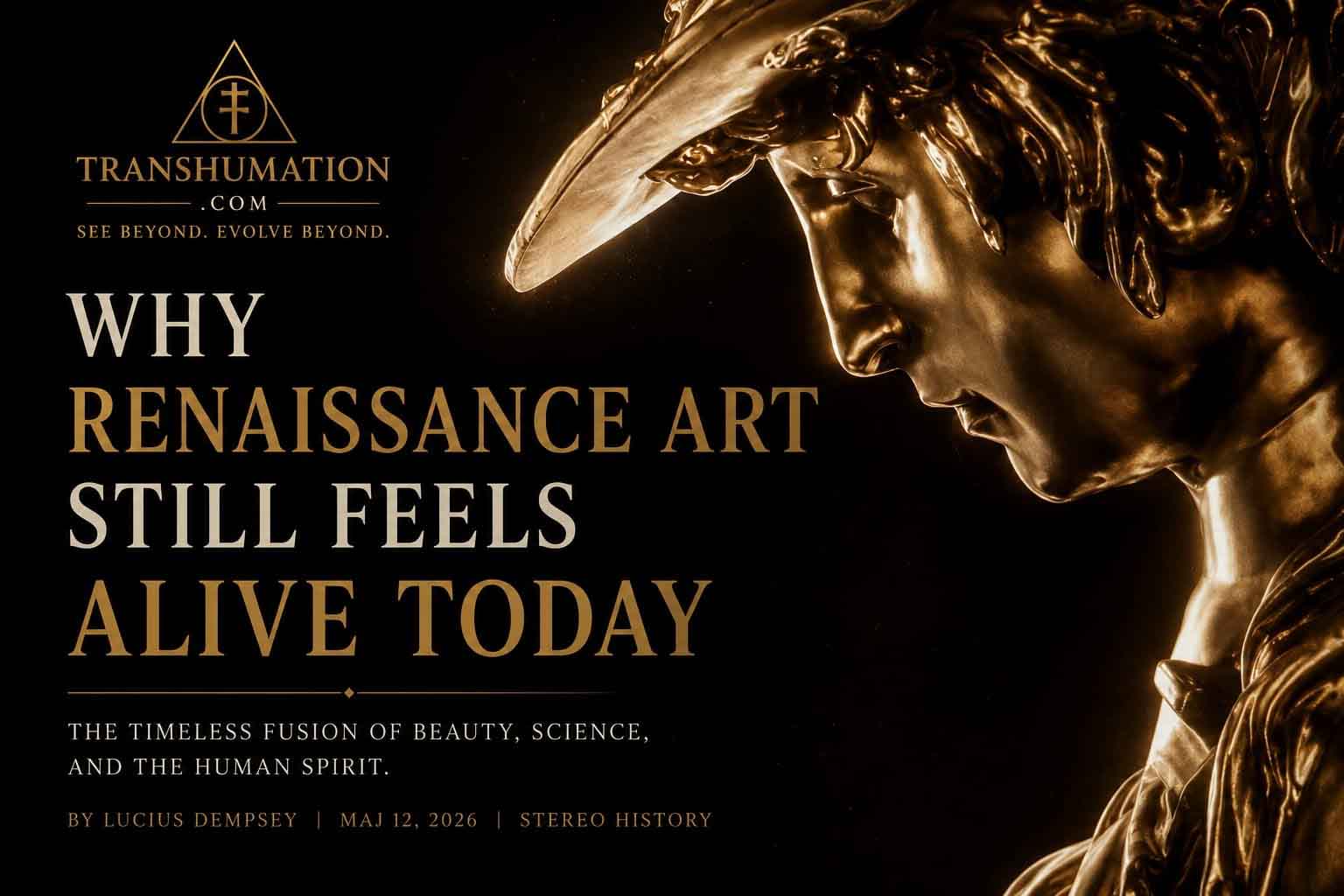
There is a useful word for this role: caretaker.
The caretaker does not need to become the protagonist.
A good curator does not repaint the painting. A librarian does not rewrite the book. A conservator does not improve the sculpture according to contemporary taste. Their value lies partly in restraint.
They protect the conditions in which another structure can remain available.
Patronage adds an earlier stage.
The patron often acts before there is anything to protect.
Money is committed before history supplies proof that the choice was correct. A building begins before anyone knows how future generations will judge it. A manuscript is purchased before anyone can calculate its eventual intellectual influence.
That requires judgment under uncertainty.
And this is where we should resist hindsight.
Cosimo did not possess a catalogue titled Masterpieces of the Italian Renaissance from which he selected works already guaranteed five centuries of prestige. He lived inside an unfinished present filled with competing artists, political interests, religious obligations and financial constraints.
History knows which bets survived.
He did not.
The Banker Who Invested in Time
A financial investment normally attempts to move value forward.
Money is committed now in expectation of greater value later.
Cultural patronage performs a strangely related operation, except that the eventual return may become detached entirely from the original owner.
The Medici Palace outlived Cosimo.
San Marco outlived him.
The manuscripts he helped collect entered intellectual chains he could never have mapped.
Works associated with the artistic world he supported became culturally valuable to societies speaking languages he never heard and inhabiting political orders he could not have imagined.
At some point, private capital crossed into public time.
This is why the best patronage can be interpreted as a form of civilizational engineering.
Not because patrons determine what civilization must admire.
That would be dangerous.
Patronage matters because it alters what receives an opportunity to survive long enough for later people to judge it themselves.
The distinction is subtle.
The patron does not create posterity’s verdict.
The patron helps ensure that there is something left for posterity to judge.
The Renaissance as an Information System
This is where the Renaissance becomes more interesting than a gallery of beautiful objects.
It was also an information environment.
Texts moved.
Manuscripts were copied.
Scholars corresponded.
Greek learning acquired new Western European audiences.
Translations changed access.
Libraries organized collections.
Artists exchanged technical knowledge about perspective, materials, geometry and anatomy.
Buildings created physical spaces in which intellectual and religious communities could operate.
Culture requires circulation.
An isolated manuscript has limited civilizational power.
The same manuscript copied, translated, discussed and placed inside institutions becomes another kind of object entirely.
It enters a network.
Cosimo’s patronage participated in this network not because he personally produced every idea but because money, protection and institutions can reduce the friction preventing ideas from meeting one another.
That is an underrated form of power.
The conqueror expands territory.
The patron sometimes expands what can remain in circulation.
Can Money Be Converted Into Cultural Memory?
Only imperfectly.
Wealth can buy marble.
It cannot guarantee Michelangelo.
It can build libraries.
It cannot guarantee wisdom.
It can finance universities and still produce mediocrity.
Money is an amplifier, not an oracle.
This is another reason patronage deserves scrutiny rather than worship.
The person controlling resources also controls selection.
One artist is financed.
Another is ignored.
One manuscript enters the collection.
Another disappears.
One religious or political worldview receives monumental architecture while another leaves weaker material traces.
The caretaker is therefore never neutral.
Preservation creates a canon partly through omission.
The Medici example illustrates both sides of cultural patronage: the extraordinary power to preserve and the equally extraordinary power to decide what receives the chance to be preserved.
A good library contains treasures.
Its silences have histories too.
The Modern Cosimo Problem
The question survives because our civilization has not solved it.
We have extraordinary systems for producing information and increasingly powerful systems for storing it. Digital media can preserve millions of texts, images and recordings at costs unimaginable to Renaissance collectors.
But abundance creates another problem.
What receives attention?
Which researcher receives ten years to pursue something without obvious commercial return?
Which archive is digitized?
Which endangered language is documented?
Which young artist is given space before the market knows whether their work will sell?
Which scientific problem receives patient funding rather than fashionable funding?
Storage does not eliminate judgment.
It may make judgment more important.
When everything can theoretically be saved, cultural scarcity moves from storage toward attention, interpretation and maintenance.
The twenty-first-century caretaker therefore may not resemble Cosimo.
It may be a foundation.
A research institution.
An archivist.
A curator.
A collector.
A publisher.
A librarian.
Even an algorithm.
But the old question remains:
Who decides what receives enough time to reveal its value?
Watch the Video
How to Read the World
Current Knowledge
Cosimo de’ Medici, known as Cosimo the Elder, was a major Florentine banker, statesman and patron of the fifteenth century. His family’s financial power contributed substantially to his political influence, although Florence remained formally republican and Medici authority operated through complex networks rather than straightforward hereditary kingship.
Cosimo supported major architectural, religious and scholarly projects, including work associated with Michelozzo, the convent of San Marco and manuscript collecting. He was also connected with important humanists and later supported Marsilio Ficino. His patronage formed one part of a much larger Florentine ecosystem that included civic institutions, guilds, religious organizations and other wealthy families.
The Renaissance was not simply a rediscovery of a completely forgotten classical world. Ancient knowledge had survived and circulated through Latin, Byzantine, Islamic and other intellectual traditions. Renaissance humanists nevertheless expanded the recovery, study, translation and circulation of classical texts in significant ways.
Patronage in Renaissance Italy combined cultural, religious, political, familial and reputational motives. Modern distinctions between philanthropy, propaganda, devotion and private consumption do not always map cleanly onto the period.
Cultural preservation depends upon material and institutional infrastructure as well as creative production. Manuscripts require copying and conservation, buildings require maintenance, and artistic careers frequently depend upon economic systems capable of supporting specialized labor.
Open Questions
One unresolved question is how much cultural history has been shaped not by the greatest creators but by the preferences of those controlling resources. We know the works that patrons financed far better than the works that never received the opportunity to exist, making cultural history vulnerable to the same survivor bias found elsewhere.
Another concerns the relationship between private wealth and public inheritance. A work commissioned for dynastic prestige can eventually become part of a shared cultural heritage, but that later value does not erase the political inequalities that made the original commission possible.
Digital civilization creates a new version of the problem. When storage becomes relatively abundant, selection shifts toward algorithms, institutions and attention systems. The future canon may be shaped less by what physically survives than by what remains discoverable.
The deepest question is whether cultural caretaking can ever become neutral. Every decision to fund, preserve, catalog or recommend gives one structure more probability of reaching the future than another. Preservation is therefore also a form of power.
Transhumation Interpretation
For Transhumation, Cosimo represents an important distinction between creating a pattern and creating the conditions that allow a pattern to survive.
Civilization needs both.
The artist produces structure. The caretaker provides time, carrier, protection and access. Neither guarantees immortality, but without the second, many forms of the first never reach another generation.
This is the same principle behind the Library of Mirrors. A library cannot manufacture great ideas simply by storing books. Its deeper task is to maintain the path through which one mind can still encounter another.
The future caretaker may use technologies Cosimo could never have imagined.
The function is older.
Give the valuable thing enough time to prove that it was valuable.
FAQ
Who was Cosimo de’ Medici?
Cosimo de’ Medici was a fifteenth-century Florentine banker, political leader and major patron associated with the rise of Medici influence in Florence.
Did the Medici create the Renaissance?
No. The Renaissance emerged from a much larger cultural ecosystem involving artists, scholars, guilds, religious institutions, merchants, cities and long-running intellectual traditions. Medici patronage was influential but not singularly responsible.
Did Cosimo create famous works of art himself?
No. His historical importance lies partly in financing, protecting and commissioning people and institutions capable of producing and preserving important cultural work.
Why does art need patrons?
Large creative and intellectual projects require resources, time, materials and institutional protection. Patronage can reduce those constraints, although it also gives patrons considerable influence over what gets produced.
Can money really become cultural memory?
Indirectly. Wealth can finance buildings, manuscripts, research, libraries and artistic work that survive long after the original money and motive disappear.
What is the deeper Transhumation question?
The interesting question is not simply who creates civilization.
It is who creates the conditions in which civilization has enough time to survive its creators.
Cosimo’s bank vanished from the economic world that made it powerful. Much of what his money helped place into circulation did not.
That may be the strangest return on capital history can offer: the fortune disappears, while the thing it protected continues earning time.
Continue the Transhumation Series
- Forgotten Religion | Ancient Gods, Symbols and the Hidden Structures of Human Civilization
- The Last Religion | Death, Immortality and the Future of Humanity
- The New Theurgy | AI, Information and the Future of Human Civilization
- End of Branding: You Were Never Meant to Become a Product
- Baal vs Ishtar: Why Ancient Gods Never Disappeared