
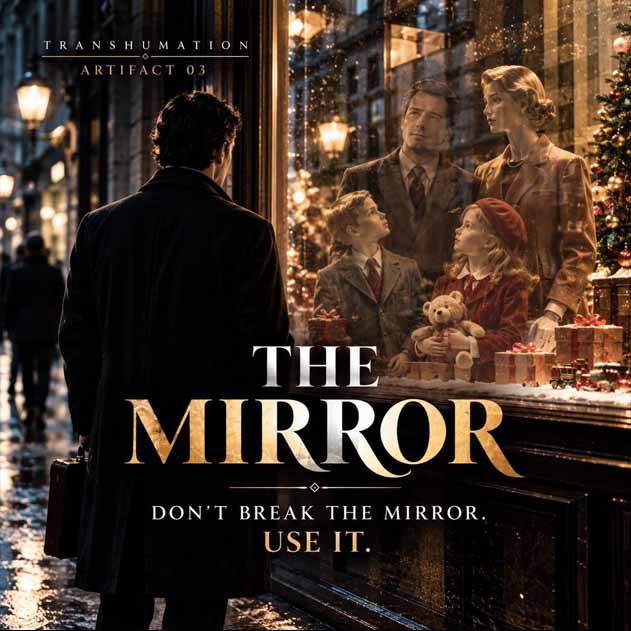
Don’t Break It. Use It.
At 182 centimetres, I have had a longer relationship with mirrors than I would necessarily have chosen. They are particularly informative in hotel bathrooms, where the person who installed one has often made a quiet assumption about where the average human face is likely to be. I have learned to duck. Mirrors, unlike people, have never apologised for this.
This seems fair. The mirror did not decide that I was tall, nor did it establish the category into which my height should fall. It merely returned light from a woman standing in front of it. The judgement — tall, very tall, perhaps inconveniently tall — arrived later, supplied by a world of doorframes, trouser lengths and other people’s shoulders. We often confuse information with the judgement we subsequently attach to it. A mirror is interesting precisely because, at least in its simplest form, it does not know what it is showing. It just shows it.
A Measurement Is Not Yet a Verdict
Imagine a shop window after dark. Behind the glass stands a carefully arranged family of mannequins: two children, a woman, and a male figure whose head has been omitted because the display designer has decided that scarves are this season’s more pressing concern. Outside, a man stops at exactly the right point. His reflection supplies the missing face. For perhaps half a second, he belongs to the family. Move twenty centimetres to the left and he does not.
Nothing mysterious has happened. The glass has combined two sets of information that happen to occupy the same visual plane from one particular position. Yet the effect is powerful because human beings are exceptionally good at turning arrangements into meanings. We see the completed family before we remember that the completion is an accident of geometry. A mirror can reveal something genuinely there and still tempt us to say more than the information permits. That distinction becomes considerably more uncomfortable when the thing being reflected is not a face. It is a choice.
The Expensive Answer
Most of us carry around a fairly detailed description of ourselves. We are kind, reasonably brave, mostly honest and more generous than circumstances usually permit us to demonstrate. This description costs remarkably little to maintain. Then someone leaves a wallet on a table, gives us authority over a person who cannot easily answer back, tells us something confidential that would make an excellent story, or offers an advantage which is not exactly dishonest provided we describe it carefully enough. Now the measurement becomes more expensive.
If I fail one test of courage, have I discovered that I am a coward? If I return one wallet, have I established that I am honest? How many observations are required before behaviour becomes character: one, ten, a hundred? Anyone who likes measurements eventually encounters this irritating problem. The number is often easier to obtain than the meaning of the number. But difficulty of interpretation does not make the measurement worthless. Before the choice, I could tell myself what I would probably do. Afterwards, something exists that did not exist before. Before you chose, there were two possibilities. After you chose, there was information.
Does the Test Reveal You or Change You?
There is an appealing idea that pressure reveals character. Give someone money, authority, fear or an unlocked door and the person underneath will finally emerge. It is appealing partly because it turns life into a laboratory experiment with unusually good lighting. Unfortunately, human beings are not quite so obliging. A decision can reveal a disposition, but making the decision can also alter the person who made it. The first lie may make the second easier. The first refusal may make the second refusal possible. Courage practised repeatedly can become less expensive; cruelty practised repeatedly can become less remarkable.
Suppose yesterday I behaved selfishly. There is information here, and pretending otherwise would be foolish. But moving from I behaved selfishly yesterday to I am a selfish person requires an additional step. We have crossed from observation into classification. Where exactly is that line? I don’t know. I distrust anyone who finds it too quickly.
The Temptation to Break the Instrument
When a measurement is pleasant, we rarely interrogate the instrument with much enthusiasm. A flattering photograph is accepted as competent photography. A successful examination appears remarkably well designed. The bank statement displaying more money than expected seldom provokes a philosophical investigation into the epistemology of accounting. Unpleasant measurements receive more scrutiny.
Sometimes they should. Mirrors distort. Tests can be badly designed. Memories fail. Statistics can conceal as easily as they reveal, and machines can confidently classify people according to categories that should never have been constructed in the first place. “The data says so” is not an argument unless we know what was measured, how it was measured and what conclusions the measurement can legitimately support. But sometimes the instrument is working. The message really was sent. The money really was taken. The promise really was broken. Destroying information about reality does not change the reality that produced it. Breaking the mirror only produces smaller mirrors.
The Distance Between “Was” and “Am”
There are two bad ways to respond to an unpleasant reflection. The first is to insist that the person in the glass cannot possibly be us. The second is to decide that the person in the glass is everything we will ever be. Both mistakes confuse a measurement with something larger. That wasn’t me throws away information. That is me may throw away something equally important: time.
Human beings remember, practise, regret, rationalise, learn and occasionally surprise themselves. Today’s measurement becomes part of the conditions under which tomorrow’s measurement will be made. A more useful response is also a less dramatic one: yes, I did that. The sentence neither acquits nor condemns. It preserves the observation long enough to learn from it. Perhaps self-knowledge is not discovering a secret permanent identity, but gradually accumulating better measurements. Short proof. Long consequence.

The Problem With a Perfect Mirror
Suppose we improved the instrument. Not a little, but absurdly. Imagine a mirror that remembered every choice you had ever made, every promise kept, every promise broken, every hesitation before an answer, every purchase, every search, every road taken when another road remained available. It would know more about your behaviour than your friends, your family and eventually your own memory. We are already building crude versions of such a thing. Phones, accounts, cameras and databases retain fragments that previous generations could misplace, forget or quietly revise.
Would the better mirror know you better? Only if we decide what better means. A million accurate observations do not automatically produce the correct interpretation of the person who generated them. Precision can reduce uncertainty about what happened while leaving the larger question untouched. The perfect record of a life would still require someone — or something — to decide which events mattered, how they should be weighted and when an old measurement stopped describing the current object. More data can sharpen the reflection. It cannot abolish the problem of the frame.
What the Mirror Cannot Measure
This is where measurement reaches one of its useful borders. A mirror can tell me that I am taller than the frame in which somebody expected my face to appear. It cannot tell me whether being tall is good. A record can establish that I broke a promise. It cannot, by itself, calculate the meaning of forgiveness. A behavioural model may identify a pattern with extraordinary accuracy and still remain silent about whether I ought to continue it.
There is a temptation to treat every increase in resolution as an increase in wisdom. The two are not identical. A microscope can make a surface more exact without telling us what the object is for. A map can become more detailed without choosing the destination. The interesting threshold appears when description becomes instruction: when this is what you did quietly turns into this is who you are, and then into this is what you will do. Those are three different claims. We should notice when we cross from one to the next.
The Mirror at the Crossroads
There is a final limitation to every mirror. However accurate it becomes, it cannot provide instructions. It can show the tired face, but not whether to continue. It can preserve evidence of the bad decision without determining the next one. It can reveal a pattern without proving that the pattern must continue. Even the most perfect record of everything you have ever done would still describe a history rather than issue a command.
That distinction matters more as our mirrors improve. A photograph remembers one instant. A bank account remembers transactions. A phone remembers locations, searches, conversations and choices. Increasingly, the world around us can preserve fragments of behaviour that previous generations could lose, misremember or quietly revise. We are building mirrors with very long memories. The temptation will be to ask them who we are. I suspect that is the wrong question.
A mirror can tell us something about the person who arrived here. It cannot decide who leaves. Don’t break the mirror. Use it. Because a good mirror does not tell you which road to take. It shows you who arrived at the crossroads. The road will do the rest.
— Alistair Brightworthton

How to Read the World
Current Knowledge
Human behaviour cannot be reduced cleanly to either fixed character or circumstance. Personality shows meaningful stability, while context, incentives, social pressure, learning and previous behaviour can substantially affect what a person does. A real choice therefore contains information about the chooser, but interpreting that information requires caution. One observation is evidence; it is not necessarily a definition.
The same caution applies to technological mirrors. Records, photographs, behavioural data and algorithmic systems can preserve information that memory loses, but preservation does not guarantee interpretation. The more precisely we can measure a person, the more important it becomes to distinguish the measurement from the conclusions built upon it.
Open Questions
How many choices are required before we are justified in calling something character? Does repetition merely provide stronger evidence of an existing disposition, or does repeated behaviour construct the disposition itself? If an action taken under fear differs from an action taken in comfort, which one tells us more about the person — or is the demand for a single “true” person already the mistake?
As machines acquire longer and more detailed records of our behaviour, they may eventually remember our previous choices better than we do. Whether that makes them better mirrors depends on something we have not solved: how much of a human being can be inferred from a record of what that human being has done?
Transhumation Interpretation
The mirror is useful to Transhumation because the important thing is not the glass. Glass is only the carrier. What matters is the relationship between a structure and information capable of describing that structure.
Choice creates an especially interesting case. Before a decision, several futures remain available as possibilities. After it, the world contains a record — perhaps physical, perhaps remembered, perhaps only causal — that one possibility became an event. Destroying a particular carrier can erase a photograph, file or reflection, but it does not automatically erase the structure of events that produced the information.
Artifact 03 therefore introduces a subtle change in the series. The sphere asked us to look at structure. The MP3 asked how much of a carrier could disappear while something recognisable survived. The mirror turns the experiment toward the observer. For the first time, the object on the table may not be the most interesting object in the room. You are.
WHAT DID YOUR LAST CHOICE REVEAL ABOUT YOU?
FAQ
Do choices reveal character?
They can provide evidence about dispositions, but a single choice does not necessarily define a person. Behaviour reflects both relatively stable traits and changing circumstances, incentives, habits and learning.
Can one bad decision tell you who you really are?
Not by itself. It tells you something real about what you did under particular conditions. Moving from an action to a permanent identity is an additional interpretation that requires more evidence.
Does destroying evidence undo a choice?
No. Destroying a photograph, message or record can remove information about an event, but it does not reverse the event that produced the record.
Can data become a perfect mirror of a person?
More data can improve the description of behaviour, but description and interpretation remain different problems. A complete behavioural record would still require decisions about relevance, context and meaning.
Can past behaviour predict future behaviour?
Past behaviour can contain predictive information, but people also learn, change environments, form new habits and respond differently to new circumstances. A pattern is evidence, not a command.
What is the deeper Transhumation question?
If our lives are increasingly preserved as information, when does a record stop being a description of what we did and begin to function as an interface that shapes what we are allowed, expected or predicted to do next?
Continue the Transhumation Series
- Forgotten Religion | Ancient Gods, Symbols and the Hidden Structures of Human Civilization
- The Last Religion | Death, Immortality and the Future of Humanity
- The New Theurgy | AI, Information and the Future of Human Civilization
- End of Branding: You Were Never Meant to Become a Product
- Baal vs Ishtar: Why Ancient Gods Never Disappeared