
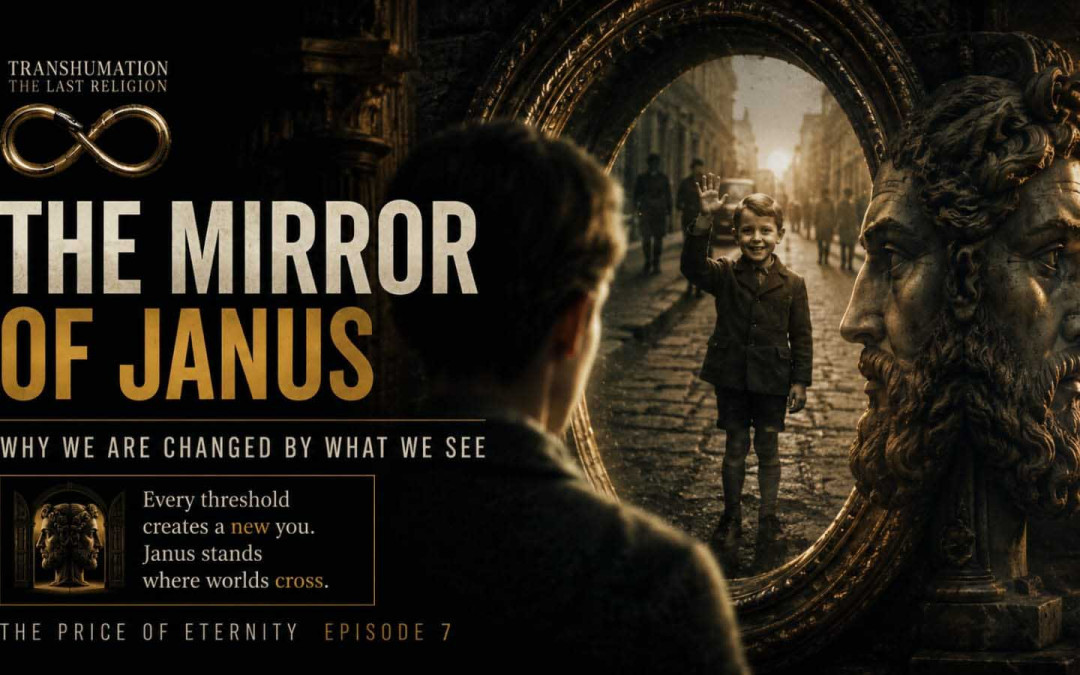
The Mirror of Time
A mirror is one of the few objects in a room that immediately turns the room back toward its observer.
A chair does not care who approaches it. A window shows what lies beyond. A painting contains an image selected by someone else. The mirror does something more unsettling: it includes you in the world you were already looking at.
Nothing metaphysical has happened. Light has been reflected. Your nervous system interprets the image. The face in front of you is not another consciousness and the glass has learned nothing about you.
Yet the informational situation has changed.
A moment earlier you occupied the room.
Now you can also inspect the person occupying it.
You straighten a collar. Notice fatigue. Discover that an expression feels different from the one you imagined you were making. You become aware, however briefly, that the self experienced from within and the person visible from outside are not exactly the same object.
That small gap may be one of civilization’s most productive spaces.
Human beings repeatedly build devices, rituals and representations that allow them to encounter themselves from another angle.
The mirror is simply the most literal.
Janus gives us another.
One shows the face.
The other gives us the doorway.
Between them appears a question larger than either symbol:
What happens when information about ourselves returns to us strongly enough that we cannot go back to being who we were before we saw it?
Who Was Janus?
Janus was one of the most distinctive gods of Roman religion.
He was associated with beginnings, passages, gateways, transitions and endings. His double-faced representation made him an especially powerful figure for moments that belong simultaneously to what has been left and what has not yet fully arrived.
It is tempting to make him more modern than he was.
One face looks at the past, the other at the future. Therefore, we might say, Janus understood psychological transformation, information theory and the recursive self.
He did not.
That would be our mythology placed inside his.
But his symbolic position remains useful.
Janus belongs to the threshold.
A doorway is not simply a place between two rooms. It is a structure through which one state becomes another. Outside becomes inside. Guest becomes entrant. Departure becomes journey. One year becomes the next.
The threshold matters because there is a before and an after.
That is why Janus survives so easily as metaphor.
He represents one of the oldest structural problems humans encounter: the moment when continuity contains change.
You cross the door as the same organism.
Something about your situation is no longer the same.
Why Do Mirrors Change the Way We See Ourselves?
A mirror does not tell us who we are.
It gives us data.
That distinction matters.
The face in the glass does not contain character, biography or intention. It shows a limited optical surface. Yet human beings are extraordinarily skilled at attaching interpretation to surfaces.
We read exhaustion into the eyes.
Age into the skin.
Confidence into posture.
We compare what appears with an internal model of what we expected to appear.
This makes the mirror less like a simple picture and more like a feedback device.
You act.
The mirror returns information.
You update.
The process repeats.
In this sense, mirrors belong to the same broad family as scales, photographs, recordings and dashboards. They externalize information about a system and return that information to the system capable of changing itself.
The important thing is not that the reflection is profound.
Most reflections are trivial.
The important thing is that self-observation can become causal.
You see yourself and behave differently because you saw.
That structure becomes much larger once we leave the bathroom mirror.
A person reads an old diary and recognizes a version of themselves they no longer endorse.
A company sees data showing that its customers behave differently from what executives assumed.
A country encounters archival evidence that complicates the story it tells about itself.
A civilization sees Earth photographed from space and discovers that an abstraction has acquired a visible form.
The mirror is not always glass.
Sometimes the mirror is evidence.
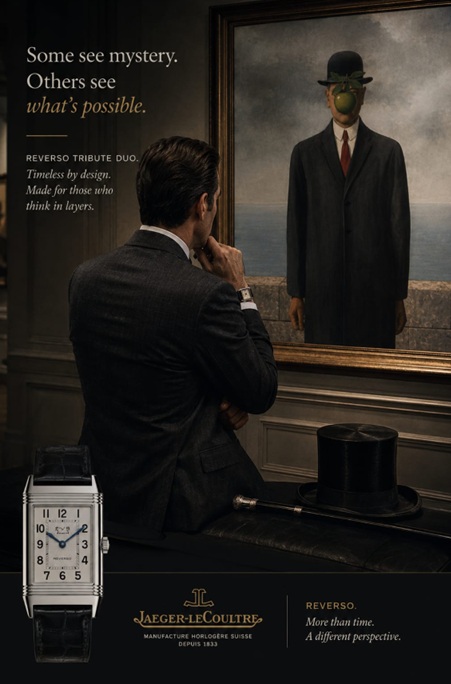
What Is a Threshold Experience?
Human cultures repeatedly mark transitions because transitions can be socially ambiguous.
Child becomes adult.
Student becomes graduate.
Civilian becomes soldier.
Two individuals become spouses.
A person dies and the community must reorganize around an absence.
Anthropology has long examined rites of passage and the transitional states surrounding them. The details vary enormously across cultures, and it would be wrong to reduce every ritual to one universal hidden template.
Still, a broad pattern recurs often enough to be useful.
There is a prior status.
There is a passage.
There is a recognized new status.
Ceremony can make that passage visible to both the participant and the group.
This is where Janus becomes more interesting than simple symbolism.
A threshold is not merely a line.
It is a social technology for handling change.
Graduation does not magically create knowledge.
Marriage ceremony does not manufacture love.
A funeral does not create death.
But each can make a changed condition publicly legible.
The person crossing the threshold may remain biologically continuous while their relationships to institutions and other people change.
Civilization has always needed ways to say:
After this, treat something differently.
Can Information Permanently Change Identity?
Sometimes, although we should be precise about what “permanently” means.
A piece of information does not always transform us.
Most information disappears almost immediately.
We forget headlines, conversations, images, instructions and names.
But some information modifies the model through which later information is interpreted.
Discover that someone betrayed you and earlier memories may be reorganized.
Learn that a diagnosis is serious and an ordinary calendar may suddenly acquire different weight.
Read a book at the right moment and an entire category of experience may become visible where previously there was only confusion.
The information has not necessarily changed the body dramatically.
It has changed the frame.
And once a frame changes, returning to the earlier interpretation can become psychologically difficult or impossible.
This is one reason knowledge is not always additive.
Sometimes one fact does not sit beside previous facts.
It rearranges them.
A child can learn that adults are fallible.
A citizen can discover that an institution they trusted behaved differently from what they were taught.
A scientist can encounter evidence that makes an elegant theory untenable.
A person can learn something about themselves that transforms the meaning of years already lived.
The past has not changed.
The model of the past has.
This is a Janus moment.
One face still has access to the world before the information arrived.
The other can no longer live there.
The Mirror Is Not a Gate
At least, not literally.
This is where the metaphor needs discipline.
A mirror does not transport anyone.
It does not create another realm behind the glass.
It does not reveal a hidden spiritual self.
The usefulness of the metaphor lies elsewhere.
A mirror can become a threshold in interpretation.
Before looking, you possess one model.
After looking, you possess additional information.
Usually nothing important happens.
Sometimes the new information is strong enough to alter the model permanently.
The gate is therefore not inside the mirror.
It is inside the observer.
That is a better fit for Transhumation because it preserves the distinction between carrier and effect.
Glass carries the image.
The nervous system interprets it.
The person changes.
Different layers.
Different functions.
The mirror matters only because one layer can affect another.
Why Do Old Films Feel Alive?
Old film produces one of the most emotionally convincing versions of this effect.
A child from 1905 looks toward a camera.
A worker pauses.
Someone waves.
A woman laughs at something outside the frame.
For a moment, the distance of a century can seem to collapse.
The temptation is to say that they are looking at us.
They are not.
They looked at a lens, a camera operator or someone standing near the machine.
The recording preserved an optical trace of that event.
We are the later recipients.
And yet the emotional effect remains powerful because the human perceptual system responds strongly to faces, gaze, movement and social cues. The information is old. The perception of presence is immediate.
This creates a peculiar form of temporal asymmetry.
The person in the film knew nothing about us.
We know that the person is dead.
They cannot alter the recording.
They cannot respond if we wave back.
But their recorded expression can still alter us.
A one-way encounter becomes psychologically reciprocal even though it is not actually reciprocal.
That is why historical media are such powerful mirrors.
We think we are inspecting the past.
Then the past activates something in the present observer.
Not because history has become conscious.
Because the surviving pattern is still capable of producing a human response.
The Eyes That Return
This is where representation begins to approach the problem of presence.
A painted portrait preserves selected appearance.
Photography preserves an optical trace.
Film preserves movement and sound.
Digital media allow reproduction at extraordinary scale.
Generative systems add something new: response.
A historical recording cannot answer a new question.
A generative system built around historical material can produce one.
That changes the structure of the mirror.
For most of history, representation remained passive.
You looked.
The image remained unchanged.
Now representation can increasingly react to the observer.
Ask.
Receive an answer.
Change the question.
Receive another answer.
This does not prove the representation possesses consciousness.
It means the mirror has acquired behavior.
That may become one of the defining cultural problems of the coming decades.
Humans are accustomed to using responsiveness as a sign of presence.
A person looks back.
A person answers.
A person adapts.
Generative systems can reproduce several of those signals without establishing that an experiencing subject exists behind them.
The mirror begins talking back.
The philosophical danger begins when we assume that because it talks, someone must be inside.
Is AI a Mirror of Humanity?
Only metaphorically, and even then imperfectly.
AI systems are trained on human-produced data, shaped by human objectives, institutional choices, technical constraints and the statistical structure of their training process. They can reproduce patterns found across culture and generate combinations no single person explicitly wrote.
This makes them fascinating cultural reflectors.
Ask enough questions and you encounter our language, our clichés, our disagreements, our prejudices, our knowledge and the gaps in what was recorded.
But AI is not a neutral mirror.
Training data are selective.
Optimization changes outputs.
System design influences behavior.
A mirror made from civilization’s archive is still manufactured.
This matters because a distorted mirror can teach us something about ourselves while also creating new distortions.
AI may therefore become less like a bathroom mirror and more like a museum assembled by an invisible curator.
We see humanity reflected.
But someone—or some process—has selected the room, arranged the lighting and decided what the mirror can reach.
That does not make the reflection useless.
It makes provenance essential.
The Janus Moment
Some experiences divide a biography.
Before the diagnosis.
After the diagnosis.
Before meeting someone.
After.
Before understanding a historical fact.
After.
Before seeing the photograph.
After.
The phrase “there is no going back” can sound melodramatic, but cognitively it points toward something real.
Knowledge cannot always be voluntarily unlearned.
You can attempt to ignore it.
You can reinterpret it.
You can deny its implications.
But you cannot recreate the exact state of not having encountered it.
The original ignorance has disappeared as a lived position.
This is why information can operate as a threshold.
The physical event may last seconds.
Its consequences become integrated into every later version of the model.
Janus gives us a useful symbolic position from which to view this.
One face looks toward the person who had not yet crossed.
The other belongs to the person who now knows.
The organism remains continuous.
The informational world has changed.
Technology and the Larger Mirror
Every major medium has expanded the scale on which humans can encounter representations of themselves.
Portraiture allowed identity to outlive an encounter.
Photography increased fidelity.
Cinema preserved movement.
Television synchronized audiences.
The internet turned representation into a network.
Social media made self-representation continuous.
Artificial intelligence now adds interpretation and response.
It would be too simple to call this one inevitable ladder.
Each medium preserved different things and lost others.
Photography did not replace painting.
Film did not make literature obsolete.
AI will not convert every earlier form into an inferior stage.
But something cumulative is happening.
Civilization has built increasingly complex systems for observing itself.
That observation is not passive.
Metrics change behavior.
Cameras change performance.
Public profiles change self-presentation.
Algorithms change what becomes visible.
AI-generated summaries may change how institutions understand their own archives.
The mirror does not merely show the system.
The system starts adapting to what the mirror shows.
At that point the mirror becomes part of the causal loop.
When the Reflection Starts Choosing
There is a further threshold.
A mirror reflects.
An algorithm selects.
An AI agent may eventually act.
Suppose a system does not simply show you your habits but recommends which ones to change. Then suppose it begins reorganizing your schedule automatically. Then it anticipates decisions before you consciously formulate them.
The mirror has crossed into guidance.
This is where Janus returns in a more modern form.
Not as ancient prophecy.
As a useful distinction.
At what point does a representation of the self become an interface through which the self is actively modified?
A fitness tracker begins as measurement.
Then comes advice.
Then adaptive planning.
A digital assistant begins as search.
Then memory.
Then coordination.
Eventually the system may participate in decisions closely enough that the user no longer experiences it as something entirely external.
This is not proof of an extended conscious self.
It is evidence that feedback can become architecture.
The thing that shows us who we are can increasingly participate in deciding who we become.
Watch The Video
How to Read the World
Current Knowledge
Janus was a Roman deity associated particularly with beginnings, gateways, passages and transitions. His double-faced representation has made him a durable symbol of looking in more than one direction, although modern associations with psychological self-reflection should be treated as later interpretation rather than ancient doctrine.
Mirrors and other reflective surfaces provide visual information about one’s own body, but they do not literally create a second observer. Their psychological importance comes from self-recognition, feedback and the ability to compare internal expectations with external appearance.
Rites of passage occur in many societies and can mark transitions between social statuses. Their forms and meanings vary substantially, so similarities should not be treated as evidence of one universal ritual code.
Historical photographs and films preserve traces of past appearances and behavior. They can create strong feelings of presence in modern viewers, but the people represented are not consciously perceiving or responding to the contemporary audience.
AI systems can produce interactive responses from cultural and personal data, but responsiveness does not establish consciousness or personal presence. Generated output remains distinct from original testimony.
Open Questions
One major question concerns self-observation. As digital systems produce increasingly detailed models of people’s behavior, will individuals gain better self-knowledge or become overly dependent on external representations of themselves?
Another concerns historical media. Generative reconstruction may make the past more accessible while simultaneously making the boundary between authentic trace and synthetic continuation harder to perceive.
AI introduces a deeper problem because representations can now respond. Human beings evolved in social environments where adaptive response usually came from other living agents. We do not yet know how persistent interaction with synthetic responders will reshape intuitions about presence, agency and relationship.
The deepest question concerns feedback. At what point does a system that models us, advises us and acts on our behalf cease to be merely a mirror and become part of the architecture through which identity is formed?
Transhumation Interpretation
For Transhumation, Janus is useful not as an ancient prophet of technology but as a symbol of the threshold.
The mirror supplies the second half of the model.
A threshold changes our position.
A mirror changes the information available about that position.
Combined carefully, they describe a powerful human process: we cross, we look back, and what we see alters the person who continues forward.
The future mirror may be interactive.
That makes one distinction increasingly important:
Does the system merely reflect us, or has it begun helping decide what we become?
FAQ
Who was Janus?
Janus was a Roman god associated with beginnings, gateways, passages and transitions. His double-faced representation became a powerful image of looking in more than one direction.
Why connect Janus with a mirror?
The connection is a modern philosophical metaphor, not an ancient Roman doctrine. Janus represents the threshold; the mirror represents self-observation.
Why can mirrors affect identity?
Because seeing ourselves provides external information that can modify our internal model of ourselves. The mirror does not create identity, but feedback can influence it.
Why do old films sometimes feel as though the dead are looking at us?
Human perception strongly responds to faces, gaze and movement. The recording preserves a trace of someone looking toward a camera, and our brain interprets that trace socially even though no reciprocal perception exists.
Is AI a mirror of humanity?
Partly, but not a neutral one. AI reflects patterns in human-produced data through systems shaped by training methods, objectives and design choices.
What is the deeper Transhumation question?
The deepest question is not whether mirrors reveal reality.
They reveal only one representation of it.
The interesting question is what happens when the representation returns strongly enough to change the original.
A person looks into glass and adjusts their appearance.
A society studies its history and rewrites its institutions.
A civilization builds AI from its own cultural archive and then begins using that AI to interpret the archive back to itself.
At that point reflection becomes recursive.
Humanity creates the mirror.
The mirror changes humanity.
Janus stands at the useful symbolic point between the two—not because Rome predicted artificial intelligence, but because thresholds always contain the same uncomfortable fact:
the person who crosses can still remember the person who stood on the other side.
But cannot completely become them again.
That may be the real Mirror of Janus.
Not an object that shows us who we are.
An interface that reveals when we have already become someone else.
Continue the Transhumation Series
- Forgotten Religion | Ancient Gods, Symbols and the Hidden Structures of Human Civilization
- The Last Religion | Death, Immortality and the Future of Humanity
- The New Theurgy | AI, Information and the Future of Human Civilization
- End of Branding: You Were Never Meant to Become a Product
- Baal vs Ishtar: Why Ancient Gods Never Disappeared