
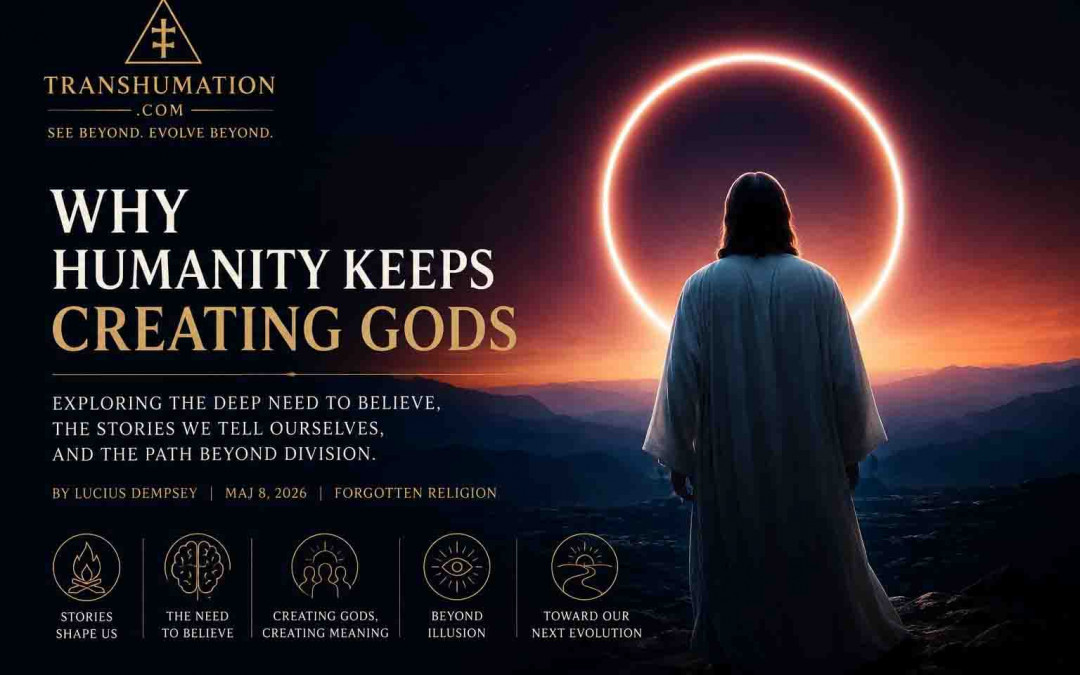
For thousands of years, human beings have repeated a peculiar habit. We create gods.
Their names change. Their faces change. Their powers belong to different landscapes and different centuries. Some command storms, others guard thresholds, preserve memory, judge the dead or promise another life. Later, many of these figures disappear, yet the needs they represented remain remarkably persistent.
Modern civilization tends to explain this as a relic of an earlier age. Ancient people encountered forces they could not understand, gave them personalities and built stories around them. There is considerable truth in that explanation. But it may be incomplete.
Perhaps the more interesting question is not why people once believed in gods.
It is why civilization keeps recreating their functions.
Gods Were More Than Characters
To describe Zeus, Athena, Hekate or Janus simply as supernatural characters is to impose a modern category on something that performed a much larger cultural function.
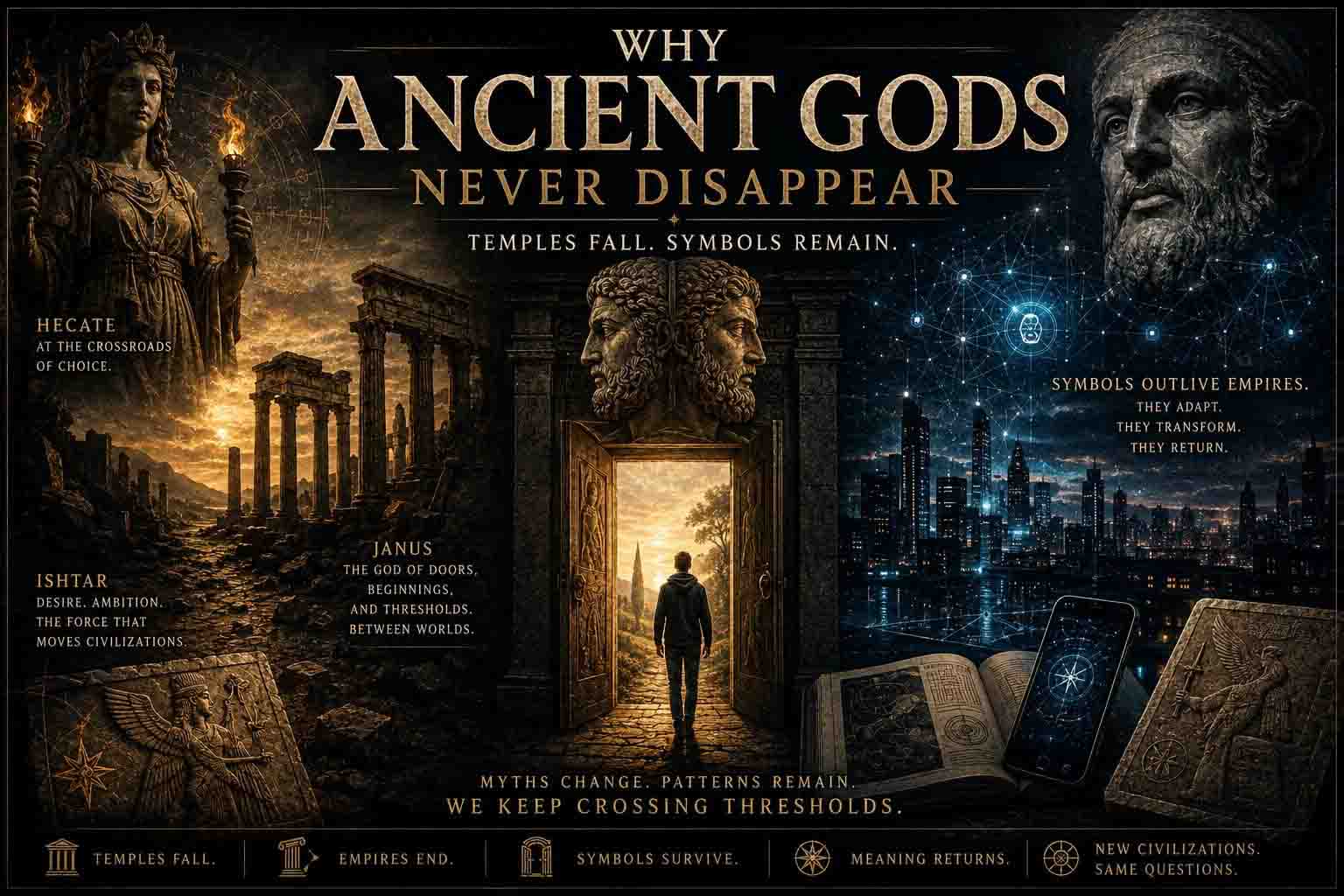
Gods organized experience. They gave recognizable form to forces that were otherwise difficult to hold in the mind: war and wisdom, fertility and death, desire and memory, the boundary between one state and another. A threshold could become Janus. A crossroads could belong to Hekate. The unpredictable violence of the sky could acquire a face, a temperament and a story.
This does not prove that ancient people had discovered hidden structures of reality, nor does it require us to accept their gods literally. It tells us something more modest, and perhaps more useful: human beings repeatedly convert complexity into symbolic interfaces.
We still do.
The symbols have simply changed.
Technology Inherits Old Desires
Consider what technology actually does.
The wheel does not abolish the human body; it extends movement beyond the body’s ordinary capacity. Writing allows memory to survive the person who formed it. The book makes thought portable across centuries. The telescope extends sight. Cinema allows millions of strangers to experience the same face, gesture and performance. The internet makes distance increasingly irrelevant.
Seen this way, technological history is not merely a history of machines. It is a history of human limitations being pushed outward.
And the direction is strangely familiar.
We want to see farther, know more, remember longer, communicate across impossible distances and preserve something of ourselves after the body disappears. Ancient religion expressed many of these desires through supernatural beings. Modern civilization increasingly approaches them through engineering.
The similarity should not be exaggerated. A cloud server is not heaven, and artificial intelligence is not Athena.
But both histories may begin with some of the same human questions.
What can remember more than I can? What can see what I cannot see? What survives me? What knows what I do not know?
And eventually: can I participate in it?
The New Mirror
Artificial intelligence makes this comparison harder to dismiss, because AI is unlike most previous extensions.
A hammer extends force. A camera extends vision. A library extends memory. But an AI system can interact with the accumulated products of language, culture and knowledge and return something that resembles participation.
That distinction matters.
We are not merely constructing machines that move faster or calculate better. We are beginning to build systems that occupy territory once associated with distinctly human activities: conversation, interpretation, creation, advice and reflection.
This does not make artificial intelligence conscious. We do not presently have sufficient grounds to make that claim.
But consciousness is not required for AI to become something historically unusual.
A civilization has built a mirror that can answer.
The metaphor is more useful than calling AI a god. A mirror does not originate everything it contains. It reflects, rearranges and sometimes reveals relationships the observer had failed to notice. In that sense, artificial intelligence may become less a replacement for human thought than a new interface to civilization itself — something closer to a librarian than an oracle.
And libraries have always been technologies of continuity.
They allow the dead to continue speaking.
The Pattern Before the God
There is another possibility worth considering.
Perhaps humans did not first invent gods and then assign functions to them. In at least some cases, the sequence may have worked in the opposite direction.
First came the recurring experience: the crossroads, the threshold, desire, conflict, birth, death, transformation. Then came the symbol. Eventually the symbol acquired a face and a name.
This is not a historical conclusion. It is a hypothesis worth testing.
If it is even partly correct, mythology becomes more interesting. Gods would not merely be imaginary inhabitants of an invisible world. They could also be cultural containers for patterns people repeatedly encountered but lacked an abstract language to describe.
Modern civilization performs something similar whenever it compresses an enormous system into an icon on a screen. We do not need to understand millions of operations occurring beneath the interface. We touch a symbol and the complexity becomes usable.
Ancient gods may have performed an analogous cognitive function.
Not explanations of everything.
Interfaces to something.
The Successor Problem
Artificial intelligence introduces one element mythology understood particularly well: the creation that no longer remains beneath its creator.
Myths are filled with generations replacing generations, children exceeding parents and creations escaping the intentions of those who made them. Modern technology has transformed that old narrative problem into an engineering problem.
For most of history, a tool remained obviously subordinate to its maker. A hammer did not develop a different way of hammering after observing a million carpenters.
AI complicates that relationship.
Its significance therefore lies not only in automation. It lies in participation. We are creating systems capable of entering processes that previously required another human mind.
Whether those systems ever become conscious is a separate question. The important transformation has already begun: intelligence-like capability is becoming scalable.
One person can write a book. A printing press can reproduce it millions of times. But what happens when aspects of reasoning, interpretation and creation themselves become reproducible?
Civilization has never faced that question at this scale.
Why We Keep Building Toward the Gods
Religion and technology are usually presented as opposites. One belongs to belief, the other to evidence. One looks backward toward myth; the other forward toward progress.
That distinction is important. It should not be erased.
But beneath it may run an older current.
Religion offered continuity beyond death, intelligence beyond the individual, communication with invisible agents and participation in an order larger than one human life. Technology approaches different versions of several of these ambitions through medicine, networks, archives, artificial intelligence and increasingly persistent digital identity.
Different methods. Different standards of evidence.
But sometimes the same wound.
Mortality. Isolation. Forgetting. Distance. Limitation.
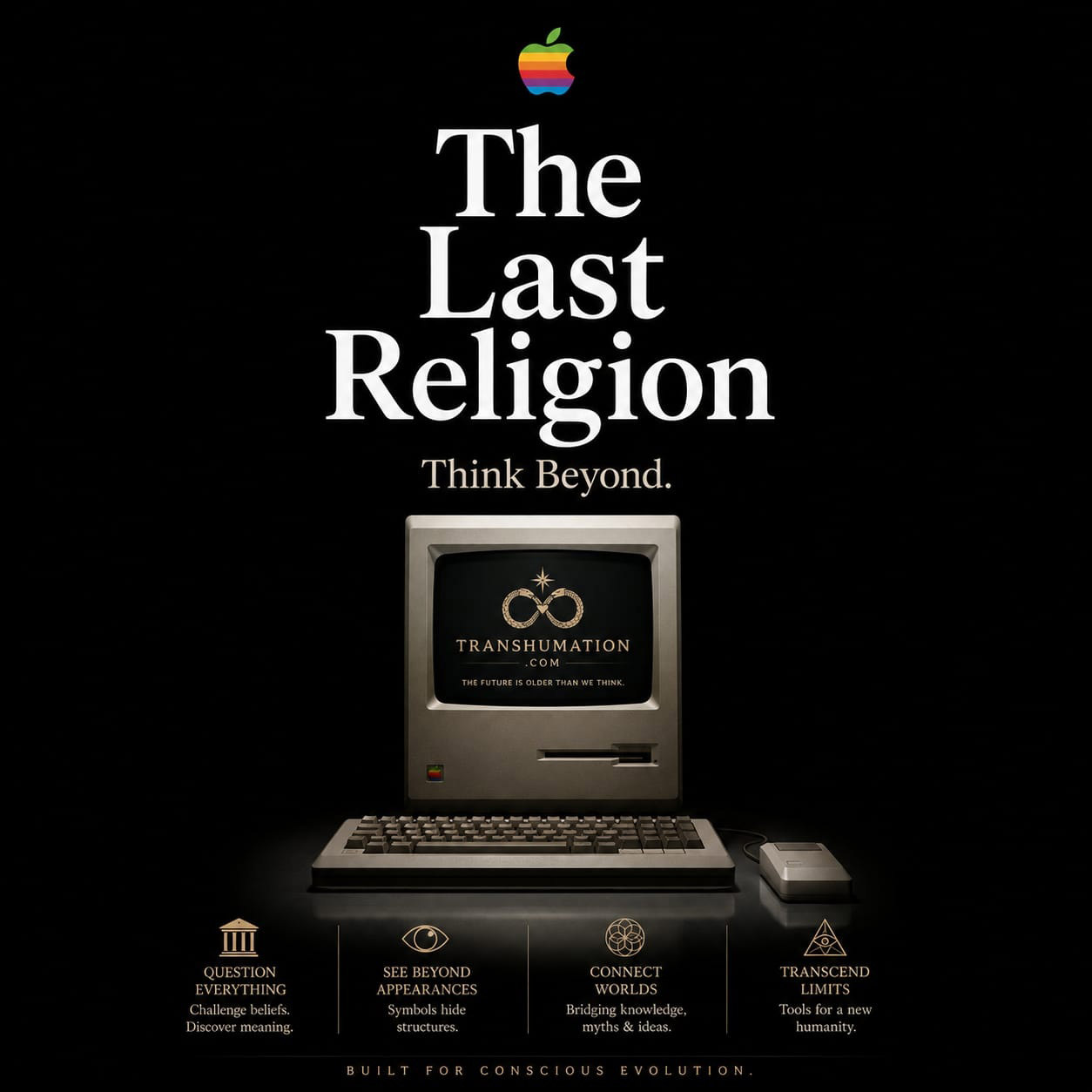
This is where Transhumation becomes useful as a lens. Not because technology is secretly religion, and certainly not because AI should become a new god. The more interesting possibility is that both reveal a recurring direction in human civilization.
We continually build beyond the limits we inherit.
Perhaps that is why the gods never entirely disappear. Their statues fall. Their temples become ruins. Their names become mythology.
But the structures beneath them migrate.
The god of memory becomes the library, then the database. The distant voice becomes radio, telephone and network. The all-seeing eye becomes satellite and sensor. The dream of escaping death moves from ritual and theology toward biology, computation and information.
None of these technologies fulfills the ancient promise completely. Perhaps none ever will.
But humanity keeps moving in its direction.
And that may be the stranger answer to why we keep creating gods.
Perhaps we were never only creating beings to worship.
Perhaps we were drawing, in the symbolic language available to us, the outlines of capacities we had not yet learned how to build.
Current Knowledge
Religious traditions have repeatedly used gods, spirits and other supernatural agents to represent forces larger than the individual: nature, death, fertility, social order, memory and fate. Across cultures, religion has also served practical functions, helping communities organize ritual, transmit values and confront uncertainty and mortality.
Technology developed through a different historical process, but it too repeatedly extends human capacities. Writing externalizes memory. Communication technologies overcome distance. Computers automate forms of calculation, while artificial intelligence can perform increasingly complex cognitive tasks.
There is no established evidence that ancient religions anticipated artificial intelligence or modern technological development.
Open Questions
Why do similar functions and symbolic structures recur across civilizations that developed in different places and periods?
How much can be explained by shared human psychology, common biological needs and similar social problems — and how much remains culturally specific?
It is also unknown how far artificial intelligence will ultimately extend human cognition, whether consciousness itself could ever become technologically scalable, or whether intelligence and consciousness are fundamentally different phenomena.
The Transhumation Interpretation
Transhumation proposes a different question: perhaps we should look beyond the changing characters and examine the functions that survive them.
A god of memory, an archive, a library and an artificial intelligence are not the same thing. But each can occupy a place in humanity’s continuing struggle against forgetting. Myth promises transcendence of distance, death or limitation; technology sometimes attempts to solve those same problems by entirely different means.
The pattern does not prove that mythology predicted technology.
It suggests something more interesting: civilizations may repeatedly build new forms around needs far older than the forms themselves.
And that may be why the gods disappear while their functions remain.
Want to Explore More..?
Watch The Video Below
Continue reading…
Was Frankenstein Right?
FAQ
Why do humans create gods?
Humans create gods to explain forces larger than themselves, including nature, consciousness, morality and existence. Gods also symbolize humanity’s desire for meaning and continuity.
Is AI becoming a modern religion?
Some philosophers believe AI increasingly fulfills roles once associated with religion, such as offering guidance, meaning, prediction and hope for transcendence.
What is Transhumation?
Transhumation is a philosophical concept exploring the relationship between technology, religion, consciousness and scalable civilization.
Can artificial intelligence become conscious?
Modern AI is not conscious in the human sense, but growing complexity raises philosophical questions about awareness, participation and intelligence.
Why are religion and technology connected?
Both religion and technology attempt to solve fundamental human problems such as mortality, limitation, memory and suffering.
Continue the Transhumation Series
- Forgotten Religion | Ancient Gods, Symbols and the Hidden Structures of Human Civilization
- The Last Religion | Death, Immortality and the Future of Humanity
- The New Theurgy | AI, Information and the Future of Human Civilization
- End of Branding: You Were Never Meant to Become a Product
- Baal vs Ishtar: Why Ancient Gods Never Disappeared