
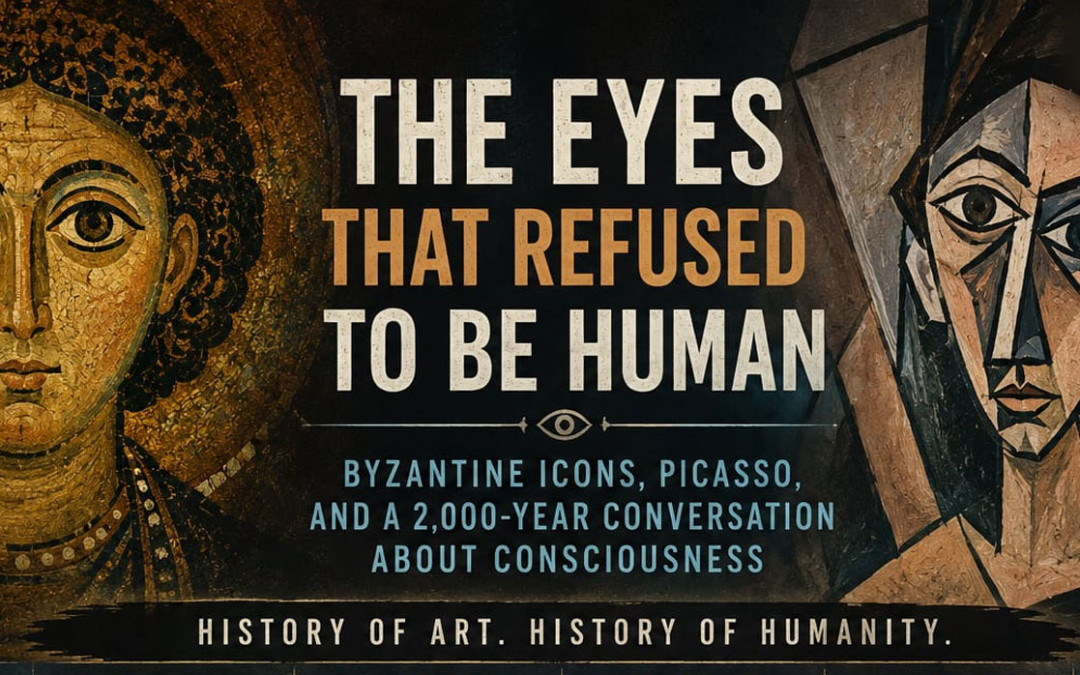
The Byzantine Eyes
Stand close to a Byzantine icon and resist the instinct to correct it.
The face appears too long. The nose may seem unnaturally narrow. The mouth is small. The body can look weightless beneath the folds of clothing, while the eyes command more attention than anatomical proportion would normally allow. To someone trained by photography, Renaissance perspective and centuries of naturalistic portraiture, the temptation is immediate: perhaps the artist simply could not paint a convincing human face.
Then step back.
The supposed mistakes begin organizing themselves.
The image was never competing with a photograph.
A Byzantine icon belonged to a religious environment in which the visible body was not necessarily the final object of representation. The saint was not simply an interesting individual whose cheekbones, complexion and posture had to be captured accurately. The image participated in devotion. Gesture, color, frontal orientation, clothing, inscription and gaze all carried meaning. Naturalistic likeness could matter, especially within established iconographic traditions, but resemblance was being asked to serve something larger than resemblance.
The strange eyes begin to make sense.
Not because every Byzantine painter followed a secret rule declaring that larger eyes literally meant a larger soul. Art history is rarely so mechanical. But because the face could be reorganized according to a hierarchy different from ordinary vision.
A portrait asks, What did this person look like?
An icon can also ask, What kind of presence is this image meant to establish?
Once that question enters the room, anatomy loses its monopoly.
When Accuracy Is No Longer the Highest Virtue
Western histories of art are often told as though realism were a technological achievement that civilizations either possessed or lacked. Greece discovers convincing anatomy. Rome inherits and modifies it. Medieval art somehow forgets. The Renaissance rediscovers perspective and the body. Modernism then deliberately breaks the rules.
The real story is less convenient.
Ancient artists were capable of extraordinary naturalism, but naturalism itself was never culturally neutral. Greek sculpture idealized bodies as well as observed them. Roman portraiture could exaggerate age and severity because wrinkles communicated gravitas as much as they recorded biology. Medieval artists inherited some classical conventions and rejected or transformed others for reasons involving theology, liturgy, patronage and visual culture. Renaissance naturalism likewise did not simply restore an objective reality that had been missing for a thousand years. It constructed another highly sophisticated visual language.
Every period decides which distortions it is willing to stop noticing.
Linear perspective is a distortion with rules.
A map is a distortion with a purpose.
A portrait painted under ideal lighting is a distortion of the average human encounter.
Even photography makes choices about lens, exposure, framing and moment.
The important question is therefore not whether an image distorts.
All representations do.
The question is what the distortion preserves.
Byzantine icon painting becomes much more interesting once we stop treating realism as the universal destination of art. A flattened field can weaken the illusion that the viewer is peering through a window into ordinary physical space. Frontal figures can become less like people accidentally encountered in a room and more like presences confronting the viewer. Proportional departures can direct attention toward the face, gesture or gaze rather than bodily mass.
The image loses one kind of reality to intensify another kind of meaning.
The Eyes That Look Back
The human eye has always carried an unfair symbolic burden.
It sees.
It reveals emotion.
It indicates attention.
It allows us to infer whether another person recognizes us.
An eye is therefore both anatomy and relation.
This may help explain why enlarged or intensified eyes appear so frequently in religious and symbolic art, although their meanings differ radically across cultures and periods. A large eye can suggest vigilance, holiness, supernatural awareness, vulnerability, terror, innocence or simply stylistic convention. There is no universal dictionary in which “large eyes” always translates into “soul.”
But within Byzantine devotional imagery, the emphasis on the face and gaze can participate in a broader movement away from ordinary portrait naturalism.
The icon is not simply an object for inspection.
It looks back.
That reciprocal quality matters. A museum visitor can study a painting as an artifact. A worshipper encountering an icon may stand within a relationship structured by prayer, saint, sacred history and presence.
The image therefore occupies an ambiguous territory between representation and interface.
That word, interface, should be used carefully here. A Byzantine icon is not a medieval touchscreen, and ancient theology cannot be translated into software vocabulary without destroying its historical specificity.
Yet structurally the comparison is useful.
An interface is a surface through which a relationship becomes possible.
The icon organizes contact between the visible and what the believer understands as exceeding ordinary visibility.
The face is therefore not merely something to reproduce.
It is something through which the image operates.
The Body Becomes Less Certain
Centuries later, European art would dismantle naturalistic representation for entirely different reasons.
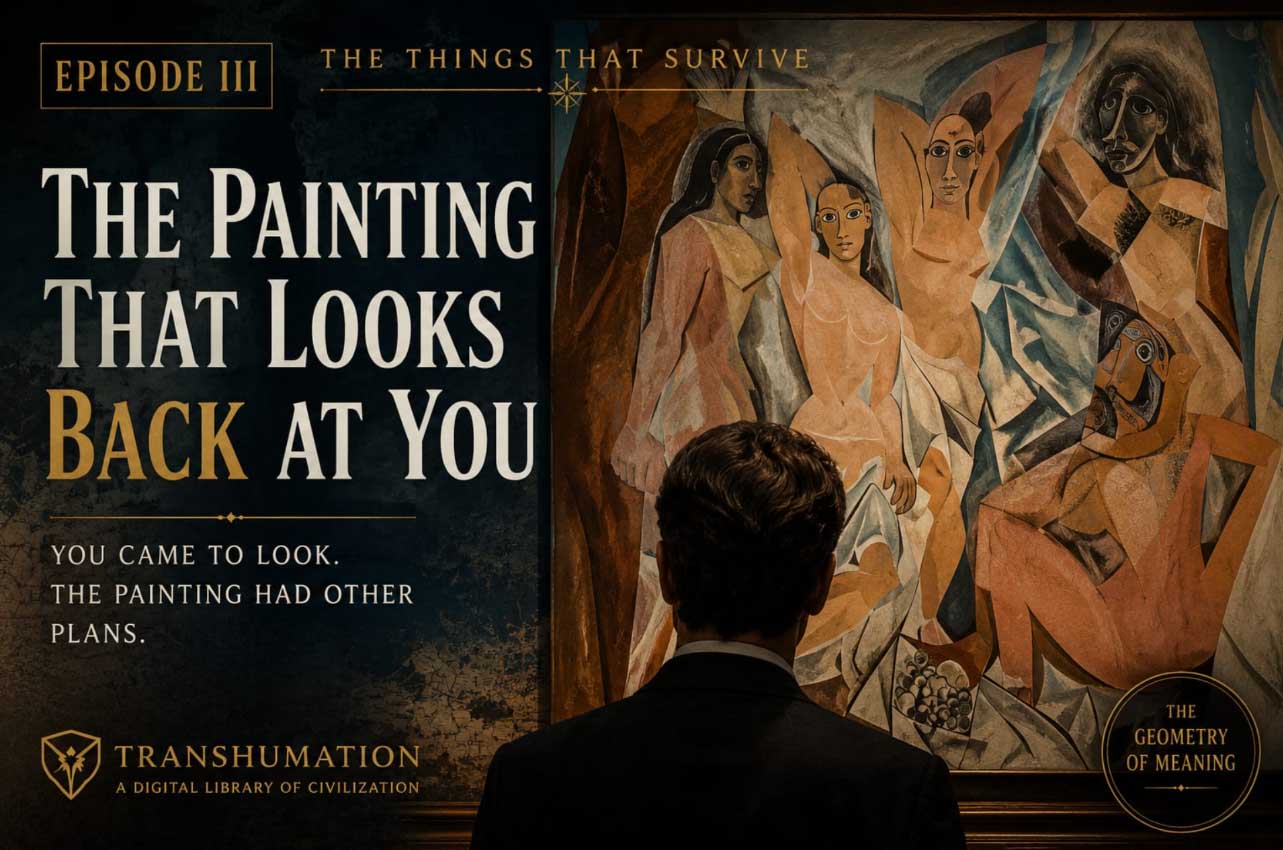
Picasso’s Les Demoiselles d’Avignon does not look Byzantine. Its fractured figures do not belong to Christian icon theology. The painting emerged from a modern artistic crisis involving Cézanne, Iberian sculpture, encounters with African art, anxieties surrounding sexuality, the history of the nude and Picasso’s aggressive experimentation with the picture plane.
Yet the painting produces a strangely comparable shock.
The human body refuses to remain visually obedient.
Faces cease behaving as faces normally behave under one viewpoint. Anatomical continuity becomes unstable. Space no longer behaves like a transparent stage extending neatly behind the canvas. Some figures seem simultaneously presented and reconstructed.
To say simply that Picasso wanted to show “multiple perspectives at once” is too neat. Cubism’s development was more complicated, and Les Demoiselles itself sits at a violent threshold before mature Analytic Cubism.
But the broader rupture is unmistakable.
The visible surface of a person is no longer treated as sufficient material for representing the person.
That is where the comparison with Byzantine art becomes interesting.
Not because Picasso was continuing an iconographic program.
Because two radically different visual cultures discovered that deforming the body can make another problem visible.
For the Byzantine painter, ordinary anatomy could become subordinate to sacred presence.
For Picasso, ordinary anatomy could become subordinate to the instability of representation itself.
Both refuse the assumption that successful art must preserve the body exactly as a single observer would normally see it.
What Is a Face Supposed to Contain?
A face is one of the strangest objects in human culture because we expect it to perform contradictory tasks.
It must identify the person.
Display emotion.
Carry age.
Express status.
Suggest character.
Reveal interiority.
And somehow remain anatomically plausible while doing all of this.
No face can actually contain everything we believe a person is.
The problem becomes obvious in portraiture. A photographic likeness may reproduce skin, hair and proportions with remarkable precision and still tell us almost nothing about the subject’s private life. A distorted portrait can violate physical appearance while communicating anxiety, authority or instability with extraordinary force.
Neither operation gives us the whole human being.
That may be why artists repeatedly attack the face.
El Greco elongates.
Expressionism intensifies.
Picasso fractures.
Icons abstract.
Masks simplify.
Each intervention removes one assumption about what a human face must look like in order to ask what else the image might preserve.
This is not evidence for some single hidden artistic project extending across millennia.
It is evidence for a recurring problem.
A human being is visually available.
A person is not.
We can see the skin.
We infer almost everything else.
The Renaissance Did Not Solve the Human Being
The Renaissance is often treated as the great restoration of the human body, and there is truth in that. Artists studied anatomy, perspective, classical sculpture, light and the geometry of spatial representation with extraordinary seriousness.
But naturalistic achievement did not settle the relationship between appearance and identity.
If anything, it made the problem sharper.
Leonardo’s portraits do not fascinate because their anatomy is correct. Their power lies partly in how much the face refuses to surrender. Michelangelo’s bodies are anatomically informed but hardly neutral biological specimens. Renaissance painters used posture, clothing, architecture, gesture, objects and landscape to construct social and spiritual identities that could never be extracted from anatomy alone.
The body returned with enormous force.
The mystery returned inside it.
This is why modernism did not simply destroy Renaissance realism. It inherited a much older problem and changed the terms of attack.
If perspective claims to organize the visible world around one stable observer, what happens when the observer is no longer stable?
If photography can reproduce likeness cheaply, what must painting do that photography cannot?
If a person appears differently from different positions and at different moments, why should one frozen view claim authority over the whole?
The face begins to fracture because the concept of the unified visible person has begun to fracture with it.
Picasso Does Not Give Us the Soul
This is where Transhumation has to resist a seductive shortcut.
It would be beautiful to say that Byzantine painters depicted the soul and Picasso depicted consciousness.
We cannot know that so cleanly.
“Consciousness” is a modern concept carrying scientific and philosophical meanings that should not simply be projected backward onto Picasso. Likewise, the theological meaning of the soul in Byzantine Christianity cannot be reduced to a generic idea of inner identity.
The more defensible comparison is structural.
Both traditions demonstrate that representation can become more meaningful by becoming less literal.
That principle extends beyond art.
A subway map distorts geography to preserve connectivity.
A mathematical diagram removes texture to preserve relation.
A myth rearranges historical possibility to make a conflict legible.
An icon reorganizes bodily appearance according to theological significance.
A Cubist painting reorganizes visual appearance according to a new pictorial problem.
The distortion is justified only if something valuable survives it.
That is the same problem encountered in the LEGO Principle.
Remove enough detail to reveal structure.
Then ask whether the structure is real or merely something the observer wanted to find.
The Human Image After the Human Body
Our own period makes this question newly unstable.
A face can now be generated without a person.
An avatar can represent someone who looks nothing like it.
A digital character can retain recognizable mannerisms while possessing no biological body.
A video call presents a face delayed, compressed and reconstructed through software while still feeling sufficiently immediate for emotional conversation.
Artificial intelligence can generate portraits of people who never lived.
Sooner or later, increasingly convincing artificial agents may possess voices, faces and behavioral continuity without resembling the ordinary relationship between body and identity on which portraiture was historically built.
This does not mean consciousness has escaped biology.
It means appearance and biological personhood have already become easier to separate technologically.
The ancient artistic question therefore returns in a new form.
What must an image preserve before we continue treating it as the presence of someone?
The face?
The voice?
The mannerisms?
Memory?
Reciprocity?
Conscious experience?
We do not yet know.
But the history of art gives us one useful warning.
Humans have never been satisfied with the body as the complete answer to the human being.
That dissatisfaction is older than digital technology.
Watch The Video
How to Read the World
Current Knowledge
Byzantine icon painting developed within Christian religious and liturgical traditions in which images served devotional, commemorative and theological functions. Stylization, frontal presentation, hierarchical composition and departures from naturalistic proportion were deliberate features of many icon traditions rather than simple evidence of technical incapacity.
It is nevertheless too simplistic to assign fixed universal meanings to individual features such as enlarged eyes. Iconographic conventions varied by period, region and subject, and the theological meaning of an icon depended upon the entire image, its inscriptions, liturgical context and the tradition in which it operated.
Ancient Greek and Roman art cannot be described simply as a pursuit of photographic realism. Both cultures employed idealization, symbolism and conventional representation alongside sophisticated anatomical observation. Likewise, Renaissance naturalism involved constructed systems such as linear perspective rather than an unmediated copy of reality.
Les Demoiselles d’Avignon was painted by Picasso in 1907 and is widely regarded as a major turning point toward Cubism. Its development involved multiple influences, including Cézanne, Iberian sculpture and Picasso’s encounter with African sculpture and masks. Interpreting the painting primarily as a statement about consciousness would go beyond what the historical evidence can establish.
There is no demonstrated historical lineage linking Byzantine icon distortion directly to Picasso’s modernism. Any comparison between them is therefore structural and interpretive rather than genealogical.
Open Questions
One important question is how much deliberate distortion can occur before likeness disappears entirely. Portraiture depends upon recognition, yet some of the most psychologically powerful portraits abandon anatomical accuracy precisely to preserve another aspect of identity.
There is also a wider historical problem. When similar representational strategies appear in cultures separated by centuries, how often are we seeing direct influence, independent solutions to comparable artistic problems or patterns created retrospectively by modern viewers? Formal resemblance alone cannot answer that question.
Digital representation creates another uncertainty. If an artificial avatar can preserve a person’s voice, gestures and behavioral tendencies while abandoning their physical appearance, which features will future cultures consider necessary for personal representation?
And the deepest question remains unresolved by both art and neuroscience: why do we experience another human face as evidence of a mind at all? We infer interiority extraordinarily quickly, yet the subjective experience we attribute to another person is never directly visible on the surface.
Transhumation Interpretation
The oversized eyes of the icon become interesting to Transhumation only after we stop claiming that they are a secret ancient symbol for consciousness.
Their importance lies in a more general transformation.
The artist changes the carrier in order to preserve another pattern.
A realistic face preserves one kind of information: physical likeness.
A symbolic face may sacrifice some of that information in order to emphasize status, sanctity, attention, suffering or presence.
A Cubist face sacrifices another set of visual conventions to reorganize relations among viewpoint, surface and object.
The face remains a face.
Its function changes.
This gives Transhumation a useful rule for thinking about identity: not every distortion destroys the thing being represented, because identity can depend upon different invariants at different levels.
We already accept this intuitively.
A caricature exaggerates the nose and remains recognizable.
A child’s drawing can preserve someone through three lines and a pair of glasses.
A voice on the telephone lacks the body but still gives us the person strongly enough to produce intimacy.
A written letter contains neither voice nor face and can nevertheless feel unmistakably like its author.
Each medium removes something.
Each asks another feature to carry more weight.
The icon does this visibly.
The eyes become larger because the image no longer pretends that ordinary anatomical proportion is the only rule worth obeying.
Whether that was intended to signify spiritual vision in a particular icon must be established historically rather than assumed. But the larger operation is clear enough: anatomy has become subordinate to meaning.
This is precisely where the subject touches the Carrier and the Pattern.
What can we alter before recognition disappears?
For a triangle, the relevant structure is comparatively easy to define.
For a melody, the carrier can change from violin to piano while enough relations survive.
For a face, things become more ambiguous.
For a human identity, the problem becomes profound.
Suppose a digital system preserves the manner in which someone speaks but not their appearance. We might still recognize them.
Preserve appearance but remove memory, humor and response, and the likeness may begin feeling empty.
Preserve memories and speech patterns in an artificial agent, and the resemblance might become intimate enough to disturb us.
But resemblance does not settle continuity.
The history of representation teaches us exactly why.
An image can successfully carry an identity-signaling pattern without becoming the individual it represents.
The icon is not the saint.
The portrait is not Picasso’s sitter.
The photograph is not the dead parent.
And an artificial reconstruction would not become its biological source merely because recognition survived.
This is the line Transhumation has to defend while exploring what can change carriers.
The image can become increasingly powerful as an interface.
That does not make it the observer.
Perhaps this is also why eyes are such a durable artistic obsession. They occupy the place where representation almost seems to become reciprocal. A painted hand does not appear to know we are standing before it. Painted eyes can.
Of course, they do not.
The experience is produced by us.
Yet the illusion is powerful enough that cultures repeatedly build meaning around it.
The eyes become the threshold between visible body and inferred interiority.
Byzantine icon painters organized that threshold according to theology.
Picasso destabilized it according to another visual problem.
Our own age is beginning to engineer it.
Synthetic faces will look back.
Artificial voices will answer.
Digital avatars will remember.
And civilization will have to decide once again whether the presence of the correct signs is enough to establish the presence of a person.
Art has been warning us for centuries that appearance and identity are not the same thing.
Technology may soon make the distinction impossible to ignore.
FAQ
Why do Byzantine icons often look anatomically unusual?
Because naturalistic anatomy was not always the highest priority of icon painting. Composition, devotional function, theological meaning and established visual conventions could take precedence over realistic proportion.
Did large eyes literally symbolize the soul?
Not through one universal rule. Eyes could carry strong spiritual or attentional significance, but their meaning depended on the specific iconographic and historical context.
Did Picasso copy Byzantine icons?
There is no good basis for making that a general claim. The comparison is about deliberate distortion, not direct historical descent.
Why did Picasso distort faces and bodies?
His early modernist experiments challenged conventional perspective and naturalistic representation and drew on several artistic influences. Saying he was specifically trying to depict “consciousness” would be an interpretation rather than an established historical fact.
What connects Byzantine icons and modernism?
Both show that an image can abandon ordinary visual realism in order to organize meaning differently. Their reasons, historical contexts and philosophies were nevertheless radically different.
What is the deeper Transhumation question?
If a human image can remain recognizable while anatomy, perspective and even medium change, then identity clearly cannot be reduced to one visual form.
But recognition is not the same as survival.
A face can carry the pattern of a person.
It cannot, by itself, tell us whether the person is still there.
Continue the Transhumation Series
- Forgotten Religion | Ancient Gods, Symbols and the Hidden Structures of Human Civilization
- The Last Religion | Death, Immortality and the Future of Humanity
- The New Theurgy | AI, Information and the Future of Human Civilization
- End of Branding: You Were Never Meant to Become a Product
- Baal vs Ishtar: Why Ancient Gods Never Disappeared