
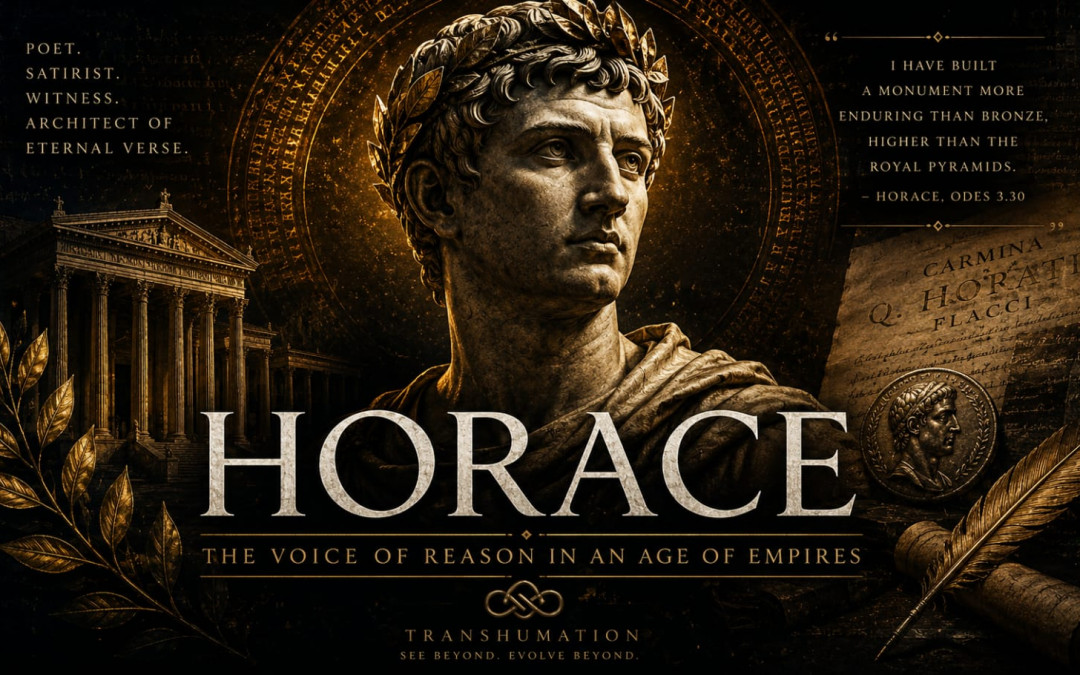
Horace and the Unknown Paths to Immortality
He predicted that his words would survive. He was wrong about almost everything else.
In 23 BCE, Horace attempted something most writers secretly attempt and few are reckless enough to announce. He predicted his own immortality.
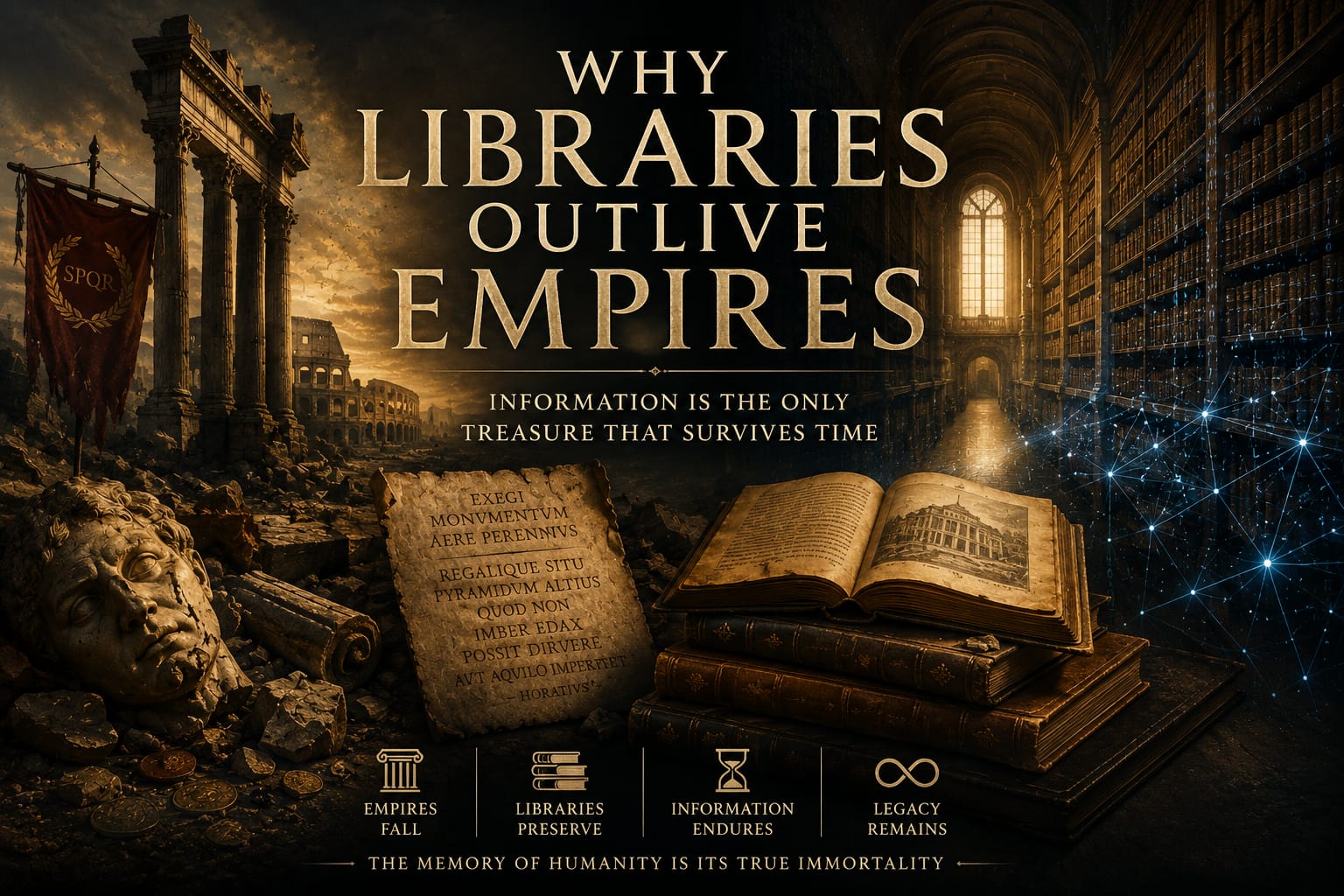
Exegi monumentum aere perennius. I have built a monument more lasting than bronze.
It is one of those lines that two thousand years of quotation have made almost too familiar to notice. We read it as the magnificent confidence of a Roman poet who knew that his verses were good enough to survive him.
But imagine reading the poem for the first time without knowing what happened next.
Horace does not simply say that his poetry will last. He tries to imagine the machinery that will carry it into the future. His fame will endure while Rome endures: while religious rites continue, while the Capitol remains important, while Roman civilization continues to recognize the world from which the poem emerged.
It was a perfectly reasonable prediction.
And almost wonderfully wrong.
The Vestal Virgins disappeared. Pagan Roman worship disappeared. The Western Empire collapsed. The political world of Augustus became archaeology. Buildings Horace could have touched were buried, dismantled or turned into ruins visited by people speaking languages he had never heard.
Yet on an illuminated screen in 2026, somebody can still read Horace.
He predicted the survival of the passenger.
He simply chose the wrong vehicle.
The Monument That Lost Its City
There is something almost cinematic about the experiment Horace accidentally left us.
Imagine placing two objects in Rome around 23 BCE. Beside one another stand an enormous bronze monument and a small manuscript containing a poem.
Which one looks immortal?
The bronze has weight. Guards can protect it. An emperor can place it in a public square. People can point toward it. The poem is fragile. Water can destroy it. Fire can destroy it. One careless person can lose it.
Matter appears strong.
Information appears terribly vulnerable.
Now allow two thousand years to pass.
The calculation changes.
A monument must remain itself in order to survive. If the bronze is melted, the monument is gone. If the building collapses, the building is gone.
A poem has a stranger property.
Destroy one manuscript and the poem may still exist in another. Copy it onto parchment and it moves. Print it and it multiplies. Translate it and something of its structure crosses into another language. Digitize it and a Roman arrangement of words can travel through machines whose physical principles Horace could not possibly have imagined.
The fragile object possessed a hidden advantage over the powerful one.
It could change bodies.
Horace wanted a monument more lasting than bronze.
Without realizing it, he chose a medium capable of escaping bronze altogether.
Rome Was Supposed to Be the Machine
This is what makes Horace more interesting than a simple story about literary fame.
He seems to have understood that immortality requires transmission. What he could not know was how radically the mechanism of transmission would change.
Rome was his imaginable horizon.
That makes sense. If you stood beneath Augustus and attempted to picture the distant future, Rome itself would have looked like the safest carrier available. Roads crossed enormous distances. institutions organized memory. Latin connected an educated world. Temples, ceremonies and political offices gave civilization continuity.
Horace could imagine himself travelling forward because the machine around him continued operating.
Instead, the machine broke.
The cargo escaped.
Monasteries copied pagan texts. Scholars preserved manuscripts. Medieval readers encountered ancient authors inside a Christian civilization Horace never anticipated. The Renaissance rearranged the relationship with antiquity again. Printing altered the economics of copying. Modern education canonized certain classical writers. Digitization removed even the requirement that a reader possess a physical edition.
No single person designed this route.
There was no courier leaving Rome with instructions to deliver Horace to the twenty-first century.
The poem migrated from carrier to carrier, institution to institution, motive to motive.
That may be the real Horace paradox:
He correctly predicted that he would survive, while incorrectly predicting almost everything that would make his survival possible.
The Men Whose Names Fell Off
Once you notice this, Rome begins to look different.
Tourists naturally ask who built something. The question usually expects a famous name: Augustus, Hadrian, Trajan.
But an aqueduct does not emerge from an emperor's hands.
Someone surveyed the gradient. Someone calculated the route. Someone negotiated land. Someone quarried stone. Someone designed scaffolding. Someone transported material. Someone solved the irritating local problem that no historian considered important enough to record.
Thousands of human decisions are embedded in structures whose makers have disappeared.
This produces a second path through the problem of immortality.
Perhaps survival does not require the survival of the name.
Some anonymous Roman engineer may have introduced a small practical solution copied by another builder, then another, until the technique became ordinary. The origin disappeared precisely because the idea succeeded so completely that nobody needed to remember its inventor.
Civilization contains an astonishing amount of anonymous immortality.
We inherit words whose creators we cannot identify, habits whose beginnings have vanished, mathematical techniques learned from teachers who learned them from other teachers, architectural conventions, recipes, gestures, melodies and ways of organizing thought.
We often imagine immortality as a statue with our name underneath.
History may operate more like a river.
Something enters it.
Far downstream, nobody remembers where.
The Future Has Terrible Filing Systems
This creates an uncomfortable problem for anyone trying to manufacture a legacy.
We do not control what the future considers important.
A Roman aristocrat could spend a fortune constructing a tomb intended to preserve his name while an obscure sentence written nearby might survive another millennium. A commercial object can become an archaeological treasure. A private letter can become more historically valuable than the official proclamation stored beside it.
The future continually changes the labels.
Things created as masterpieces become curiosities. Tools become art. Propaganda becomes historical evidence. Children's toys become museum objects. Ordinary photographs become priceless because everything surrounding them disappeared.
And the reverse happens too. Objects intended to be permanent vanish almost without residue.
This makes immortality less like building a vault and more like releasing something into an ecosystem.
You can influence the beginning.
You cannot control the route.
Horace could write the poem. He could refine it, publish it and attach it to the cultural machinery available to him.
He could not invent the monastery that would preserve classical literature centuries later. He could not arrange the Renaissance. He could not anticipate movable type, universities, mass literacy, digital archives or a reader scrolling through Latin poetry on glass.
The path existed only from the perspective of the future.
From Horace's position, it was invisible.
We May Be Making the Same Mistake
This is where an ancient poem stops being an ancient poem.
Our civilization is obsessed with preservation.
Cloud storage promises that photographs will remain available. Companies construct enormous data centres. Institutions digitize archives. People create videos, books, websites, genetic records and increasingly detailed digital traces of themselves.
We possess more methods of recording a human life than Horace could have imagined.
That does not mean we understand what survives.
A stone inscription requires almost no compatible technology. A digital file may depend on hardware, software, standards, passwords, companies, electricity and institutions that maintain the surrounding infrastructure. Something can be copied perfectly millions of times and still become inaccessible.
Meanwhile, an idea may escape all of those containers simply because somebody remembers it and tells another person.
We may therefore be repeating Horace's mistake at vastly greater scale.
We look at the strongest structures surrounding us — global platforms, corporations, states, networks, cloud systems — and unconsciously assume that whatever survives us will survive through them.
Perhaps it will.
Or perhaps the thing that survives will leave them.
The Ladder of Information
There is another way to picture civilization.
Not as a sequence of empires, but as a ladder of information.
Each generation receives an incomplete collection of things from the previous one: equations, stories, symbols, technologies, religious questions, musical structures, political mistakes, recipes, myths, architectural solutions.
Most disappear.
Some climb.
And the interesting part is that information does not necessarily climb in the form in which it began.
A religious symbol becomes a psychological metaphor. A military technology becomes civilian infrastructure. A philosophical problem reappears as a computer-science problem. An ancient story enters cinema. A handwritten poem becomes pixels.
The carrier changes while something recognizable continues.
This is precisely why information may be more durable than the systems that temporarily contain it.
An empire needs borders.
An idea needs another mind.
A corporation requires capital, employees and legal continuity. A pattern can escape through someone who learned it on Tuesday afternoon and applies it somewhere completely different twenty years later.
The strongest form of immortality may therefore be the one least interested in remaining unchanged.
It survives because it can transform.
The Unknown Paths to Immortality
We usually imagine immortality as continuity of the object.
The same body continuing indefinitely. The same consciousness preserved. The same name remembered. The same monument standing where we placed it.
Horace suggests a stranger possibility.
Perhaps continuity sometimes depends upon discontinuity.
The manuscript disappears, but the poem remains.
The language changes, but the idea crosses it.
The teacher dies, but a distinction taught to one student alters a decision made forty years later.
The civilization collapses, but something it discovered enters the civilization that follows.
This is not biological immortality, and it should not be confused with it. Horace is dead. Information surviving about a person is not equivalent to that person continuing to experience the world.
But it reveals that the word survival contains more possibilities than we usually notice.
A structure can persist after losing its original material.
And, more intriguingly, the creator may never know which structure that will be.
Horace thought Rome would carry Horace.
Instead, countless unknown people carried him across the ruins of Rome.
Perhaps that is the treasure hidden inside Exegi monumentum. Not that a brilliant poet predicted his immortality.
Something stranger happened.
He threw a message into the future, guessed where it would land—
and missed by two thousand years.
The message arrived anyway.
Watch The Video
How to Read the World
Current Knowledge
Horace's Odes 3.30, conventionally dated to 23 BCE, opens with Exegi monumentum aere perennius — the famous claim to having created a monument more enduring than bronze. The poem connects Horace's anticipated literary survival with enduring Roman religious and civic imagery.
The political and religious structures of ancient Rome did not survive unchanged. The Western Roman Empire ended centuries later, traditional Roman religious institutions disappeared, and Latin developed into new linguistic forms. Horace's writings nevertheless survived through manuscript transmission, medieval copying, later humanist scholarship, printing and modern editions.
The survival of classical literature was uneven. A significant portion of ancient writing is lost, meaning Horace's survival should not be treated as evidence that culturally valuable information automatically persists.
Open Questions
What determines whether information survives when the civilization that produced it disappears? Is survival primarily a property of the work itself, or of copying networks, institutions, historical accidents and later cultures that repeatedly decide the work is worth preserving?
Digital civilization introduces another uncertainty. We can reproduce information at almost no marginal cost, but many digital objects depend upon technological ecosystems more complicated than parchment or stone.
Does greater capacity to record information actually make civilization better at remembering?
And perhaps the most difficult question: can anyone deliberately create a legacy, or can legacy only be recognized from the future?
Transhumation Interpretation
Horace offers a small historical model for one of Transhumation's central questions: what can remain continuous when the carrier changes?
The empire disappeared. The rituals changed. Manuscripts were copied onto different materials. Languages and institutions transformed. Yet a recognizable informational structure continued moving through civilization.
This does not prove that human consciousness can survive a change of carrier. A poem is not a person, and informational continuity should not be confused with experiential continuity.
But it gives us a better question than simply asking whether something can last forever.
What is the smallest structure that must survive for something to remain itself?
Horace thought immortality required Rome.
History discovered that it didn't.
And that leaves us with a possibility Horace could never have tested:
we may already be building things that will survive us by routes we do not yet have names for.
FAQ
Who was Horace?
Horace was a Roman poet who lived during the reign of Augustus. He is famous for writing that he had created a monument "more lasting than bronze," believing his poetry would survive through future generations.
What is the Horace Paradox?
The Horace Paradox is the idea that information can outlive the institutions, civilizations, and structures that created it. Horace expected his work to survive because Rome survived. Instead, his work survived even after Rome itself disappeared.
Why did Horace underestimate his own immortality?
Horace linked the future of his poetry to Roman religious and political institutions. He did not imagine that his writings would continue to be copied, studied, and translated long after those institutions vanished.
Can ideas really outlive empires?
History suggests they can. Philosophical texts, myths, scientific discoveries, and works of art often survive for centuries or millennia after the civilizations that produced them have disappeared.
What does this have to do with information?
Information survives differently from physical objects. Buildings decay, governments collapse, and technologies become obsolete. Information can continue existing as long as it is remembered, copied, or transmitted.
Why do we remember emperors but forget builders?
History often focuses on visible power. Yet every civilization depended on countless architects, engineers, craftsmen, teachers, and organizers whose names were forgotten even though their work shaped the future.
How is the Horace Paradox connected to the Ladder of Information?
The Ladder of Information suggests that civilization progresses through the transmission of knowledge, symbols, and ideas. The Horace Paradox demonstrates that information can continue climbing this ladder long after its creators are gone.
Is immortality only a biological concept?
Not necessarily. Biological immortality concerns the survival of the body. Informational immortality concerns the survival of ideas, memories, works, and contributions beyond an individual's lifetime.
What can modern society learn from Horace?
The future is difficult to predict. The things we believe are permanent may disappear, while ideas that seem small today may survive for centuries. History reminds us to pay attention not only to power, but also to meaning.
Why is this relevant in the age of artificial intelligence?
AI, digital archives, and global networks dramatically increase humanity's ability to preserve and distribute information. This raises an ancient question in a new form: what will survive longer—our institutions, or the information they create?
Does Transhumation view information as more important than matter?
Not necessarily more important, but often more durable. Matter builds civilizations. Information allows civilizations to be remembered, understood, and continued by future generations.
Continue the Transhumation Series
- Forgotten Religion | Ancient Gods, Symbols and the Hidden Structures of Human Civilization
- The Last Religion | Death, Immortality and the Future of Humanity
- The New Theurgy | AI, Information and the Future of Human Civilization
- End of Branding: You Were Never Meant to Become a Product
- Baal vs Ishtar: Why Ancient Gods Never Disappeared