
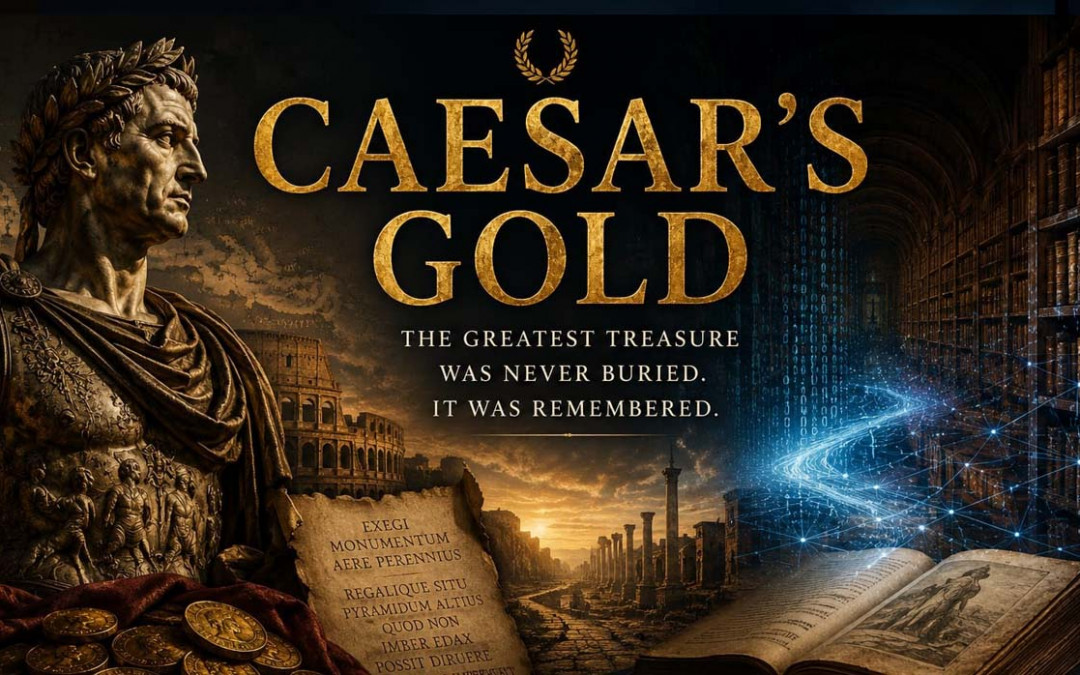
Caesar’s Real Treasure
Rome accumulated gold on a scale few civilizations before it could imagine. Almost none of it still belongs to Rome. Yet Caesar’s name, his decisions and even the language built around him continue to travel through a world he could never have imagined.
If you had been allowed into the treasury of a victorious Roman general, you would probably have known immediately what you were looking at. Gold and silver had weight. Land could be measured. Captives could be counted. A triumph made power wonderfully visible: wagons filled with spoils, exotic objects from conquered countries, prisoners, standards, coins and precious metal moving through streets lined with spectators. Rome understood wealth in a language that required very little explanation.
Julius Caesar acquired enormous resources through conquest and political power. Rome itself accumulated the material proceeds of centuries of expansion. Yet if someone asked us today to locate Caesar’s wealth, the question would become surprisingly difficult. Coins were spent and restruck. Metal was melted and made into other objects. Buildings were dismantled, burned or buried beneath later cities. Estates changed owners. The political system that gave all this property meaning eventually disappeared.
And yet something belonging to Caesar escaped.
His name survived. So did his books, fragments of his words, accounts of his decisions, the consequences of his calendar reform, and a political story that people are still retelling more than two thousand years later. The curious thing is not simply that Caesar became famous. It is that the least substantial part of his world proved, in some respects, the hardest to destroy.
The Treasure Without an Address
There is something almost comic about trying to compare the two inheritances. A Roman aureus was valuable precisely because possession could be established: somebody had it and somebody else did not. Caesar’s story works in the opposite way. Millions of people can know it simultaneously, and one person’s possession of it does not prevent another from acquiring the same thing.
Matter and information therefore obey very different economies. Divide an estate among ten heirs and each receives a smaller estate. Give ten people an idea and, assuming they remember it, there are now ten carriers. Give it to a million and the original has not been depleted. It may instead have become culturally stronger because it can be quoted, translated, disputed, imitated and passed on again.
This does not make information immortal. Most information disappears. The overwhelming majority of Roman conversations, letters, jokes, arguments and private memories vanished as completely as the contents of forgotten purses. Survival requires carriers: manuscripts, inscriptions, teachers, copyists, institutions and, eventually, printing presses and servers. A text that nobody copies can die almost as effectively as a person.
But once information begins moving successfully between carriers, it acquires a peculiar advantage. The gold must survive as gold. The pattern does not have to survive as parchment.
What Actually Survived Caesar?
Imagine placing a genuine coin minted in Caesar’s lifetime beside a modern edition of De Bello Gallico. The coin is materially closer to Caesar. The book is informationally closer. Almost every physical component of the modern volume is new: paper, ink, typography, binding. Caesar never touched it. Its manufacturer did not exist in his world. The language may even appear beside a translation into English, Polish or Japanese.
And nevertheless, something crossed the distance.
This is where the distinction becomes interesting for Transhumation. Continuity does not always require continuity of matter. A text can migrate from papyrus to parchment, from manuscript to printed book, from microfilm to database, and from database to a screen. Each carrier can disappear while the structure being carried continues. What survives is neither the original object nor a mystical essence floating independently of matter. It is a reproducible arrangement capable of being instantiated again.
Caesar himself understood the importance of controlling narrative. His commentaries were not merely neutral military records; they presented campaigns, enemies and decisions in a form that could circulate among Roman readers. Whatever his immediate political intentions, the result exceeded them spectacularly. Armies that once frightened Europe disappeared. The account of those armies entered classrooms.
Perhaps this is why asking where Caesar’s treasure went produces the wrong sort of archaeological adventure. We imagine a chamber waiting beneath the earth. Much of the treasure may instead have escaped by becoming something that required no chamber at all.

The Strange Vaults We Call Libraries
Civilizations have always built places for the things they considered worth preserving. A treasury protects concentrated material value; an archive protects concentrated memory. The resemblance is easy to miss because libraries rarely look dangerous enough to be vaults. Their treasures sit openly on shelves and can sometimes be taken home for the afternoon.
Yet the logic is extraordinary. A library contains objects whose principal value is not exhausted by possession of the objects themselves. Burning one copy of The Odyssey does not destroy The Odyssey if another copy survives. Stealing a book does not remove the knowledge from somebody who has already learned it. The physical object matters enormously, particularly when it is the last carrier, but the treasure has a capacity to move beyond it.
This may explain one of history’s recurring reversals. Palaces that once represented the summit of power become archaeological sites, while modest texts written inside their civilizations continue to govern language, law, philosophy and imagination. Horace believed he had erected a monument more lasting than bronze. The phrase sounds poetic until one notices that, in a literal historical sense, it worked rather well. Bronze was repeatedly melted. Horace kept being copied.
The great treasure houses of civilization may therefore be less like Fort Knox than they first appear. Alexandria, monastic scriptoria, universities, archives and modern data centres belong to another tradition of wealth: preserving patterns so that they can be reconstructed somewhere else.
When Gold Learns to Copy Itself
Digital technology makes this old distinction much harder to ignore. A photograph once depended upon a particular negative or print. A digital image can appear on thousands of machines in seconds. A manuscript once required another human being to copy it painstakingly. A file can reproduce almost without marginal cost. Artificial intelligence adds another layer: enormous collections of human language and images can be processed not merely as stored objects but as material from which statistical patterns can be extracted and recombined.
Calling information “the new gold” is tempting, but the metaphor eventually fails. Gold derives much of its value from scarcity. Information often derives its power from circulation. Gold locked permanently inside a vault can remain valuable. An idea locked permanently inside a vault is approaching extinction.
That difference changes the nature of competition. The important question is increasingly not simply who possesses information, but who can preserve it, search it, interpret it, connect it and determine the interfaces through which other people encounter it. A library with ten million inaccessible books may contain less usable knowledge than a smaller collection whose relationships can actually be explored. The treasure has moved one level upward: from possession toward organization.
AI may therefore be interesting not because it creates an unprecedented human obsession with information, but because it continues a very old one. Civilization has repeatedly invented better ways of preventing useful patterns from dying with their original carriers. Writing detached memory from the individual brain. Libraries gathered written memory. Printing multiplied it. Networks removed much of the geographical friction. AI may become another interface to that accumulated inheritance.
The technology is new. The treasure hunt is ancient.
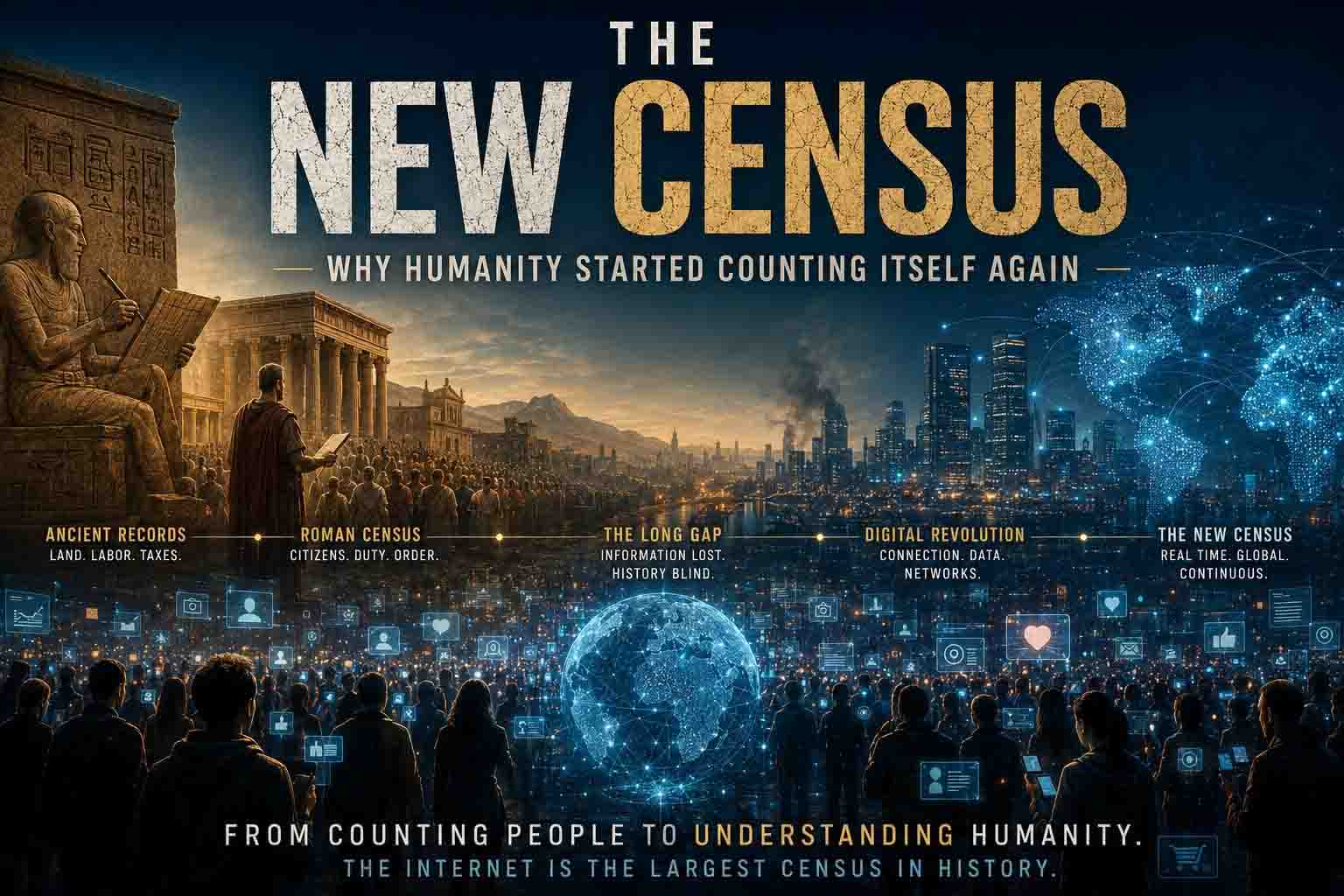
Caesar Without the Gold
There is a danger in taking the argument too far. Civilizations cannot live on information alone. Roman roads required stone. Armies required food. Servers require energy, minerals, factories and enormous physical infrastructures. Information without a carrier is not a civilization; it is an abstraction. Even Caesar’s surviving words reached us because generation after generation spent material resources keeping them alive.
But the asymmetry remains remarkable. Matter supports information, while information can repeatedly abandon one piece of matter for another. The Roman Empire could lose the original scroll and preserve the text in a medieval manuscript. The manuscript could decay after its contents had entered print. The printed edition could disappear after digitization. No individual carrier needs to be immortal for the pattern to exhibit continuity.
That gives Caesar’s vanished fortune a different meaning. Somewhere in antiquity, people must have regarded particular coins, houses and objects as extraordinarily important. Many were. Almost all eventually changed form or ownership. Meanwhile, decisions and sentences that may once have seemed secondary entered a chain of copying whose destination nobody could foresee.
Perhaps this is the more interesting definition of treasure: not what can be kept forever, but what can continue finding another carrier.
Caesar conquered Gaul with armies, financed politics with wealth and entered Rome with power. None of those instruments remained his for very long. Yet every time someone writes “Caesar,” opens his commentaries, argues about the Rubicon or uses a calendar descended from his reform, a tiny piece of that Roman structure is instantiated once more.
The gold stopped belonging to Caesar long ago.
The information is still travelling.
Watch the Video
How to Read the World

Current Knowledge
Julius Caesar accumulated considerable wealth and political resources through military command, conquest and Roman elite politics, particularly during and after the Gallic campaigns. Roman precious metals and objects were continually recirculated: coins were spent and restruck, metal objects could be melted, property changed ownership, and many physical structures were altered or destroyed over succeeding centuries.
Caesar’s Commentarii de Bello Gallico and Commentarii de Bello Civili survived through manuscript transmission and later printing. His calendar reform also had an exceptionally long institutional legacy: the Julian calendar remained fundamental to European chronology for centuries and influenced the later Gregorian calendar.
Information nevertheless requires physical carriers and transmission systems. Ancient works survived unevenly, and a large proportion of Greek and Roman literature is lost. The survival of Caesar’s writings therefore demonstrates successful transmission rather than any general immortality of information.
Open Questions
Why do some pieces of information survive while apparently important contemporary works disappear? How much depends upon intrinsic usefulness or literary quality, and how much upon institutions, political circumstances, copying traditions and accident?
Digital replication makes copying extraordinarily easy, but does that make modern information more durable—or merely more abundant? Could a civilization capable of storing almost everything become worse at deciding what deserves to be carried forward?
And as AI becomes an interface to enormous collections of inherited information, who will determine which parts of the archive remain visible, connected and culturally alive?
Transhumation Interpretation
Transhumation treats the story of Caesar’s vanished wealth as an example of carrier-independent continuity. The claim is not that information can exist without matter. It is that a sufficiently reproducible structure can survive the destruction of any particular material instance by migrating to another carrier.
Seen this way, civilization resembles an immense relay. Human beings, books, institutions, computers and perhaps future systems are temporary carriers. The enduring element is not necessarily the object but the pattern capable of being reconstructed.
Caesar may therefore have possessed two kinds of treasure. One required guards.
The other required readers.
Continue reading...
End of Antiquity
FAQ
What is Caesar's Gold?
In this article, Caesar's Gold is not simply physical treasure. It is a metaphor for information, memory, and knowledge that survive long after material wealth disappears.
Did Julius Caesar possess great wealth?
Yes. Caesar accumulated enormous wealth through military campaigns, political influence, and control of territories across the Roman world. However, very little of that physical wealth survives today.
Why does information outlive gold?
Gold can be lost, stolen, melted, or destroyed. Information can be copied, shared, translated, and preserved across generations. This allows ideas to survive far longer than physical objects.
What was Julius Caesar's greatest legacy?
Caesar's greatest legacy may not have been his wealth or military victories, but the lasting impact of his actions on history, politics, law, culture, and civilization.
How is information different from material wealth?
Material wealth becomes divided when shared. Information often becomes more valuable as it spreads. An idea can influence millions of people without being diminished.
Why are libraries important in this context?
Libraries function as vaults for information. While ancient civilizations stored gold in treasuries, they stored memory and knowledge in libraries, archives, and educational institutions.
What is meant by the 'hidden economy of civilization'?
The hidden economy refers to the exchange and preservation of information. Throughout history, ideas, stories, laws, and knowledge have often shaped civilization more profoundly than physical resources.
How does Caesar's Gold connect to The Horace Paradox?
Both ideas explore the same principle: information can outlive the structures that created it. Horace's poetry survived the Roman Empire, just as Caesar's historical influence survived the loss of Rome's material wealth.
How does artificial intelligence relate to Caesar's Gold?
Artificial intelligence can be viewed as a new tool for preserving, organizing, and transmitting information. In this sense, AI may become part of humanity's next great information vault.
What is the main idea of Caesar's Gold?
The article argues that the most valuable treasure of any civilization is not gold, territory, or power. It is information—the knowledge and memory that continue shaping the future long after empires disappear.
Why is Julius Caesar still remembered today?
Because information survived. His story was recorded, copied, studied, and transmitted through generations. The treasure vanished, but the memory remained.
What does Caesar's Gold say about the future?
It suggests that humanity's most valuable resource is increasingly becoming information itself. The civilizations that preserve knowledge may leave a greater legacy than those that accumulate wealth.
Continue the Transhumation Series
- Forgotten Religion | Ancient Gods, Symbols and the Hidden Structures of Human Civilization
- The Last Religion | Death, Immortality and the Future of Humanity
- The New Theurgy | AI, Information and the Future of Human Civilization
- End of Branding: You Were Never Meant to Become a Product
- Baal vs Ishtar: Why Ancient Gods Never Disappeared